No. EXH2026-041
Bangba / Ngbaka (egburuburu)
Democratic Republic of the Congo · NE Congo (Kereboro, Haut-Uele) · Central Africa
Play / practical
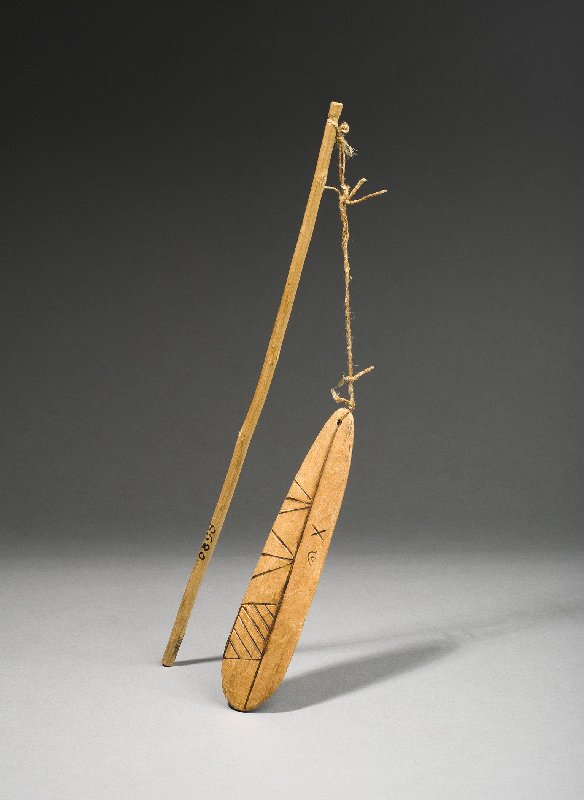
egburuburu
Source term: egburuburu / rhombe / bull-roarer
egburuburu: the Bangba/Ngbaka name for the bull-roarer at Kereboro.
Etymology. An onomatopoeic name imitating the instrument's whirring roar rather than a word with independent lexical meaning.
Three decorated wooden bull-roarers called egburuburu, collected among the Bangba and Ngbaka at Kereboro in the Haut-Uele in 1911, sit in the Tervuren collection with an unusually blunt catalogue verdict: nothing sacred, just boys' toys. One is a slightly curved, perforated blade incised with regular horizontal and vertical line patterns and worked by pyrography, fitted with a cord; two others are a decorated curved blade tied by a cord to a separate straight wooden stick, one of them 38.5 centimetres long. All three came back with the expedition of Armand Hutereau, sent into the northeastern Congo in 1911 to enrich the Musée du Congo belge; he returned with some eight thousand objects, was drafted on the outbreak of war, and fell in battle near Saint-Georges in November 1914.
Ce bâtonnet vibrant n'a aucune signification sacrée et servait de jouet aux jeunes garçons.
This buzzing stick has no sacred significance and was used as a plaything by young boys.
RMCA/AfricaMuseum object record MO.0.0.8494 (Bangba/Ngbaka egburuburu, Kereboro, Haut-Uele; Hutereau mission)
Particulars
- Object
- Three decorated wooden egburuburu bull-roarers from Kereboro, Haut-Uele (RMCA MO.0.0.8494, MO.0.0.8515, MO.0.0.8520).
- Function
- Whirled by young boys at play.
Source
Royal Museum for Central Africa (AfricaMuseum), Tervuren, MO.0.0.8494, MO.0.0.8515 and MO.0.0.8520