No. EXH2026-044
Amanga (kundrukundru)
Democratic Republic of the Congo · NE Congo · Central Africa
Function not recorded
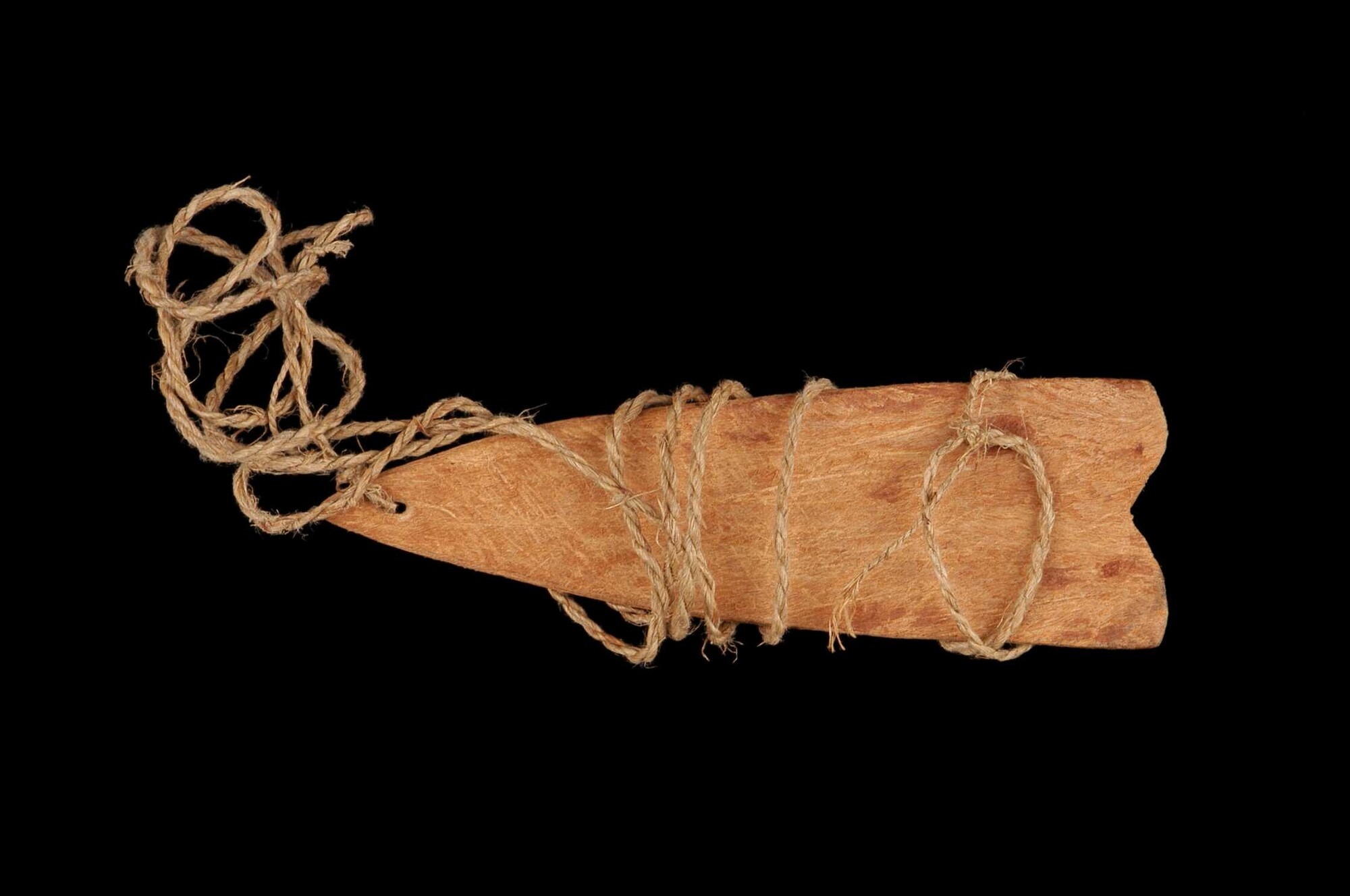
kundrukundru
Source term: bullroarer (New Grove cross-entry)
kundrukundru: the Amanga (Mangbetu-cluster) name for the bullroarer, an onomatopoeic term collected by de Hen and shared with the neighbouring Adoi, Andebogo and Andowi.
Etymology. An onomatopoeic name: the reduplicated word imitates the instrument's whirring roar. It is shared with the neighbouring Adoi, Andebogo and Andowi.
Among the Amanga, one of the small Mangbetu-cluster peoples of the north-eastern Congo, the bullroarer is called kundrukundru. The name belongs to a run of echoing Congo names whose very sound mimics the whirring instrument: the Adoi, Andebogo and Andowi call it kundrukundru too, the Bagbwa and Mamvu egburuburu, the Bangba mbirimbiri.
the varied names collected by de Hen suggest an onomatopoeic derivation, for example, the Adoi, Amanga, Andebogo and Andowi kundrukundru
K.A. Gourlay, "Bullroarer," Grove Music Online (after F.J. de Hen, Belgisch Kongo und Ruanda-Urundi, 1960)
Particulars
- Object
- Bullroarer, called kundrukundru.
- Function
- Not recorded.
Source
K. A. Gourlay, 'Bullroarer,' Grove Music Online, after F. J. de Hen, Beitrag zur Kenntnis der Musikinstrumente aus Belgisch Kongo und Ruanda-Urundi (doctoral dissertation, Köln; Tervuren, 1960)