No. MUS2026-098
Koma iron blade, buried voices
Alantika Mountains · North Cameroon · Central Africa
Restricted
Source term: bull-roarer
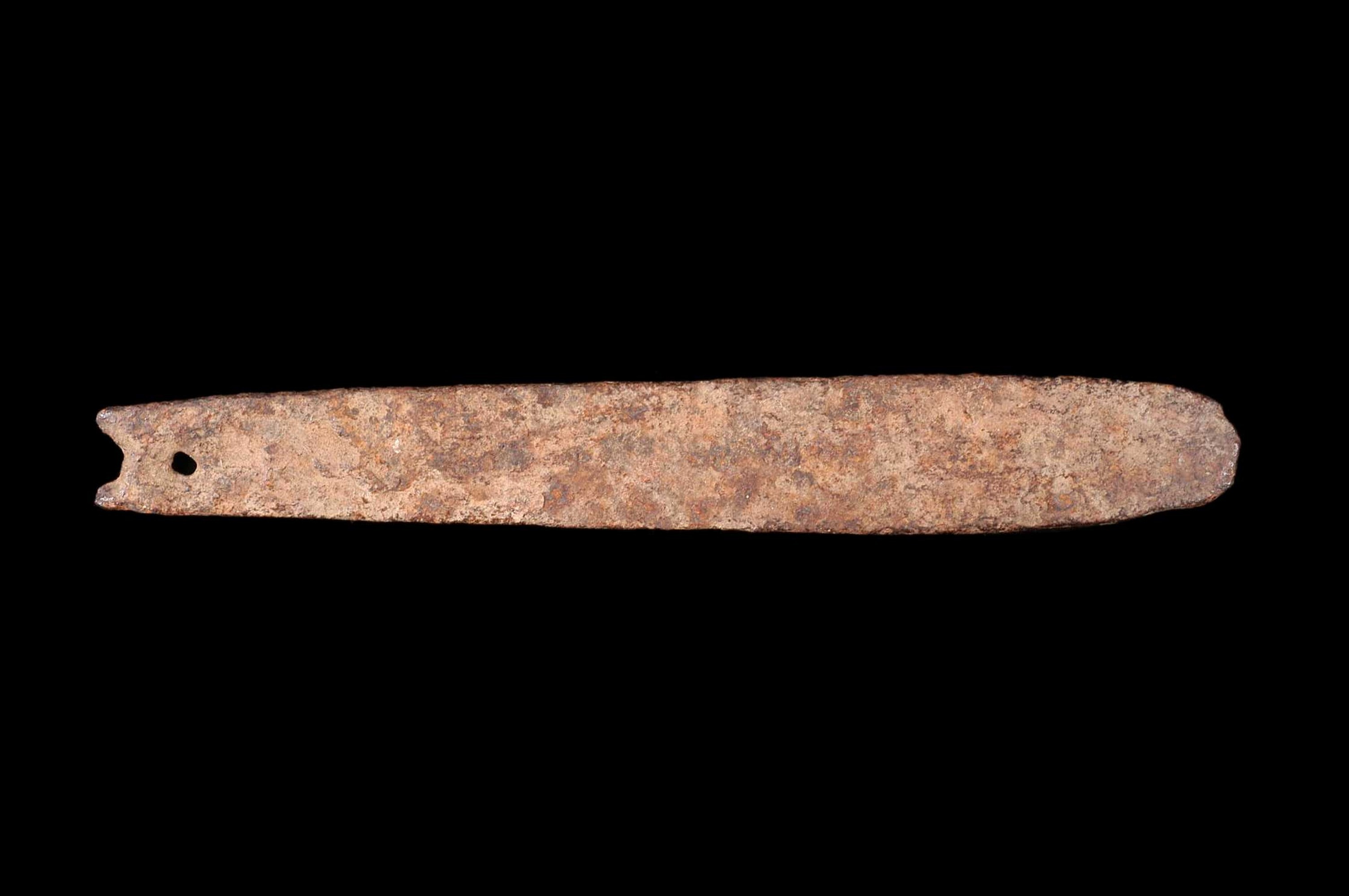
Among the Koma of the Alantika Mountains, on the Cameroon–Nigeria border, the bull-roarer is forged from iron: a thin, narrow blade that tapers along its length, with a notched head pierced for the cord. It belongs to a class of sacred instruments from which the uninitiated are kept apart: unlike the drums and pipes played openly at gatherings, these hidden instruments carry a protective power released only by the officiants of the cult. In the ethnographer Edmond Dounias's account, the roaring of the rhombe is the transposed voice of the ancestors, who hold malevolent spirits at a distance so that a rite may proceed undisturbed; when it sounds, the uninitiated are ordered to stay indoors. Koma smiths and ritual chiefs were buried with bullroarers beneath their armpits; when their skulls were later exhumed, the instruments were recovered and returned to the cult. Every rhombe the Koma make is of iron; this blade, sixteen centimetres long and barely three millimetres thick, is held by the musée du quai Branly–Jacques Chirac.
Le vrombissement des rhombes est une transposition des voix des ancêtres qui maintiennent à distance les esprits maléfiques susceptibles de troubler le bon déroulement d'une cérémonie rituelle. Tous les rhombes confectionnés par les Koma sont en fer.
The whirring of the bull-roarers is a transposition of the voices of the ancestors, who keep at a distance the malevolent spirits liable to disturb the proper course of a ritual ceremony. All the bull-roarers made by the Koma are of iron.
Dounias 1998, “L'élevage du taurin chez les Koma gɨ́mbē des monts Alantika (Nord-Cameroun),” in Des taurins et des hommes (ORSTOM), p. 202 n. 9
Particulars
- Object
- Iron bullroarer of the Koma: a thin, tapering strap 16 × 2.2 × 0.3 cm (58 g), its head notched in a shallow fork and pierced just below for the cord.
- Function
- Hidden cult instrument whose roar carries the ancestors' voices and keeps malevolent spirits away; non-initiates must stay indoors. Koma smiths and ritual chiefs were buried with bullroarers, recovered when their skulls were exhumed.
Sources
- Musée du quai Branly – Jacques Chirac, object 241891, Koma, Alantika Mountains. View · archived
- Edmond Dounias, “L'élevage du taurin chez les Koma gɨ́mbē des monts Alantika (Nord-Cameroun),” in Des taurins et des hommes (ORSTOM, 1998), p. 202 n. 9, p. 208 n. 12. View · archived
- Françoise Dumas-Champion, “Le mort circoncis: le culte des crânes dans les populations de la Haute Bénoué (Cameroun/Nigeria),” Systèmes de pensée en Afrique noire 9 (1989): 33–74, §25. View · archived