No. SCHEBESTA1933-003
Go, child of the great pot glöi
Democratic Republic of the Congo · Kilo, Kilo-Moto goldfields district, Ituri · Belgian Congo · Central Africa
Sacred / spirit
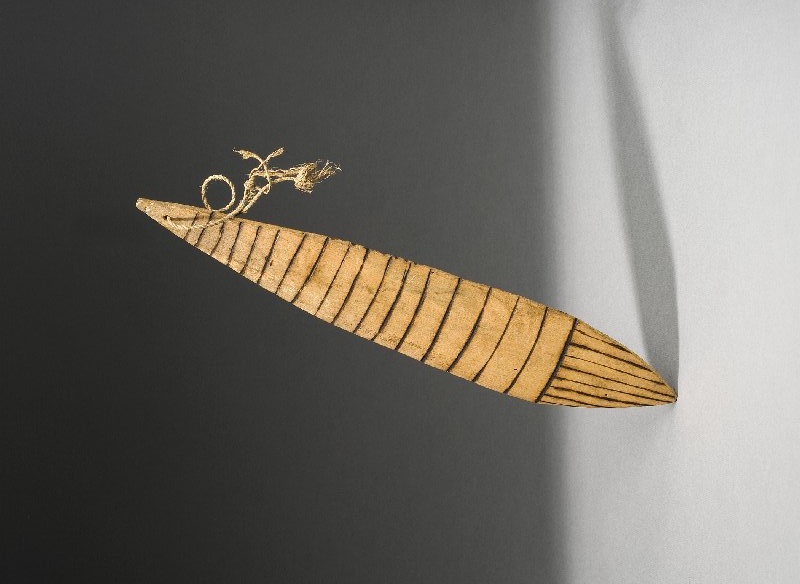
go
Source term: Schwirrholz
go: the Balendu (Lendu) name for the bullroarer at Kilo. The circumcision rite is iago, named from it, and the reed-blown pot-instrument glöi is reckoned "die Mutter des go" — the mother of the go.
Among the Balendu at Kilo, in the goldfield country on the eastern edge of the Ituri, the bullroarer is go — and the circumcision rite itself is iago, named from the instrument that sounds in it. Paul Schebesta collected the words around 1929–30 while assembling the initiation vocabulary of the peoples ringing the Efe, hoping their terms would explain a rite he had not been allowed to watch. The best of them is a kinship. The deep pot-instrument, blown through a reed, is glöi here, and glöi, Paul Schebesta writes, counts as the mother of the go: the roarer is the drum's child, the two of them a family of voices rather than a pair of objects. Schebesta had a bullroarer with him, and when he held it out to a Lendu man and asked what it was, the answer came flat and immediate — das ist Tore, that is Tore, the forest high god whose voice the whole sound-kit was said to be.
Die Balendu von Kilo nennen das Schwirrholz go; die Beschneidung iago; das Topfinstrument, in dem mittels eines Rohres geblasen wird (oben pengi genannt) nennen sie glöi, das als die Mutter des go gilt. Da ich einen Lendu nach dem Schwirrholz fragte und ihm eines zeigte, meinte er, das ist Tore.
The Balendu of Kilo call the bullroarer go; the circumcision iago; the pot-instrument, blown into by means of a tube (called pengi above), they call glöi, which counts as the mother of the go. When I asked a Lendu about the bullroarer and showed him one, he said: that is Tore.
Schebesta 1933:134–135
Particulars
- Object
- The object is not described. Schebesta gives the name only — no dimensions, material, wood, cord count or perforation — and states at p. 133 that he saw no bullroarer in use in this district. The one physical object in the episode is the specimen he himself carried and held out to a Lendu informant, which he likewise does not describe.
- Function
- Recorded inside Schebesta's list of initiation terminology gathered from the peoples living around the Efe: go is the bullroarer and iago the circumcision rite named from it, while the reed-blown pot-instrument glöi "counts as the mother of the go". Shown a bullroarer and asked what it was, a Lendu man answered that it was Tore, the forest high god.
Source
Paul Schebesta, “Religiöse Ideen und Kulte der Ituri-Pygmäen,” Archiv für Religionswissenschaft 30 (1933), pp. 134-135