No. DESCHAMPS1962-001
Kwele / Bakwele namiqwott funeral bullroarer, Makokou
Gabon · Makokou · Haut-Ivindo · Central Africa
Restricted
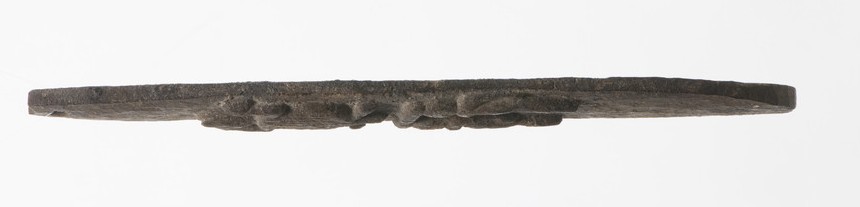
namiqwott
Source term: bull-roarer; planchette tournant autour d'une corde (a small board turning around a cord)
At Kwele funeral dances in the forests of the Haut-Ivindo, a small board whirled on a cord — the namiqwott — was the spirit of the dead, and women and children were forbidden to see it. The Kwele, whose white-faced, heart-shaped ekuk masks are among the celebrated images of African art, told the historian Hubert Deschamps of it at Makokou: a spinning plank that was the voice of the revenants.
Le namiqwott était un « bull-roarer » (planchette tournant autour d'une corde) employé pour les danses de funérailles, que les femmes et les enfants ne devaient pas voir. C'était l'esprit des revenants.
The namiqwott was a bullroarer — a small board turning around a cord — used for funeral dances, which women and children were not to see. It was the spirit of the dead.
Hubert Deschamps, Traditions orales et archives au Gabon (1962), p. 78.
Particulars
- Object
- A small board whirled on a cord.
- Function
- Funeral-dance voice of the dead, not to be seen by women or children.
Source
Hubert Deschamps, Traditions orales et archives au Gabon: contribution à l'ethno-histoire (Berger-Levrault, 1962), Groupe Nord / Kouélé chapter