No. FRAZER1913-018
Boloki toy-magical bullroarer
Democratic Republic of the Congo · Upper Congo · Central Africa
Play / practical
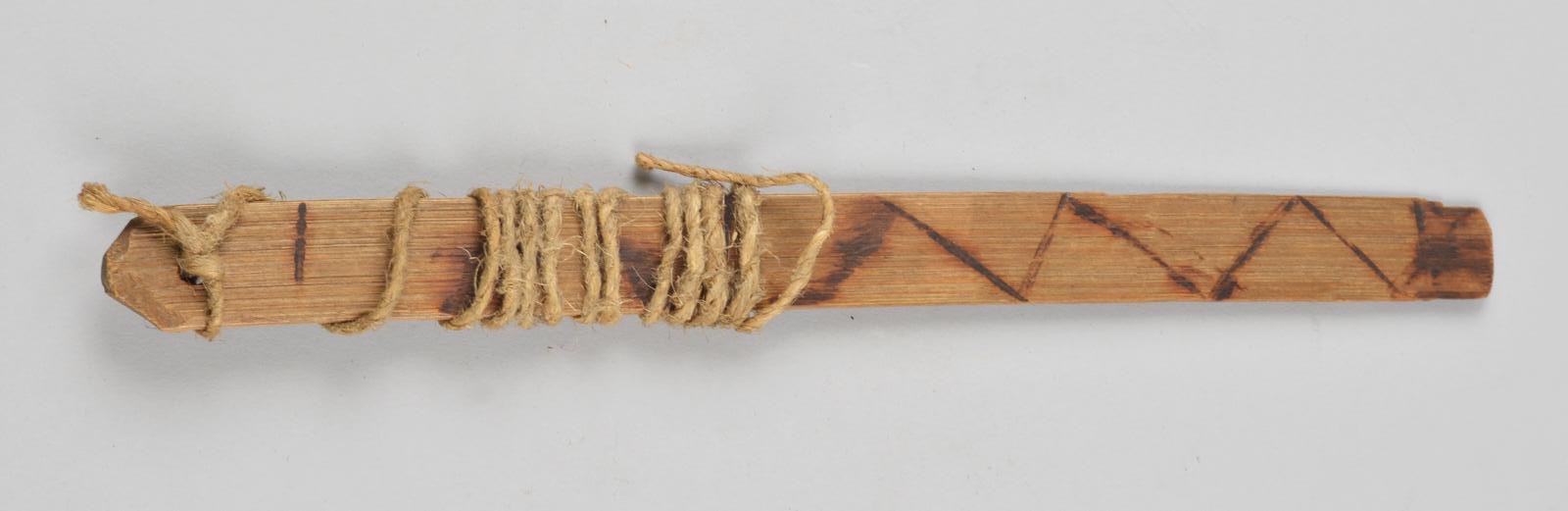
Source term: bull-roarer
Among the Boloki of the Upper Congo, the bullroarer was a boys' toy, but their elders disliked seeing it whirled, and gave a single reason: "You are calling the leopards." The spun bamboo slat made a sound like the growling of a leopard, and so the old men warned the lads off. The missionary John H. Weeks, who went to the Congo in 1881 and spent thirty years there, fifteen of them among the Boloki, recorded the toy in his chapter on native games; he also gave evidence to the 1904 commission of inquiry into the abuses of Leopold's Congo Free State. Frazer took the case into The Golden Bough. The object itself was no more than a piece of bamboo a boy could make.
Although Congo is practically a toyless land, and so far as the adults are concerned the children are not catered for, yet from their loud laughter the young folk seem to extract a great amount of pleasure out of life.
Weeks, Among Congo Cannibals (1913), p. 158
Particulars
- Object
- A whirled strip of bamboo.
- Function
- Children's toy with magical/leopard-attracting taboo or danger.
Source
John H. Weeks, Among Congo Cannibals (London: Seeley, Service & Co., 1913), p. 157