No. EXH2026-014
Babali (Bali)
Democratic Republic of the Congo · NE Congo (Babali initiation belt) · Central Africa
Restricted
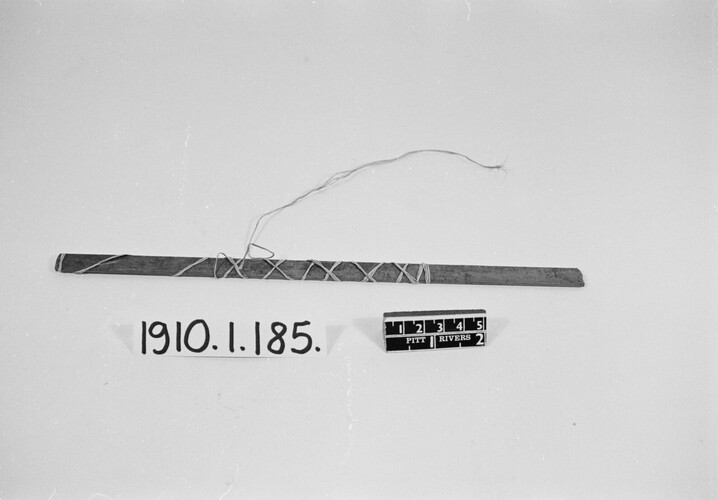
Source term: Maduali
Blindfolded Mombela novices lay on their backs while three initiated elders divided the ordeal. The Isumu cut tattoo marks into their bellies with a keen blade; the Nasasa mimicked the cry of the grey ibis on a flute; and the Maduali whirled a hollowed slat of wood on a cord above his head. The mournful, siren-like note it threw was itself called the Maduali — a spirit or supernatural being, the territorial administrator Bernard wrote in 1922, that the uninitiated took for the Supreme God himself. Its voice carried through Babali country for some three kilometres. Bernard pried the account loose only after years of patience, under an oath of secrecy sworn on pain of death. This was the same forest world that bred the dreaded anioto, the leopard-men who killed disguised in claws and hide; farther south the roarer had dwindled to a child's toy, still feared for the blade that could slip its cord into a bystander's face.
le rhombe est lié au complexe d'initiation tribale qui «se rencontre avec quelques variantes chez les voisins des Babali: Bakumu, Babira, Wanyanza, Bangelima, Barundi, Bapopoi, Wagenia et Lokele».
the bullroarer is tied to the tribal-initiation complex which "is found, with some variants, among the neighbours of the Babali: Bakumu, Babira, Wanyanza, Bangelima, Barundi, Bapopoi, Wagenia, and Lokele."
Söderberg 1956:184-185, quoting de Jonghe 1936:62
Particulars
- Object
- Hollowed wooden, tamtam-shaped bullroarer on a two-to-three-metre cord, swung horizontally overhead.
- Function
- During Mombela initiation, Maduali swung the siren-like voice while Isumu tattooed blindfolded novices and Nasasa played the gray-ibis flute; the sound carried about three kilometres.
Sources
- Bernard, Une société secrète chez les Babali: Le Mombela, Congo, 3e année, tome 2 (1922):349–353, pp. 351–352 View
- Bertil Söderberg, Les instruments de musique au Bas-Congo et dans les régions avoisinantes (1956), pp. 184–185, quoting E. de Jonghe, “Formations récentes de sociétés secrètes au Congo belge,” Africa 9(1) (1936), p. 62