LEIRIS1934-001 - ethnographic attestation
Namchi sẹ̄yo, the moon that roars at a death
Namchi massif, right bank of the Faro (Bénoué basin), Poli, North Cameroon - Africa
Restricted
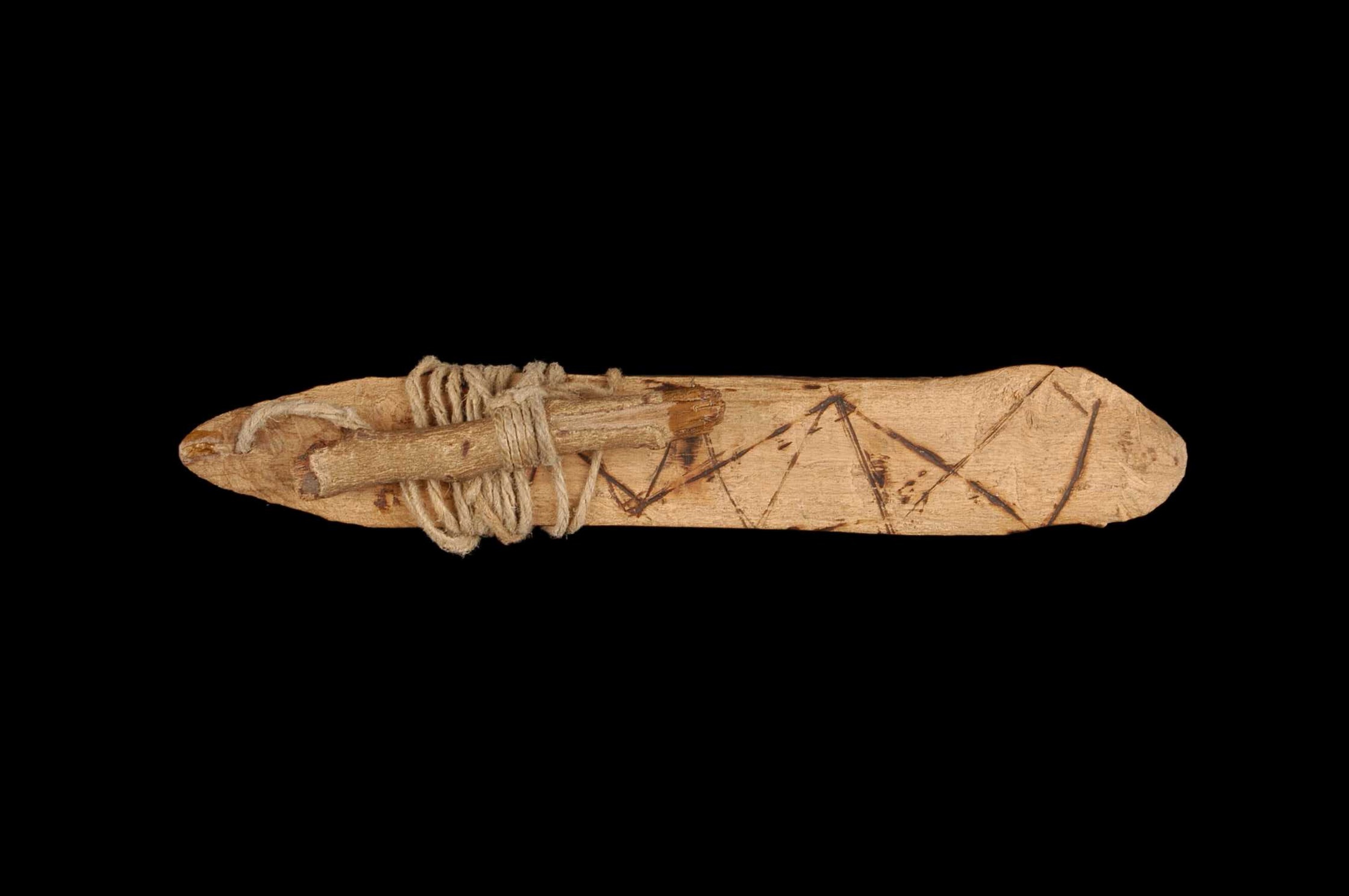
sẹ̄yo
Source term: rhombe (sẹ̄yo)
sẹ̄yo: the bullroarer, a homonym of the Namchi word for “moon” (sẹ̄ búlẹ, “twelve moons”, is the length of the circumcision seclusion).
When a man of Séwé died, the boys in their circumcision retreat, the chief’s son and their attendants made new roarers, long ellipses of wood on a cord, and at nightfall they came to whirl them close to the village. The Namchi word for the bullroarer, sẹ̄yo, is also their word for the moon; the boys stayed in the bush for twelve moons and came home at the full. The roarers were then put away in the wālẹ, the skull house high on the mountain, among the pots that hold the skulls a smith takes from the dead a month after death. There, on a great stone, lies the sẹ̄yo the old men sound when a man has died. No one but the smiths and the chief’s son may go inside, and when it must be played, the eldest smith goes to fetch it.
Quand un homme du village meurt, les circoncis, le fils du chef et les yoko fabriquent des rhombes (sẹ̄yo, homonyme de « lune »).
When a man of the village dies, the circumcised boys, the chief’s son and the yoko make bullroarers (sẹ̄yo, the same word as “moon”).
Michel Leiris, Journal de la Société des Africanistes 4 (1934), p. 75
- Object
- A long elliptical wooden blade tied to the end of a cord or leather thong. One great sẹ̄yo lies on a stone in the skull house.
- Function
- Whirled near the village at nightfall after a man’s death by the boys in circumcision retreat, the chief’s son and the circumcision attendants; kept in the skull house, which only the smiths and the chief’s son may enter.
- Source
- Michel Leiris, « Rites de circoncision namchi », Journal de la Société des Africanistes 4(1) (1934): 63-80, pp. 75, 77-79; Françoise Dumas-Champion, « Le mort circoncis; Le culte des crânes dans les populations de la Haute Bénoué (Cameroun/Nigeria) », Systèmes de pensée en Afrique noire 9 (1989), §31
- Source location
Page references
Leiris pp. 75, 77 n. 1, 78-79 | Dumas-Champion 1989 §31
- Source confidence
- high
- Location note
- Poli, Faro department (OSM/Nominatim), chef-lieu of the old Namchi-Alantika subdivision where Leiris worked 23-29 Jan 1932, on the Namchi massif. The account belongs to Séwé, Nyako’s village, which Leiris does not locate; Poli stands for Namchi country.
Regions: Africa · Central Africa
- Initiation rite
- Death and rebirth
- Forbidden to women