No. EXH2026-016
Babira (Bira)
Democratic Republic of the Congo · NE Congo (Babali initiation belt) · Central Africa
Restricted
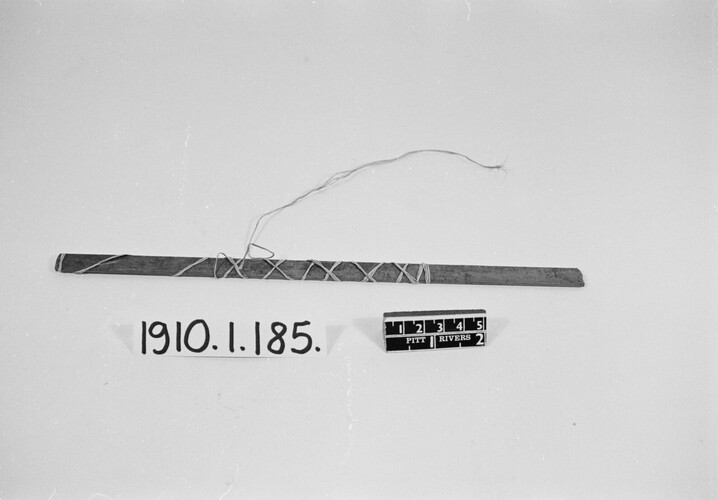
Source term: rhombe
A board on a cord, swung in a sling motion, gave off a roaring whir that frightened the uninitiated: among the Babira (Bira) of northeastern Congo, as among their Babali neighbours, the bullroarer was one of the sacred instruments of initiation. In the Lower Congo, far to the west, the Swedish ethnomusicologist Bertil Söderberg found the same instrument reduced to a child's toy, still feared mainly because a roarer slipping its string could fly into a bystander's face.
…le rhombe est lié au complexe d'initiation tribale qui «se rencontre avec quelques variantes chez les voisins des Babali: Bakumu, Babira, Wanyanza, Bangelima, Barundi, Bapopoi, Wagenia et Lokele».
…the bullroarer is bound up with the tribal-initiation complex which "is found, with some variations, among the neighbours of the Babali: Bakumu, Babira, Wanyanza, Bangelima, Barundi, Bapopoi, Wagenia and Lokele."
de Jonghe 1936:62–63, quoted in Söderberg, Les Instruments de Musique au Bas-Congo (1956:184–185)
Particulars
- Object
- A sounding board fixed to the end of a cord.
- Function
- Sounded in the tribal initiation complex shared by the Babali and their neighbours.
Source
E. de Jonghe, 'Formations récentes de sociétés secrètes au Congo belge,' Africa 9(1) (1936), pp. 62-63, quoted in Bertil Söderberg, Les instruments de musique au Bas-Congo et dans les régions avoisinantes (1956), pp. 184-185