No. MUS2026-059
Koinambula, the palm-wine ghost
Democratic Republic of the Congo · Kasai (Kuba) · Central Africa
Restricted
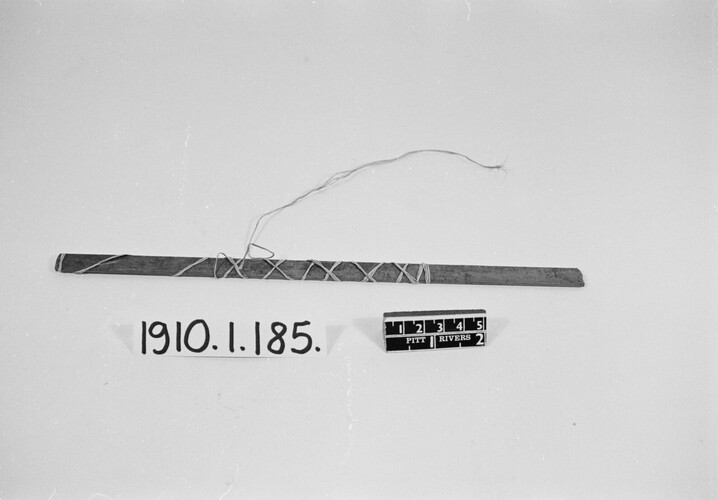
KOINAMBULA
Source term: bull-roarer
Koinambula: koy na bula, 'the leopard of the village.' The name came to Oxford with this roarer; Torday and Joyce record it for the Kuba friction drum.
The Bushongo say they invented the bull-roarer. A young man brought palm-wine home each day for himself and his mother and left none for his father; the old man followed him into the wood, and as the boy gathered his brimming calabashes, a thin strip of wood on a string began to howl above his hidden father's head. Night after night the 'awful ghost' waylaid him until the son begged forgiveness — and the old men, let in on the trick, took the roarer for their own: since that day, the royal historian told Emil Torday, it has sounded at initiation to frighten the boys and teach them to respect their elders. At the puberty seclusion the elders still circled the boys' camp by night, whirring out the howls of wild beasts. This specimen came back with Torday himself from the Kasai.
At night the elders go near the camp and make weird noises with the bull-roarer, which imitates very closely the howling of wild beasts.
Emil Torday, On the Trail of the Bushongo (1925), p. 187
Particulars
- Object
- Bull-roarer of the Kuba, Pitt Rivers Museum, Oxford (acc. 1910.1.185).
- Function
- Torday, the collector, records the Bushongo bull-roarer as an initiation instrument: whirled at night around the boys' seclusion camp to imitate the howling of wild beasts and frighten the novices, with an origin story presenting it as the elders' invented ghost.
Sources
- Pitt Rivers Museum, Oxford, accession 1910.1.185
- E. Torday and T. A. Joyce, Notes ethnographiques sur les peuples communément appelés Bakuba, Annales du Musée du Congo Belge, Ethnographie III, II:1 (Brussels, 1910), pp. 87, 250 View · archived
- Bertil Söderberg, Les instruments de musique au Bas-Congo et dans les régions avoisinantes (Stockholm, 1956), p. 148 n. 68, p. 151 n. 78
- Emil Torday, On the Trail of the Bushongo (1925), pp. 87-88, 185, 187, 190
- Vansina (1955), p. 141, via Söderberg 1956, p. 151 n. 78