No. SUBSAH-016
Lamba
Copperbelt · Lambaland, Zambia-Katanga border · Central Africa
Play / practical
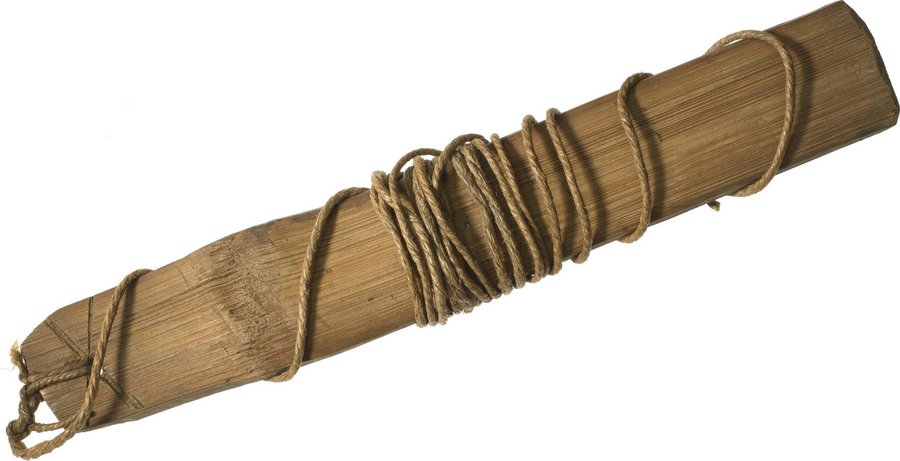
lendya
lendya — Lamba name for the bull-roarer.
Etymology. Doke's glossary gives lendya as a gladiolus bulb used as a bull-roarer.
Among the Lamba of the Copperbelt, on the Zambia–Katanga border, the bull-roarer was the bulb of the gladiolus plant twirled on a string. The missionary-linguist Clement Doke, who lived among the Lamba from 1914 to 1921 and published his study in 1931, recorded that they called it lendya and applied to it the term intambangoma, their word for a friction drum. But among the Lamba, Doke wrote, the bull-roarer was a child's plaything and had no further significance.
The term intambangoma is also applied to the lendya, or bull-roarer, the bulb of the gladiolus plant twirled on string. But among the Lambas the bull-roarer is but a child's plaything, and has no further significance.
Doke, The Lambas of Northern Rhodesia (1931), "Folklore and Music"
Particulars
- Object
- A bull-roarer made of the bulb of the gladiolus plant twirled on a string.
- Function
- A children's plaything only, whirled for the roaring noise, with no further significance among the Lamba.
Source
Doke, The Lambas of Northern Rhodesia (1931)