No. MUS2026-149
Amvam Fang evuntere bullroarer
Gabon · Woleu-Ntem · Oyem · Central Africa
Restricted
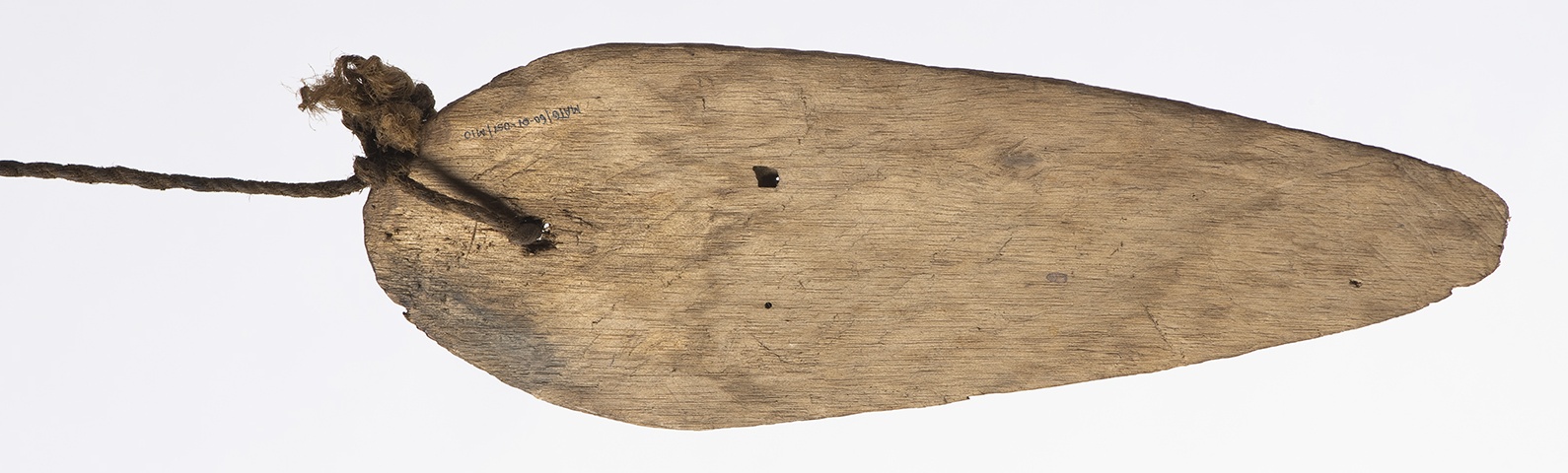
evuntere
Source term: Bullroarer
evuntere: the Fang name for this bullroarer.
Not a secret-society voice but a household terror. After dark, Fang men and older boys whirled a slat like this on its cord until its eerie drone became the cry of the edžībŏ'ngo, the "child-eater" — the bogeyman conjured to frighten unruly children into obedience. Günter Tessmann, who lived among the Fang around 1908, pointedly filed the roarer not with their musical instruments but among the stamping noise-sticks parents used to discipline the young. This specimen was made near Oyem before 1960.
kōkō-boṅgo, d. h. böser Mann für die Kinder; er ist dasselbe, was bei uns der „schwarze Mann“ für unsere Kinder ist; im besonderen heißt das Schwirrholz so.
kōkō-boṅgo, that is, the bad man for children; he is what the bogeyman is for our own children at home; the bullroarer in particular is called this.
Günter Tessmann, Die Pangwe, Bd. II (1913), p. 335 n. 1
Particulars
- Object
- A leaf-shaped wooden blade, its cord knotted through a hole at the broad end.
- Function
- Sounded as a bogey to frighten small children into good behaviour.
Source
Musée des Arts et Traditions du Gabon, inv. MATG60.01.051, 'evuntere' (Fang, Amvam, Woleu-Ntem; before 1960), record on Musical Instrument Museums Online; Günter Tessmann, Die Pangwe, Bd. II (Berlin: Wasmuth, 1913), pp. 287–288, fig. 86