No. EXH2026-019
Wagenia (Genya)
Democratic Republic of the Congo · NE Congo (Babali initiation belt) · Central Africa
Restricted
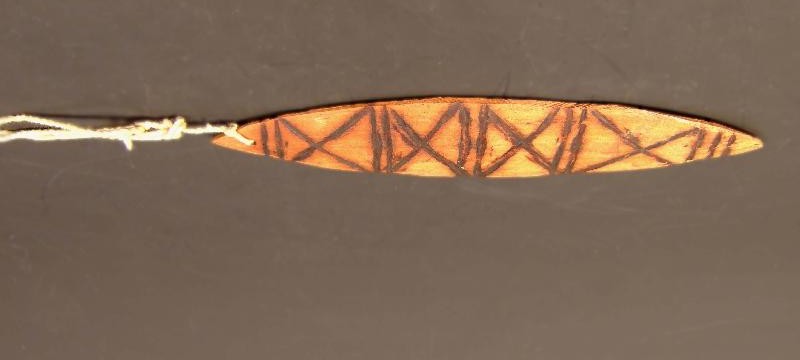
Source term: rhombe
At Kisangani the Wagenia lash tall wooden tripods into the Boyoma (Stanley) Falls, wedging cone-shaped basket traps into the whitewater to haul fish from the roaring rapids — a craft handed down the male line for generations. These same falls-fishers stand in the belt of forest initiation that Édouard de Jonghe traced outward from the Babali: a complex found 'with some variations' among the Bakumu, Babira, Wagenia, Lokele and their neighbours, and the bullroarer is bound to it wherever it runs.
de Jonghe a souligné que le rhombe est lié au complexe d'initiation tribale qui «se rencontre avec quelques variantes chez les voisins des Babali: Bakumu, Babira, Wanyanza, Bangelima, Barundi, Bapopoi, Wagenia et Lokele».
de Jonghe stressed that the bullroarer is tied to the tribal-initiation complex which "is found, with some variations, among the neighbors of the Babali: Bakumu, Babira, Wanyanza, Bangelima, Barundi, Bapopoi, Wagenia, and Lokele."
Söderberg 1956:184, quoting de Jonghe 1936:62
Particulars
- Object
- Rhombe of the NE-Congo tribal-initiation complex.
- Function
- Rhombe tied to the tribal initiation complex of the Babali and their neighbours (de Jonghe).
Source
E. de Jonghe, 'Formations récentes de sociétés secrètes au Congo belge,' Africa 9(1) (1936), pp. 62-63, quoted in Bertil Söderberg, Les instruments de musique au Bas-Congo et dans les régions avoisinantes (1956), pp. 184-185