FROBENIUS1913-004 - ethnographic attestation
Laka gandu b(i)jae, iron voices of the harvest
Laka country between Lamé (North Cameroon) and the western Logone, Logone Oriental, southwestern Chad - Africa
Restricted
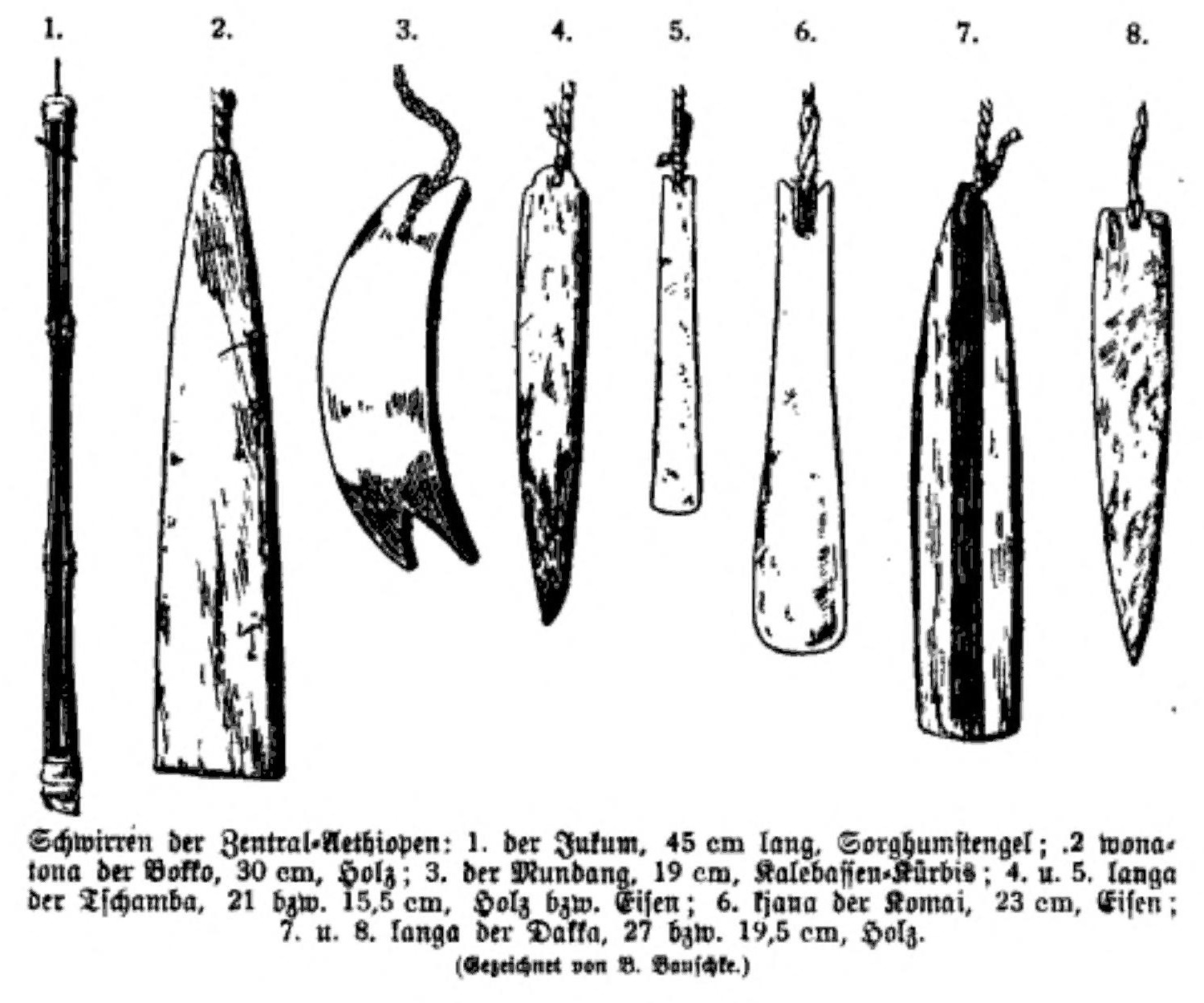
gandu b(i)jae (iron); lŭ́ (wooden)
Source term: Schwirre aus Eisen; Schwirrholz
gandu b(i)jae: the set of iron bullroarers among the Laka sacred instruments (Kuma); lŭ́: the wooden bullroarer used to frighten small children.
When the sorghum ripened, the Laka high priest, the Gongoria, led five old men and a black he-goat to his own field and sacrificed it at night, praying for a rich harvest, for health and for many children. For seven days no one might eat the new grain or lie with a woman, and through that holy time the sacred instruments sounded: a set of iron bullroarers, swung by men with iron bells on their ankles. Women must never see them. On the eighth day the priest carried sorghum to the hut in the bush where the instruments were kept and offered it “for the earth and the Kuma”, and everyone brewed beer. A humbler wooden roarer, the lŭ́, was for frightening small children.
Eisenschwirre, Fußschellen und Perr finden in der Erntezeit bei den großen Festen Verwendung. Demnach dürfen die Frauen sie auf keinen Fall je zu Gesicht bekommen.
The iron bullroarers, the ankle bells and the perr are used at the great festivals of the harvest season. Women may therefore never on any account set eyes on them.
Leo Frobenius, Und Afrika sprach… III (1913), p. 167
- Object
- Iron bullroarers kept as a set of several, swung by men wearing iron ankle bells (mandi); a wooden roarer, the lŭ́, is also recorded.
- Function
- The iron set sounds at the great sorghum-harvest festivals and must never be seen by women; the hereditary high priest keeps it in a bush sanctuary. The wooden lŭ́ frightens small children.
- Source
- Leo Frobenius, Und Afrika sprach…, vol. III: Unter den unsträflichen Aethiopen (Berlin: Vita, 1913), pp. 167-169; Günter Tessmann, “Die Mbaka-Limba, Mbum und Lakka,” Zeitschrift für Ethnologie 60 (1928): 305-352, p. 351
- Source location
Page references
Frobenius 1913 III pp. 167-169 | Tessmann 1928 p. 351 (§71)
- Source confidence
- high
- Location note
- Baïbokoum, Logone Oriental (OSM/Nominatim), on the western Logone inside Tessmann’s stated Laka range from Lamé to the western and eastern Logone; group anchor. Neither source names the village of the Lokuma sanctuary.
Regions: Africa · Central Africa
- Forbidden to women
- Agriculture / crop magic