No. EXH2026-015
Bakumu (Komo) tuambi
Democratic Republic of the Congo · NE Congo (Babali initiation belt) · Central Africa
Restricted
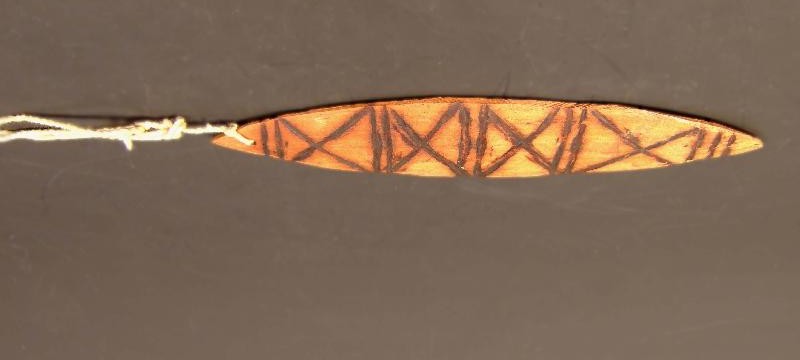
tuambi
Source term: Tuambi (rhombe)
tuambi: the Bakumu (Komo) name for the bullroarer swung at circumcision, paired with the whistle kabili and the bird-pipe mokomo; the same tuambi + kabili pair recurs among the Bamanga, and as tuamba + kabili among the Warega (Lega).
Circumcision, among the Bakumu, was not done by a man. It was done by a bird — the mokomo, whose beak was pointed, so the pipe that gave its cry was cut to a point to match. Beside it the initiators swung the tuambi, the bullroarer, and blew a whistle called kabili. Alfred Moeller, administering the Province Orientale, described the object under its Babali name, maduali: a simple oblong plank fixed to the end of a string, which whirling makes a noise like an engine roaring. He was blunt that the 'spirits of the initiation' were nothing more than these very simple instruments in the initiators' hands — and equally blunt about what was built on them. Novices were shut away and forbidden to speak to women or to the uninitiated; the sight of the spirits was itself a stage of the rite; parents surrendered their rights over their children; women were excluded outright. The Bakumu kept only the circumcision, not the Babali mambela. Their word for the roarer, tuambi, is the word the Bamanga used too, and, as tuamba, the Warega away south in Maniema.
La circoncision, comme le tatouage chez les Babali, est censée être faite par un oiseau que les Bakumu appellent « mokomo »; le bec de ce volatile étant pointu, la forme de l'instrument varie donc en conséquence.
Circumcision, like tattooing among the Babali, is supposed to be performed by a bird which the Bakumu call "mokomo"; the beak of this bird being pointed, the shape of the instrument varies accordingly.
Moeller 1936:552
Particulars
- Object
- An oblong plank of wood, whirled on the end of a string.
- Function
- Swung at the boys' circumcision rite alongside the whistle kabili and the bird-pipe mokomo, cut to a point in imitation of the beak of the bird said to perform the circumcision; one of the three 'spirits of the initiation' that initiates were forbidden to speak of to the uninitiated, in a rite whose common features included seclusion in an isolated place, a ban on speaking to women, and the exclusion of women.
Source
A. Moeller, Les grandes lignes des migrations des Bantous de la Province Orientale du Congo Belge (Mémoires de l'Institut Royal Colonial Belge, Sciences Morales et Politiques, t. VI; Bruxelles, 1936), pp. 551-552