No. MOELLER1936-004
Bamanga tuambi circumcision bullroarer
Democratic Republic of the Congo · Lindi and lower Aruwimi rivers around Bengamisa and Banalia, north of Stanleyville (Kisangani), Province Orientale (now Tshopo) · Central Africa
Restricted
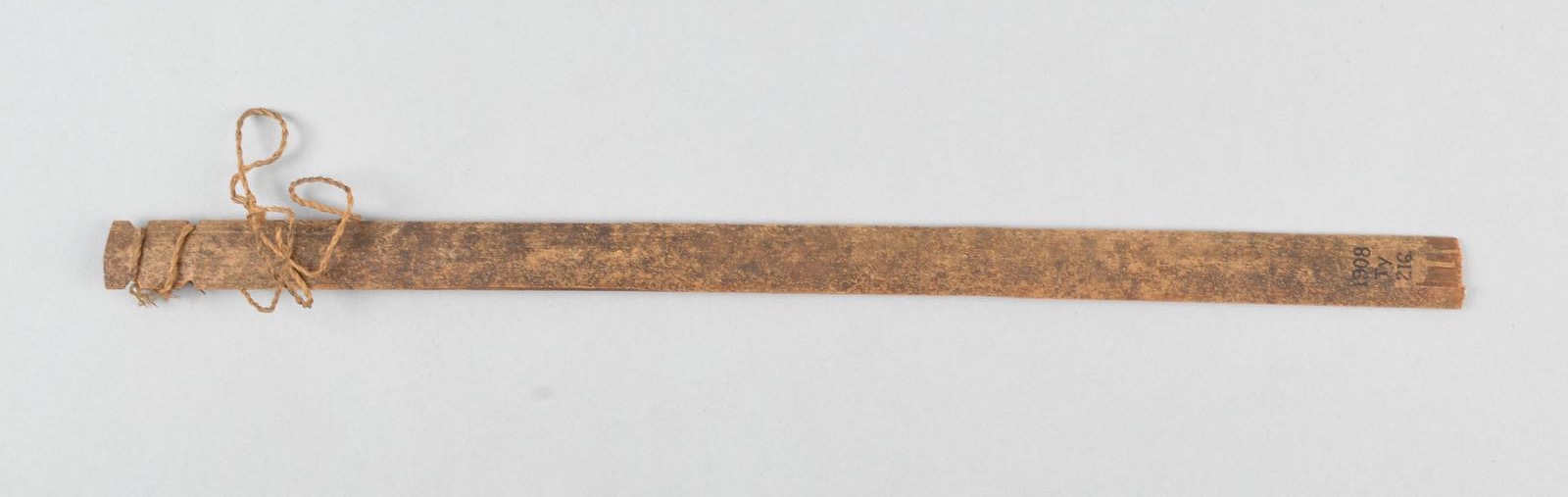
tuambi
Source term: Tuambi (rhombe)
tuambi: the Bamanga name for the circumcision bullroarer, paired with the whistle kabili and the pipe lokomo; the Bakumu use the same tuambi + kabili pair, and the Warega (Lega) say tuamba.
The Bamanga of the Lindi and lower Aruwimi rivers, north of present-day Kisangani, were a people gathered from many. Most came of Mongelima families, others of Turumbu and Popoie stock, and their clan stories keep telling the same tale: the founding ancestor is a stranger, taken in or found by a woman of the country. Yet their language, kimanga, and their whole way of life came from the smallest strand among them, the Bayuki, who had come down the Lulu under attack from their neighbours to become the first settlers on the Lindi near Bengamisa, and who by the 1930s had all but vanished. At circumcision the Bamanga swung the tuambi, a bullroarer, with a whistle called kabili and a pipe, the lokomo. Their Bakumu neighbours used the same two names for roarer and whistle, and the Warega, far to the south, called the roarer tuamba. To the uninitiated these were spirits, never to be spoken of; in the hand the tuambi was an oblong plank of wood on the end of a string, whirled until it droned like an engine.
Ils ont donné leur langue (que nous appelons actuellement le kimbanga) et leur culture au conglomérat que nous connaissons sous le nom de Bamanga.
They gave their language (which we now call Kimbanga) and their culture to the conglomerate we know by the name of Bamanga.
Moeller 1936:277
Particulars
- Object
- An oblong plank of wood fixed to the end of a string and whirled.
- Function
- Sounded at the boys' circumcision rite alongside the whistle kabili and the pipe lokomo; one of the three 'spirits of initiation' that initiates were forbidden to discuss with the uninitiated, in a rite whose shared features included seclusion, a ban on speaking to women, and the exclusion of women.
Source
A. Moeller, Les grandes lignes des migrations des Bantous de la Province Orientale du Congo Belge (Mémoires de l'Institut Royal Colonial Belge, Section des Sciences Morales et Politiques, t. VI; Brussels, 1936), pp. 551-552 (table, p. 552); the Bamanga, pp. 276-279