No. EXH2026-026
Bali Nyonga (seed warding)
Bali (Bali Nyonga), Cameroon Grassfields · Central Africa
Restricted
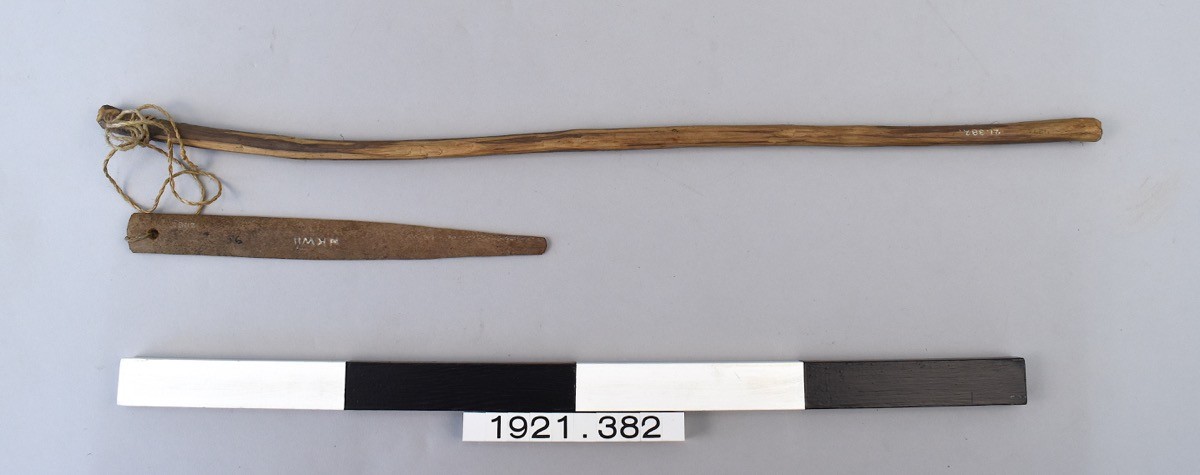
Source term: Schwirrholz
Woma: the Bali sowing-festival (Saatfest) of mid-November at which the bullroarers were whirled; Hutter lists it alongside Ndänga (a mid-January harvest-feast), Mandet (a mid-October dance), and Leda (a mid-December weapon-dance).
At the Woma, a sowing-festival the Bali of the Cameroon Grassfields held in mid-November as the long rains ended, three elders in peace-dress walked from the chief's compound through the village and out into the farms, carrying flat iron cult-implements that no woman might look upon, tracing slow circles and arcs in the air to drive harmful influences from the settlement and above all from the young seed. Running and springing ahead of them, younger men swung carved pieces of wood on long cords, flinging them out to spin and roar like tops. The women danced turned away, shielding their eyes with their hands; if a woman had to pass near the implements she did so with her head wrenched aside. The reason given for the taboo was blunt: a woman who looked would bear no more children. Captain Franz Hutter, who spent eighteen months in the Bali country, set this down from his own observation; the same rite had reached Leo Frobenius a few years earlier, only in compressed form and through Hutter's and Zintgraff's letters, where it was rendered loosely as a harvest custom.
Ihnen voraus rennen und springen, umkreisen sie dann wieder einige Jüngere mit Schwirrhölzern, geschnitzten Stücken Holz an langen Fäden, die sie wie Kreisel auswerfen und tanzen lassen. ... Nun ist es aber höchst possierlich, zu sehen, wie ängstlich die Weiber bemüht sind, ja nicht nach diesen verbotenen Dingen hinzusehen. ... Und der Grund, warum sie nicht hinschauen dürfen? „Wenn sie das thäten, bekämen sie keine Kinder mehr!"
Running and springing ahead of them, and circling round them again, are some younger men with bull-roarers — carved pieces of wood on long cords, which they fling out and let dance like spinning-tops. ... Now it is most droll to see how anxiously the women take care not to look at these forbidden things. ... And the reason they may not look? "If they did, they would have no more children!"
Hutter, Wanderungen und Forschungen im Nord-Hinterland von Kamerun (1902), pp. 430-431
Particulars
- Object
- Piece of wood on a long cord, made to whizz through the air.
- Function
- Whirled by younger men at the Woma, the Bali sowing feast, to keep evil influences off the village and the sprouting seed.
Source
Franz Hutter, Wanderungen und Forschungen im Nord-Hinterland von Kamerun (Braunschweig: Vieweg, 1902), pp. 429-431