No. SUBSAH-030
Yalemba-Ligasa Upper Congo bullroarers
Democratic Republic of the Congo · Tshopo Province · Yalemba-Ligasa area · Central Africa
Function not recorded
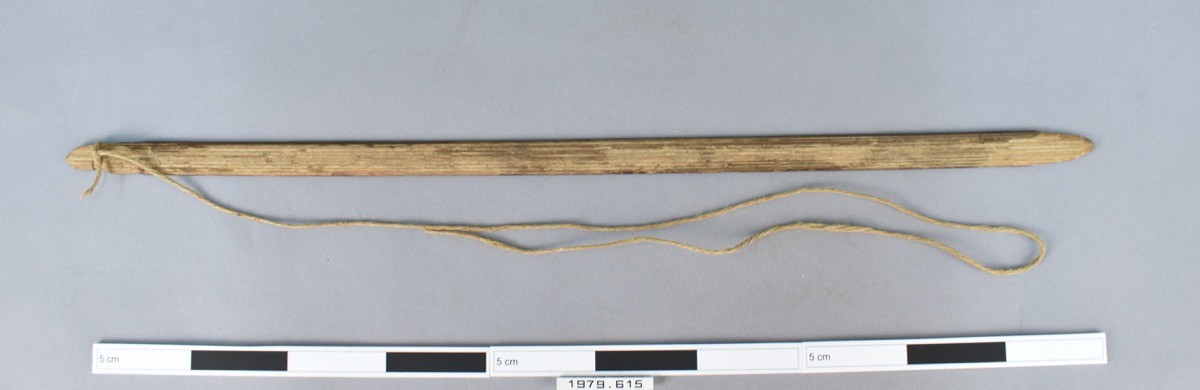
Source term: Bullroarer
To make boys into men, the Lokele and their forest neighbours on the Upper Congo turned their elders into spirits: faces daubed white, brandishing knives and scimitars, the men burst from the sacred grove to terrify women and children and carry off the chosen. A survivor of this libeli rite won a single word — LILWA — that no woman could utter without a heavy fine. These two plain slats of whirled wood, collected here by the missionary A.R.D. Simpson among the Lokele's forest neighbours, the Olombo and Topoke, come from that world; a bullroarer's howl is the classic voice such spirits are given.
Bullroarer made from plain wood. Long and narrow in shape, both ends have been rounded, one with a carved notch and a piece of string attached.
Cambridge Museum of Archaeology and Anthropology, object record 1979.615
Particulars
- Object
- Two plain wooden bullroarers, long and narrow with rounded ends: the longer, 54 cm, notched at one end and still carrying its string; the shorter, 39 cm, also strung.
- Function
- Function not recorded.
Source
Cambridge MAA 1979.615 and 1979.616, bullroarers from Africa; Central Africa; Democratic Republic of the Congo; Tshopo Province; Yalemba-Ligasa area; Field collection of Rev. A.R.D. Simpson from the Upper Congo River, 1923-1954; probably mostly Olombo and Topoke, possibly some Lokele