No. SCHEBESTA1948-002
Tore comes for the bananas
Democratic Republic of the Congo · Ituri forest, Belgian Congo; Machongani's Balese village (Schebesta's second journey) · Central Africa
Restricted
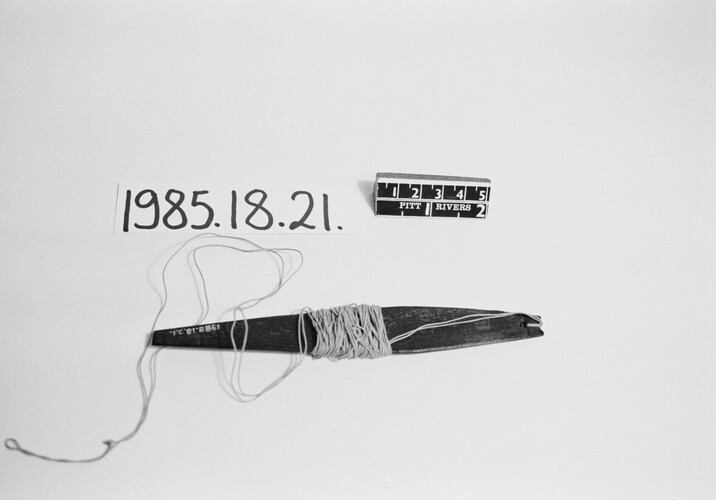
pahudjuhudju
Source term: Schwirrholz
pahudjuhudju (also hudjuhudju): the Ituri bullroarer name Schebesta records among the Balese and here for the Efé Tore procession. Tore: the forest being of the men's society; at p. 481–482 the whole set of sacred noise instruments is called Tore.
First came the gift of meat. When the Efé Tore society meant to visit a farming village, the forest hunters sent game ahead; the villagers then ordered their wives to hide, because Tore was coming. In a great din the Efé pushed into the banana groves, cut as many bunches as they needed and carried them off to their Tore hut. Under the noise droned the pahudjuhudju. Tore was the forest being whose name the men’s society bore, and among the neighbouring Balese the roarer, flute, droning pot and great wooden trumpet sounded together were simply called Tore.
dass das Dröhnen des Pahudjuhudju (Schwirrholz) den Tore-Zug begleite
that the droning of the pahudjuhudju (bullroarer) accompanied the Tore procession
Paul Schebesta, Die Bambuti-Pygmäen vom Ituri II-2 (1948), p. 506
Particulars
- Object
- Not recorded.
- Function
- Said to drone during the Efé Tore procession into a farming village: the Efé first brought game, the villagers' wives were told to hide because Tore was coming, and the Efé took bananas from the plantations to store in their Tore hut.
Source
Paul Schebesta, Die Bambuti-Pygmäen vom Ituri, vol. II-2 (Brussels, 1948), pp. 481–482, 506