No. EXH2026-045
Andebogo (kundrukundru)
Democratic Republic of the Congo · NE Congo · Central Africa
Function not recorded
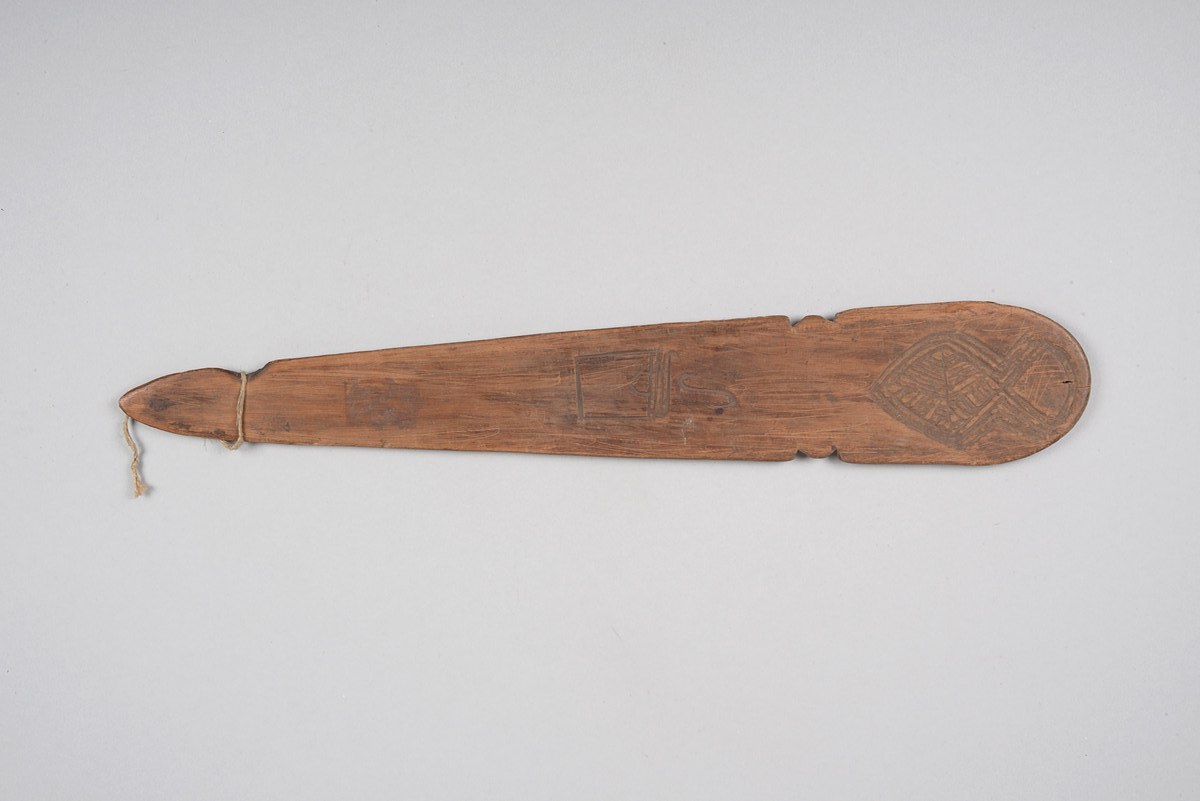
kundrukundru
Source term: bullroarer (New Grove cross-entry)
kundrukundru: the bull-roarer name recorded for the Andebogo, shared with the Adoi, Amanga and Andowi and cross-referenced to the regional "atuamba" family.
Etymology. An onomatopoeic name echoing the instrument's whirring buzz, shared with the Adoi, Amanga and Andowi; it is not a decomposable lexical word.
The Andebogo of the northeastern Congo are recorded as one of four small peoples — alongside the Adoi, Amanga and Andowi — whose bull-roarer carries the name kundrukundru. The reference that preserves the word, the New Grove Dictionary of Musical Instruments, gives only the term and routes the reader onward with "See ATUAMBA," the regional family of NE-Congo bull-roarers sounded at boys' initiation. The dictionary offers no Andebogo-specific account of how the instrument was used, who was permitted to see it, or whether it belonged to a men's cult; that initiation reading is documented for the wider atuamba complex and its better-attested neighbours, not for the Andebogo by name.
Kundrukundru. BULLROARER of the Adoi, Amanga, Andebogo and Andowi [peoples of Zaire]. See ATUAMBA.
New Grove Dictionary of Musical Instruments, ed. Sadie (1984), s.v. "Kundrukundru"
Particulars
- Object
- Bullroarer, called kundrukundru.
- Function
- The Andebogo name for the bullroarer is recorded; no use is described.
Source
New Grove Dictionary of Musical Instruments, ed. Stanley Sadie (London: Macmillan, 1984), s.v. 'Kundrukundru'