No. SCHEBESTA1933-005
Banyari (Nyali) of Geti — nékundurúku
Democratic Republic of the Congo · Geti, Irumu Territory, Ituri · Belgian Congo · Central Africa
Sacred / spirit
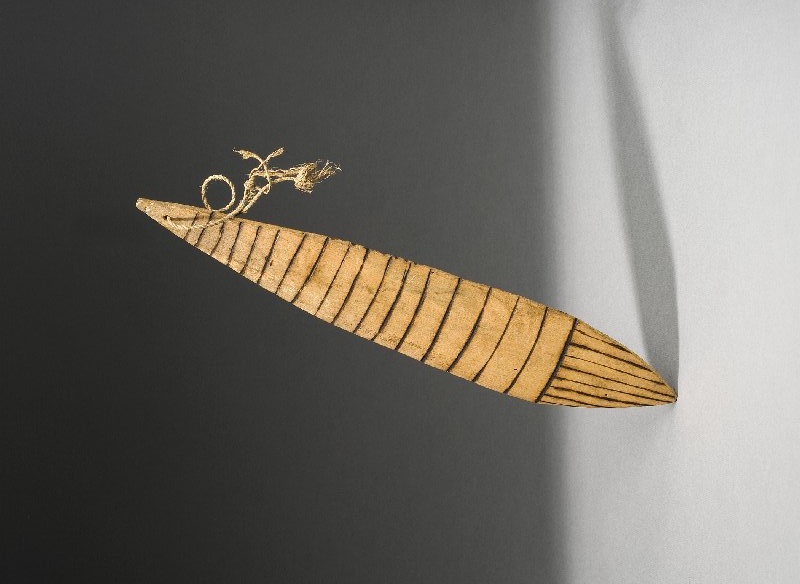
nékundurúku
Source term: Schwirrholz
nékundurúku: the Banyari (Nyali) name for the bullroarer at Geti, given with Abĕli (God), mukuru (chief of the initiation) and banda (the initiation itself).
For the Banyari at Geti the bullroarer is nékundurúku, and God is Abĕli. Paul Schebesta collected the word in a run of initiation vocabulary that also gives mukuru, the chief of the initiation, and banda, the initiation itself, along with bĕngi for the reed-blown pot-instrument and apandía for the great wooden trumpet — a whole apparatus of sound named in one breath. He never saw a bullroarer among the Banyari, here or at the village he had visited earlier, though several people told him one was used. The name is worth holding beside kundrukundru, recorded to the west for the Adoi and their neighbours: the same doubled, drumming shape of a word for the same instrument, on the far side of a language boundary.
Bei den Banyari von Geti heißt Gott — Abĕli, das Schwirrholz — nékundurúku; die große Holztrompete — apandía; bĕngi heißt das Topfinstrument; mukuru der Chef der Initiation; banda die Initiation selbst.
Among the Banyari of Geti, God is called Abĕli, the bullroarer nékundurúku; the great wooden trumpet apandía; bĕngi is the pot-instrument; mukuru the chief of the initiation; banda the initiation itself.
Schebesta 1933:135
Particulars
- Object
- The object is not described. Schebesta records the name only — no dimensions, material, cord or perforation — and states at p. 133 that he saw no bullroarer among the Banyari, though he knew from several statements that one was used.
- Function
- Entered in Schebesta's list of initiation terminology from the peoples around the Efe: for the Banyari of Geti the bullroarer is nékundurúku and God is Abĕli, alongside mukuru (chief of the initiation), banda (the initiation itself), bĕngi (the pot-instrument) and apandía (the great wooden trumpet). No eyewitness account of use.
Source
Paul Schebesta, 'Religiöse Ideen und Kulte der Ituri-Pygmäen,' Archiv für Religionswissenschaft 30 (Leipzig/Berlin: Teubner, 1933), pp. 133-135