No. FROBENIUS1925-001
Tschamba Samba Leko Langa circumcision bullroarer
Cameroon · Tchamba · Beka · Faro Department · North Region · Africa
Restricted
Langa
Source term: Holzerne Schwirren
Langa: Tschamba name for the bullroarers, wooden and iron, and for the ancestral being whose voice they were. With the iron bells (Jeskinna) the iron Langa made up the Woma, the sacred gear kept by the priest.
The Tschamba say the smith taught them everything: fire, pottery, how to lie with a woman, how to deliver a child, how to bury the dead. When an old man died, the smith told them to bury iron with him, and a year later to brew beer, dance, take the iron back out of the grave and forge it into sacred bells and iron bullroarers, Langa. When the women asked what the whirring was, the men were to answer: 'Grandfather has come out!' Wooden Langa sounded every fourth year, when the harvest was in and the boys were circumcised and sent to the bush for four months. On the day they came home in men's clothes, the Langa sounded again at dusk, and women, children and the uncircumcised fled. A mother whose son had died in the bush was told then: 'Langa had no meat, so he ate your son.' Langa, the women were told, was an ancestor who came for beer and food and spoke kindly to very few; no uncircumcised man could join the Langa.
Abends erklingen dann die holzernen Schwirren, die Langa.
That evening the wooden bullroarers called Langa sound.
Frobenius 1925:13
Particulars
- Object
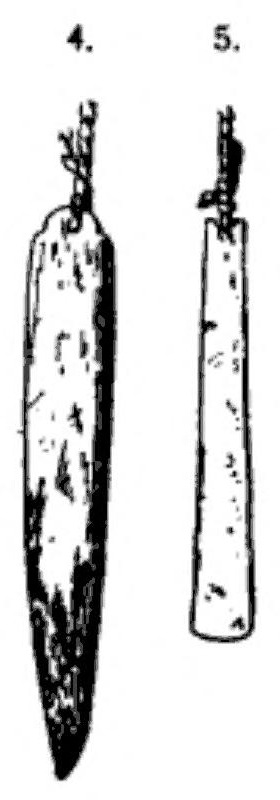
- Wooden bullroarers; Frobenius's 1913 plate draws a Tschamba pair, one of wood (21 cm) and one of iron (15.5 cm).
- Function
- Sounded after circumcision in the bush camp; women, children, and uncircumcised people fled; Langa was explained as an ancestor. Also sounded at an old man's burial, as the ancestor come to fetch him, and with the iron bells at the close of harvest.
Source
Leo Frobenius, Dichten und Denken im Sudan (1925), pp. 13-15, 23, 29-33