Bee swarms, rain birds and the creatures of initiation
Across Southern Africa, whirling sound acts on growth: bees and honey, weather and crops, and children becoming adults. San swarm voices and rain-beast imagery meet Owambo Big Birds and the lion voices of Angola and Zambia. Children also carry the craft in toys, protection and clapping songs.
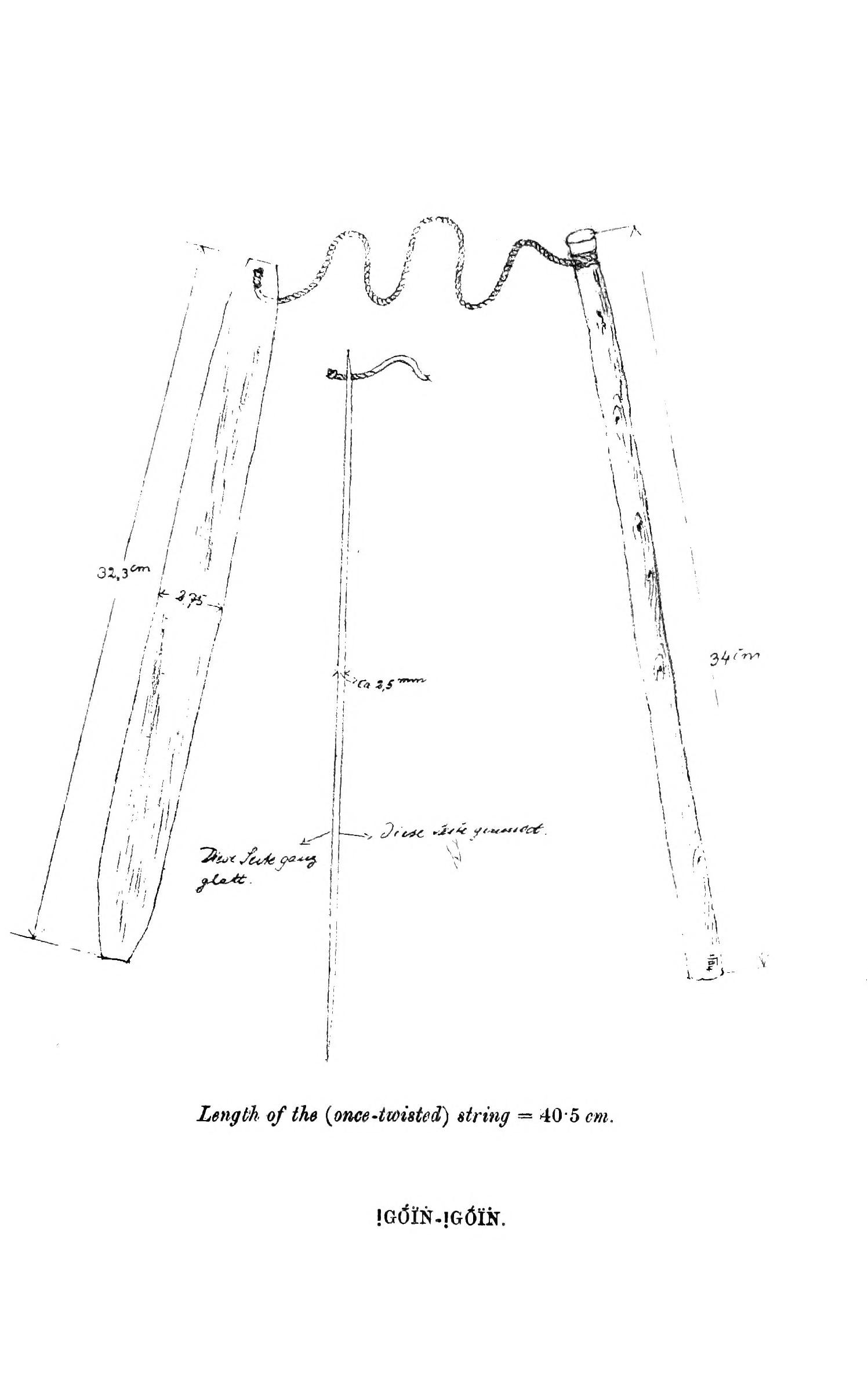
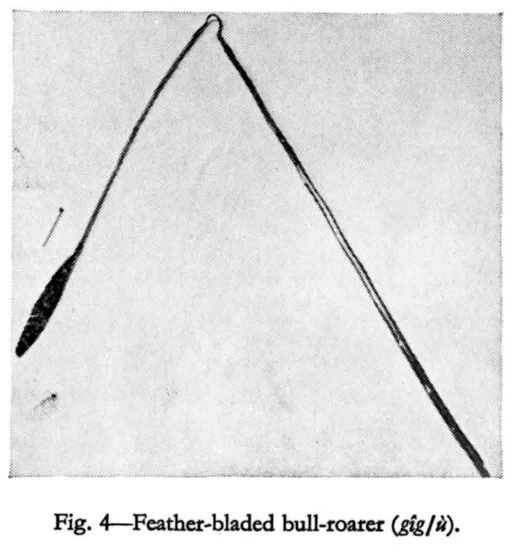
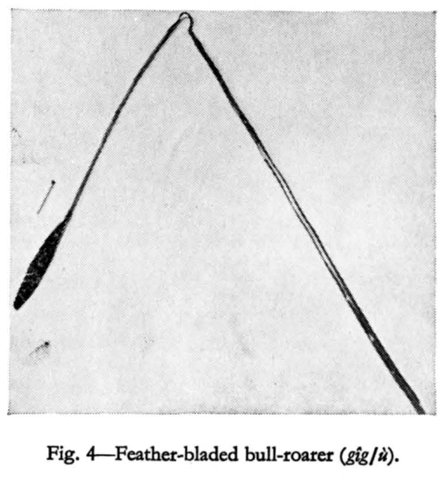
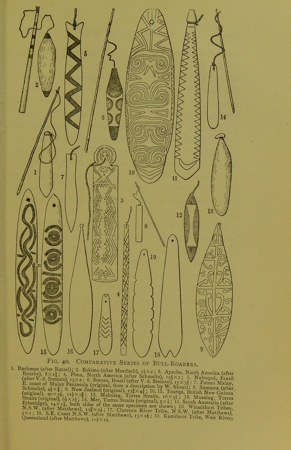
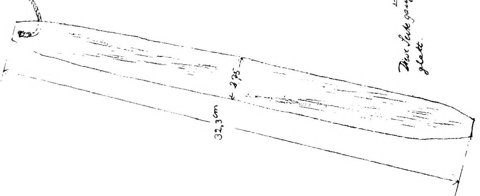
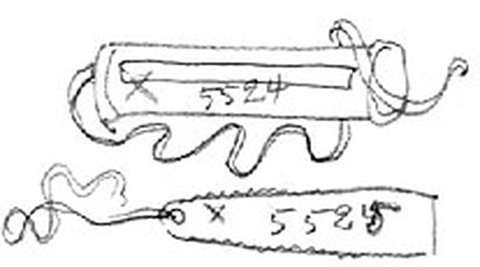
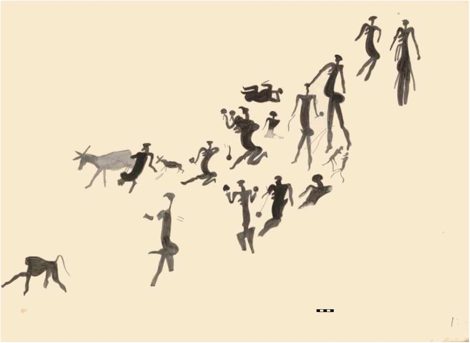
|Xam BushmenTwo |Xam !goin !goin blades with the short handle and measured cord, Bleek and Lloyd 1911, plate 19.W. H. I. Bleek and Lucy C. Lloyd, Specimens of Bushman Folklore (1911), plate 19; drawing by H. Werdelmann · Public domainG/wi and G//anaG/wi feather-bladed gig/u, Nurse 1972, fig. 4.G. T. Nurse, “Musical Instrumentation among the San (Bushmen) of the Central Kalahari,” African Music 5(2), 1972, p. 26, fig. 4
The |Xam beat the !goin !goin so bees would become abundant, move into other people’s places and leave honey to be cut and carried home. The buzzing opens into a dance: men dance, one woman drums, the others clap. Farther north, Uukwaluudhi elders go through the country sounding the wingbeats of the Big Birds as rain and sowing approach. These voices act on abundance. Southern Africa repeatedly turns the roarer into a creature whose sound can change a season, a harvest or a person’s passage into adult life. 3, 1
|han≠kass’o’s account, published by Bleek and Lloyd, gives bee work a sequence. The people want swarms to increase and move, then to cut the honey, put it in bags and share it at home. The !goin !goin’s wooden blade and little handle make an insect presence audible to the human company. The surrounding dance is part of that company’s action, with women’s drumming and clapping beside men’s dancing. The desired change is a landscape with honey in it. 3
Animals could also be the direct listeners. Among the Auin, Gretschel describes a long blade swung on a cord, its drone likened to a male ostrich’s luring call. Gretschel records hunters sounding it to draw a female from her nest into shooting range. The bee and ostrich accounts give the imitation an ecological purpose: the sound is useful because of the creature it evokes and what people expect that creature to do. 15
In |Xam testimony, !Khwa took animate form as the rain-beast, a cow, bull or eland that specialists could capture and lead across the country. Its leading thong vibrated with a ringing sound likened to a bullroarer passing along the sky. Rain could thus be worked with as a moving being. The roarer comparison connects a familiar hand-made sound to the strange audible passage of water’s power across the dry land. 4
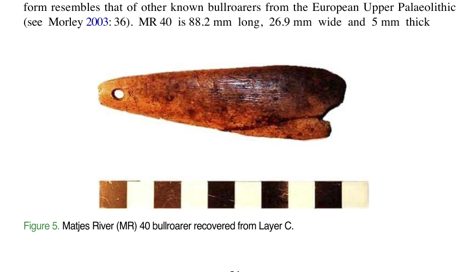
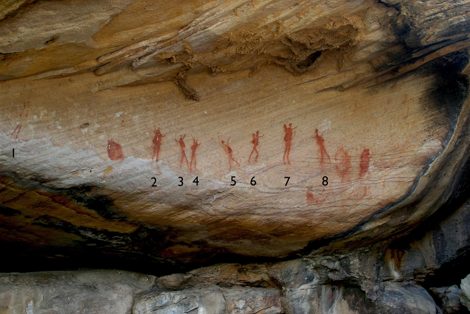
Rusch and Wurz bring that testimony to a Doring River painting of eight figures holding what they identify as sounding bullroarers. They recovered faded detail, made replicas and recorded their sound, interpreting the scene as work with rain. It gives the regional account a painted depth, with the authors’ interpretation attached to it. The excavated Matjes River MR40 offers another kind of depth: experiments and perforation wear support a spun instrument, while its ancient purpose remains unrecorded. 4, 17
The Uukwaluudhi king appointed the ekanjo, old men who called clouds for rain. Moving in secret at night and eastward at dawn, they whirled blades to imitate great flying birds. No one could address them or look at them without risking misfortune for crops. The four-day first procession accompanied the Small Rains and sowing; on its last day, small stock acquired on the journey was sacrificed to the omathila. Sound joined royal appointment, movement through settlements and the opening of the farming year. 1
A second procession came when crops were established and the Big Rains expected. People now greeted the feather-bearing men with cries for rain and drove their hoes harder as though it had fallen. In the neighbouring Kwanyama world, Loeb records edila as the giant bird that swallowed circumcision boys; its hum concealed the instrument from boys and mothers. A survivor had passed through the bird’s anus. The bird voice met two sorts of growth, with the particular offices belonging to their own communities. 1, 2
The Kwanyama voice could also mark the end of kingship. On the fourth mourning day for a circumcised king, a player stood within a crowd of initiated men to sound the hidden instrument. Loeb calls this osinghuma: it announced that there was no longer a king and that the mourning was extraordinary. The same sounding craft could gather a royal community around regeneration, a dangerous initiation and the loss of its ruler. 2
In the Angola–Zambia initiation worlds, the names ndumba mwila, ndumbamwelela and ndumba mwelela keep the lion close. Turner saw the Ndembu voice sounded by a junior guardian behind the Mukanda lodge: a fish-shaped blade of red mukula wood, terrifying novices and mothers with a monster said to swallow boys. At Luvale Solochi, two roarers broke into women’s Mukanda dancing. The dancers cheered and answered the lion-like growl; it announced that the boys’ camp would begin. 10, 11
Kubik’s Luchazi recording catches another stage. At kulonda ntsimba, the climbing of the genet cat, all the wounds had healed and the boys had regained their nimbleness. Kukuwa songs, choirs, rattles and struck instruments sounded with ndumba mwelela, whose strange voice frightened the secluded novices. The regional family has an actual sequence of lodge events: a camp’s announcement, the sound behind its wall and the celebration of bodily recovery. Each example gives the animal voice its own moment. 12
A Chokwe man showed Baumann a flat-board ndumbamwela when asked about children’s games, glossing it lion-roaring. Baumann wondered whether the name retained a Mukanda tie; his witnessed use was play. The shared name can be heard beside living lodge voices without turning that speculation into the toy’s biography. A lion’s sound remains recognizable as it moves between different kinds of ownership. 13
Humbi-Handa lumpoku sounded in ekwendje camps as the voice of an all-powerful being. Estermann’s Nyaneka-Humbe account also names the roaring ehulumphuku, and the saying that it had swallowed a boy maimed by the operation. Humbe mothers sent new baskets for homecoming; a dead son’s basket returned with the bottom cut out. For those who came back, the mothers danced childbirth. The heard being and the returning body belong to a rite in which departure from home becomes a second birth. 14, 18
Naro elders likewise gave boys a presence outside ordinary village sight: a night roarer stood for //Gauwa or Hise, and an elder-built grass hut became the being’s address. Among Ju|’hoansi, later ethnographic accounts place elders’ secret sounding with mythical creators and the burning of the instrument afterward. These San scenes share a controlled encounter between a growing boy and a powerful voice, while the bee dance carries the sound into a mixed company seeking a different kind of increase. 16, 17, 3
G/wi and G//ana men made gíg/ù for boys, trimming a korhaan tail feather for its rotor. Nurse watched boys vary the buzz’s rhythm as children of both sexes clapped, sang or hummed. The noise belonged inside music. A Korana boy at Bloemhof whirled burubush by its cord; Sotho children carried sevuruvuru against dogs and other animals. The Tswana seburuburu name joins these rolling words across communities where children made the sounding object part of daily life. 5, 6
Other southern accounts keep play and ceremony in the same history. Theal’s Xhosa nodiwu silenced crying children, yet adults stopped it when calm weather was wanted because its sound invited a gale. Venda children made both slats and spinning disks, while Blacking records the bullroarer in adopted circumcision rites. Van Schalkwyk, describing Molepo toys, also cites Mönnig’s account of Pedi kgabubu in girls’ initiation. The voice can grow with children into adult institutions while remaining in younger hands. 7, 6, 8, 9
The |Xam beat the !goin !goin — a wooden blade on a little stick, whirled to a low whirring likened to swarming bees — so bees would grow abundant and move into other people's places, leaving honey to be cut, bagged, carried home, and shared. Its buzzing opened into a dance: the men danced, one…
Among the Uukwaluudhi of Owamboland, a rain and sowing rite was carried out in the name of the omathila, the Big Birds: spirits thought to fly over the country making frightening noises, whose voice was a flat piece of wood, roughly six inches by two, fixed to the end of a whip-like lash. Four or…
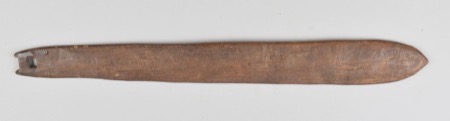
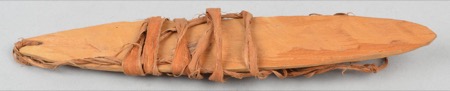
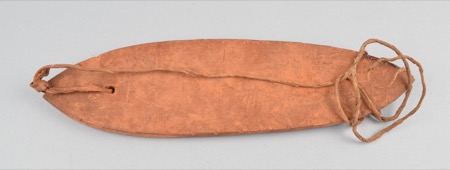
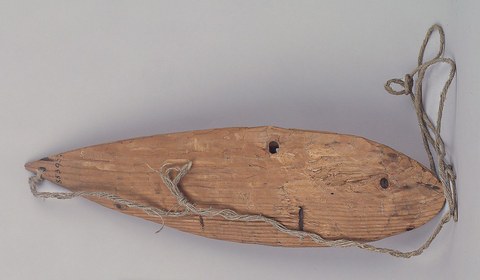
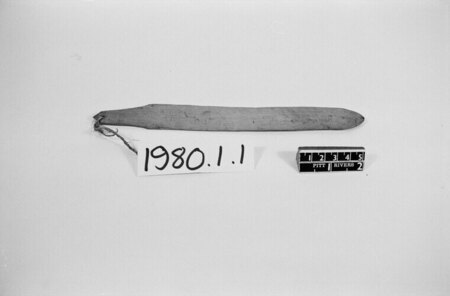
Representative — not this record’s object · Plain wooden blade with a pierced stepped tang and rounded point.
In the Uukwanyama circumcision rite of the Owambo, the boys were eaten by a Big Bird and then defecated from its anus. The men who staged this wore bird masks and were called the "spirits" or the "Gods" of circumcision; "eaten by" was the ordinary Owambo metaphor for spirit possession, so to be…
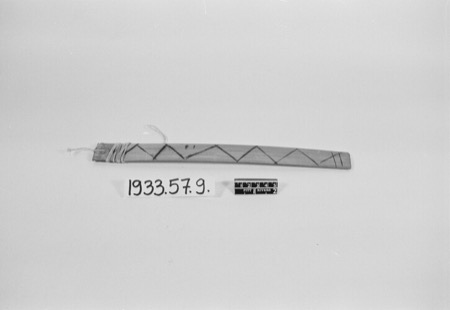
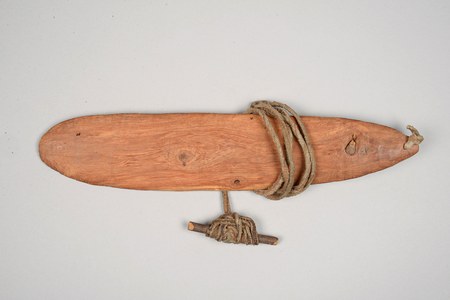
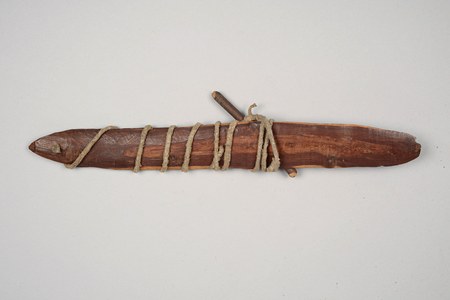
Representative — not this record’s object · Angolan bullroarer with attached cord.
Behind the Ndembu Mukanda lodge at Wukengi, a junior guardian whirled ndumba mwila, a fish-shaped bullroarer carved from red mukula wood. Its growl terrified the novices and their mothers. The old explanation was worse: a monster had come to swallow the boys.
G. T. Nurse, “Musical Instrumentation among the San (Bushmen) of the Central Kalahari,” African Music 5(2), 1972, p. 26, fig. 4
A G|ui man who caught a kori bustard could roast it, hide it in a tree, then slip out at night as though going to the toilet. He lit a little fire and swung a bullroarer: the old men understood and ran through the darkness to eat. Kireho told Kazuyoshi Sugawara this secret summons belonged to…
Venda boys encountered the bullroarer in circumcision rites adopted during the nineteenth century. Children also made their own: a slat swung from a handle, and a disk spun on a doubled string. Kirby recorded *luvuva* for both, with *tshivhilivhi* as another name for the slat. One rolling name…
H. Werdelmann, drawing in W. H. I. Bleek and Lucy C. Lloyd, Specimens of Bushman Folklore (1911), illustration 19; Kirby Collection KK052 · Public domain
|'Auni and ‡Khomani Bushmen (San), southern Kalahari
African Studies7(1):16–28, pp.26–27: eastern Osikuanyama initiation, edila, swallowed boys and osinghuma royal mourning. Later Loeb1962 ritual detail distinguished.
JAS:Reports33,102511: digital recovery and replica sound, interpreted as rainmaking. Rusch2016 p.5 independently relays |Xam rain-beast thong sounding like a bullroarer; ancient function remains the authors’ interpretation.
2013 pp.97–103: Korana Bloemhof player, Sotho animal protection, Pedi and Venda names. All cited page numbers are the reset2013 edition; do not transfer disk uses to slats.
Baessler-Archiv15.1 p.13 and fig.19: ndumbamwela flat-board toy, lion gloss. Former Mukanda use is Baumann’s conjecture; Borgonjon1945 tube mechanism is distinct.
Pp.71,74–76: Nyaneka-Humbe ehulumphuku, maiming swallowing idiom, Humbe empty-bottom basket and return as second birth. Distinct from Kubik’s1965 Humbi-Handa lumpoku recording.
JAS:Reports24:693–711: Matjes MR40 use-wear/replica study, and distinct ethnographic chains for Ju|’hoansi/!Kung sound, creators and disposal. Archaeological function not observed.
Kamuvia ekwendje camp recording, CREM CNRSMH_E_1974_004_001_01, booklet: lumpoku c.20×4cm on two-metre cord, taken for an all-powerful Being’s voice. Distinct from Estermann’s Nyaneka-Humbe accounts.