No. FRAZER1913-017
Bushongo initiation bullroarers
Democratic Republic of the Congo · Kuba · Kasai region · Central Africa
Restricted
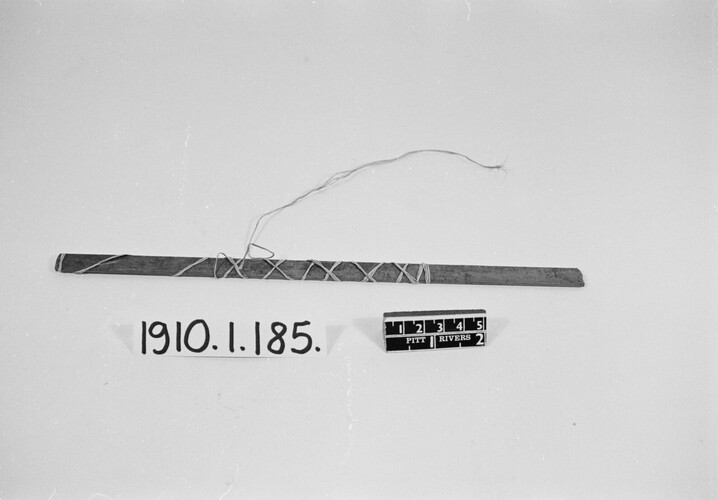
Iphungula
Among the western Bushongo of the Kuba kingdom, the bull-roarer was a thing of palm. Emil Torday, who spent 1907-09 in the Kasai for the British Museum, and his co-author T. A. Joyce recorded that the elders made it from very thin strips of palm-leaf rib tied to a cord. During the Nkanda initiation the boys were kept in seclusion, considered impure, forbidden to be seen by women; at night the old men ringed the camp, raised the most supernatural cries they could, and whirled these strips, the sound imitating closely the howling of wild beasts. The official who presided, the Kananyenge, would visit the alarmed novices and, when they complained of ghosts walking in the dark, answer that boys who were impudent to everyone surely could not be afraid of ghosts. Torday also took down the tale the Bushongo told of its invention: a youth used to drink the day's palm-wine with his mother, leaving none for his father, until the father followed him to the wood and, hidden, swung a thin strip of palm-leaf stalk on a string until the noise terrified the boy into dropping his calabashes and fleeing. The son begged forgiveness and never again neglected his father's share; from that day, the elders said, the bull-roarer was used at initiation to frighten the boys and teach them to respect their elders.
Pendant la nuit, quand tous furent endormis, le père réunit tous les vieux du village et leur dit : « J'avais un fils irrespectueux et désobéissant ; je l'ai rendu bon en lui faisant peur ; faisons de même avec tous nos fils afin qu'ils ne bravent pas leurs parents en se basant sur leur force supérieure. » Telle est l'origine de la cérémonie d'initiation Nkanda.
In the night, when all were asleep, the father gathered all the old men of the village and said to them: “I had a disrespectful and disobedient son; I made him good by frightening him. Let us do the same with all our sons, so that they do not defy their parents on the strength of their superior force.” Such is the origin of the Nkanda initiation ceremony.
Torday & Joyce 1910, Les Bushongo, p. 241
Particulars
- Object
- A very thin strip of palm-leaf rib, whirled on a cord.
- Function
- Restricted men's initiation instrument sounded at night to create supernatural voices and frighten novices.