No. SCHEBESTA1933-001
Bakango / Bafwaguda maduali bullroarer
Democratic Republic of the Congo · Asunguda-Apare river district · Ituri Forest near Avakubi · Central Africa
Restricted
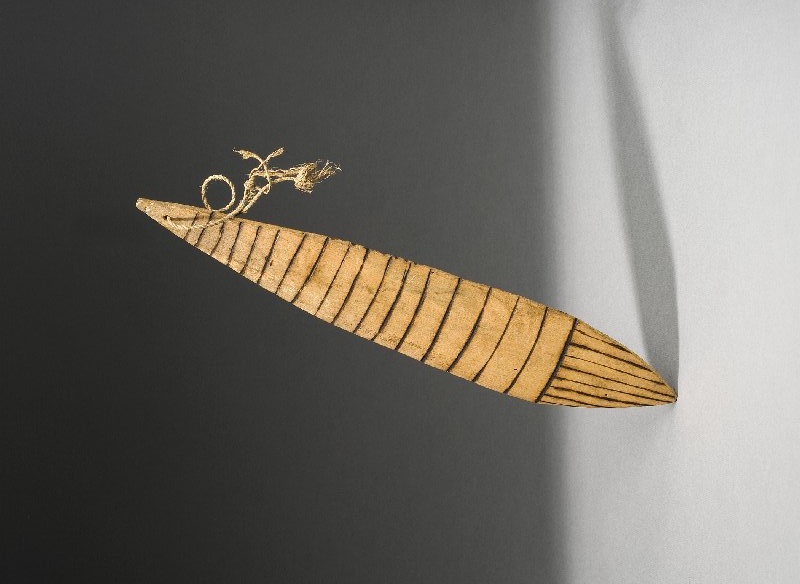
maduali
Source term: Schwirrholz
maduali: names both the bullroarer and the primordial father (Urvater) among the Babali and Bakango.
A masked ndiki, dressed in grass and embodying the primordial ancestor endekoru, swung the maduali while frightened novices watched from a distance — the first secret shown to Bakango boys after nearly a year secluded in the forest, where women could not follow. The word carried a whole cosmology: among the Babali and Bakango, maduali meant both the bullroarer and the primordial father, and its drone was said to be one with thunder — the same thunder Schebesta watched silence entire Bakango camps, everyone lying still around the fires until the storm passed. The larger rite belonged to a serpent: boys who had passed Mambela without ever seeing a python were marched in procession to view one killed nearby, whipped with rods along the way — Schebesta saw it happen on the Apare — for the python is the symbol of ambelema, the rainbow serpent somehow behind the initiation itself. The instrument he never saw: the Bakango said the objects had vanished with the last ndiki to die.
Er schwingt das Schwirrholz und warnt alle, ihm nahe zu kommen.
He swings the bullroarer and warns everyone against coming near him.
Schebesta 1933:116
Particulars
- Object
- A bullroarer, swung by the masked ndiki; Schebesta never saw one.
Source
Paul Schebesta, Religiöse Ideen und Kulte der Ituri-Pygmäen (Belgisch-Kongo), Archiv für Religionswissenschaft 30 (1933), pp. 115-116; Paul Schebesta, Die Bambuti-Pygmäen vom Ituri, vol. IV-1: Die Religion der Ituri-Bambuti (Brussels: Institut Royal Colonial Belge, 1950), pp. 15, 20-21