No. EXH2026-043
Kunzukunzu, sent ahead to clear the path
Democratic Republic of the Congo · Watsa–Gombari district, Haut-Uele, NE Congo · Central Africa
Restricted
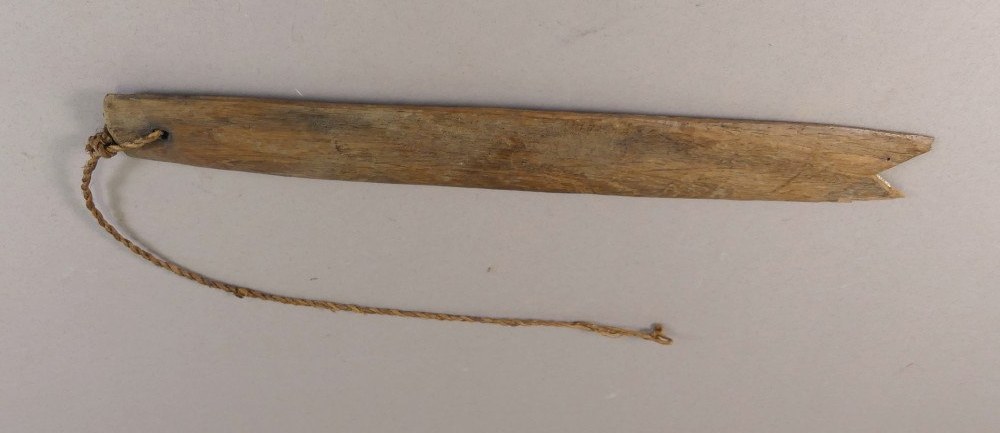
kunzukunzu (Aïméri); anziko (Walese)
Source term: Schwirrholz / snorrend plankske (Costermans); bullroarer (New Grove cross-entry)
kunzukunzu: the Aïméri name for the bullroarer, echoing its roar; the Walese call it anziko.
Aïméri means forest people, and Costermans noted they can just as well be called Walese. Their boys were circumcised at puberty, when the cutting coincided with initiation into the clan: two months at least in a hut on a mountain top, in the keeping of two elders who taught them the clan's history and obligations. The bullroarer led the way. At the head of the procession went the man who whirled the Anziko, and he was called Anziko himself; when the circumcised youths came down again, a boy ran ahead of them making the kunzukunzu roar so that no woman should be met on the path. At harvest it led as well: when a great man brought in his maize, sesame and eleusine, the Morèndu was blown by broad daylight, and it never went out alone — the Anziko went in front. Women could never see the Torè, the sacred instruments of the clan initiation. The board was tende wood, thirty centimetres by four, hung on a saga cord, and its voice was likened to a decapitated man's and to a leopard's growl.
Als zevende en laatste Torè-instrument hebben we het wereldberoemd « Schwirrholz » dat ons aan onze kinderjaren herinnert.
As the seventh and last Torè instrument we have the world-famous 'Schwirrholz' [bullroarer], which reminds us of our childhood.
B. Costermans, 'Muziek-instrumenten van Watsa-Gombari en omstreken,' Zaïre 1 (1947), p. 540.
Particulars
- Object
- A whirled board of tende wood about 30 by 4 cm, hung on a saga cord or whatever cord was to hand; the seventh and last of the Torè instruments.
- Function
- Whirled at the head of the initiates' procession to warn the uninitiated of their coming, and in front of the Morèndu at a great man's harvest.
Sources
- B. Costermans, 'Muziek-instrumenten van Watsa-Gombari en omstreken,' Zaïre 1 (1947): 515-542, pp. 524-525, 528, 540-541
- B. Costermans, 'De Besnijdenis bij de Mamvu-Mangutu en omstreken,' Aequatoria 13 (1950): 14-20, pp. 18-20 View · archived
- New Grove Dictionary of Musical Instruments (1984), s.v. 'Kunzukunzu'
- Laurenty (1974), intermediary in the Costermans–New Grove source chain