No. SUBSAH-013
Banda
Central African Republic · Bangassou · Ubangi region, CAR · Central Africa
Restricted
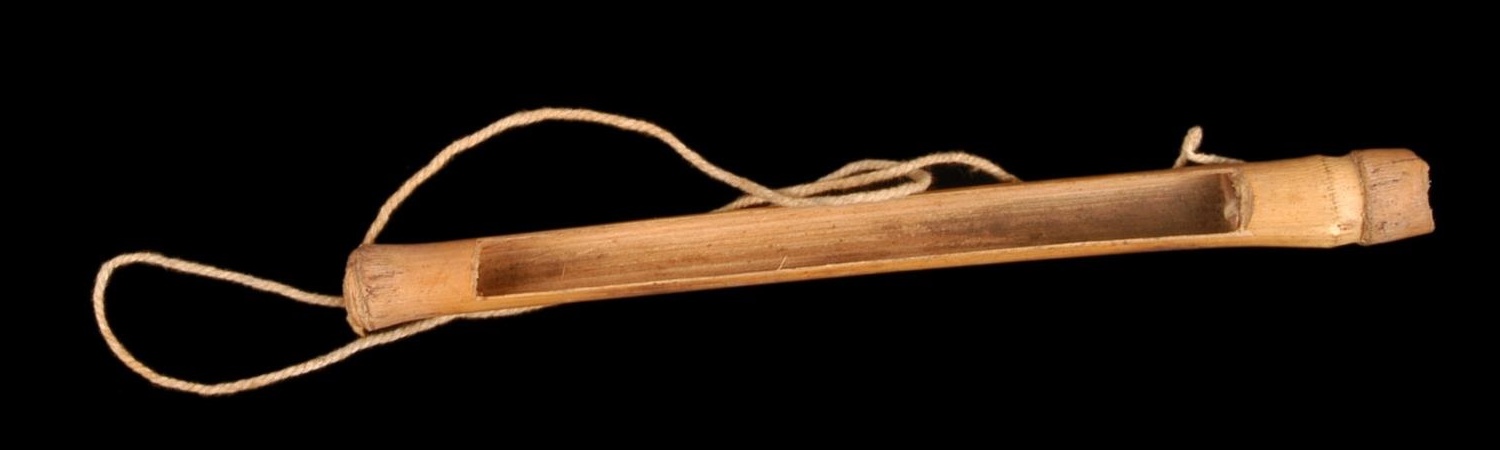
ngàkôlâ
ngàkôlâ: Banda name of the Bangassou rhombe; the same name as Ngakola, the swallowing spirit of the sômalè secret society.
Etymology. Not a decomposed word but a name: ngàkôlâ is Ngakola, the central Banda bush spirit - a hero-cultivator sent to restore order who degenerates into a giant, hairy, cannibal ogre, and the figure at the heart of the sômalè secret society. The rhombe is named after, and serves as the voice of, this spirit.
Ngakola, the Banda hero who hardened into a hairy, cannibal tyrant, told men: send me people, I shall eat them and vomit them up renewed. In his secret society, the sômalè, a novice was declared swallowed alive — whipped and tortured in the monster's belly, hearing its mournful voice, until the master cried that Ngakola had spat him back reborn. This bamboo bullroarer from Bangassou carried the monster's own name, ngàkôlâ. Collected by the Dakar-Djibouti mission, it vanished into the Musée de l'Homme for seventy years before resurfacing in a 2007 exhibition catalogue.
un rhombe banda en bambou
a bamboo Banda rhombe
Fürniss, Journal des africanistes 63(2) (1993), pp. 92-93
Particulars
- Object
- Bamboo Banda rhombe collected at Bangassou by the Dakar-Djibouti mission; long untraceable at the Musée de l'Homme, it reappears as Fig. 1.74 of the 2007 Ubangi exhibition catalogue (musée du quai Branly 71.1931.74.2876).
- Function
- Sounded as Ngakola's voice during initiation into the sômalè secret society.
Sources
- Susanne Fürniss, 'Les instruments de musique de Centrafrique au musée de l’Homme. Collections et collecteurs,' Journal des africanistes 63(2) (1993), pp. 92-93, inventory p. 116 View · archived
- A.-M. Vergiat, Les rites secrets des primitifs de l’Oubangui (Payot, 1936), pp. 60, 102, 134, via Fürniss 1993
- Grootaers (ed.), Ubangi: Art and Cultures from the African Heartland (2007), p. 58, fig. 1.74
- Musée du quai Branly – Jacques Chirac, object 71.1931.74.2876 (Mission Dakar-Djibouti)