ANDERSSON1993-001 - museum specimen
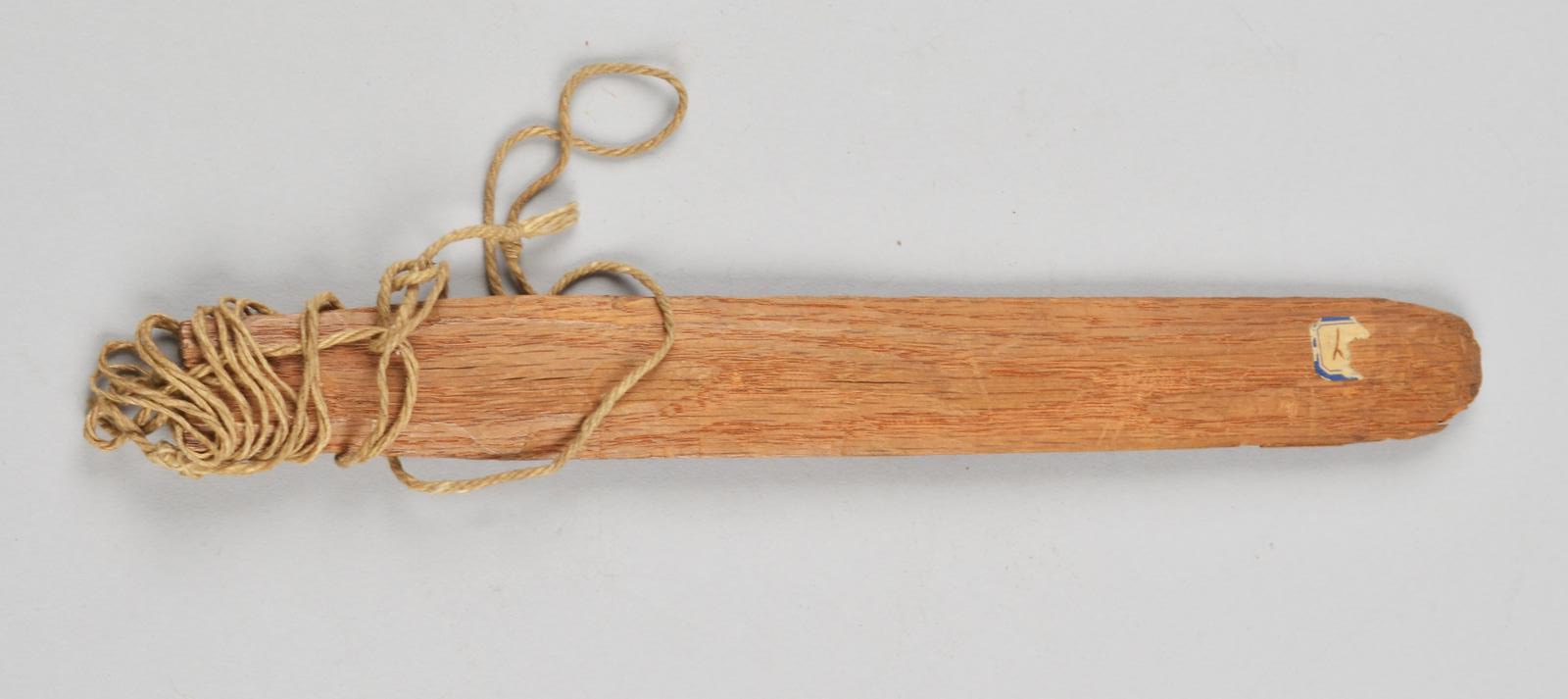
Bongo bamboo-midrib bullroarer pair
Republic of the Congo - Kongo-Brazzaville - French Equatorial Africa (no locality recorded) - Central Africa
Sacred / spirit
Source term: vinare / bullroarer
vinare: the Swedish catalogue term for a bullroarer, not a local name — no Bongo or Babongo word is recorded for either object. The record's Swedish class words aerofon and idiofon are the museum's own titling and disagree between the two accessions.
It was swung over the head at religious ceremonies, and a whirring sound rose out of the air. The instrument was nothing more than the midrib of a bamboo leaf, a hand's length of it, with a cord four feet long knotted to one end — that, and the skill of the arm. It came to Stockholm with the collection of Efraim Andersson, a Swedish missionary who spent decades in the Congo forests, and it arrived with a smaller twin the museum measured but never described. Where either was made, and who swung them, is not written on the cards.
Snöret är fastbundet i ena änden av bambustycket. Vinaren svingas sedan över huvudet och ett vinande ljud uppstår. Används vid religiösa ceremonier.
The cord is tied fast at one end of the piece of bamboo. The bullroarer is then swung over the head and a whirring sound arises. Used at religious ceremonies.
SMVK / Etnografiska museet, object record 1993.06.0210
- Object
- Two accessions from one collection. SMVK 1993.06.0210 is the midrib of a bamboo leaf, 29 cm long, 4 cm high and 3.8 cm wide, with a cord about 120 cm long tied to one end of the bamboo. Its sibling 1993.06.0211 is a bamboo and wood piece 25 cm long, 3 cm high and 3 cm wide, entered with no description beyond its measurements. Neither has an object photograph in the museum record.
- Function
- Used in religious ceremonies: the record for 1993.06.0210 states that the cord is tied at one end of the bamboo, the instrument is then swung over the head, and a whirring sound arises.
- Source
- English object term "bullroarer" on both; maker group Bongo, earlier group label Babongo [brukare] on .0210; origin country Kongo-Brazzaville / Republic of the Congo; material bamboo/wood; OCM classification Musikinstrument (534); Ritual (788); acquired 1993-05-24 from Ebba Andersson, missionary; collection 1993.06 Andersson, Efraim
- Source location
Page references
SMVK 1993.06.0210; 1993.06.0211
- Source confidence
- low National-level anchor for the Republic of the Congo, the only origin the museum records for either accession. No village, district or subgroup is given, and neither Andersson's mission stations in the Niari-Bouenza country nor the northern forest are inferred as a findspot.