Atlas Essay ·
One Sahul
One bullroarer cult across Australia and New Guinea
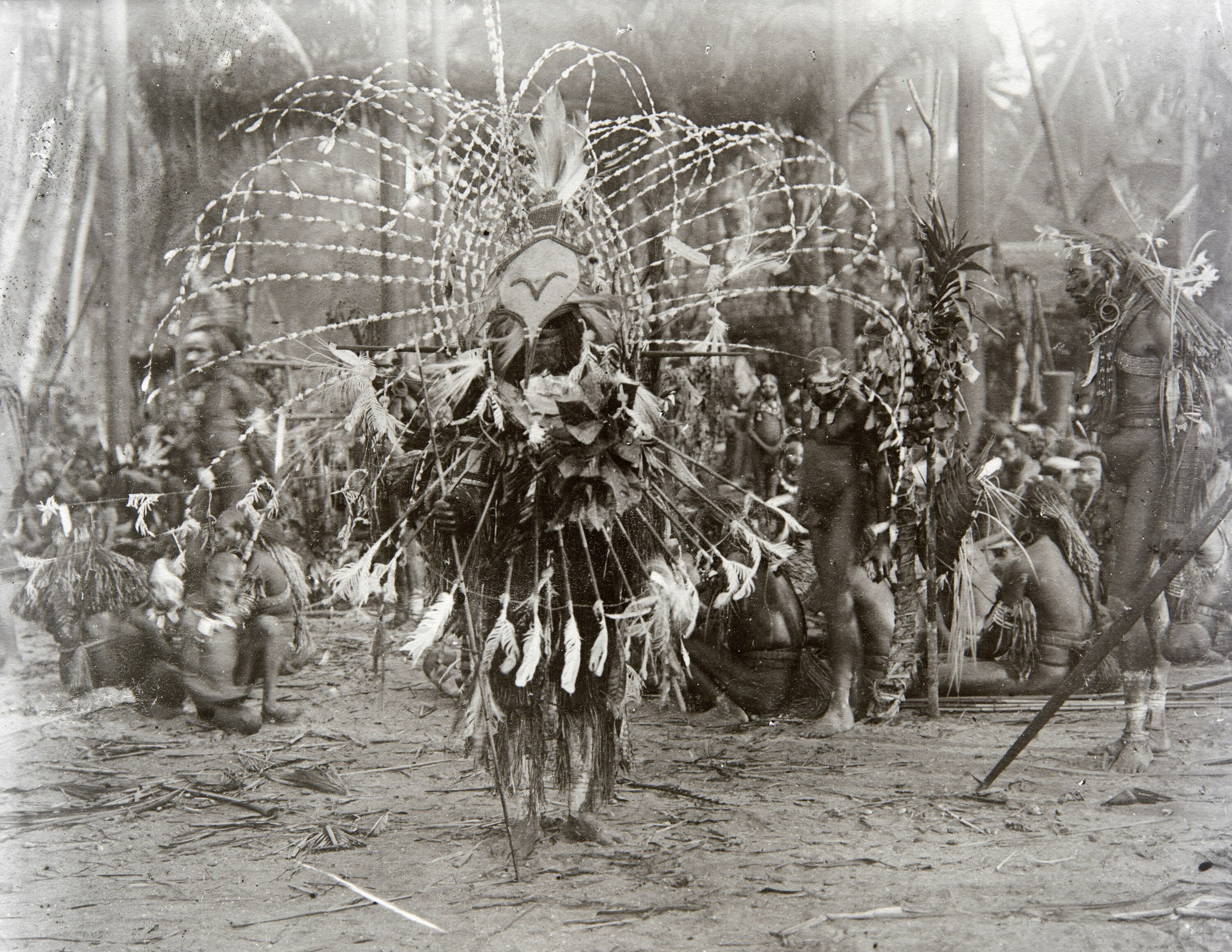
Out of sight, men are swinging a thin blade of wood on a cord. The boys waiting nearby have been told that the roar is a being who has come for them, and that it will swallow them and give them back as men. That scene was played out on both shores of the Arafura Sea, in northern Australia and in New Guinea, and it was played out with the same strange details: the same first owner, the same kind of monster, even the same marriage between two blades.
Australia and New Guinea share one bullroarer cult, carried by contact across Sahul and not invented twice.
In brief
- The Sepik cult name Nggwal has close counterparts in northern Australia, Manggawila and Djanggawul, and on both shores rites are on record moving between peoples with their names attached.
- Details no one would invent twice recur on both shores: the woman who made the first bullroarer and lost it to men, the swallowing being whose voice is the roar, the deep blade as husband and the shrill one as wife.
- Ten such traits, from the snake in the voice to the fate of a spent blade, each turn up on both sides of the Arafura Sea.
All ten traits. Every people on the ten trait charts, coloured by how many traits it shares. In Australia, six of the eight peoples who share two or more live across the north, on the coast that faces New Guinea, as contact or a shared root would leave them.

Nggwal. The Sepik cult name and its Australian counterparts. Read below · the full essay

Women first. A woman made the first bullroarer, owned its rite, or is its voice. Read below · the full essay

Swallowed. A being takes the boys and gives them back; the roar is its voice. Read below · the full essay

Serpent. The roarer is a snake, sounds in a snake’s rite, or belongs to serpent country. Read below · the full essay

Husband and wife. Two blades with two voices, joined as a couple. Read below · the full essay

Kin names. The roarer is called grandfather, mother, or the dead. The full essay

Little people. The roarer carries the name or voice of small beings. The full essay

First one failed. The first instrument was made of the wrong stuff, or the first rite killed. The full essay

Spent blades. After the rite the blade is destroyed, kept, or both. The full essay

Whitened. White clay on the performers, or on the blade itself. The full essay

Nggwal crossed the water
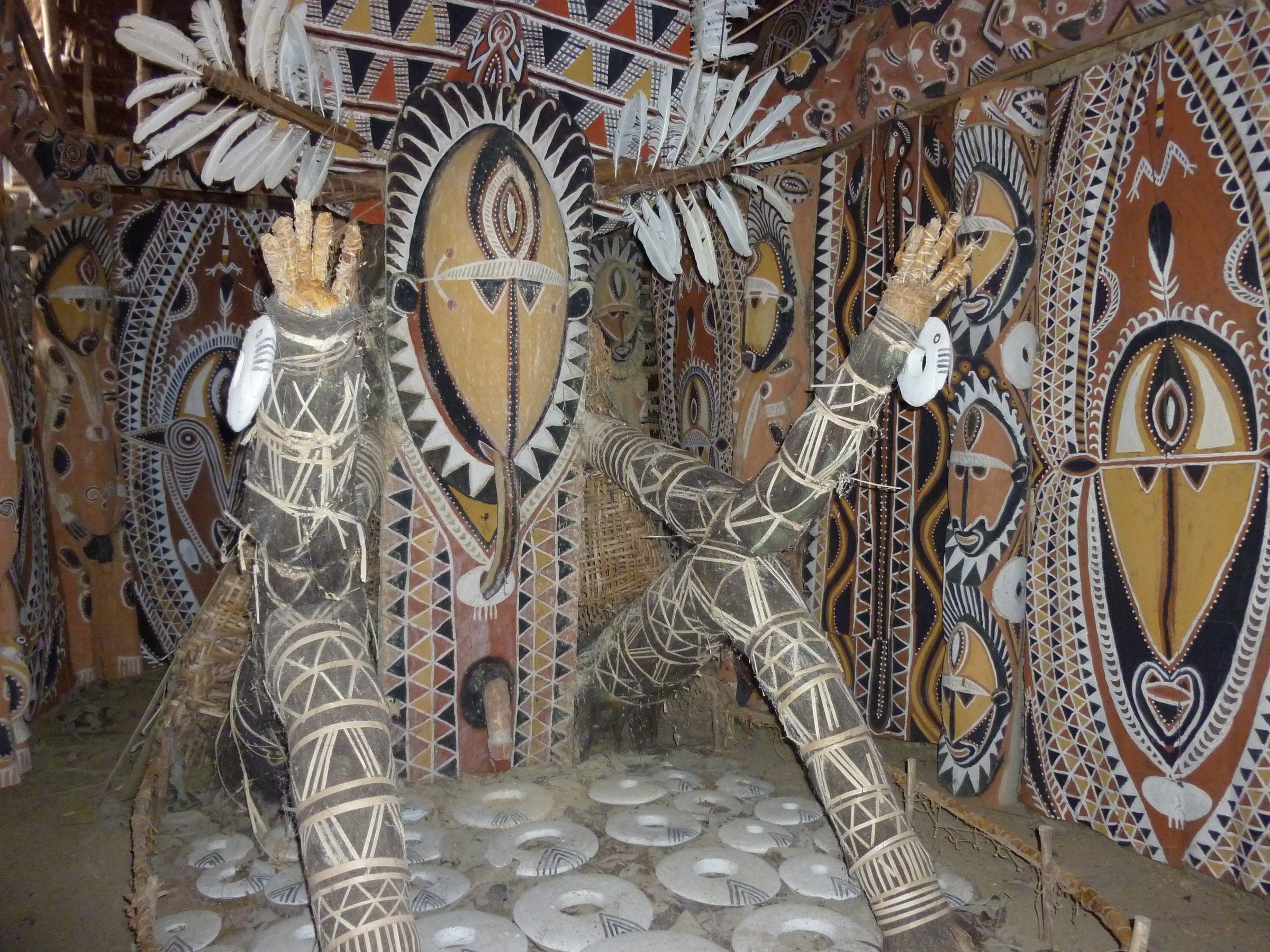
In the East Sepik hills of Papua New Guinea, the highest power of the men’s cult is Nggwal. Among the Abelam the great clan spirits are nggwalndu. On the Middle Sepik, Iatmul nggwail means a grandparent and a clan ancestor. At Ilahita, an Arapesh village, Donald Tuzin found Nggwal ruling the cult’s top grade, and the name was not Arapesh at all. Ilahita remembered it as a power brought in from the Middle Sepik, rite and name together.
Across the Arafura Sea, in northern Australia, the same sound returns. At Port Keats the Murinbata call their senior bullroarer initiation Manggawila. They did not always have it. Their Djamindjung neighbours taught them to swing a bullroarer in place of a spear-thrower on a cord, and the Murinbata built a new rite around it. In north-east Arnhem Land the Yolngu tell of the Djanggawul, ancestors who crossed the sea and made the country, its law and its clans. Set the names side by side: Manggawila, Djanggawul, Nggwal. The heart of the word barely changes.
The names did not drift on their own. On both shores, rites are on record moving from people to people with their names still on them. Among the Abelam, Anthony Forge watched ceremonies being sold and leased between villages, objects, spells, songs and all.
“In these ways virtually perfect transmission of ritual innovations can take place.”Anthony Forge, “The Power of Culture and the Culture of Power,” p. 145
In southern New Guinea the Marind said their own bullroarer cult and its giant Sosom had come to them from the east. Three times over, a rite crosses a language boundary and keeps its name. Run it for long enough across a single continent and Nggwal and Djanggawul are what you would expect to find.
Details no one would invent twice
Any two peoples who swing a bullroarer at initiation will share a few things. The instrument is loud, it is easy to hide, and its roar is easy to call a spirit. What follows is different. These are arbitrary choices, the kind of thing a story could have done a hundred other ways, and the two shores made them the same way.
The woman made it, and the men took it
At Ilahita a woman is cutting firewood when a chip of it hums. She ties it to a string and whirls it. The men learn the trick, and they kill her; from then on the instrument belongs to them. Among the Mungarai of the Roper River in northern Australia, an ancestral woman carries her Kunapippi blades in a net bag and swings one as she walks. At Kunjerri the man Kumkum spies on the women’s ceremony, digs up the blades they have hidden, and takes them. Between the two shores, on Boigu Island in Torres Strait, a woman named Méte hears her firewood call out its own name, bigu, and is the first to swing it. Murder in one telling, theft in another, a forced silence in the third: in every one the men own an instrument whose story begins in a woman’s hands. See it on the map.
The woman stays in the sound. At Port Keats, when the hidden bullroarers roar, the elders cry that the Old Woman is calling. Among the Boazi of the Middle Fly in Papua New Guinea, the roar in the night is atu gisagaru, the voice of the old woman.
The being swallows the boys
At Port Keats the boys are warned about Karwadi, the Old Woman whose voice the bullroarer is:
“The youths have been told that they will be swallowed alive by Karwadi and then vomited up.”
W. E. H. Stanner, On Aboriginal Religion, p. 5
On the south coast of New Guinea the Marind give the roar to Sosom, a giant who devours the novices and disgorges them, and the bullroarer itself is called sosom. In the mountains behind the Huon Gulf, on the north-east coast of Papua New Guinea, the Kai call their devouring being Ngosa, “grandfather,” and give the same name to the blades they swing. A pig ransoms each boy, a man mimes retching, and the novice is given back. The beings differ, an Old Woman, a giant, a grandfather. The plot does not: the hidden roar is a monster, it eats the boy, and it returns a man. See it on the map.
The snake in the voice
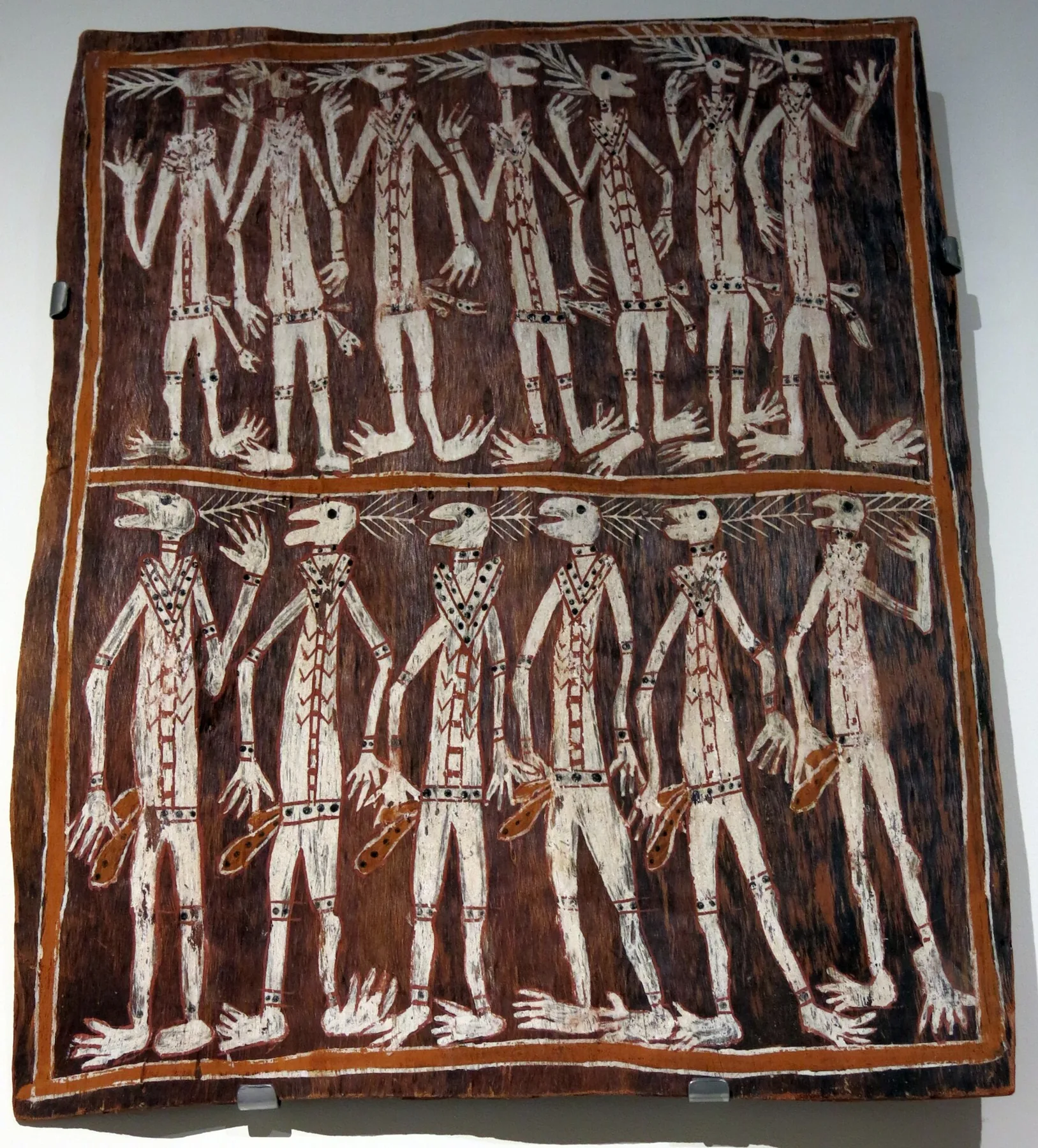
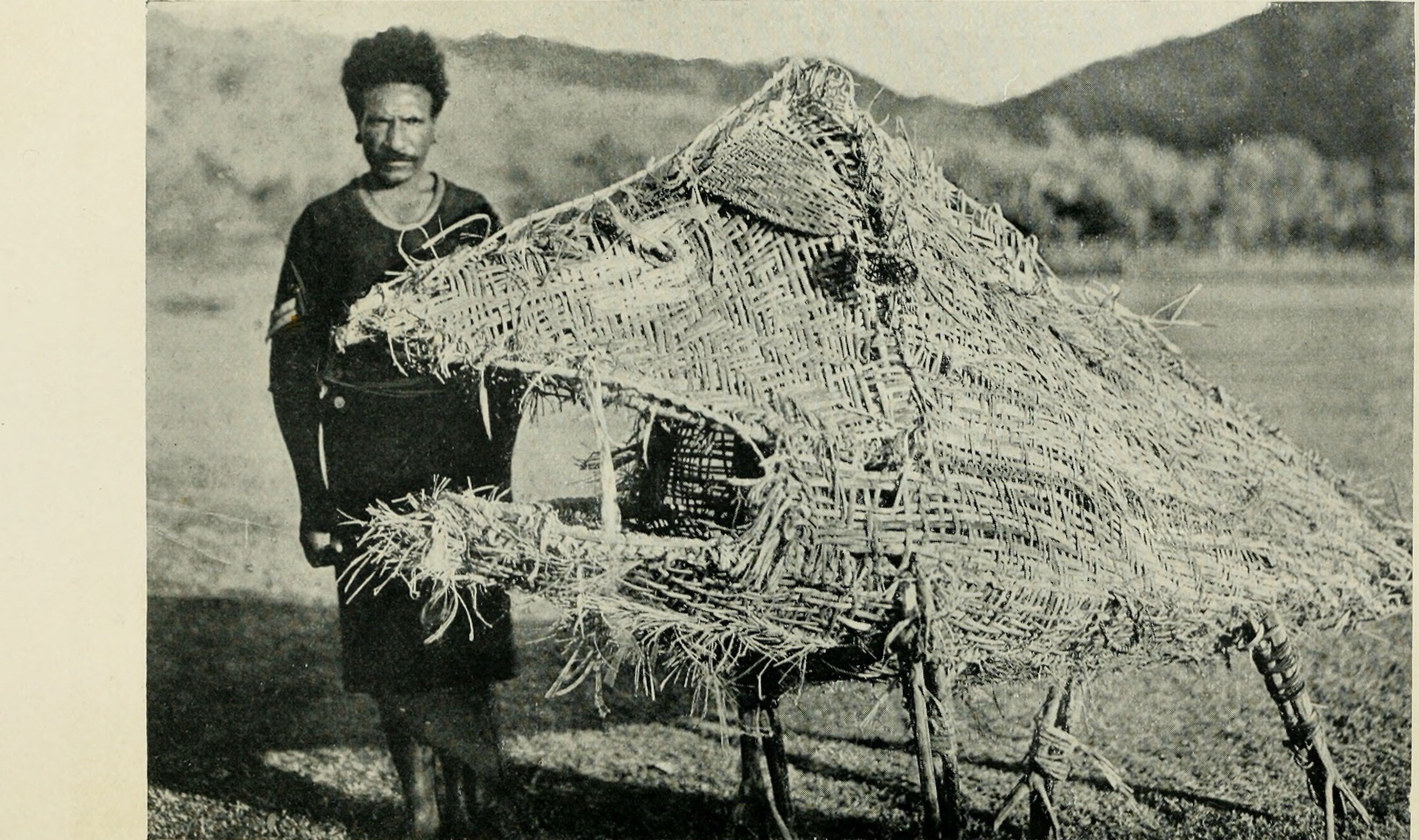
In the Gunabibi ceremony of the Yolngu, a bullroarer is painted with a snake, and the men say plainly that the instrument is the snake. When messengers swing it outside other camps, the roar is the snake’s voice, and the women answer as the ancestral Wawilak sisters. In southern New Guinea the serpent lives inside Sosom’s own story, where a piece of the giant becomes a watersnake. On Cape York, where Australia reaches toward New Guinea, the Guugu Yimidhirr word for the initiation bullroarer, dunggul, also means snake. See it on the map.
Husband and wife
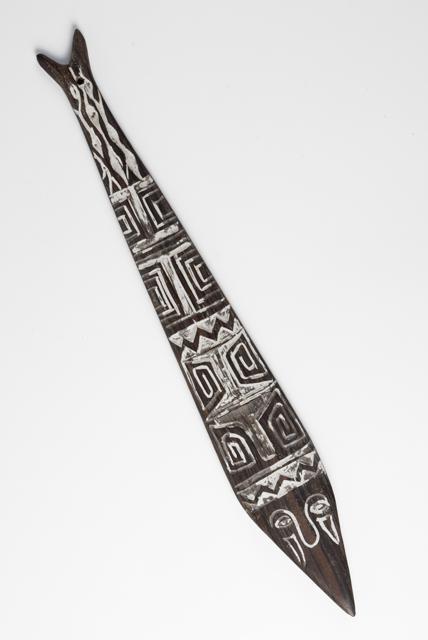
The most arbitrary detail of all is a marriage between two pieces of wood. The Kurnai of Gippsland, in south-eastern Australia, swing a larger bullroarer, Tundun, “the man,” and a smaller one, Rukut-Tundun, “the woman, or wife of Tundun.” On Cape York the Wiknatara join their two blades in a single word, moipaka, a male and a female married to each other. On the upper Bian River in southern New Guinea, the Marind pair an ezam with an uzum. Ezam is the ordinary word for husband. The uzum is his wife, and because she is narrower, her voice is lighter. On both shores the deep blade is the husband and the shrill one the wife. See it on the map.
One continent, one cult
A single shared trait could be chance. Two peoples might each decide that the roar is a spirit, or that women must not see the blade. But the traits on the map do not arrive alone. They come bundled, and the bundle is the same on both shores: the woman who had it first, the being who eats the boys, the snake in the voice, the married blades, the kin name, the white clay, the spent blade thrown away or kept. On the map, six of the eight Australian peoples who share two or more traits live across the north, facing New Guinea; the Murinbata of Port Keats carry five, and across the water the Marind and the Kai carry four each. Independent invention would have to make the same arbitrary choices, one after another, around one small piece of wood.
Nothing stood in the way of contact. For most of human time in this region, Australia and New Guinea were one continent, Sahul, joined by a wide plain where the Arafura Sea and Torres Strait now lie. Most of the drowned shelf went under between about 14,600 and 8,000 years ago. Even then the water was no wall. The islands of Torres Strait held the two shores together: a Kiwai storyteller in Papua New Guinea told of Méte on Boigu, and on Mabuiag, a Torres Strait island now part of Australia, the deep bullroarer was still bigu.
Peoples who sold, borrowed and carried their rites across language boundaries, on one continent and then across a strait full of islands, were never going to keep their cults apart. The bullroarer cults of Australia and New Guinea are one cult, carried across Sahul, and each people made it its own.
Key sources
- Donald F. Tuzin, Unity in Duality: Social and Ritual Organization of the Ilahita Arapesh (ANU dissertation, 1973), pp. 279–81 for Nggwal as a borrowed grade at Ilahita; Appendix E no. 4, p. 358, for the woman who made mimi’unemb.
- Anthony Forge, “The Power of Culture and the Culture of Power,” in Style and Meaning (2017), pp. 143–45, for nggwal, nggwalndu, nggwail and the trade in ritual complexes.
- W. E. H. Stanner, On Aboriginal Religion (Sydney University Press edition, 2014), pp. 3–9 for Karwadi, the novices and the bullroarer revelation; pp. 142–47 and 159–60 for the transferred Manggawila initiation.
- Ronald M. Berndt, Djanggawul: An Aboriginal Religious Cult of North-Eastern Arnhem Land (1952), pp. 1, 40–41.
- Paul Wirz, Die Marind-anim von Holländisch-Süd-Neu-Guinea (1922), part II, pp. 25 and 86, for the Marind bullroarer cult arriving from the east.
- Baldwin Spencer, Native Tribes of the Northern Territory of Australia (1914), pp. 217–18, for the Mungarai woman’s Kunapippi blades and Kumkum’s seizure.
- Gunnar Landtman, The Folk-Tales of the Kiwai Papuans (1917), tale 261, pp. 316–17, for Méte of Boigu, told by Námai at Mawata.
- J. van Baal, with J. Verschueren, Dema (1966), pp. 267, 271–73 and 480–85 for Sosom, his watersnake and the devouring of the novices; pp. 573–74 for the upper Bian ezam and uzum; p. 590 for the Boazi old woman’s voice.
- Christian Keysser, “Aus dem Leben der Kaileute,” in Richard Neuhauss, Deutsch Neu-Guinea, III (1911), pp. 36–38, for Ngosa, the ransom pig and the release.
- W. Lloyd Warner, A Black Civilization (1964 edition), pp. 281–82 and 290–91, for the Gunabibi snake-instrument and the Wawilak women’s reply.
- Walter E. Roth, North Queensland Ethnography Bulletin 12 (1909), p. 175, for Guugu Yimidhirr dunggul.
- A. W. Howitt, The Native Tribes of South-East Australia (1904), pp. 628–30, for Tundun and Rukut-Tundun.
- Ursula McConnel, “The Bullroarers (Moiya and Moipaka),” Oceania 6 (1935), pp. 80–83, for the Wiknatara married pair.
- A. C. Haddon (ed.), Reports of the Cambridge Anthropological Expedition to Torres Straits, V (1904), pp. 182–84 and 345–47, for Mabuiag bigu and wanes.
- Alan N. Williams et al., “Sea-level change and demography during the Last Glacial Termination and early Holocene across the Australian continent,” Quaternary Science Reviews 182 (2018), pp. 144–54, for the drowning of the Sahul shelf.
- The trait charts gather the peoples of these Atlas essays, where each is told with its sources: Nggwal, Women and the Bullroarer, The Murder of Mimi’unemb, Swallowed by the Monster, The House That Swallows Boys, The Serpent’s Voice, Two Roarers, Two Voices, Grandfather and Mother, The Little People, The First One Didn’t Work, Killing the Voice and Paint Yourself Dead.
- As far as we know, the pairing of Nggwal with Manggawila and Djanggawul is original to this site.