Atlas Essay —
Two Roarers
Torres Strait · the north-east of Scotland · Chukotka · Nagaland · Arnhem Land · the Gulf of Papua · Walpi · the Upper Xingu
On Mer, the easternmost island of Torres Strait between New Guinea and Australia, a rain-maker named Gasu kept a small, worn stone man called Dugena. Round its neck, on a line of coconut fibre, hung a little bullroarer, and Dugena, Alfred Haddon wrote, “made very heavy rain with a little thunder.” Once, when it failed to bring the rain, Gasu threw it down in a rage and broke its head off. At the other end of the strait, on Boigu, close under the New Guinea coast, an old woman named Méte heard a splinter of wood cry bigu-bigu as it flew, and that night it came to her in a dream with its orders: swing me over the yams, and hide me from the women. One strait, one board on a string, and two different instruments.
There are two bullroarers. One is a rain-maker: a board that roars like the wind tells anyone who hears it about the weather, and people all over the world found that use for themselves, with no common origin and no cult to hold it together. The other is a cult instrument, hidden from women, the voice of a serpent or a spirit, set over the crops, and its parts have no reason to go together, yet they travel together at two to three and a half times chance. That arbitrariness is the mark of diffusion. Agriculture is the hinge between them: when farming arrived it took up both, the weather tool anyone could invent and the cult voice that came from somewhere else.
In brief
- The roarer forbidden to women, the roarer bound up with women in myth and rite, and the roarer that is a serpent turn up together two to three and a half times as often as chance would have it. The rain roarer keeps clear of all three; it is forbidden to women less than half as often as chance predicts.
- Count only the boards that are serpents in their own right, painted with one, named for one or said to be its voice, and the package tightens: those 42 roarers are tied to women at more than four times chance and set over the crops at three and a half.
- Rain roarers run from the Chukchi blizzard to the thunder over Aberdeenshire, from Konyak boys in Nagaland to Mapuche children in Patagonia.
- Only farming is tied to both roarers: three times chance with rain, more than three times with the serpent and with women. At Walpi the rain roarer is painted with a snake and whirled for the corn; among the Kamaiurá of the Upper Xingu a spirit of fish and serpent guards the pequi trees and fetches the late rain.
Every roarer here is on the map: see the serpent roarers or the rain roarers.
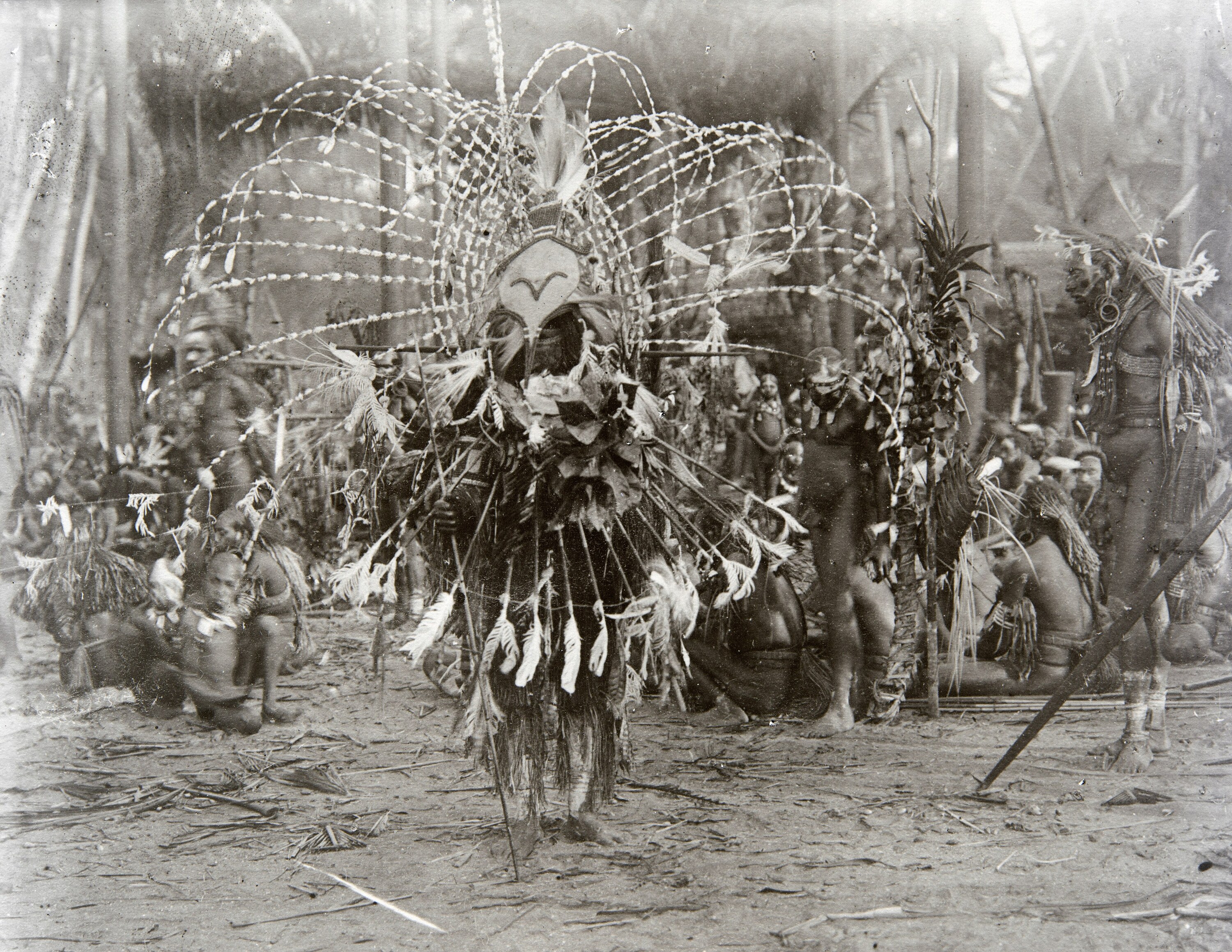
A board that sounds like the weather
Whirl a slat of wood on a cord and it begins to spin on its own axis, and the spinning blade gives out a roar that swells and falls with every swing of the arm. Outdoors it sounds like a gust coming over a hill, or thunder still a long way off. Nobody who hears it needs to be told what it resembles. All over the world people heard the same thing in it, and drew the same conclusion: a sound like the weather can call the weather, or send it away.
In the north-east of Scotland it was a charm against the thunderbolt. The minister and folklorist Walter Gregor set it down in 1881:
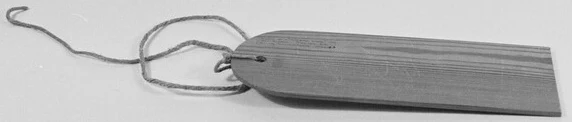
“During thunder it was not unusual for boys to take a piece of thin wood a few inches wide and about half-a-foot long, bore a hole in one end of it, and tie a few yards of twine into the hole. The piece of wood was rapidly whirled round the head, under the belief that the thunder would cease, or that the thunderbolt would not strike. It went by the name of ‘thunner-spell.’”
— Walter Gregor, Notes on the Folk-Lore of the North-East of Scotland (1881), p. 153
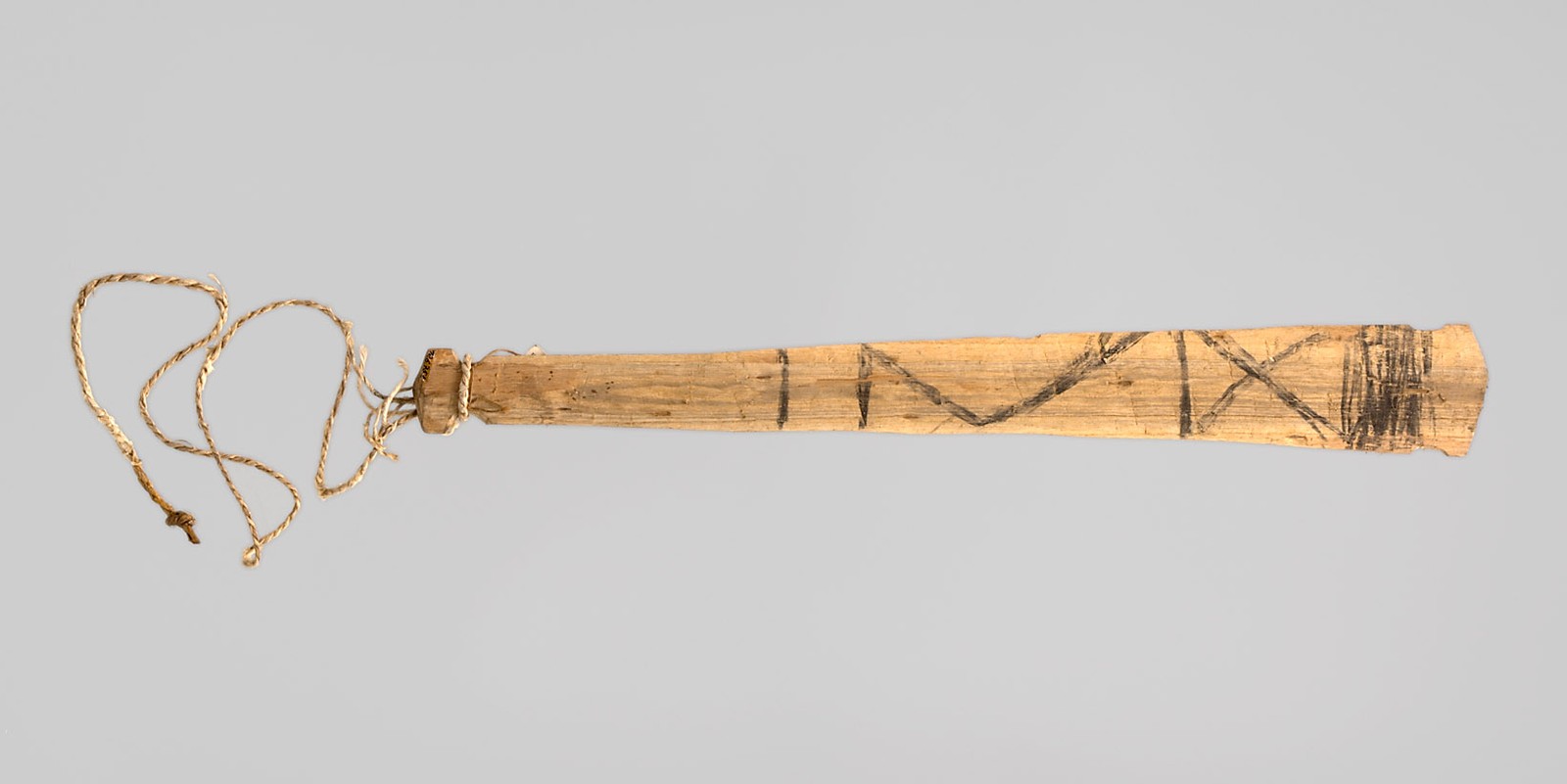
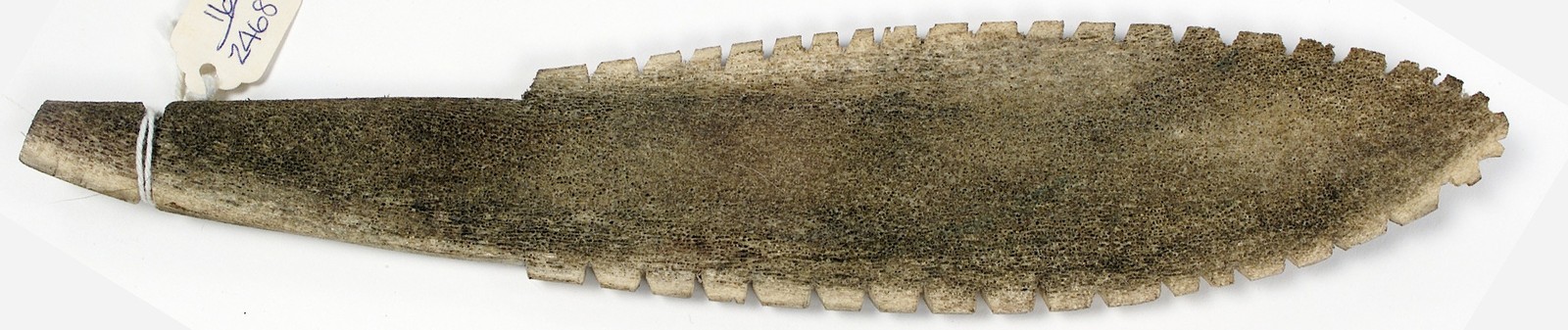
Gregor had swung one himself at Keith with the same intention, and he sent a specimen then in use at Pitsligo to the Pitt Rivers Museum in Oxford. It is a plain slat of deal with its string knotted through the rounded end, the whole instrument and nothing more. Half a world away, in the hills of Nagaland in north-east India, the Konyak used the same board for the opposite end of the storm. The note on a board J. P. Mills collected at Tamlu in October 1923 calls it a “bull-roarer used by boys as a toy to bring rain,” and the ethnographer Christoph von Fürer-Haimendorf carried two rain-callers away from Wakching in the 1930s, one of them cut from bamboo.
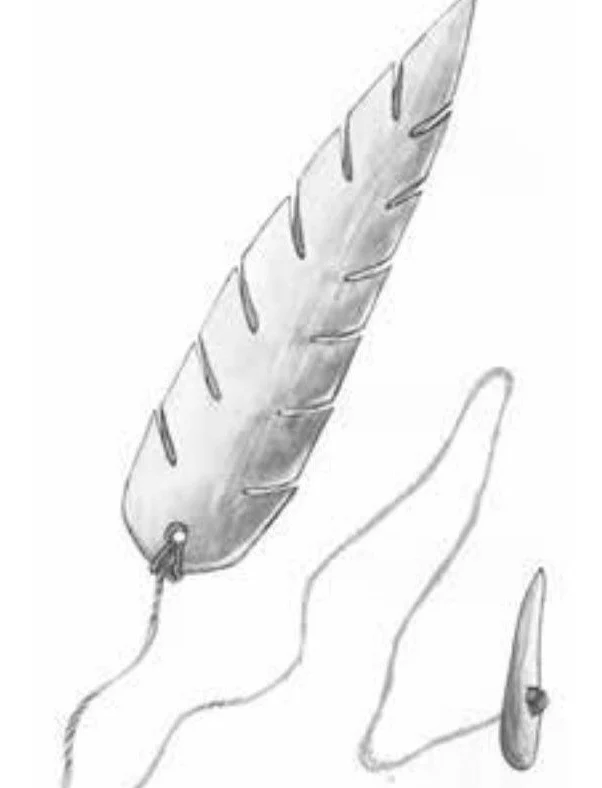
The roar can be any weather the country needs. In the Taurus mountains of central Turkey, the Afshar villagers of İcadiye told Erhard Franz in the 1960s that the whirring boards their children played with had once been swung at the end of winter “to lure the warm south wind of spring.” Among the Mapuche of Patagonia, Raúl Martínez-Crovetto heard that “formerly, in the region of Lagunita Salada, the children whirled their bullroarers during storms to make it rain” (los niños revoleaban sus palos zumbadores durante las tormentas para hacer llover). The Chukchi of north-eastern Siberia call theirs vyutkunen, from vyal-vyal, ‘blizzard,’ and believe that because it imitates “the sounds of the blizzard,” its voice acts on “the surrounding nature.” The Chukchi buzzer lived on as a toy; the howler never became one. Its carvers cut it in the shape of a feather, notched along the edge for the barbs.
In the north woods of Canada the weather wanted was cold. John M. Cooper found the bullroarer doing one job wherever he went in the Algonquian country, from the St. Maurice River west to the Albany: “To bring the north wind, the buzzer, the bull-roarer, and the snow man are resorted to.” Among the James Bay Cree the point was to harden a crust on the softened snow of late winter, so that snowshoes and toboggans would run on it. In the Great Basin the wanted wind was warm. The Wadatika Northern Paiute remembered a winter when the snow lay waist deep and the people were starving, and a conjurer stood inside a ring of men and women praying for the south wind; then “he whirled the conjuring stick and made the thaw come. It made a good noise.” The Kaibab Paiute swung theirs to make the wind blow, and the Gosiute of Skull Valley to bring the warm wind. Edwin Loeb, surveying the bullroarer across North America in 1929, gathered the pattern into a sentence: “Thus the Havasupai, San Carlos Apache, and Papago associate the bullroarer with rain, while the Arapaho and the Klamath have an analogous use, to produce wind. Among the Gros Ventre and Paiute it is only a toy.”
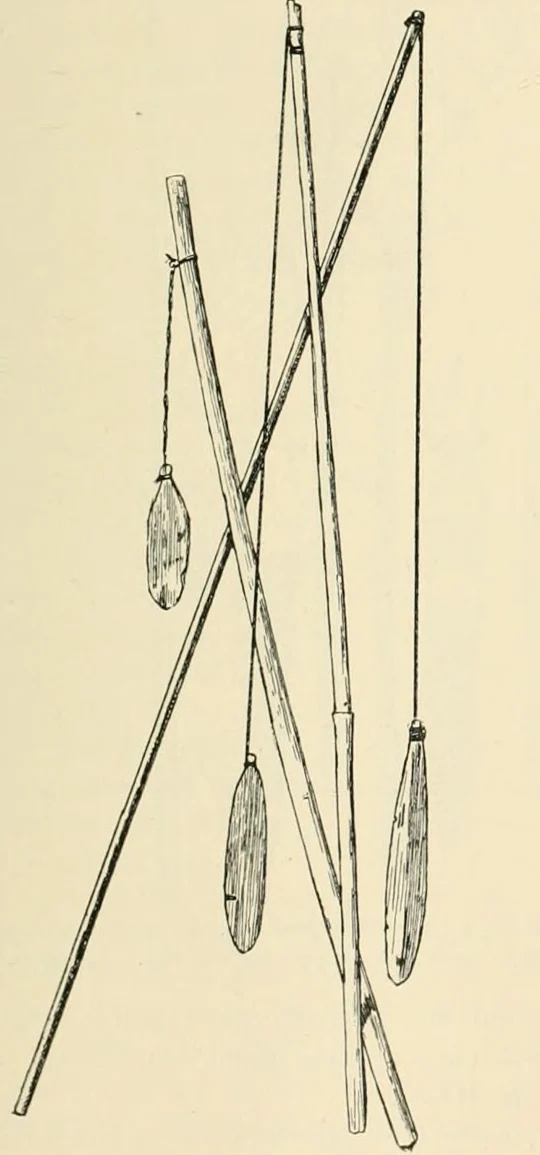
Norwegian fishermen swung bullroarers against the dangerous winds of the fjords and used the same carrying sound to call the boat crews together. And on Mer, where this essay began, every rain-maker owned a doiom, a roughly carved stone man, and dressed it for work with a small bullroarer, a bigo, hung at its neck with two or three nuts. The working Meriam bigo was a plain lanceolate blade of hard wood, “imperforated and undecorated,” tied on a cord about two feet long to a stick of three feet or more. Haddon bought Dugena after Gasu had given him a complete exhibition of the ceremony, and Gasu, he wrote, “has never ceased regretting its loss.”
Set these side by side and the only thing they share is the sound. The Scottish boys did not hide their thunner-spells; the Konyak boys played with theirs; Mapuche children made the rain themselves, and among the Afshar the boards outlived the rite as toys. No spirit is needed to explain any of them, because the board explains itself. A use that the instrument suggests to everyone who hears it is a use that anyone can find, and this is what finding looks like: scattered, unsystematic, a sentence here and a label there, the same idea arrived at in Scotland and Chukotka and Patagonia without anyone carrying it. The rain roarer needs no common origin. Of the 111 bullroarers that call or turn the weather, 79 carry none of the marks of the cult, and 53 are also children's toys.
A voice that must not be seen
Méte's splinter wanted something else. Gunnar Landtman took the story down at Mawáta, near the mouth of the Fly, before the First World War, and printed it in the Papuan pidgin his informants spoke. The splinter comes to the old woman in her sleep and tells her how to make it, how to rub it with the fluids of sex, and how to swing it over the yam gardens. Then it gives her the rest of its law in one breath:
“You make (swing) me along nigori too (the turtle-breeding ceremony), make him water lucky. You learn (teach) him people, you stow away along (from) woman, by-and-by no more kaikai.”
— Gunnar Landtman, The Folk-Tales of the Kiwai Papuans (1917), tale 261, “The First Bull-Roarer,” p. 316
Teach the people, hide me from the women, or by and by there will be no food. In a variant told at Mawáta the teacher is a snake-man, Máigidúbu, who comes to a woman of Budji in a dream and shows her how to swing the board “to wake him up ground” before the yams are planted. The Kiwai roarer is a secret, a voice, a serpent's gift and a garden charm all at once, and its own origin stories bind those four things together.
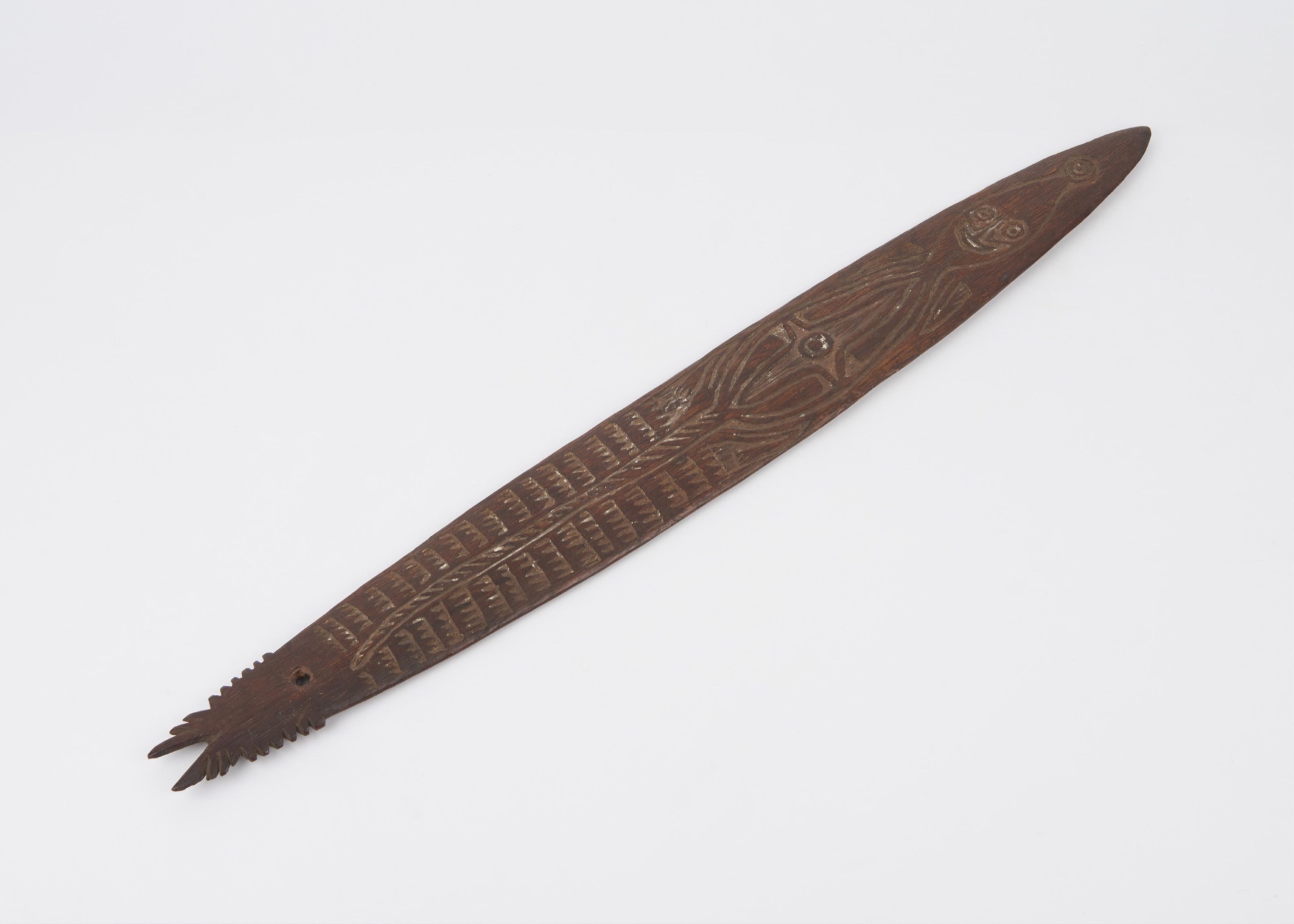
None of them comes from the sound. A roar sounds like wind; it does not say that women must not look, and it does not say yams. Yet the same bundle turns up wherever the cult roarer is found. In Arnhem Land in northern Australia, among people who planted nothing, the Yolngu men told the women that the roar from the men's ground was the great python Yurlunggur crying out in hunger, and that any woman who came near would be swallowed whole; at initiation the men became the python, swept up the boys, and handed them back weeks later as men. W. Lloyd Warner recorded the rite in 1937, and a Yolngu roarer at Harvard's Peabody Museum is a paddle painted with the python and hung with braided hair. South of them the Dalabon tell of Lumaluma, the serpent mother of all Aboriginal people, who swallowed the men given to her in the Gunabibi ceremony. When men put bullroarers in her place and she spoke again, Kenneth Maddock was told, “a left-handed nocturnal bird caught her voice by swinging a bullroarer.”
East along the Gulf of Papua the bundle is the same, with gardens added. Along the Elema coast, the anthropologist F. E. Williams found, the everyday word for snake in some villages is hevehe, and Williams thought it the original meaning of the whole word-family that names the roarer and its secret. The women of Orokolo were told that the voices howling in the men's houses were creatures, snakes and lizards “from obo, the great carpet snake, downwards,” and the men liked to pretend they made the snakes cry by tickling their tails with a stick. The missionary J. H. Holmes, writing in 1902, said what it cost to let the women know that the whining of the bull-roarers was “not the cry of a god but the work of a man”: the curse of tiparu, “equivalent to death.” And the great named boards of the Elema, hung in the men's houses at initiation, received offerings to prosper the hunting, the sago-making and the gardens.
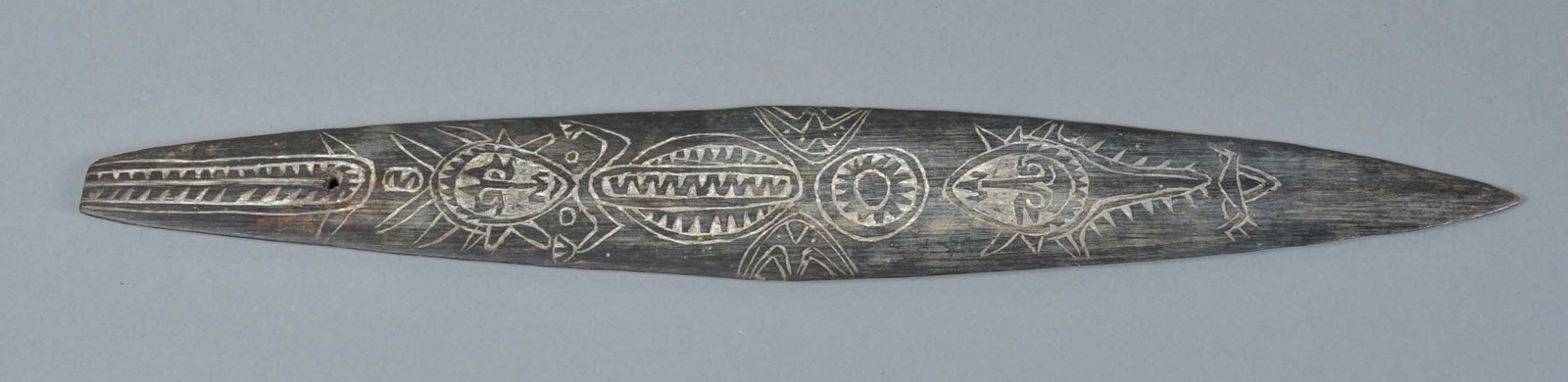
North-east, in the Huon Gulf, the Bukaua said the roar of the hidden boards was the voice of the monster balum, who swallowed the boys at circumcision and gave them back as men, and who often took the form of a sea-snake. The old carvers told the missionary Stefan Lehner what the patterns on the blades meant, and among them was a little sea-snake. On the far south-western coast of New Guinea, among the Marind-anim, the roarer is Sosom, the giant who swallows the boys and returns them unharmed. When the older men tired of his roaring they cut off his member; it fell into the river and became a watersnake, and the board the men whirl is that member, the serpent's own voice.
The bundle crosses the oceans. On the Bandiagara cliffs of Mali the Dogon carve three bullroarers for each Sigui, the rite of every sixtieth year, and give them the name of the carved serpent Great Mask, imina na; the first ancestor to die rose again as that serpent. When a grown man dies a young man of the mask society spins the blade at the edge of the village at night, and women and children must stay in their houses. “For the Dogon,” Germaine Dieterlen wrote, “these bullroarers speak, and they say: ‘I swallow, I swallow, I swallow men, women, children, I swallow everything.’” In Yoruba country the roar from the forest was the voice of Oro, and when Oro was abroad the women shut themselves indoors on pain of death. Of the Oro blades kept at the University of Ibadan the most striking is covered by a single snake, zigzagging the whole board with its tail at the cord hole.
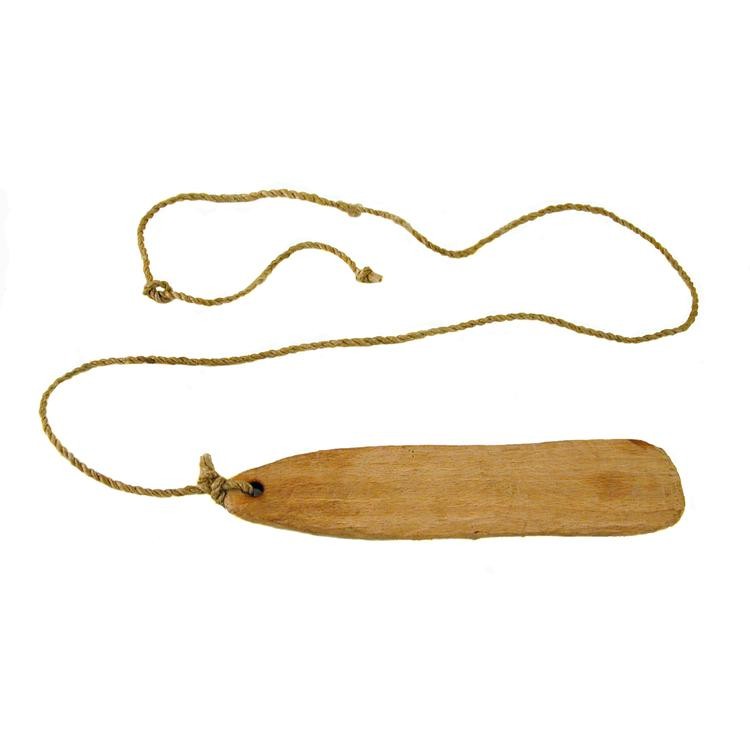
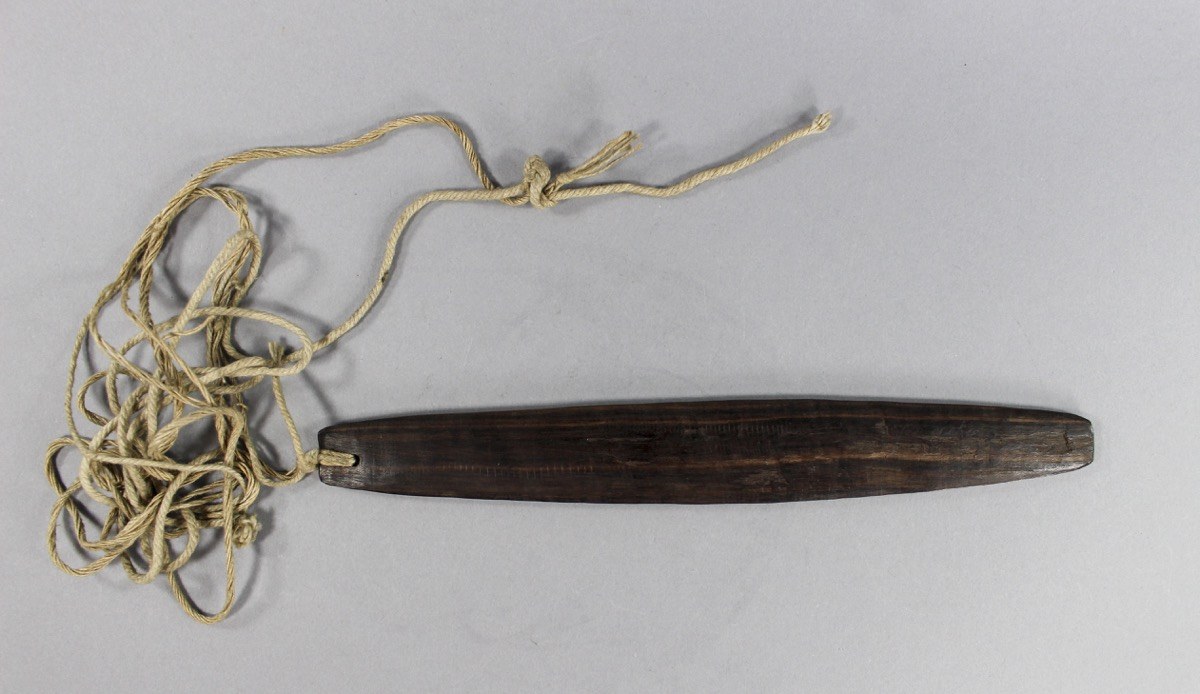
And in the Upper Xingu in Brazil, at the pequi festival, the Wauja men spin their fish-shaped matapu before the houses of the spirits' masters while the women stay shut indoors, “for they are not permitted to see the matapu in movement,” as the ethnomusicologist Maria Ignez Mello wrote. The men who spin them are painted with temepé-aná, the anaconda design. A secret kept from women, the voice of a serpent or a spirit that swallows, and the crop: in Australia, New Guinea, West Africa and the Amazon the same unlikely bundle is tied with the same knots.

What travels together
Of 1,283 bullroarers known from around the world, 316 are forbidden to women, 93 are women-linked (women first owned the roarer, or have a special part in its cult), 123 are tied to a serpent, 78 to farming, and 111 call or turn the weather.
Seventy-eight farming roarers and 123 serpent roarers meet 25 times, more than three times chance: scattered at random through 1,283, they would meet seven or eight times. The women-linked roarer meets the farming one 19 times, where chance would give fewer than six. The figure below draws every link that rises well above chance; the thickness of each line is how far above.
| Pair | Both | By chance | Ratio |
|---|---|---|---|
| Women-linked × Agriculture | 19 | 5.7 | 3.4× |
| Snake-linked × Agriculture | 25 | 7.5 | 3.3× |
| Agriculture × Rain & weather | 20 | 6.7 | 3.0× |
| Women-linked × Snake-linked | 26 | 8.9 | 2.9× |
| Forbidden to women × Women-linked | 60 | 22.9 | 2.6× |
| Forbidden to women × Snake-linked | 68 | 30.3 | 2.2× |
| Forbidden to women × Agriculture | 35 | 19.2 | 1.8× |
| Snake-linked × Rain & weather | 12 | 10.6 | 1.1× |
| Women-linked × Rain & weather | 4 | 8.0 | 0.5× |
| Forbidden to women × Rain & weather | 12 | 27.3 | 0.4× |
Secrecy from women, the women's myth and the serpent hold together, each pair two or three times above chance. The rain roarer stands apart from them. It meets the serpent almost exactly as often as chance would have it meet anything, it is tied to women half as often as chance, and it is forbidden to women fewer than half as often: twelve rain roarers are kept from women, where twenty-seven would be expected.
The package grows tighter, not looser, at its core. Take only the 42 roarers that are serpents in their own right, the Hopi blade painted with a snake, the Koko-Yimidhirr board whose name means snake, the Yolngu paddle that is the python's voice, the Marind board that is Sosom's watersnake member, the Dogon blade named for the serpent mask. Of those 42, 25 are forbidden to women, two and a half times chance; 13 are women-linked, more than four times chance; nine are set over the crops, three and a half times chance. Only three call the rain, which is fewer than chance would give.
The two roarers also sit differently in the written record. A rain charm is something anyone will tell a visitor in a sentence, and the rain roarers turn up in the thinnest accounts about as often as in the fullest. The cult roarer is known only where an observer was let inside: 36 roarers forbidden to women in the thinnest third of the accounts, 186 in the fullest.
There is no psychological principle involved which would necessarily group these elements together, and they therefore must be regarded as having been fortuitously grouped in one locality of the world, and then disseminated as a complex.— Edwin M. Loeb, Tribal Initiations and Secret Societies (1929), p. 285
Bought and carried
The Kiwai tale that begins with Méte's splinter ends with the secret travelling. When the first man of Boigu swung the board the ground moved and the noise resounded like thunder from one end of the island to the other, and the men of Saibai and Budji came to find out what the wonderful sound was, “and all wanted bull-roarers.”
“They brought their women to the Bóigu men as the price of their admission into the secret, and somewhat reluctantly the Bóigu men gave them bull-roarers and showed them how to handle them. The use of bull-roarers began in Bóigu and spread thence all over the country.”
— Gunnar Landtman, The Folk-Tales of the Kiwai Papuans (1917), tale 261, p. 317
The secret was bought, and it was bought whole: the board, the handling, the medicine and the rule that no woman may see it. The Marind initiates on the Torassi River told Paul Wirz that Sosom still lived somewhere along the coast to the east, and that his cult and his bullroarer had come west from there. In Arnhem Land the Dalabon say that after the night bird caught Lumaluma's voice, it swung that voice all the way south as the Gunabibi spread. Loeb set the rain uses down as a scatter, one tribe here and another there; the rest he could explain by nothing in the human mind, and so he explained it by a road. A cult cannot be rediscovered by listening. It has to be taught, and what is taught is the whole package, women's exclusion and serpent and garden together. A rain charm needs no teacher. Any child with a slat and a string can find it.
The hinge
Only farming is tied to both roarers. It meets the rain roarer three times as often as chance, and the serpent and the women's roarer more than three times as often. Farmers need rain, so wherever they planted they made the board that sounds like the weather, as anyone can. And farmers received the cult, the secret voice that had come from elsewhere, and set it over the crop.
At Walpi on the Hopi mesas both roarers are in one hand. In August 1881 John Gregory Bourke watched an old man trail the Antelope priests at the Snake Dance, whirling a board “which emitted the shrill rumble of falling rain.” Ten years later he said what it was for:
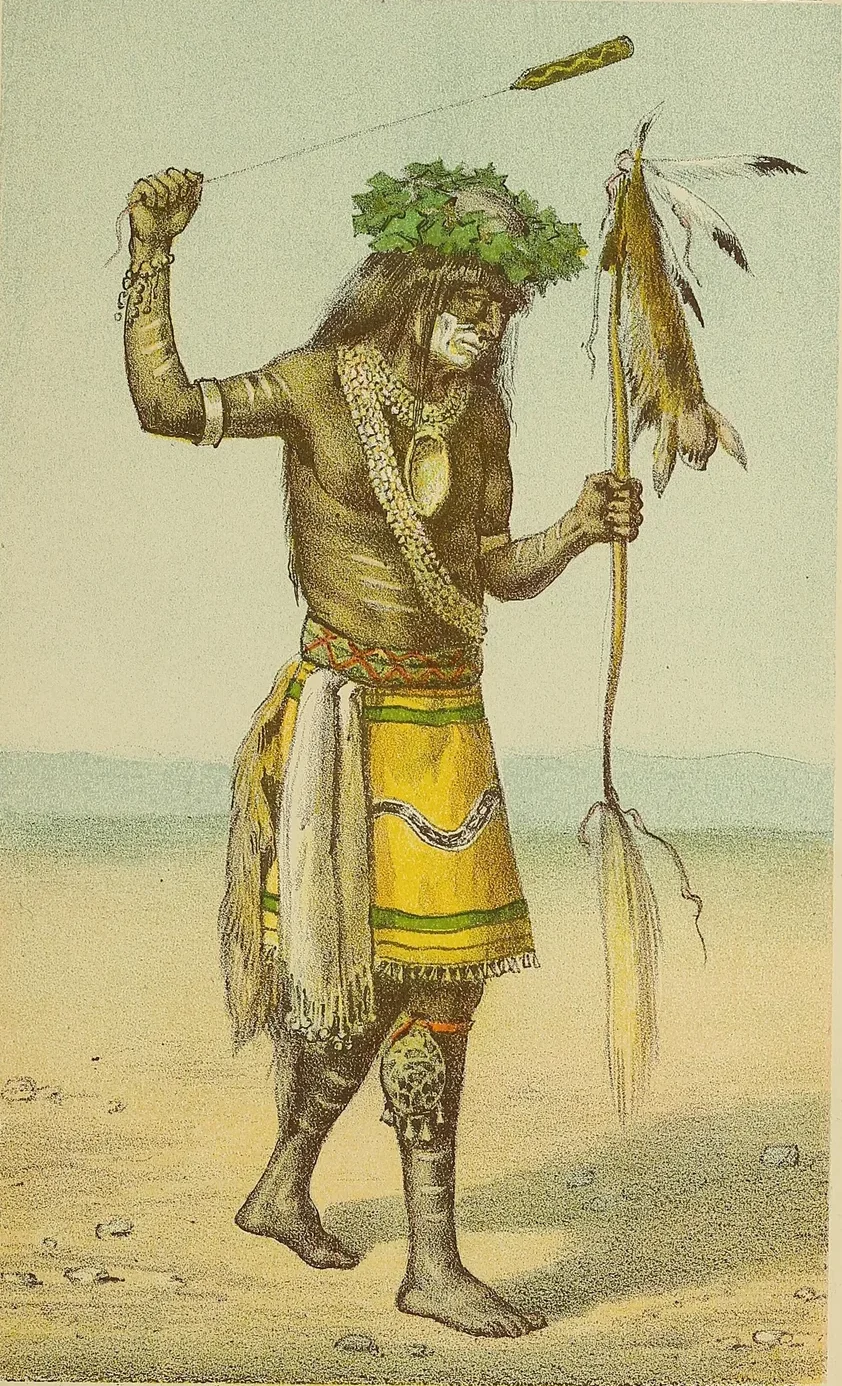
“The medicine-men twirled it rapidly, and with a uniform motion, about the head and from front to rear, and succeeded in faithfully imitating the sound of a gust of rain-laden wind. As explained to me by one of the medicine-men, by making this sound they compelled the wind and rain to come to the aid of the crops.”
— John G. Bourke, The Medicine-Men of the Apache, Ninth Annual Report of the Bureau of Ethnology (1892), p. 476
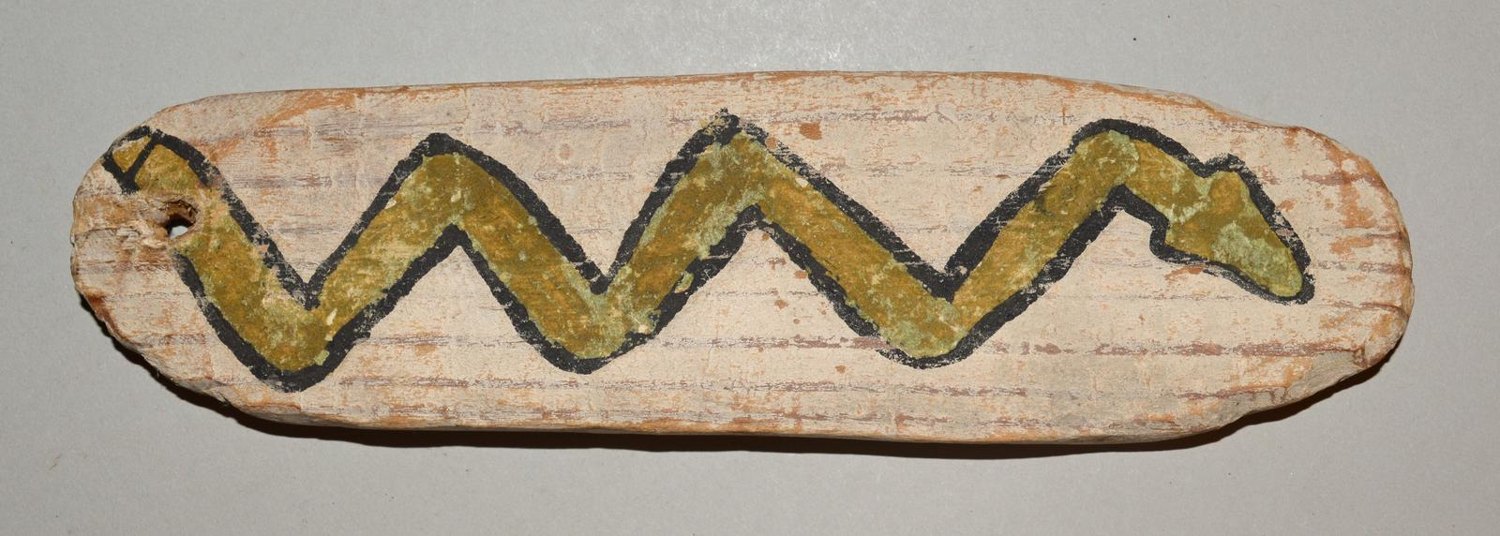
That is the rain roarer, doing what the sound suggests. But the blade itself carried a serpent. Bourke saw the Walpi roarer painted in blue or yellow with a snake running down its length, the triangular tip serving for the snake's head, and the board was whirled in the rite in which the Hopi carry live snakes in their mouths and send them down the mesa to the four quarters with the people's prayers for rain and corn. A roarer that a Mishongnovi boy made and painted with a black zigzag went into a museum in 1928 with a label explaining it as thunder and lightning, swung to bring the rain.
In the Upper Xingu the Kamaiurá hold both as well. Their origin story says that women were the first flute-players until the twins Sun and Moon drove them off with bullroarers, the parapara and the uriwuri, which Rafael Bastos describes as water spirits of fish and serpent essence; the men took the sacred flutes, and a woman who sees the flutes now faces gang rape. Kalervo Oberg, working among them in 1948, found the uriwuri to be one of the three guardian spirits of the pequi tree, present at the ceremony that opens the pequi harvest. And when the dance to make the trees and plants grow did not bring the weather, the other roarer took over:
“If rain is slow in coming the dance can be repeated with the use of the urivuri, bull-roarer, which is specifically used to induce rain.”
— Kalervo Oberg, Indian Tribes of Northern Mato Grosso, Brazil (1953), p. 57
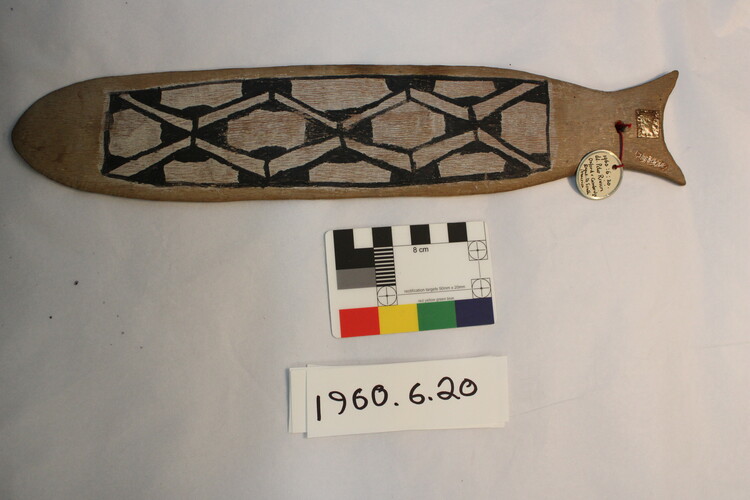
In northern Namibia the Uukwaluudhi clothed the weather tool in the cult's secrecy. Each year at sowing the king sent out four or five old men, “men who call the clouds for rain,” whirling boards on whip-like lashes to make the noise of huge flying birds, and “no one is allowed to address them or even to set eyes upon them as this will bring bad luck to such persons and their crops.” Among the Turka and Karaboro of the Bobo group, in the sorghum fields of Burkina Faso, the priest opened the harvest with the whirring of an iron roarer, and as soon as it sounded the women were chased away. And on the Fly the Kiwai roarer that Méte's splinter taught is the garden charm Alfred Haddon described in plain terms: “One function of the madubu is to ensure good crops of yams, sweet potatoes, and bananas.”
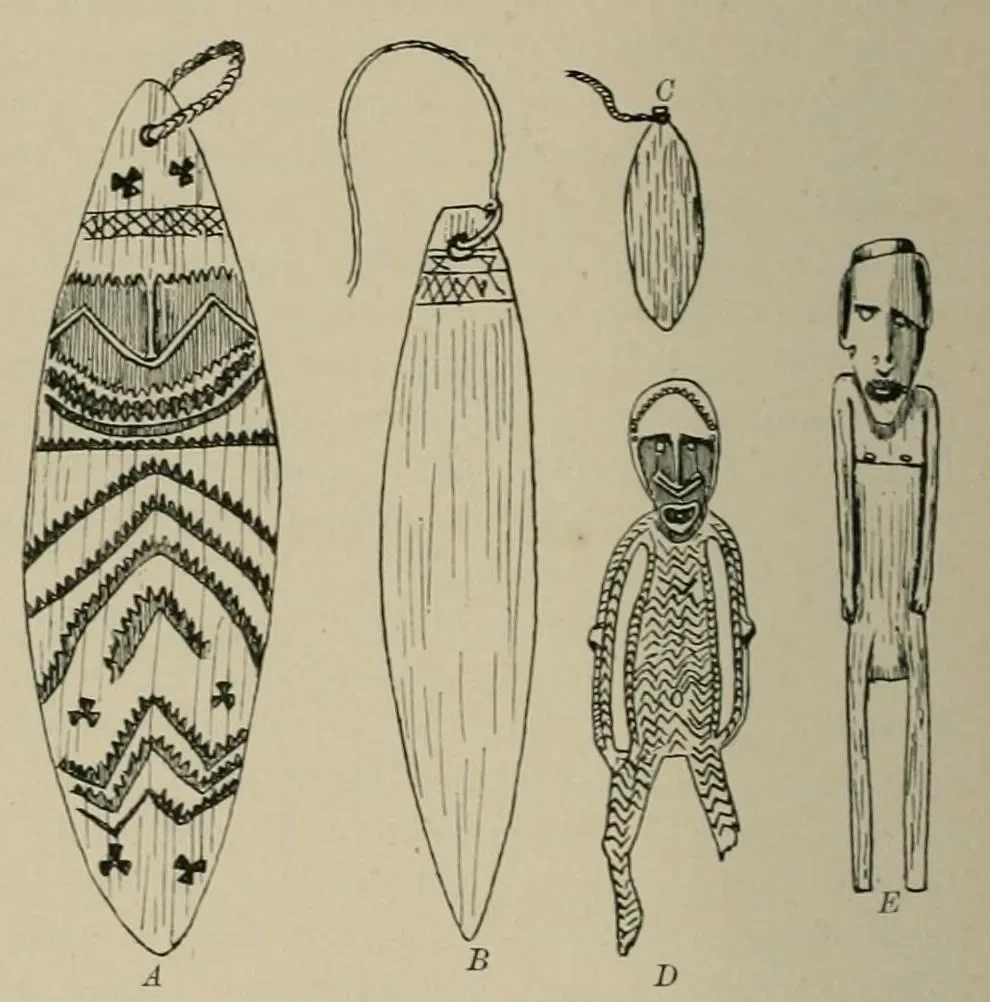
These are the places where the two roarers meet, and they are farming places. The Bullroarer and the Harvest follows the crop-roarer across five continents and argues that the crop cult travelled with farming, out of the Near East into Africa and quite possibly toward New Guinea.
Two roarers
Go back to Torres Strait. On Mer the stone rain-maker wears its little bigo at the throat and makes heavy rain with a little thunder, and when it fails its owner throws it down in a temper. Nobody hides it from the women. It does what it sounds like. On Boigu the splinter cries its own name, demands to be rubbed with the fluids of sex and swung over the yams, and forbids itself to the women on pain of hunger; then the men of the neighbouring islands pay for it with their wives and carry it home. One of these was found. The other was handed on.
Key sources
- The counts are taken over the 1,283 bullroarers in the atlas (October 2026), using the five traits the map offers as filters. The figure expected by chance for a pair is the product of the two counts divided by 1,283. Comparisons within thirds by length of account use Mantel–Haenszel odds ratios: Forbidden × Women-linked 4.25, Forbidden × Snake 3.14, Snake × Agriculture 3.38, Women-linked × Agriculture 3.08, Agriculture × Rain 4.70, Snake × Rain 1.13, Forbidden × Rain 0.31. The 42 serpent roarers in their own right are those whose form, name, voice or origin story is a serpent.
- Haddon, A. C. (ed.) 1908. Reports of the Cambridge Anthropological Expedition to Torres Straits VI, pp. 194–198 and pl. VIII (Mer, Dugena and the bigo); vol. IV (1912), fig. 235; vol. V (1904), p. 218 and fig. 30. Haddon, A. C. 1901. Head-hunters: Black, White, and Brown, pp. 104–105.
- Landtman, G. 1917. The Folk-Tales of the Kiwai Papuans. Acta Societatis Scientiarum Fennicae 47, tale 261, “The First Bull-Roarer,” pp. 316–317, and variant 261A (Máigidúbu); tale 414, pp. 456–457.
- Gregor, W. 1881. Notes on the Folk-Lore of the North-East of Scotland. London: Folk-Lore Society, p. 153. Pitt Rivers Museum 1893.14.7.
- Cambridge Naga Database, Konyak bull-roarer, Tamlu, coll. J. P. Mills, 16 October 1923 (Pitt Rivers Museum 1928.69.609); Museum of Archaeology and Anthropology, Cambridge, 1937.1086, and Weltmuseum Wien 126758 (Wakching, coll. C. von Fürer-Haimendorf).
- Franz, E. 1969. Das Dorf İcadiye, p. 367. Martínez-Crovetto, R. 1969. “Juegos araucanos de la Patagonia.” Etnobiológica 13, p. 19. Sheikin, Yu. I., Dobzhanskaya, V. & Ignatieva, A. 2019. “Zvukovye orudiya i muzykal'nye instrumenty chukchei.” Traditsionnaya kul'tura 20(4), pp. 14–15 and fig. 4, after Bogoraz.
- Cooper, J. M. 1928. “Field notes on northern Algonkian magic and divination.” Journal of the Washington Academy of Sciences 18(8), p. 230; Cooper 1930, Proceedings of the 23rd International Congress of Americanists, p. 515 (James Bay Cree). Heizer, R. F. (ed.) 1972. Notes on Northern Paiute Ethnography, doc. 52 (Wadatika). Stewart, O. C. 1941 and 1942. Culture Element Distributions XIV and XVIII. Steward, J. H. 1943. Culture Element Distributions XXIII. Fowler, D. D. & Matley, J. F. 1979. Material Culture of the Numa, p. 72.
- Lund, C. S. “The Bullroarer: A Global and Timeless Sound Instrument,” in Music and Sounds in Ancient Europe (EMAP), p. 31.
- Warner, W. L. 1937. A Black Civilization. Maddock, K. 1976. “Communication and Change in Mythology,” in N. Peterson (ed.), Tribes and Boundaries in Australia, p. 166.
- Williams, F. E. 1936. Bull-roarers in the Papuan Gulf. Territory of Papua Anthropology Report 17; Williams, F. E. 1940. Drama of Orokolo, pp. 158–159, 204. Holmes, J. H. 1902. “Initiation Ceremonies of Natives of the Papuan Gulf.” Journal of the Anthropological Institute 32.
- Lehner, S. 1911. “Bukaua,” in R. Neuhauss, Deutsch Neu-Guinea III, pp. 410–412. Van Baal, J. 1966. Dema: Description and Analysis of Marind-anim Culture, pp. 271–273, 480–486. Wirz, P. 1922–25. Die Marind-anim von Holländisch-Süd-Neu-Guinea.
- Dieterlen, G. 1989. “Mythologie, histoire et masques.” Journal des Africanistes 59, p. 34. Leiris, M. 1934. “Rhombes dogon et dogon pignari.” Bulletin du Musée d'Ethnographie du Trocadéro 7. Ellis, A. B. 1894. The Yoruba-Speaking Peoples of the Slave Coast of West Africa, pp. 110–111. Batty, R. B. 1890. “Notes on the Yoruba Country.” JAI 19, pp. 160–164.
- Mello, M. I. C. 1999. Música e Mito entre os Wauja do Alto Xingu. Dissertation, UFSC, p. 142. Oberg, K. 1953. Indian Tribes of Northern Mato Grosso, Brazil. Smithsonian Institution, Institute of Social Anthropology Publication 15, pp. 24, 53–57. Bastos, R. J. de M. 1978. A musicológica Kamayurá.
- Bourke, J. G. 1884. The Snake-Dance of the Moquis of Arizona, pl. XIII; Bourke, J. G. 1892. The Medicine-Men of the Apache, 9th Annual Report of the Bureau of Ethnology, pp. 476–478. Salokoski, M. 2006. How Kings Are Made, How Kingship Changes, p. 230, quoting C. H. L. Hahn 1928, p. 4 (Uukwaluudhi). Frobenius, L. 1913. Und Afrika sprach… III, pp. 297, 300, 306 (Turka and Karaboro).
- Loeb, E. M. 1929. Tribal Initiations and Secret Societies. University of California Publications in American Archaeology and Ethnology 25(3), pp. 284–285.