Atlas Essay —
The First One Didn’t Work
New South Wales · Central Australia · the Kimberley · New Guinea · Vanuatu · Nigeria · Senegal
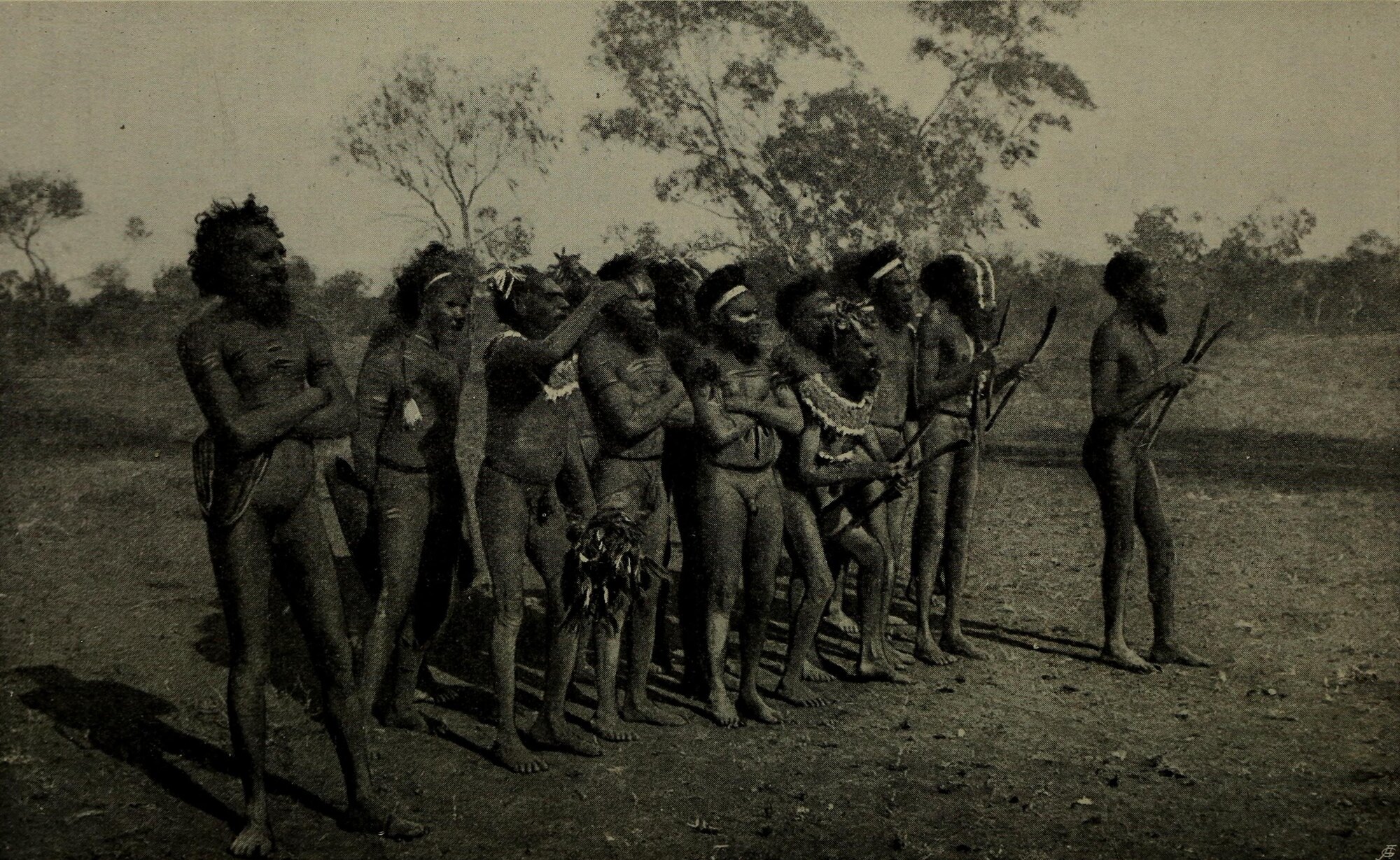
Baiame, the All-Father of north-western New South Wales, tried three times to give the initiation its voice. His first try was a stone man who was meant to knock out the novices’ teeth and ate their faces instead. His second was a stone blade too heavy to roar. The third was wood, and it worked. In Central Australia two ancestors tried bark before they found the right tree. On the Digul River in New Guinea the first cord snapped and the blade flew into the women. In Yorubaland the first voice of Oro was a strip of his own flesh, and it fell silent. And on the coasts and rivers of three continents, the first initiation killed the boy, or was meant to, and the rite was founded again.
From Australia to New Guinea, Vanuatu and West Africa, the origin of the bullroarer and of the rite it voices is told as a second attempt: the first instrument did not work, or the first initiation killed, and the rite people keep is the one that was put right.
In brief
- The Euahlayi of the Narran River in New South Wales say Byamee first made a stone blade “too heavy to make the noise he wanted,” then heard a chip whiz from his axe and made one of wood (Parker 1905, p. 67).
- The Kaitish of Central Australia say their two Tumana ancestors tried bark, “but it did not make the right noise”; mulga wood “was a success,” and the down off their blades grew into the mulga trees bullroarers are still cut from (Spencer and Gillen 1904, pp. 273, 420).
- The Mandobo of the upper Digul, in the Indonesian province of South Papua, say the first fibre snapped and the blade struck a woman. Three more casts were lost before a man from the Teri River brought tenot fibre and a springy rod (Boelaars 1970, pp. 77–78).
- A Yoruba story from south-western Nigeria makes the first Oro a piece of the god’s own forearm. It fell silent when a king’s wife hid to watch, its thread broke, and Oro left a stick and a string in its place (Parkinson, in Dennett 1910, pp. 49–51).
- The Kai of north-eastern New Guinea, the Nyikina of the Kimberley and the southern Arrernte each say the first initiation killed and was replaced by a lesser cut; among the Bedik of Senegal the killing is demanded and a pretence given instead.

Byamee tried stone
The Euahlayi lived on the Narran River in north-western New South Wales, near the Queensland border (Plate II). Katie Langloh Parker spent twenty years among them on Bangate station and sat through the preparations for a Boorah, their initiation, at a ground cleared in the scrub. Every night the women and children heard the Gayandi, the Boorah spirit, roaring from the bush, and the younger women stopped their ears. Parker could hear it too, and knew what made it: old men whirling wooden blades in the scrub. “These bull roarers sound curiously uncanny,” she wrote. “I did not wonder the uninitiated accepted the spirit theory as to their origin” (p. 66).
Then she gave the men’s account of where the blades came from, and it begins with two mistakes:
The function of the Gayandi is to inspire awe, and it fulfils it. Byamee himself made the first. It was some time before he got quite the effect he wanted. At first he desired to give the Boorah spirit a form as well as a voice, to inspire awe; he also wished it to knock out the front tooth of an initiate.
He made a stone figure in the image of man, having a voice. This spirit, known variously as Gayandi, or Darramulun, went to the Boorah, but when he was to knock out the front tooth, he began to eat the boys’ faces. He was too strong; he would not do to preside over Boorahs. Byamee transformed him into a large piggiebillah-like animal, though instead of being covered with spines, thick hair grew over him; he has since been known as Nahgul. He went away into the bush, where he has been a dreaded devil ever since … He haunts Boorah grounds.
Next Byamee made a stone bull roarer sort of thing, but this was too heavy to make the noise he wanted.
K. Langloh Parker, The Euahlayi Tribe (1905), p. 67
Two failures, then, and both of stone. The first was a body with a voice, and the body was the problem: it was too strong, and it ate the boys it was meant to make into men. The second was a voice without a body, but stone could not carry it. The third came by accident, and Parker tells it as Byamee’s own discovery:
One day he was chopping a big Coolabah tree close to Weetalibah water-hole, which tree, much to the horror of our blacks, was burnt down a few years ago by travellers.
As Byamee chopped, out flew a big chip. He heard the whizzing sound it made, gave another chop, out flew another; again the whizzing sound.
‘That is what I want,’ he said; ‘I’ll make a Gayandi of wood.’
He cut a piece of mubboo, or beefwood, and shaped it; he tied a piece of string to a hole in one end; he hung it up in the big Coolabah tree. Then he went and cut one out of Noongah or Kurrajong, tied a string on to that and put it beside the other on the tree, and left them swinging there.
Parker (1905), pp. 67–68
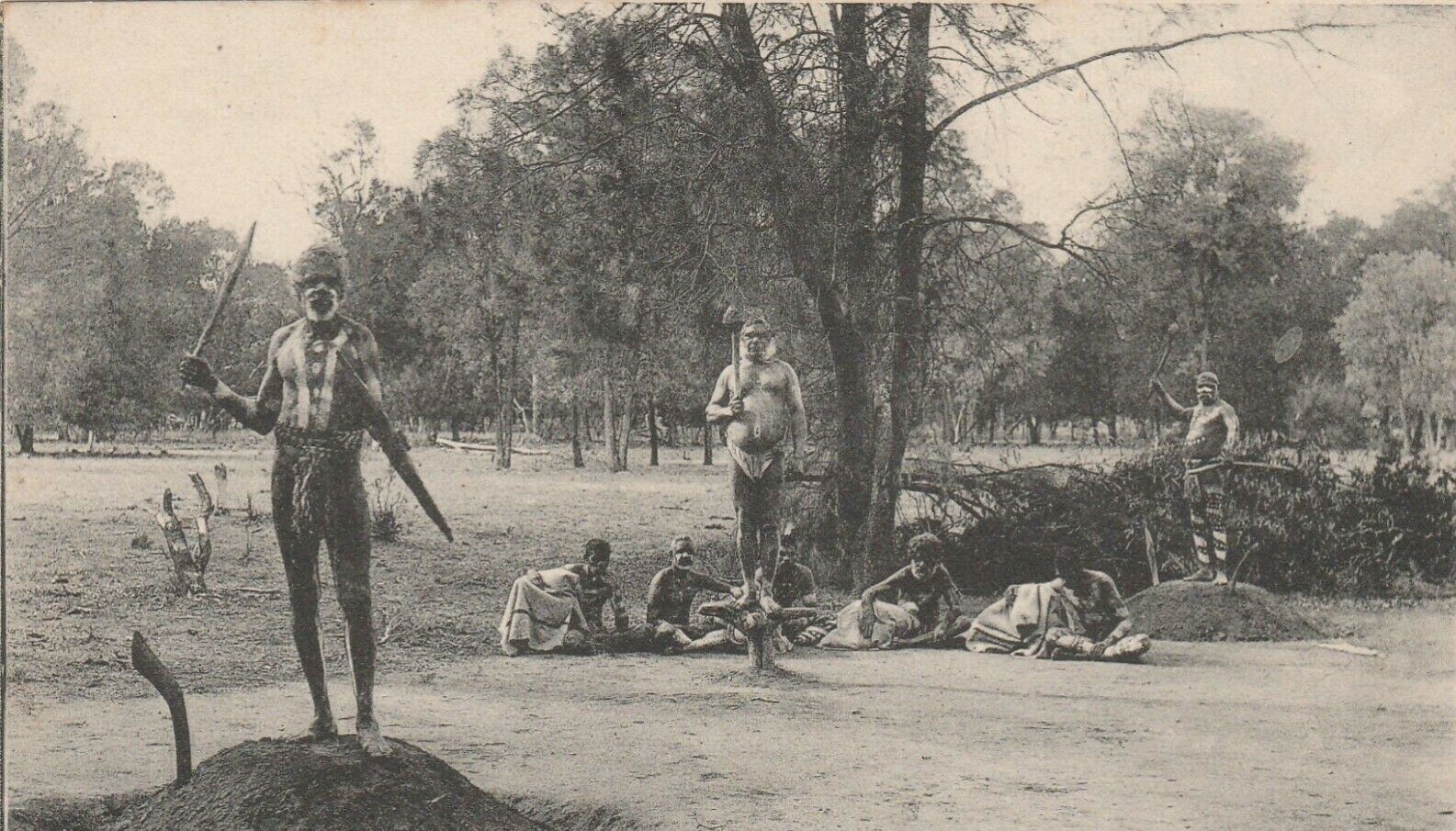
His two wives came by the coolabah and heard “such strange voices, such as we never heard.” Byamee sent them back to camp to make a fire, took the blades down, and “was satisfied now they would answer his purpose” (p. 68). He hid them until he made a Boorah, and ever since, Parker says, such pieces of wood have been the medium for the Gayandi’s voice.
The first failure did not go away. Nahgul still haunts Boorah grounds. “Nahgul is the rejected Gayandi, who was found by Byamee too destructive to act as president of the Boorahs,” Parker writes later in the book. He still carries a sacred stone inside him, which is the source of his strength, and he sets string traps for men, who touch them, “feel ill, and suddenly drop down never to rise again” (pp. 137–138). The prototype that ate the boys is out in the bush on the edge of every initiation ground, and the instrument that replaced it is what keeps him there.
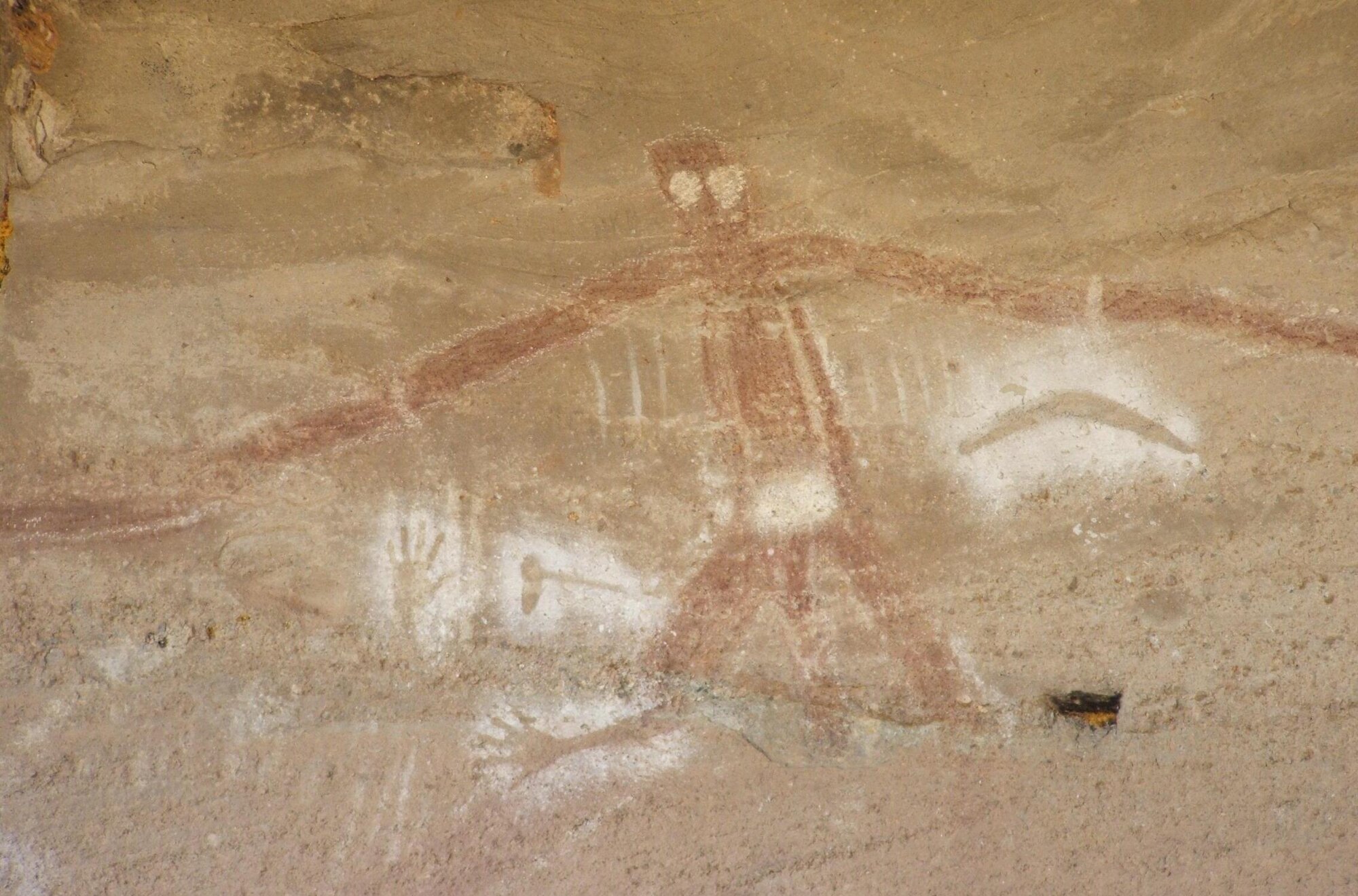
Bark would not roar
The Kaitish, now usually written Kaytetye, live around Barrow Creek on the overland telegraph line in Central Australia, about 1,400 kilometres north-west of the Narran. Baldwin Spencer and Frank Gillen camped there in 1901 and wrote down the origin of the Kaitish bullroarer three times in the same book. Their churinga is the sacred board, and when it is whirled its roar has a name, Tumana. It is also the name of the two ancestors who first made it sound:
The Kaitish have a tradition with regard to two Alcheringa men named Tumana—a term applied to the roaring noise made by the Churinga. These two men themselves arose from Churinga, and one day they heard Atnatu, who lived up in the sky, making the noise with his Churinga, and they tried to imitate it. First of all they took pieces of bark, but could not succeed with this, and then they cut a churinga irula (irula = wooden) out of a mulga-tree. This time they were successful. They decorated their Churinga with down, which flew about in all directions when they twirled them. Where the down fell, mulga-trees arose out of which Churinga can now be made.
Baldwin Spencer and F. J. Gillen, The Northern Tribes of Central Australia (1904), p. 273
The second telling, a hundred and fifty pages on, is plainer about what went wrong. The Tumana men “took a piece of bark, tied string on to it, and swung it round, but it did not make the right noise. At length they hit on the idea of making a Churinga out of mulga wood, which was a success, and they said that it was a very good one” (p. 420). Bark has a cord and it can be swung. What it lacks is the voice. The third telling, in the chapter on the beings of the sky, repeats it in a line: “At first they used pieces of bark, but were not successful until they tried mulga wood” (p. 500).
“They took a piece of bark, tied string on to it, and swung it round, but it did not make the right noise.”Spencer and Gillen, on the Kaitish Tumana men (1904), p. 420
The success had a price. Two wild dogs heard the Tumana men swinging their blades all day long, sneaked up on them, smelled them (“Oh, they smell very good”), and cut off their heads as they were going down into holes in the ground. The churinga spilled out and were left on the ground. But two other men had watched. They had seen the down fly off the whirled blades and knew that the trees which sprang up where it fell “were not like the other trees,” and they “told the men always to make and swing the Churinga, when they were initiating the boys” (pp. 420–421). So the instrument and the trees it must be cut from were found together, by two men who tried the wrong material first, and passed on by two men who watched.
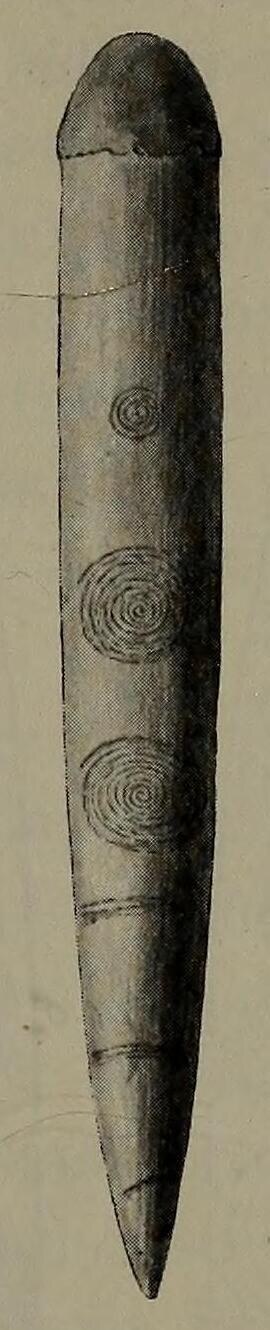
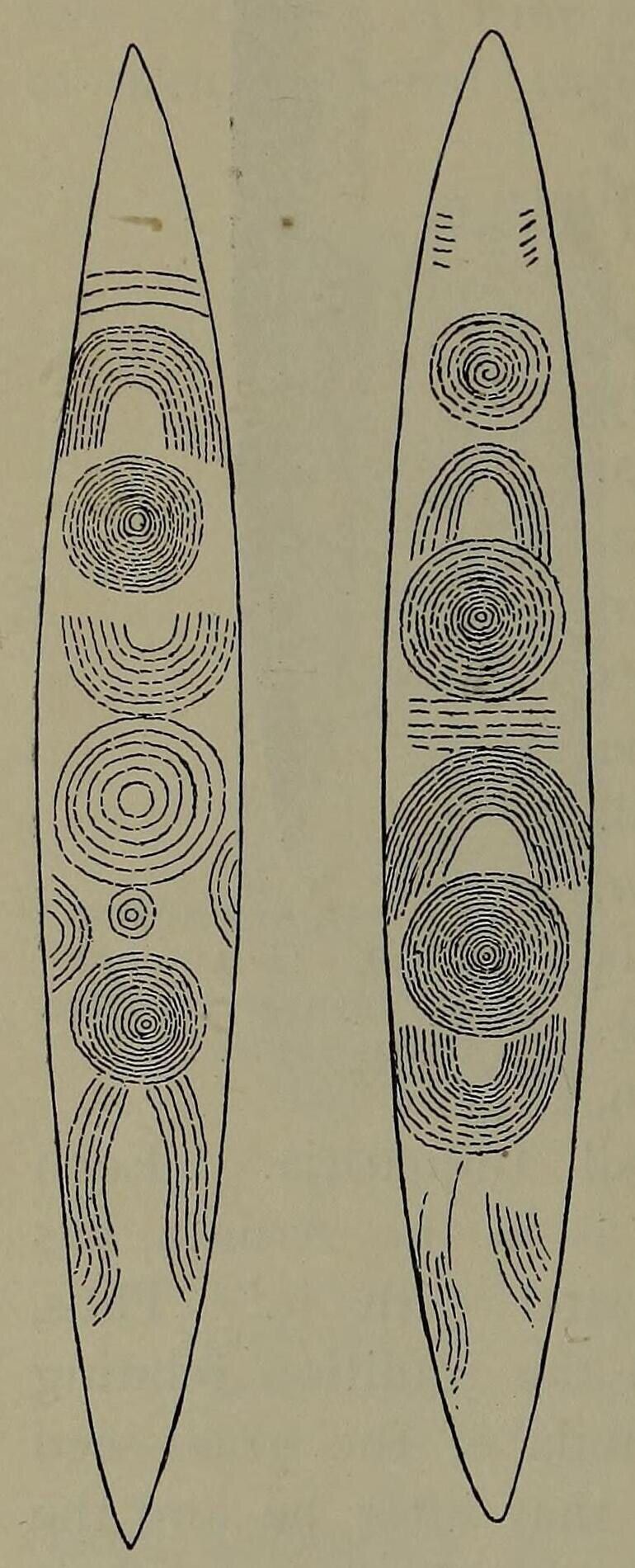
The Kaitish keep both stone and wooden churinga in their sacred storehouses, and Spencer and Gillen drew one of each (Plate V). The stone ones are carved and kept. The ones that are swung at initiation are wood. The Euahlayi story says the same thing from the other side of the continent: stone is for keeping, and a voice has to be cut from a tree.
The Kaitish also tell what happens when the roar is left out. Atnatu, the being in the sky who swung the first churinga, is always listening for it. Once, at a place called Irribilia, the men initiating some boys grew so tired that they stopped swinging, “and the boys were actually cut without the swinging of the sacred Churinga.” Atnatu hurled his spears down, killed the men, and dragged them up into the sky. “Tradition says that he eat one of them, … but found the flesh no good for food, so he did not eat the other men, but brought them to life again in the sky.” The women heard no bullroarers and no singing, ran to the place, and found only tracks and blood (p. 347). A rite without the right voice does not work either. Every Kaitish boy is told, when the bullroarer is shown to him for the first time, that he must be careful to swing it, “or else Atnatu will spear him” (p. 500).
The neighbouring Warramunga, to the north, tell the origin of their own bullroarer, the murtu-murtu, as a dismemberment rather than a trial. The ancestor Murtu-murtu roared with his own mouth until two wild dogs tore him apart; “as the flesh flew through the air it made a sound like that of the murtu-murtu,” and where it fell grew the trees bullroarers are now made from (p. 435). It shares the Tumana story’s dogs, flying fragments and trees.
The cord snapped
Across the Arafura Sea, the Mandobo live between the Digul and Kao rivers in the lowland forest of the Indonesian province of South Papua, on the western half of New Guinea. The Dutch missionary Peter Drabbe took down their origin myth from Kaeti tellers, and the ethnographer Jan Boelaars printed the bullroarer episode in 1970. It is the most detailed failure in the set, told cast by cast.
At the first feast where the sacral pig Mutut, a pig who had been a person, was to be eaten, Mutut’s Throat spoke and laid down how the Mandobo were to live. It began with the bullroarer:
Mutut orders the men to go into the forest to cut short flat pieces of wood and to break off some switches. For the short pieces various hardwoods are named, among them the nibung palm. To these short pieces they fasten a fibre cord; the other end they must now hold in the hand and then whirl the slat round through the air.
The first who tries it has no success at all: the fibres break; the slat lands among the women and strikes one of them in the groin, where it sticks fast. When they look for it, the women point to the one in whose groin it stuck, but she denies it. At a second try the slat flies up into the air and becomes a rondu bird; a third lands in the mud; a fourth flies further off and can no longer be found. They ask the ‘Throat’ what is to be done now, and it says they must go and fetch someone from the Teri River, namely Kaomberim. Kaomberim comes, and when they have explained to him how they did it, he says they went about it the wrong way.
J. Boelaars, Mandobo’s tussen de Digoel en de Kao (1970), pp. 77–78, after P. Drabbe. Dutch: “De eerste die het probeert heeft al geen succes: de vezels breken door; het latje komt terecht onder de vrouwen en treft er een in de lies, waar het blijft steken.”
Four casts, four losses: one into a woman, one into the sky as a bird, one into the mud, one gone. Then the expert from the Teri River puts it right, and Boelaars lists his corrections one by one:
He has them fetch better fibres now, the fibres of the tenot.
Further he has them make a new one; they put the fibres through the hole again and tie them fast in the notch, and then he has them tie the other end to a switch (which Mutut, note, had already had them fetch from the forest the first time), a springy length of wood about 1.70 m long. With it he goes and stands on a little hill and swings it, until they hear the bullroarer murinop (now so called for the first time) give its sound. Hurrah, says Kaomberim, that is how you must do it. The Throat of Mutut says too: hurrah, now it is right. And now that you have heard the bullroarer, you must eat me at once.
Boelaars (1970), p. 78. Dutch: “Hoera, zegt Kaomberim zo moeten jullie het doen.”
The details are an instruction sheet: a stronger fibre, a notch as well as a hole, and a rod to swing it from, which Mutut had ordered at the start and the first men had not used. Drabbe’s tellers did not stop at the story. They carved him a true-to-life model and gave him its measurements: a thin slat about 20 centimetres long, three or four wide at one end and tapering to a point, notched and drilled near the tip, the nibung fibre run through the hole and tied in the notch (p. 77, n. 5). At Wakeriop the same instrument is called tenotkok, after the fibre that finally held, and when it hums it is Murinop, the voice of Kowamup, the first human pig (p. 78, n. 6).
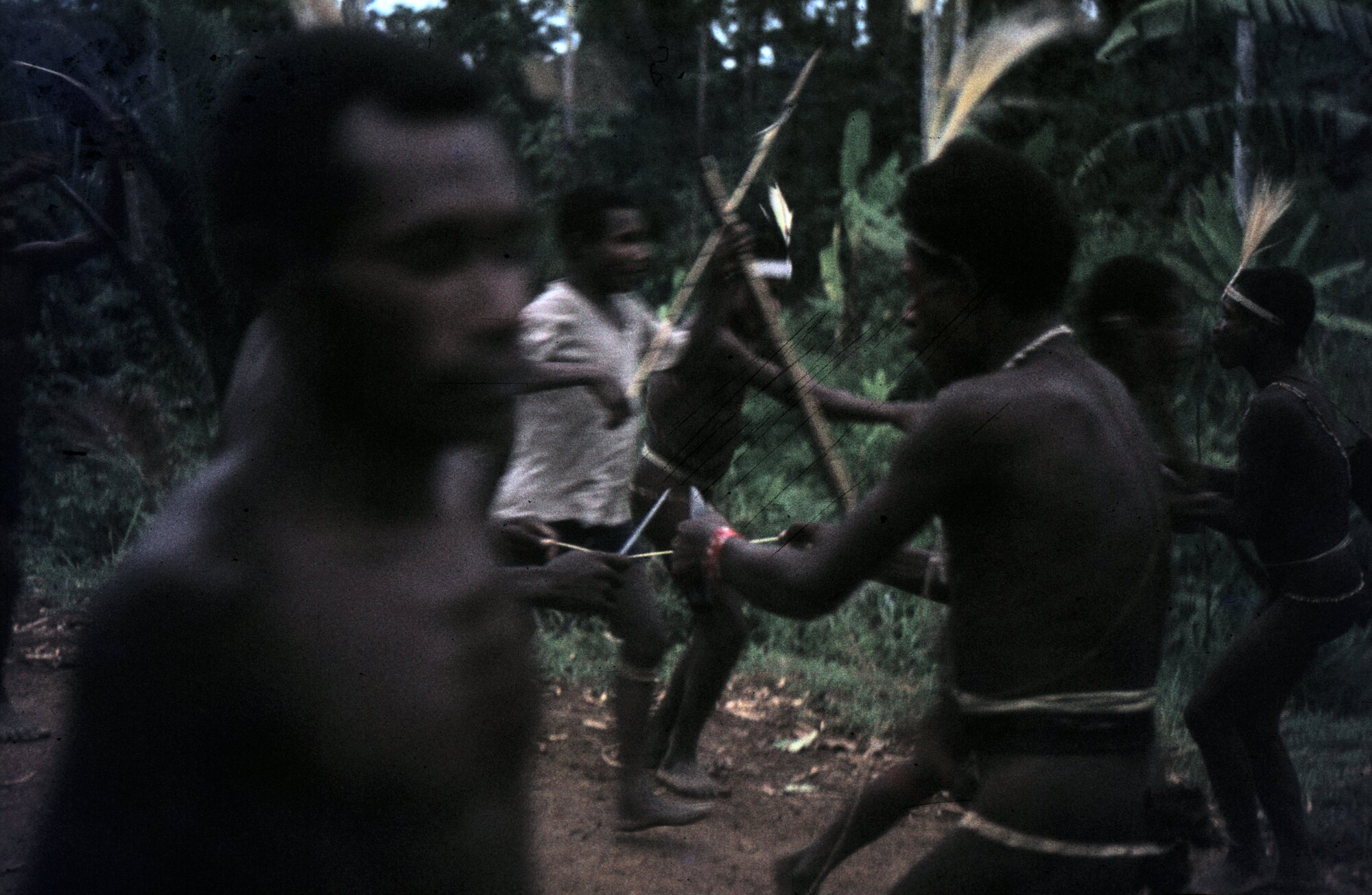
The failed cast did not simply vanish. The woman it struck fell ill, and sent for her cross-cousin Imbondagomop, whose bullroarer it was. He made a knife from bamboo, cut two incisions in her groin and lifted out the skin between them. He laid that skin down a little way off, “and it becomes the tenot plant” (p. 78): the fibre that finally held grew from the wound the first cord made. The blade itself stayed fast where her vagina was just coming into being, and a hornbill had to pull it out with its beak, her blood spattering its face (pp. 78–79).
Even the marriage that follows is found by trial. On the Throat’s orders the woman is given to her elder brother, then her younger brother, then her mother’s brother, and each time she cries out in pain. Then her cross-cousin Imbondagomop, her father’s sister’s son, comes to her. “Lovely,” she says, “the son of father’s sister, only now is it good.” Throat and Bullroarer agree: “now it is right; let it stay so” (p. 79). The rule of Mandobo marriage, like the rig of the Mandobo bullroarer, is what was left when the wrong ones had been tried.
“Hurrah, says Kaomberim, that is how you must do it.”The Kaeti telling of the first Mandobo bullroarer, in Boelaars (1970), p. 78
Down on the coast of Papua New Guinea, two hundred kilometres to the south-east, the Gambadi tell the bullroarer’s origin at Kwavaru, on the shore east of the Morehead River. Tiv’r the Originator’s wife Engu carries the thowatti inside her, and it sounds faintly whenever she moves, until a little bird, Serekute, snatches it from her for him. “Tiv’r hugs it to his breast and declares that from henceforth it shall belong to man alone.” And then, F. E. Williams writes, “there follows a long account of a search for a suitable fibre to make a string for swinging it, and then of the first initiation ceremony in which Tiv’r shows the bull-roarer to his son” (Williams 1936, p. 308). In the Trans-Fly, as on the Digul, owning the blade was not enough: the right string had to be searched for.
Oro would not speak before a woman
In Yorubaland, in south-western Nigeria, the whirring from the forest is the voice of Oro. When Oro is abroad the women shut themselves indoors, because no woman may see him and live. In 1906 John Parkinson printed two Yoruba stories of how the voice began, and R. E. Dennett reprinted them in Nigerian Studies four years later. In both, Oro falls silent before a woman.
In the first, a king wanted his wives present at the rite, the people danced and sang, and nothing happened. “I am king; how is it that common wood can talk and say ‘Baba ma mu-o’?” he asked. Oro kept silent. Two diviners told him the wood had not failed: “Oro does not cry where women are.” The king sent his wives home, the men sang again, and Oro cried out. “Hence it is from that day Oro is not made in the presence of women” (pp. 47–48).
The second goes further back, to six men made by God in a place full of a crying in the bush, whose children were dying. A hunter came to them, Oro, and told them the place was his:
And Oro replied, “I am the man who makes that noise every night.” Then he cut a piece out of his forearm and gave it to them. But they said, “What shall we do with it?” Oro replied, “I am very old and cannot always come here every seven days, but when you come, bore a hole in the flesh and place a thread in it, and when you fling it outwards it will cry like me, being part of me. Take care, moreover, that no woman comes, and when you have finished with the piece of flesh put it in the ground before going home.”
John Parkinson, in R. E. Dennett, Nigerian Studies (1910), p. 49
The children stopped dying, and the people multiplied and elected a king. The king’s wife, whom he loved greatly, asked to see the thing that cried at night, and he had a big chair made with a seat inside it to hide her:
Arrived at the place they made the usual feast, and, as before, took the flesh from the ground and flung it out, but there came no sound. Then one of the four elders said, “Something is wrong here; the hunter said, ‘No woman must come,’ or he would fail to answer.” … Then one went to the king’s chair and broke it and saw the king’s wife inside, and they began again to fling the flesh of the hunter into the air when suddenly the thread broke and the flesh flew off and cut the throat of the woman.
Then said the small piece of flesh, “I go to my father and will tell him what I have seen here to-day, but since you have broken the rule I must change myself, and on the next feast-day you will see what I have taken to fill my place.”
When all had gone the piece of flesh told the hunter what had happened, and Oro the hunter came back, and Oro said, “Come to my flesh again,” and Oro cut a stick and tied a string to it and left it in the ground.
Parkinson, in Dennett (1910), pp. 50–51
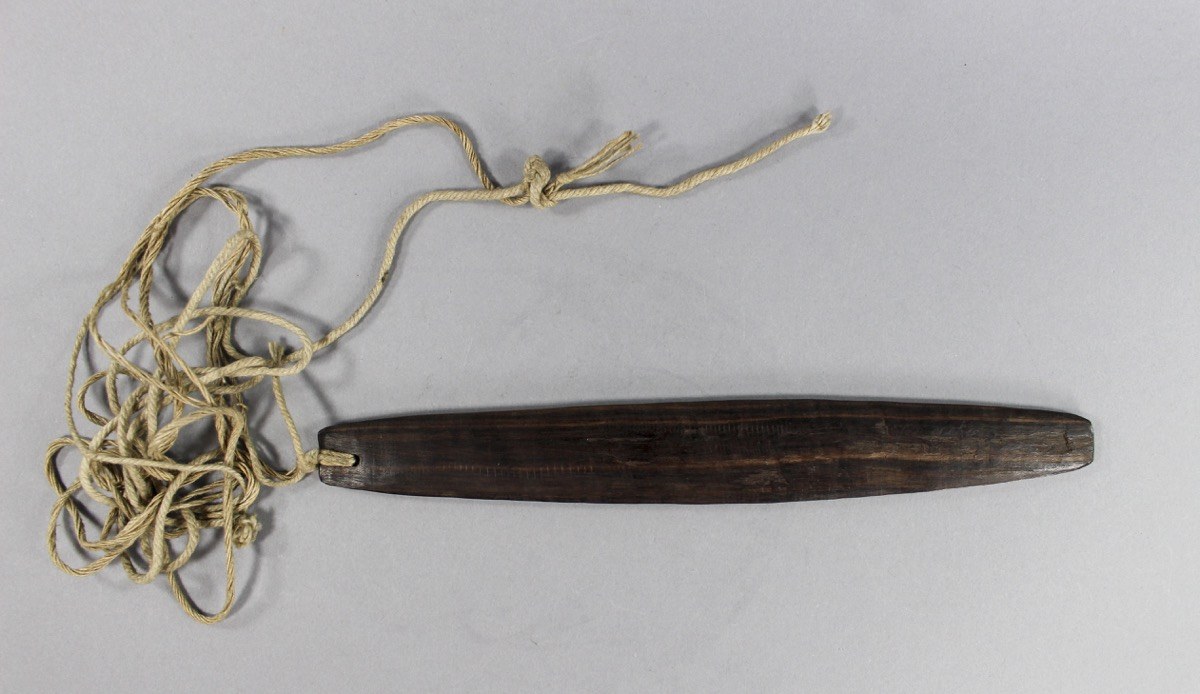
The cord broke here too, and the loose piece flew into a woman, as on the Digul. But the Yoruba story turns the other way. The first voice did not fail because it was the wrong material. It failed because a woman was watching, and the flesh took its revenge and went home. What replaced it was the instrument the Yoruba still use, a stick and a string, left in the ground the way the flesh had been. Then Oro departed from the world, “being offended because a woman had seen part of him.” The legend adds that he went into the camwood, “hence any ‘Oro’ made from cam-wood is held to be especially good” (p. 51). The second Oro, like the Kaitish churinga, came with the name of the tree it should be cut from.
A third story in the same pages comes from Orun, an old Egba town near Ibadan, sent to the Nigerian Chronicle by a man who called himself a grandson of Oro worshippers. A woman splitting firewood saw a chip fly from the cleft “which made a whizzing sound similar to the ‘voice’ of the God Oro.” She showed it to her husband, who took it from her, “and ere long invented the Ise or Abe, and with the aid of his companions the mystifying Oro worship was soon evolved” (p. 51, n. 1). The same chip flies off Byamee’s axe at Weetalibah water-hole, and off the firewood of a woman in the hills of the Kai.
Fire before the stone knife
The first instrument failed by making the wrong noise or none. The first rite failed in a worse way: it killed. In Central Australia the Arrernte, whose country lies around Alice Springs, told Spencer and Gillen that in the early days of the Alcheringa circumcision was done with a fire-stick. Then a group of Little Hawk men arose at Atnaturka on Love’s Creek, “remarkable for the possession of very fine stone knives.” Spencer and Gillen record the state of things before them: “Amongst the men of all other totems up to that time stone knives were not used for this purpose, and the operation was always performed with a fire-stick” (1899, p. 394).
Even the stone knife did not arrive right the first time. Two Little Hawk men at Utiara, north of Alice Springs, had a cutting ground ready and meant to use the usual fire-stick. A third told them they must cut with stone knives. “We have no Lalira,” they replied sorrowfully, “but we will cut them with Ura-ilyabara,” the fire-stick. They flew to Atnaturka for knives, and the old men there hid the good ones and gave them rough ones wrapped in bark; they flew back several times, and were always given the poor ones, until the old men came themselves with good knives. The local men they operated on “considered the Lalira to be a great improvement upon the fire-stick” (pp. 394–395). In a footnote Spencer and Gillen add that ilyabara, which they had translated as fire-stick, in fact means “a piece of bark” (p. 401, n. 1). The first Arrernte cut, like the first Kaitish bullroarer, was made with bark.
The southern Arrernte told it without the hawks, and with the cost spelled out:
… one day the men were, as usual, circumcising a boy with a fire-stick when an old woman rushed up and, telling the men that they were killing all the boys because they were using a fire-stick, showed them how to use a sharp stone, and ever afterwards the fire-stick was discarded.
Baldwin Spencer and F. J. Gillen, The Native Tribes of Central Australia (1899), pp. 401–402
Among the Kaitish the first two initiated men, the brothers who cut themselves with knives Atnatu dropped from the sky, went about the country making others into men. They heard some little bird people, the Lintjalinga, singing, “and watched while they tried to circumcise themselves with a fire-stick.” The brothers operated on them properly with stone (1904, p. 346). The Arrernte and the Kaitish both remember the fire-stick as the wrong tool and the stone knife as the reform.
Far to the north-west, on the Fitzroy River in the Kimberley of Western Australia, the Nyikina told the ethnologist Helmut Petri how their initiation came from two sky beings, Kumbaruga and Golwilir. The same telling makes the law “that women may not see bullroarers” (Südkamp, p. 258). Then the boy Yalgi goes out as the candidate and gathers the boys:
Kumbaruga came and made all these Malolo into men. But he did not circumcise them: he burned them with a glowing stick. Many of them died. Golwilir saw this and thought it was not good. He took djimare, the white stone knife, and cried “Dju!” Then he performed the circular cut on Yalgi.
Horst Südkamp, Wondjina, “Yalgi und Windinbigi,” after Petri 1954, p. 260. German: “Aber er beschnitt sie nicht, sondern brannte sie mit einem glühenden Holz. Viele von ihnen starben.”
The Nyikina go on to correct the blood as well. Kumbaruga drew his from the nose, and Golwilir told him it was not good: “you must take kanggulari, the blood from your arm.” Yalgi, Windinbigi and Kumbaruga all agreed: “Yes, that is right” (p. 261). Burning with a glowing stick killed many boys, and the white stone knife replaced it. That is the southern Arrernte story told in the Kimberley, with the founder who burned the boys still standing beside the one who corrected him.
The first boy died
The Kai live in the mountains behind Finschhafen, above the Huon Gulf on the north-east coast of Papua New Guinea. Their missionary, Christian Keysser, wrote down how their circumcision feast and its bullroarers began, as the Kai told it to him again and again. A woman of the district of Läugube, barely an hour south of Sattelberg, “was once chopping firewood. A flat piece sprang off and flew whirring through the air” (p. 34). She told her brother, who saw a great pig feast in it, to be eaten by the men at the women’s expense. She advised him to kill her so that the secret would stay with the men, and he did. Then he needed a reason to keep the feast for the men:
He hit on the idea of slitting open a boy’s testicles. The little one died of this treatment. So with a second he removed only the foreskin. That succeeded. He invited the people round about, told them his secret, gave each village the two principal bullroarers, which bear names, and staged the first feast, which gradually spread among all the Kai.
Christian Keysser, “Aus dem Leben der Kaileute,” in R. Neuhauss, Deutsch Neu-Guinea III (1911), pp. 34–35. German: “Der Kleine starb infolge dieser Behandlung. Daher entfernte er bei einem zweiten nur die Vorhaut. Dies gelang.”
“That succeeded.” The Kai founder’s first operation is a failure in the plainest sense, and Keysser’s German puts the second in a word, gelang, the verb for a thing that comes off. Only then are the bullroarers handed out. The Kai rite is the second version, and its instruments arrive after the first boy’s death, as the seal on the one that worked.
The Kai feast still begins with a trial. The great carved Ngosa boards that bear names are, Keysser says, “too heavy to swing,” and are only hung on a cord, like Byamee’s first wooden blades in the coolabah. The ordinary bullroarers come out of their wrappings by the score, many of them newly carved, and then:
Now follows the trial of the boards. From the mass of those on hand, the ones that swing most easily and sound most strongly are chosen. The others stay unused and are later burned.
Keysser (1911), pp. 36–37. German: “Nun folgt die Probe der Hölzer. … Die andern bleiben unbenutzt und werden später verbrannt.”
The Bedik, in the hills of south-eastern Senegal near the border with Guinea, tell of a killing demanded and refused, and the refusal is repeated at every initiation. The voice of their bullroarer is Nyandemém, “the giant and terrifying servant of the Gindam,” the master of the rite:
Nyandemem demands that the candidates for the first bush initiation really have their heads cut off, but the Gindam holds him back and decides on a pretence which reveals the initiatory secret.
Pierre Smith, “Le ‘Mystère’ et ses masques chez les Bedik” (1984), p. 26. French: “Nyandemem exige que l’on coupe réellement la tête des candidats … mais le Gindam le retient et décide un simulacre.”
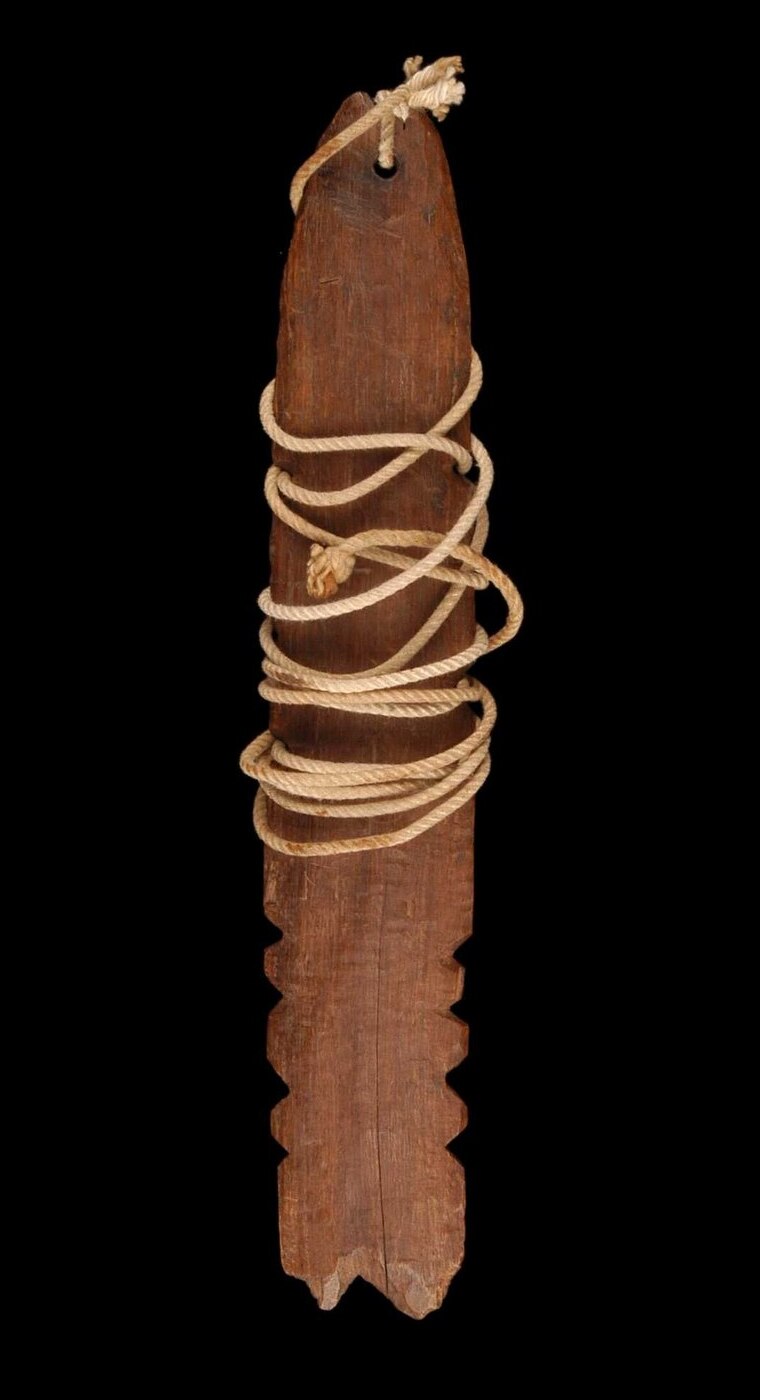
At the first initiation the boys are “symbolically beheaded,” and at the second they are “symbolically swallowed by the python, who gives birth to them again” (p. 27). By the day itself, Smith was told, the boys know “their being put to death will only be a pretence.” What the elders feared was a boy who panicked past all control: “That would be the sign that he can never live among us as a man, and in former times he was killed for good” (p. 21). The Bedik rite is the pretence the Gindam chose in place of the killing Nyandemém asked for.
The first initiator ate the boys
Byamee’s stone man, who ate the boys’ faces when he was meant to knock out a tooth, has a close kinsman in the country of the Wiradjuri of central New South Wales, south of the Euahlayi. R. H. Mathews heard the story from the headman at a Burbung camp on Bulgeraga Creek, a branch of the Macquarie River. Dhuramoolan, whose voice was like distant thunder, took the boys away to initiate them and came back with some of them missing, and reported that they had died of ordinary illness. When Baiame forced the survivors to speak, they told him that Dhuramoolan knocked out their teeth with his own lower incisors, “and at this part of the performance he sometimes bit the entire face off the boy and devoured him” (Mathews 1896, pp. 297–298). Baiame destroyed him,
but put his voice into all the trees of the forest and told it to remain in these trees for ever. He then split one of the trees, and made a bull-roarer (mudthega) which he fastened to a string and swung round, and it had Dhuramoolan’s voice. … Baiamai then told his chief men that for the future they must themselves initiate the youths of the tribes, using the mudthega … to represent the voice of Dhuramoolan.
R. H. Mathews, “The Būrbŭng of the Wiradthuri Tribes” (1896), p. 298
In the Euahlayi telling the failed initiator becomes the hairy devil Nahgul; in the Wiradjuri telling he is destroyed and his voice is kept in the wood. In both the first presider over initiation was a body that ate boys, and the second is a wooden blade on a string, swung by the old men.
Far to the north, in southern Arnhem Land in northern Australia, the Dalabon tell it of Lumaluma, the swallowing mother of the Gunabibi ceremony. Kenneth Maddock was told what went wrong:
Lumaluma she would vomit the bones of men she had swallowed. She should have brought them up whole and alive. The father and son decided not to give her more men to swallow, but to put bullroarers in her place. When next she spoke a left-handed nocturnal bird caught her voice by swinging a bullroarer.
Kenneth Maddock, “Communication and Change in Mythology” (1976), p. 166
“She should have brought them up whole and alive.” That is what a swallowing at initiation is for, and the first one did not do it. Her replacement is the instrument, and the novices of the Gunabibi are swallowed now by a voice.
On Malekula in Vanuatu, the whirring of the Nevinbur bullroarers is the voice of Nevinbumbaau, crooning her child to sleep. She was the first to kindle a sacred fire, and no man but her husband might come near it:
… if other men attempted to do so, she ate them. It was only after some time that she admitted men who were not her husband to this privilege on payment of pigs to her.
A. B. Deacon, Malekula: A Vanishing People in the New Hebrides (1934), p. 627
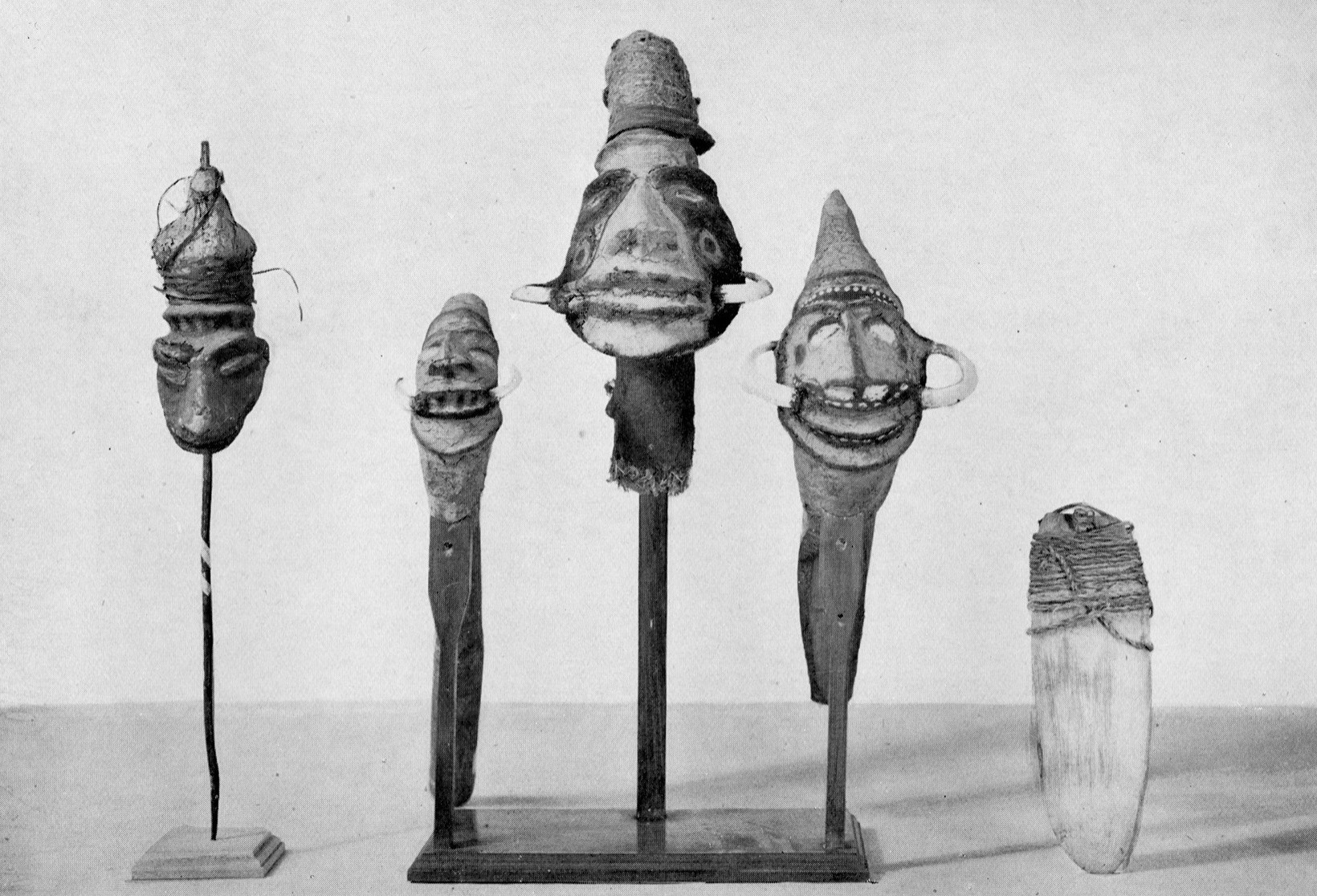
The first order of the fire ate men; the second took pigs. The full run of these killings and their substitutes, from the Huon Gulf to Liberia and the Amazon, is laid out in Initiates Used To Die. Here the point is the order. The rite that is practised comes second, after one that failed at its own purpose.
The one that works
Set side by side, the stories name what went wrong with unusual care. Stone was too heavy, and bark made the wrong noise. The first fibre snapped, and the first voice, a strip of flesh, fell silent because a woman was watching. The first initiator ate the faces of the boys he was meant to bring back changed, the fire-stick killed them, the first Kai operation went too deep, and Lumaluma brought up bones. Then each one names the fix: beefwood and kurrajong, mulga, tenot fibre and a springy rod, a stick and string of camwood, the white stone knife, the foreskin alone, a pretence, the bullroarer in her place.
None of these peoples found the bullroarer ready-made. They built it, got it wrong, and kept the story of getting it wrong. The failures stay in the story because they carry the instructions. A Kaitish boy shown the churinga for the first time also learns why it is mulga and not bark; a Mandobo man learns why the cord is tenot and why it hangs from a rod; a Euahlayi novice at the Boorah has Nahgul on the edge of the ground to show him what the voice replaced. The Kai still try every board before the feast and burn the ones that will not sound.
The pattern recurs from the Narran to the Digul to Yorubaland because the story travels with the instrument, as instructions travel: what to cut it from, what to tie it with, and what happens if you get it wrong. In every one of these places the rite people practise is the second version, and they remember the first.
Key sources
- K. Langloh Parker, The Euahlayi Tribe: A Study of Aboriginal Life in Australia (London: Constable, 1905), pp. 66–68, 137–138. Scan.
- Baldwin Spencer and F. J. Gillen, The Northern Tribes of Central Australia (London: Macmillan, 1904), pp. 273, 346–347, 420–421, 434–435, 498–500; figs. 54, 89, 91. Scan.
- Baldwin Spencer and F. J. Gillen, The Native Tribes of Central Australia (London: Macmillan, 1899), pp. 394–395, 401–402. Scan.
- J. Boelaars, Mandobo’s tussen de Digoel en de Kao (Assen: Van Gorcum, 1970), pp. 77–79, after P. Drabbe, “De oorsprongsmythe der Kaéti’s,” Nieuw-Guinea Studiën 2(1) (1958). PDF.
- F. E. Williams, Papuans of the Trans-Fly (Oxford: Clarendon Press, 1936), pp. 307–308. Scan.
- John Parkinson, Yoruba legends of Oro, Man 6 (1906), reprinted in R. E. Dennett, Nigerian Studies, or The Religious and Political System of the Yoruba (London: Macmillan, 1910), pp. 47–52. Scan.
- Christian Keysser, “Aus dem Leben der Kaileute,” in R. Neuhauss, Deutsch Neu-Guinea, vol. III (Berlin: Reimer, 1911), pp. 34–38. Scan.
- Horst Südkamp, Wondjina: Der göttliche Tiermensch, appendix “Yalgi und Windinbigi,” after Helmut Petri (1954), pp. 258–261. PDF.
- Pierre Smith, “Le ‘Mystère’ et ses masques chez les Bedik,” L’Homme 24(3–4) (1984), pp. 21, 26–27. Persée.
- R. H. Mathews, “The Būrbŭng of the Wiradthuri Tribes,” Journal of the Anthropological Institute 25 (1896), pp. 295–318, esp. pp. 297–298. Scan.
- Kenneth Maddock, “Communication and Change in Mythology,” in N. Peterson (ed.), Tribes and Boundaries in Australia (Canberra: AIAS, 1976), p. 166.
- A. B. Deacon, Malekula: A Vanishing People in the New Hebrides, ed. C. H. Wedgwood (London: Routledge, 1934), p. 627 and Plate XVI.