No. NGUINEA-008
Mali Baining bullroarers, Iwon (Bateson, 1928)
Papua New Guinea · East New Britain · Gazelle Peninsula · Iwon · Oceania · Bismarck Archipelago
Sacred / spirit
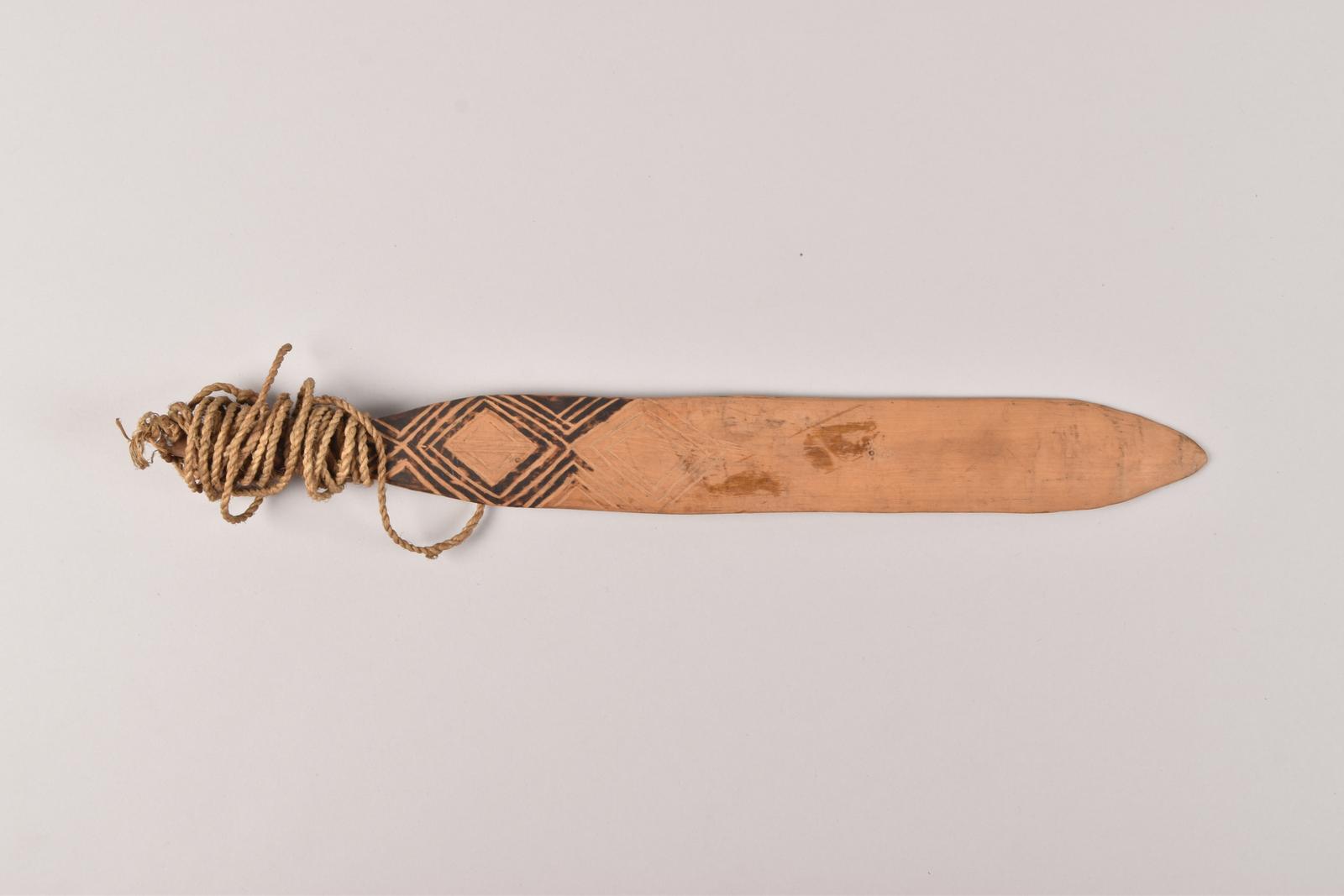
alendanga / anlqiek / galupka
Source term: Bullroarer
Three names recorded by Bateson, one per splint; galupka is the name of the palm wood itself ("The name 'galupka' refers to the wood").
Etymology. Galupka, the name Bateson recorded for the third bull-roarer splint from Iwon, is stated in the accession notes to refer to the wood itself — the palm from which the splint is cut. The instrument thus carries the name of its raw material rather than of a spirit or ceremony.
When a Mali boy died in initiation seclusion, the men said only that "the bullroarer killed him." The aŋricha, as the Mali call the bullroarer, speaks for Rigenmucha, the supreme being, and comes in two forms, a longer and a shorter kind; its sudden roar frightened the boys in seclusion. It belongs to a ceremonial world where the vuabun mask dances with snakes in its hands. Gregory Bateson collected these three narrow, blackish palm-wood splints at Iwon, each with a squared, pierced end and a pointed tip, one touched with white lime. He wrote down a name for each — alendanga, anlqiek and galupka, the last of them the name of the palm wood itself — and noted that one served in the Mendas, the mask dances that open Mali initiation.
Ist alles zum Empfang vorbereitet, so schlägt einer der Alten im Dorf die Trommel (runepka) zum Zeichen, daß alle Frauen in die Hütten verschwinden müssen. Rings im Busch hebt nun ein großes Lärmen an: die Schwirrhölzer (aŋricha) heulen los, die Grasflöten (kaigoga) kreischen schrill und die Männer schreien aus Leibeskräften.
When all is ready for the welcome, one of the old men in the village beats the drum (runepka) as the sign that every woman must vanish into the huts. All round in the bush a great din breaks out: the bullroarers (aŋricha) howl, the grass flutes (kaigoga) shriek, and the men yell with all their strength.
Carl Laufer, 'Rigenmucha, das Höchste Wesen der Baining,' Anthropos 41-44 (1946-49), p. 538
Particulars
- Object
- Three palm-wood splint bullroarers from Iwon, MAA 1928.622-624, with pierced ends and cord loops; one accession says the bull-roarer was used in the MENDAS ceremony.
- Function
- One was used in the Mendas initiation ceremony.
Source
Cambridge MAA 1928.622, 1928.623, and 1928.624; bullroarers from Iwon, Gazelle Peninsula; cultural affiliation Mali Baining; local terms ALENDANGA, ANLQIEK, GALUPKA; 1928.622 accession note: bull-roarer used in MENDAS ceremony; Carl Laufer, 'Rigenmucha, das Höchste Wesen der Baining (Neubritannien),' Anthropos 41-44 (1946-49), pp. 531-539