Atlas Essay —
Women and the Bullroarer
Australia · New Guinea · Amazonia · Tierra del Fuego · the Mediterranean · Ice Age Europe
A woman is chopping firewood when a chip flies off with a whirring sound. She picks it up, turns it over, bores a hole in one end and strings it — and has invented the voice of the god. Within the space of the same story the men have borrowed it, built a club-house around it, agreed on the tale that its roar is a spirit no woman may see and live, and speared the one woman who knew better. That is how the Busama of the Huon Gulf say the men’s secret began. And from Arnhem Land to the Sepik to the Amazon, wherever the bullroarer is sacred and forbidden to women, the men’s own myths open the same way: she had it first.
In brief
- In the Kunapipi cult of Arnhem Land the bullroarer’s roar is the “voice” of the murdered Old Woman Mumuna herself (Berndt, Kunapipi, 1951).
- Berndt’s own male informant confessed the theft outright: “In the beginning we had nothing, because men had been doing nothing; we took these things from women.”
- On the Fly, the Kiwai say a woman discovered the madubu; the Keraki say the first bullroarer was born of a woman; at Ilahita the first maker has a name, Mimi’unemb — and was killed for it (Tuzin 1980).
- The Boadzi call the instrument atu gisagaru, “voice of the old woman” (van Baal, Dema, 1966).
- Amazonia tells the identical theft of the sacred flutes (Baniwa, Mehinaku, Mundurucú) — sibling instruments that have travelled with the roarer since the Magdalenian caves.
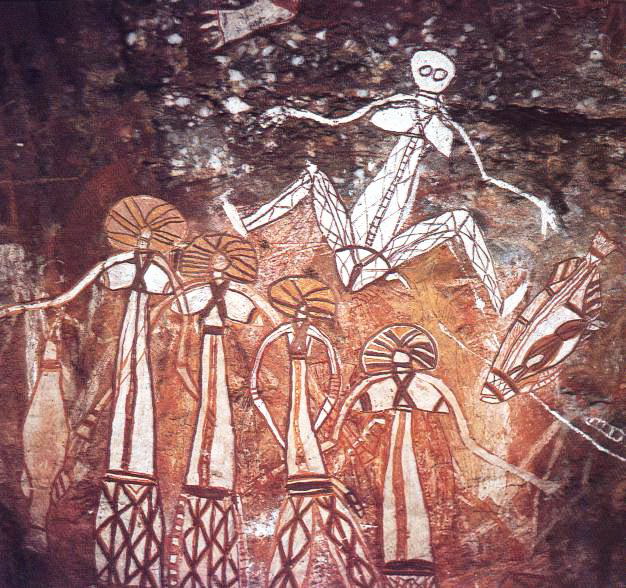
Everywhere the bullroarer is sacred, women are barred from it — classically on penalty of death. And everywhere men guard that secret, their own myths confess the same thing: the women had it first. A woman discovered it, made it, or gave birth to it; its roar is the voice of an Old Woman, a Mother, a pair of Sisters; and the men took it — usually by killing her. The taboo and the confession travel together, from Arnhem Land to the Sepik to the Amazon. That pairing — total exclusion resting on an admitted theft — is one of the strangest and most consistent facts in the whole bullroarer complex, and it is the subject of this page.
The men's cult, wherever we meet it, keeps a secret from women with lethal seriousness. Yet the secret itself, told to initiates at the heart of the ritual, is very often this: the thing we are hiding from the women belongs to the women. The pattern is so regular that the ethnographers who catalogued it treated it as a defining feature of the institution.
Gourlay's four cases
The cleanest statement of the pattern comes from the ethnomusicologist K. A. Gourlay, whose 1975 survey of “esoteric instruments” in New Guinea remains the standard treatment. His summary is worth quoting in full:
Similar themes in which the bullroarer is first associated with a woman but later becomes the man’s prerogative are found in such widely separated areas as the Ngaing (B) the Huon Gulf Busama (C), the Kiwai (E) and the Keraki Papuans (E). The Ngaing relate how the bullroarer was created by the deity Gab’me of Yakierak and placed in the net bag of an old woman. She tried various ways of whirling it but always failed. Later Gab’me taught her grandson the secret in a dream (Lawrence 1965:205). The Busama tell how a woman, chopping firewood, strikes off a chip which flies into the air with a whirring sound. Intrigued, the woman bores a hole in one end and strings it. Her husband borrows it to show his friends at the club house who, having difficulty in keeping the women out of the club, see the bullroarer as a means of keeping their cult secret from the women. They decide on the story that the bullroarer is the voice of a spirit which the women must not see on penalty of death. Unfortunately, one woman already knows and she will, therefore, ‘laugh at them’. The only means of keeping the secret is thus to kill the woman. The husband reluctantly agrees, the woman is speared to death and her remains buried, while the women are informed that she has been eaten by an ogre. From this time onwards the cult becomes an exclusively male secret (Bodrogi 1961:72-73; Hogbin 1951:214-15).
K. A. Gourlay, Sound-Producing Instruments in Traditional Society, 1975, p. 81.
Notice what the Busama story does. It is not only a myth about the bullroarer — it is a myth about the invention of the men's cult itself. The instrument is a woman's discovery; the spirit-voice is a cover story the men agree on; and the founding act of the exclusively male secret is the killing of the woman who knew. Every element of the institution — the taboo, the death penalty, the ogre tale told to the women — is presented, by the men who run it, as the machinery for keeping stolen property.
Australia: the voice of the Mother
In Australia the pattern runs deeper than a discovery tale. Across the north of the continent the bullroarer does not merely belong to a female being — it is her voice.
Kunapipi: the murdered Old Woman speaks
In the great Kunapipi (Gunabibi) fertility cult of Arnhem Land, the bullroarer is called mumuna — and the sound it makes, Ronald Berndt records, “is its ‘voice’, the ‘voice’ of Kunapipi or Mumuna herself when she was killed by Eaglehawk” (Berndt, Kunapipi, 1951). In the Mara version of the myth, Mumuna is the cannibal Old Woman who devoured the young men until Eaglehawk killed her; he then “cut a bullroarer from a tree, and in swinging it gave back her cry as ‘mumuna’” (Poignant, Oceanic Mythology, 1967). The instrument is her murder made permanent: the men killed the Mother, and now they carry her scream on a string. At the Mara initiation the novices are shown boys smeared with red paste and told: “Look at the colouring they have on their bodies: they are smeared with the inside liquids of Mumuna’s womb!” (Berndt 1951:160).
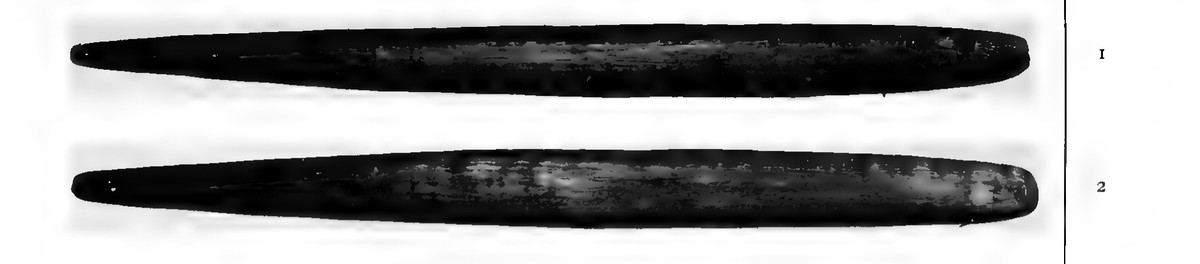
And Berndt’s male informants said the quiet part aloud. One explained the whole ritual economy to him in these words:
But really we have been stealing what belongs to them (the women), for it is mostly all woman’s business; and since it concerns them it belongs to them. Men have nothing to do really, except copulate…. all the Dreaming business came out of women — everything…. In the beginning we had nothing, because men had been doing nothing; we took these things from women.
Male informant, in R. M. Berndt, Kunapipi, 1951, p. 55; quoted in Chris Knight, Blood Relations, 1991, ch. 13.
Karwadi and the Punj bullroarer
Among the Murinbata of Port Keats, W. E. H. Stanner documented the Punj ceremony in which hidden bullroarers sound as “the voice of the Mother” — Karwadi, the Old Woman Mutjingga who swallowed the children and was killed for it (Stanner, On Aboriginal Religion, 1959–63). As Knight glosses Stanner’s account: “This ritual, it is said, was originally performed by ‘the Mother’ herself, until men sadly had to kill her and take her place with artificial replicas of her bloody presence” (Knight 1991). The Australian material and the Busama story are the same story: the men perform, with an instrument, a ceremony that was hers.
The Djang’kawu Sisters: “Haven’t we still our uteri?”
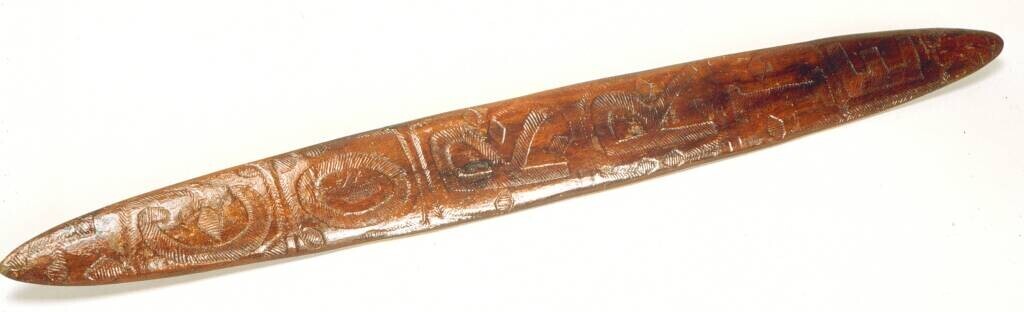
In north-east Arnhem Land the Yolngu Djang’kawu cycle makes women the original custodians not of one instrument but of the entire sacred order. “Originally the sisters were the owners of ceremonial law” (National Museum of Australia): the two Sisters carried the sacred rangga objects in their uterus-shaped baskets until their brother and his companions stole the bags. The Sisters’ response, in the song cycle Berndt recorded, concedes the ritual and keeps the power:
Men can do it now, they can look after it…. We know everything. We have really lost nothing, for we remember it all, and we can let them have that small part. For aren’t we still sacred, even if we have lost the bags? Haven’t we still our uteri?
R. M. Berndt, Djanggawul, 1952, pp. 40–41.
Berndt himself drew the conclusion in his introduction to the cycle: the likening of women to the sacred rangga “probably derives from the fact that women themselves are said to be the source of ritual knowledge, and consequently sacred” (Berndt, Djanggawul, 1952).
The related Wawilak cycle says the same of the men’s three great cults: the songs, dances, and rites all come from the Two Sisters, who returned as spirits and taught the two ancestral men in a dream — “This is all now. We are giving you this dream so you can remember these important things” (Warner, A Black Civilization, 1937, p. 259).
The Two Sisters on a string
Among the Warlpiri of the Tanami Desert, in Central Australia, the Gadjari ceremony makes the identification physical. Its central symbols are two bullroarers of different sizes, the smaller said to be the elder sister of the larger — and at the climax, Stephen Wild records, “the junior novices are permitted to watch the bullroarer being swung. They are told that it is the Two Sisters themselves” (Wild, “Men as Women: Female Dance Symbolism in Walbiri Men’s Rituals”, JASHM 4(3)). The name Gadjari — katjiri, in Wild’s spelling — itself means “woman.”
Central Australia: the alknarintja women
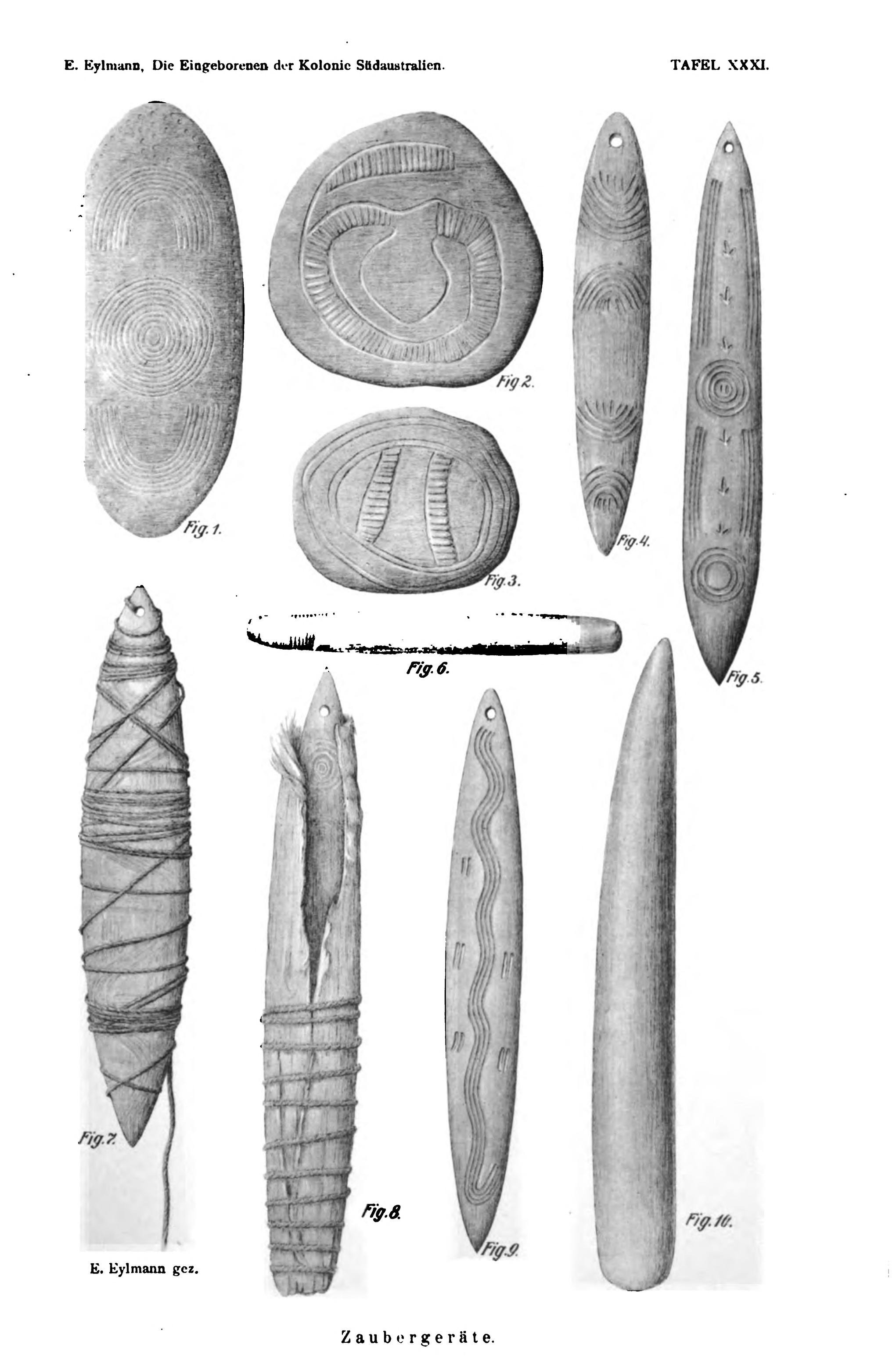
Even in the central deserts, where the public doctrine gives the bullroarer a male voice, the older layer shows through. Géza Róheim’s Aranda material is explicit: “It is a general Aranda belief that the small bull-roarer (namatuna)… was originally owned by the alknarintja women themselves. It then passed into the possession of men” (Róheim, The Eternal Ones of the Dream, 1945, p. 175) — part of what he called “the primeval superiority of women” in Australian tradition. In his ceremonial songs the ancestral alknarintja women menstruate, make bullroarers, and whirl them. And on Cape York, Róheim quotes a Wik-Munkan myth in which the women hand the instrument over themselves, with the whole future institution compressed into a few lines:
This is a moiya (bull-roarer) we have found! We women! It is we who have found it! But no matter! We will hide it for the men! It is they who will swing it! To us it will be forbidden!
Wik-Munkan myth, in G. Róheim, The Eternal Ones of the Dream, 1945, p. 175.
New Guinea: discovered, birthed, and stolen
New Guinea supplies the densest cluster of women-first bullroarer myths anywhere — Gourlay’s four cases above, and more besides. Each adds its own detail to the same skeleton.
Kiwai: “the mother of yams”
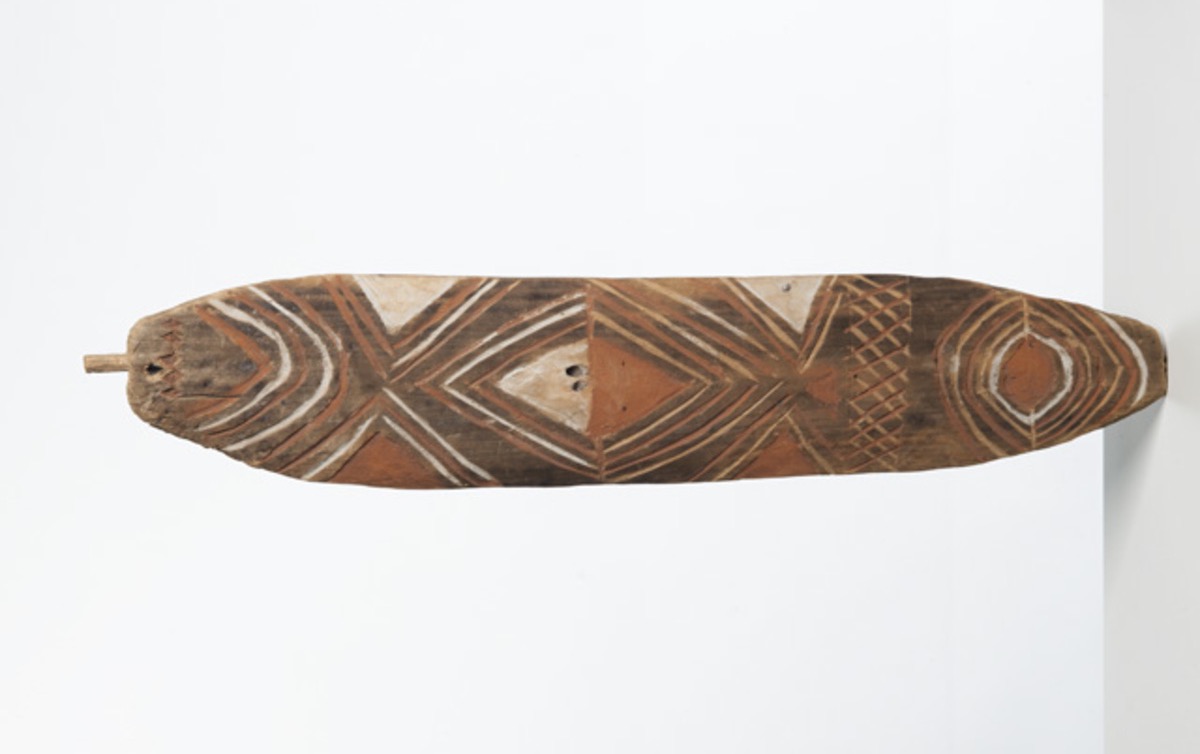
Among the Kiwai of the Fly estuary, tradition holds that a woman discovered the bullroarer (madubu) near Bugi; she showed it to her husband, who dreamed that the spirit of the wood ordered it made in the men’s club-house, sacred, and hidden from every woman and child (Haddon, Reports of the Cambridge Anthropological Expedition to Torres Straits I, 1935, pp. 219–20, quoting Baxter Riley). In the Kiwai’s own version the instrument was brought over from the island of Boigu — where, once again, the discovery story begins with a woman — and they call it umamomaramu, “the mother of yams.” Landtman collected that Boigu story in full: an old woman named Méte picks up a splinter that flies whizzing from her firewood, and in a dream the instrument tells her its name and its garden magic. It is her husband who stages the unveiling — drawing his bow on the assembled men with the warning “What man he tell him woman I shoot him” — while Méte, listening from among the banished women, “pretended to be frightened” (The Folk-Tales of the Kiwai Papuans, 1917, no. 261, pp. 316–17). Jan van Baal, reviewing the same material, remarked: “Though by no means uncommon, it certainly is remarkable that the origin of the bull-roarer is attributed to a woman” (“The Cult of the Bull-Roarer in Australia and Southern New Guinea”, BKI 119, 1963, p. 205).
Keraki: born of a woman
The Keraki of the Trans-Fly push the claim to its limit: the first bullroarer was not found by a woman but born of one. In the myth recorded by F. E. Williams, the originator’s wife is pregnant with the first bullroarer; it hums in her womb whenever she stirs; and a little bird snatches it from her genitals, drawing “the first menstrual blood” (Williams, Papuans of the Trans-Fly, 1936, pp. 307–8, as given in van Baal, Dema, 1966, pp. 269–70). A now-obsolete Keraki rite re-enacted the plucking. The bullroarer, in other words, is the woman’s first-born child — and the men keep it.
Ilahita: Mimi’unemb
Among the Ilahita Arapesh of the Sepik, the woman even has a name. “It was the woman who, long ago, made the first bullroarer (walop), which was named Mimi’unemb” (Tuzin, The Voice of the Tambaran, 1980). In the fuller telling, she terrorized everyone with it until a man stayed behind to see what made the sound, judged that “a voice this big should not be made by a woman,” and killed her (Metzner, Pulse of the Planet, 1994). Publicly the instrument is the voice of the male spirit Lefin; the female origin is the cult’s inner secret — exactly the Busama structure, with the theft remembered inside the institution built to conceal it.
Marind-anim: the women were already playing it
In the Verschueren version of the Marind-anim Sosom myth, the giant arrives at Yavar-makan to find the rites already in progress — run by women. “There he met with women celebrating the sosom-rites. For two days already they had been whirling the bullroarers, but Sosom went up to them and said: ‘Aye, women, from now on you may only follow the mayo-kai…; men only may go with me’” (van Baal, Dema, 1966, p. 272). In the Wirz variant the displacement is franker still: the women held their own secret feast, and the men “invented Sosom so as to frighten the women” (Wirz, Die Marind-anim III, p. 39, in van Baal).
Boadzi: “we kill the old woman”
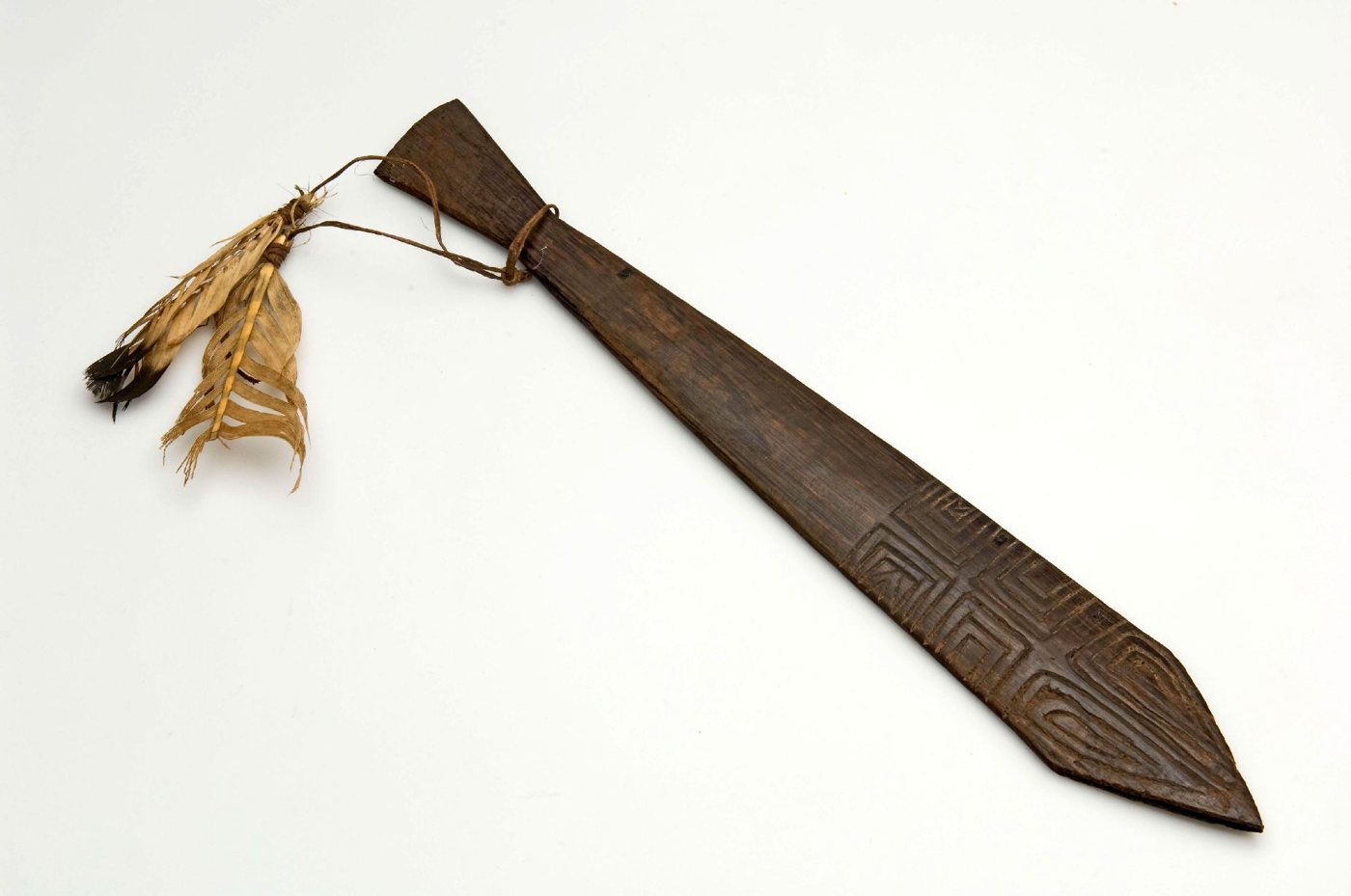
Just up the Fly from the Marind, among the Boadzi, the bullroarer is called atu gisagaru — “voice of the old woman” (van Baal, Dema, 1966, p. 590). The gomai ritual climaxes with the initiates crying, in van Baal’s rendering, “…we kill the old woman” (p. 593); the women at home are then told, step by step, that the men are eating the flesh of the atu, burning her excrement, and burying her bones. Van Baal’s own comment could stand as the epigraph for this whole page: “The association of so eminently phallic an object with a female deity is surprising and raises many questions” (p. 595). And on the upper Bian the instrument is a married couple: two bullroarers, the ézam (husband) and the uzum (wife) — “the bullroarer, among the eastern coastal Marind the voice of Sosom, the man, among the Boadzi that of the atu, the old woman, is the voice of both Ezam and Uzum among the upper Bian Marind” (p. 597).
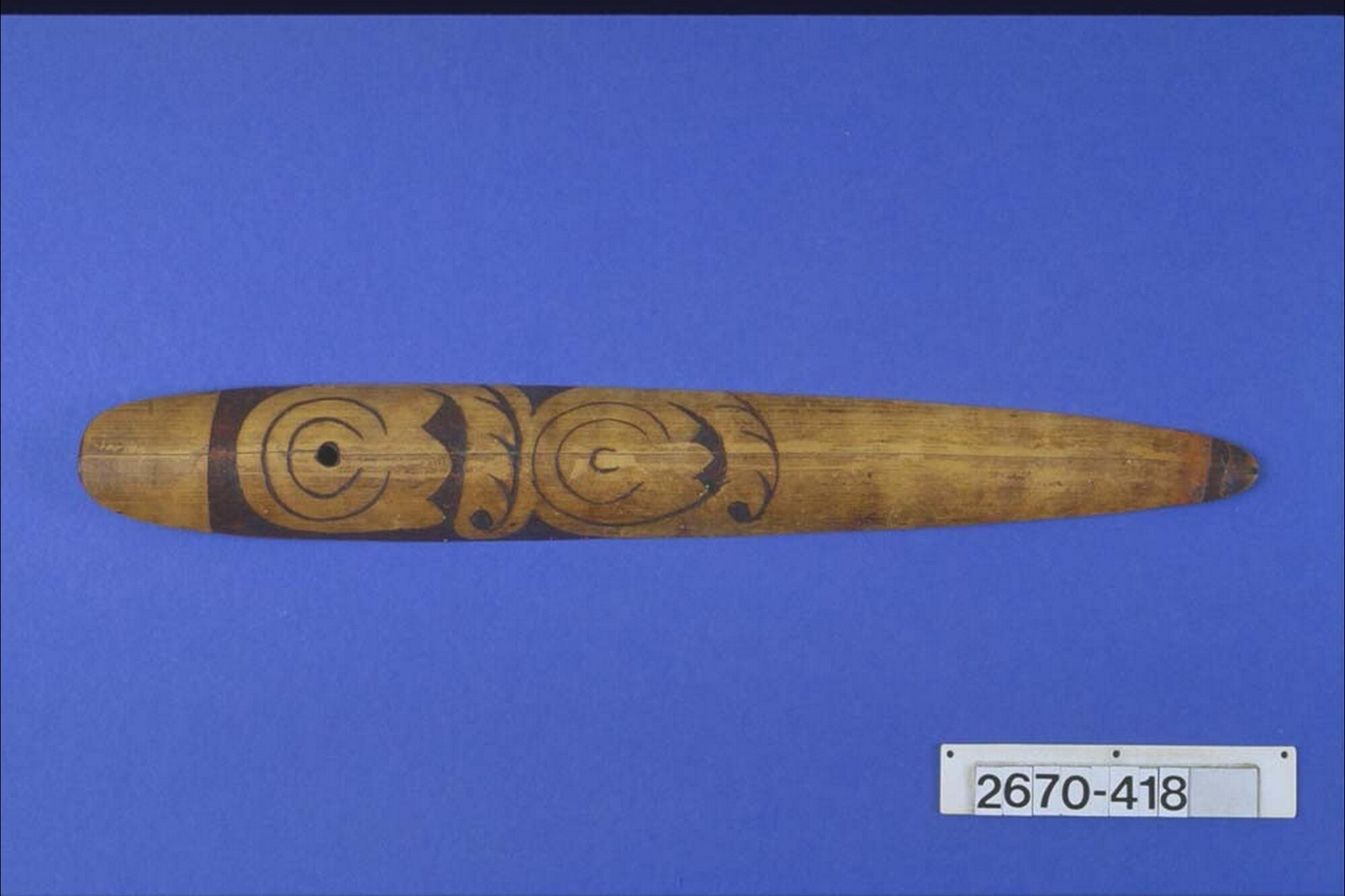
Atu gisagaru — “the voice of the old woman.”— the Boadzi name for the bullroarer, in van Baal, Dema (1966), p. 590
The sister instruments: the same theft, half a world away
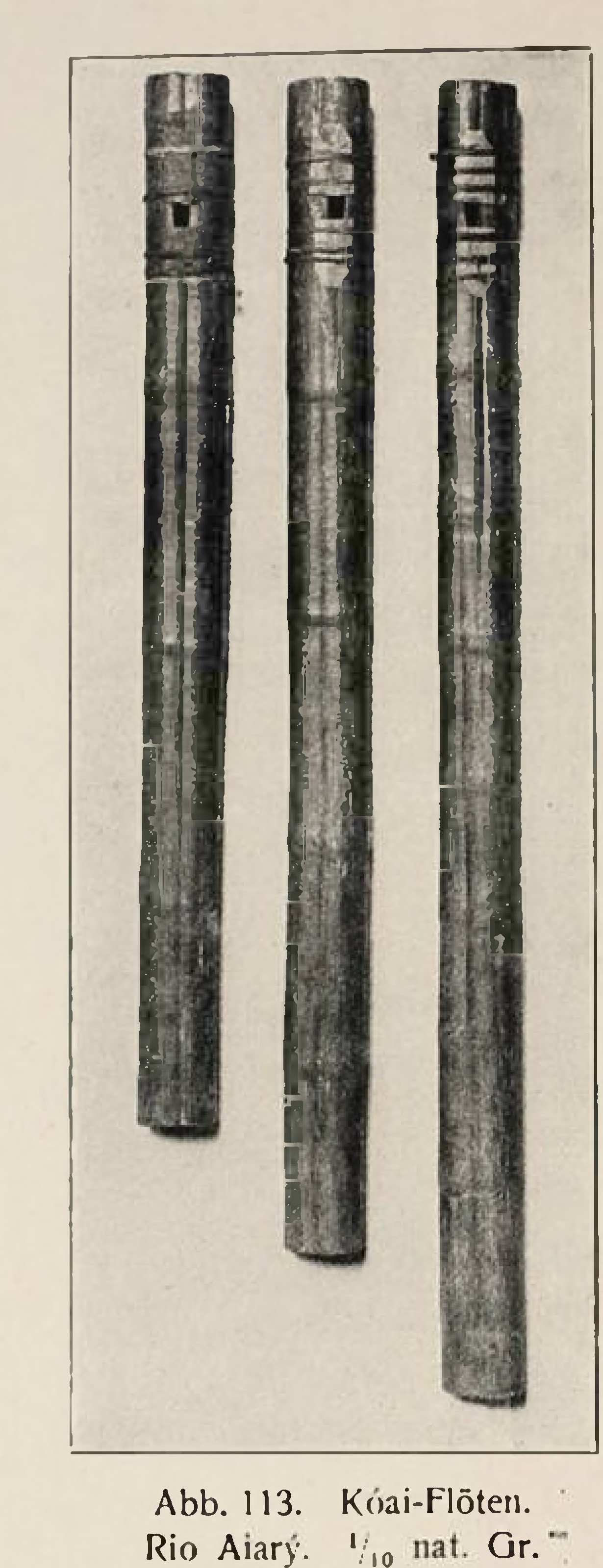
Cross the Pacific and the men’s cult reappears — the sacred sound-instruments, the death-penalty taboo, the initiation, the spirit voice. In Amazonia the instrument at the center is usually the sacred flute or trumpet rather than the bullroarer. It does not matter. The charter myth is the same myth, told of the same complex, on a sibling instrument — and as the Ice Age section below shows, flutes and bullroarers have travelled together since the beginning. What recurs, again and again, is the idea itself: there is a men’s mystery cult, and its sacred voice originally belonged to the women.
In the northwest Amazon, the Baniwa and their Arawakan neighbors tell how “Kuwai’s mother and the women steal these flutes and trumpets and flee from Nhiaperikuli to the hill called Mothipana, where they hold the first female initiation ritual”; the culture-hero then summons his allies and makes war on the women, taking the instruments back and barring women from them forever (Wright, “The Kuwai Religions of Northern Arawak-Speaking Peoples”, Boletín de Antropología). In the Tukanoan Yuruparí epic recorded by Barbosa Rodrigues in 1890, it is the Sun’s daughter who discovers the hidden instruments, and the women who take over the rites — inverting the social order until the men reclaim them. In the Barasana branch of the same complex the primordial being is Romi Kumu, the Woman Shaman (Hugh-Jones, The Palm and the Pleiades, 1979).
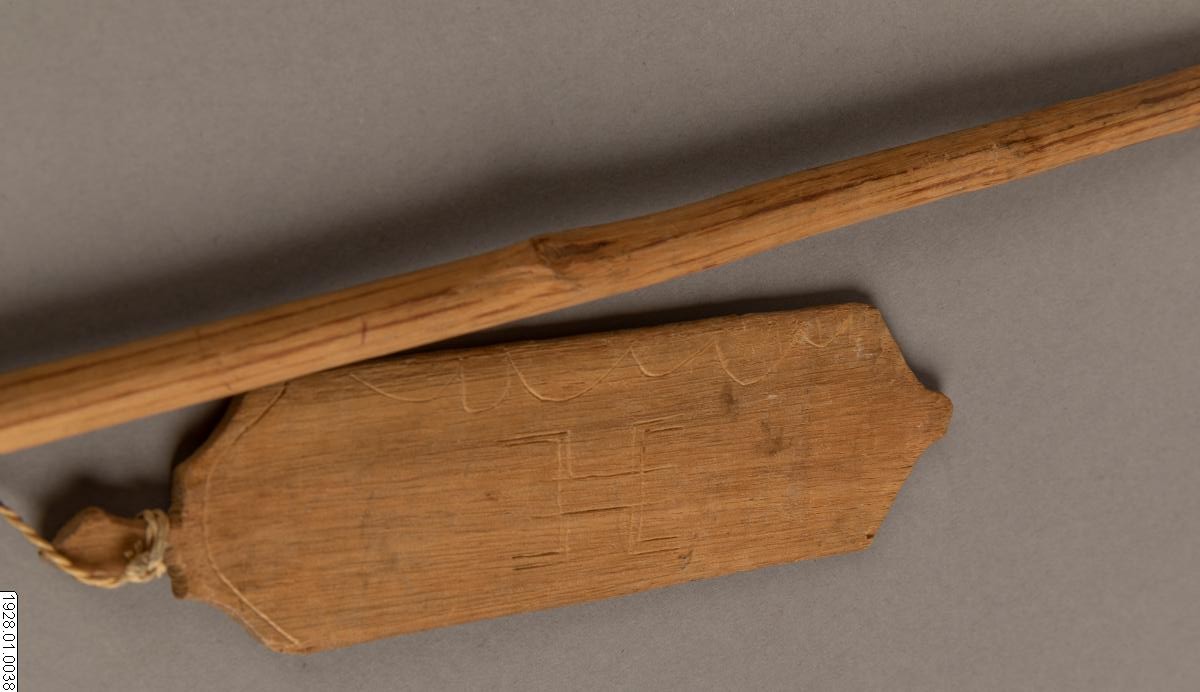
Among the Mundurucú, the myths say the men gained control of the sacred trumpets that the women previously controlled, and in doing so subdued the women themselves (Murphy & Murphy, Women of the Forest, 1974). In the Upper Xingu, the Mehinaku and their neighbors say women were the original owners of the sacred flutes until the men attacked the women’s village and seized them (Gregor, Anxious Pleasures, 1985) — and in the Kamayurá telling, the instrument the male twins used to scare the women away from the flutes was the hori hori: the bullroarer. The bullroarer is there at the founding scene of the theft, on the men’s side of it.
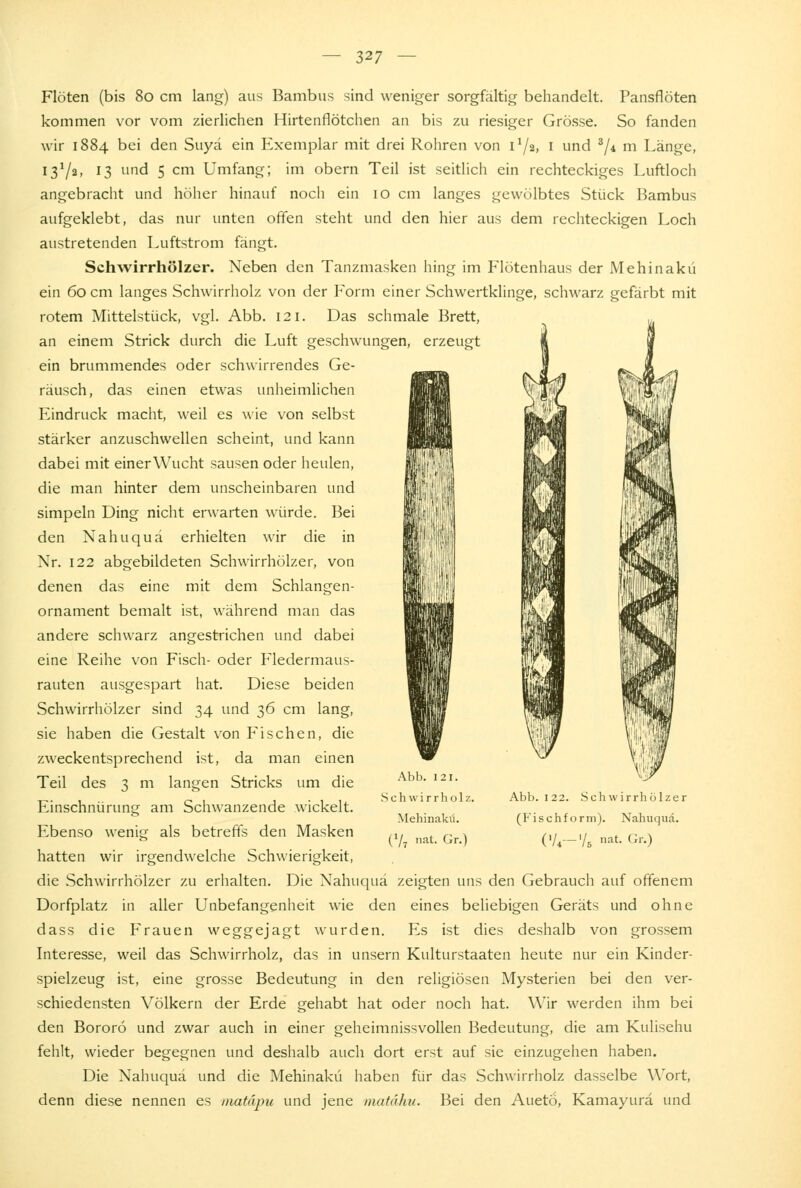
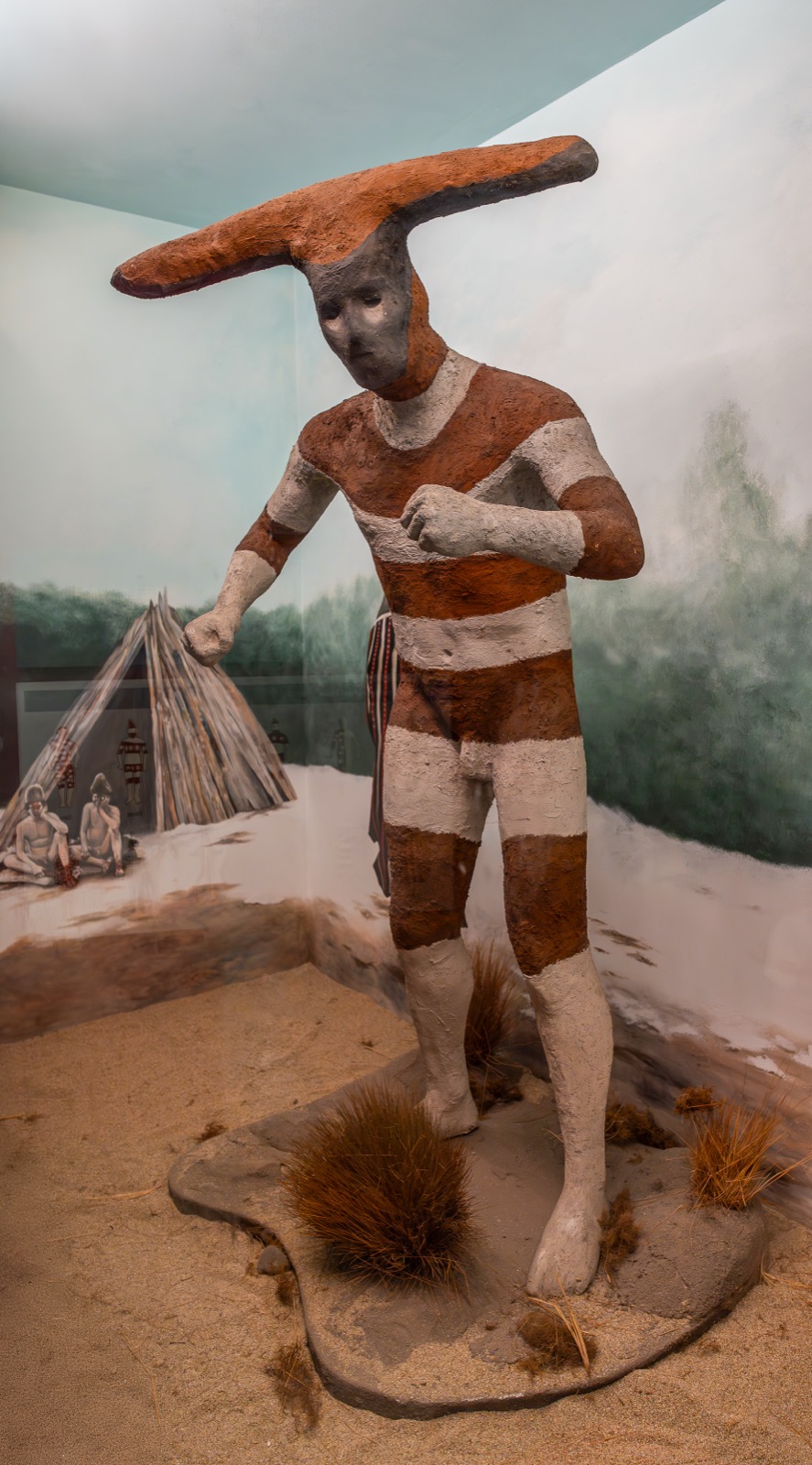
At the far southern tip of the Americas the Selk’nam of Tierra del Fuego told the most explicit matriarchy-overthrow myth on record: in the mythic past the women ran the ceremonial lodge, impersonating the spirits to keep the men in awe, until the men discovered the masquerade, killed the women, and took over the Hain — running the identical theater on the women from then on (Gusinde, Die Feuerland-Indianer, 1931; Chapman, Drama and Power in a Hunting Society, 1982). No instrument even needs to change hands here: what the men steal is the spirit-voice itself, the secret of impersonation that is everywhere the bullroarer’s job. It is the same charter, stripped to its logic.
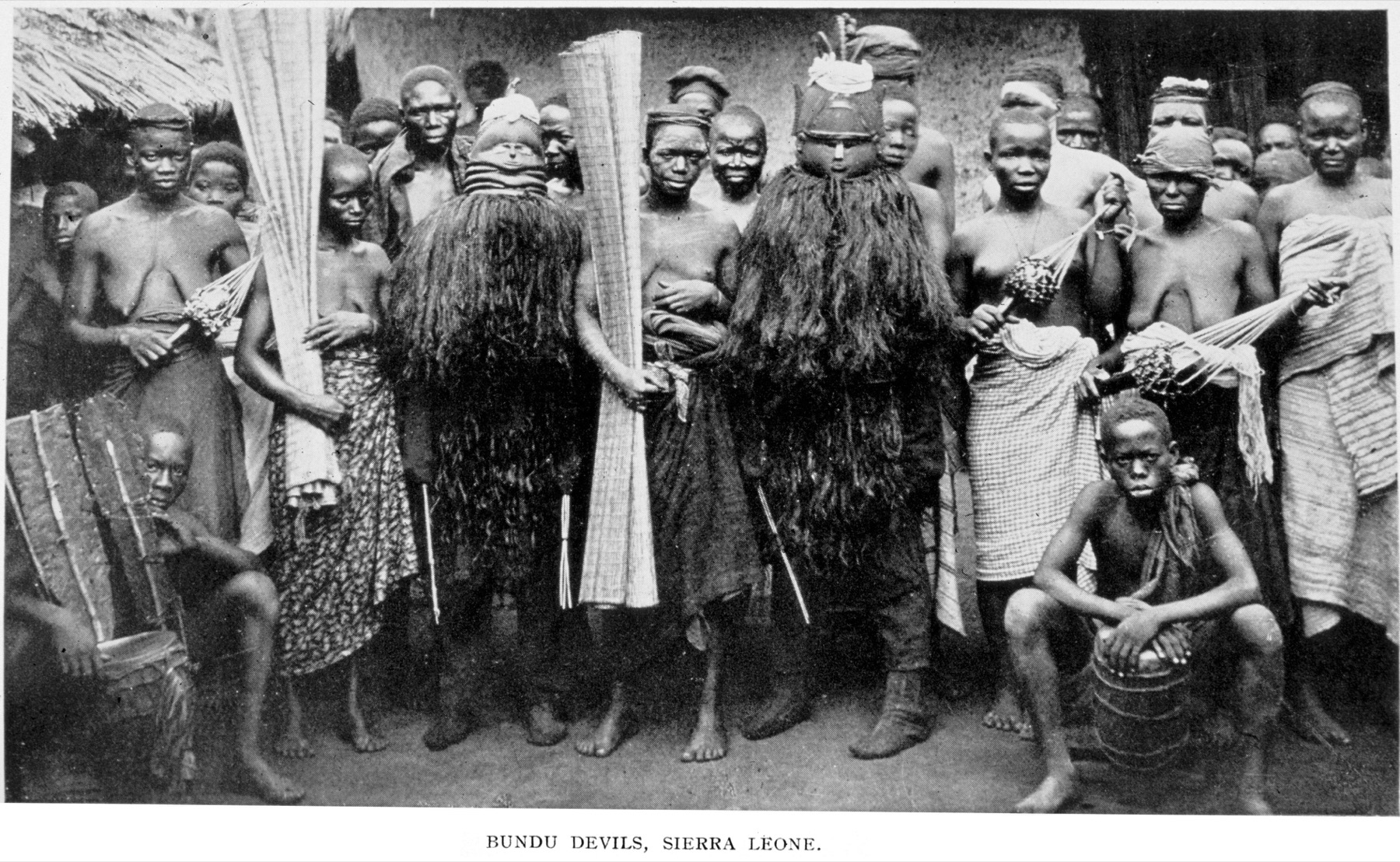
And West Africa keeps a living counter-proof that women can run exactly this kind of institution: in Sierra Leone and Liberia the Sande (Bundu) society of the Mende and their neighbours — the celebrated exception among the world’s masking traditions — is a secret initiation society owned by women, whose masked spirit is danced by a woman.
The Mother of the Gods
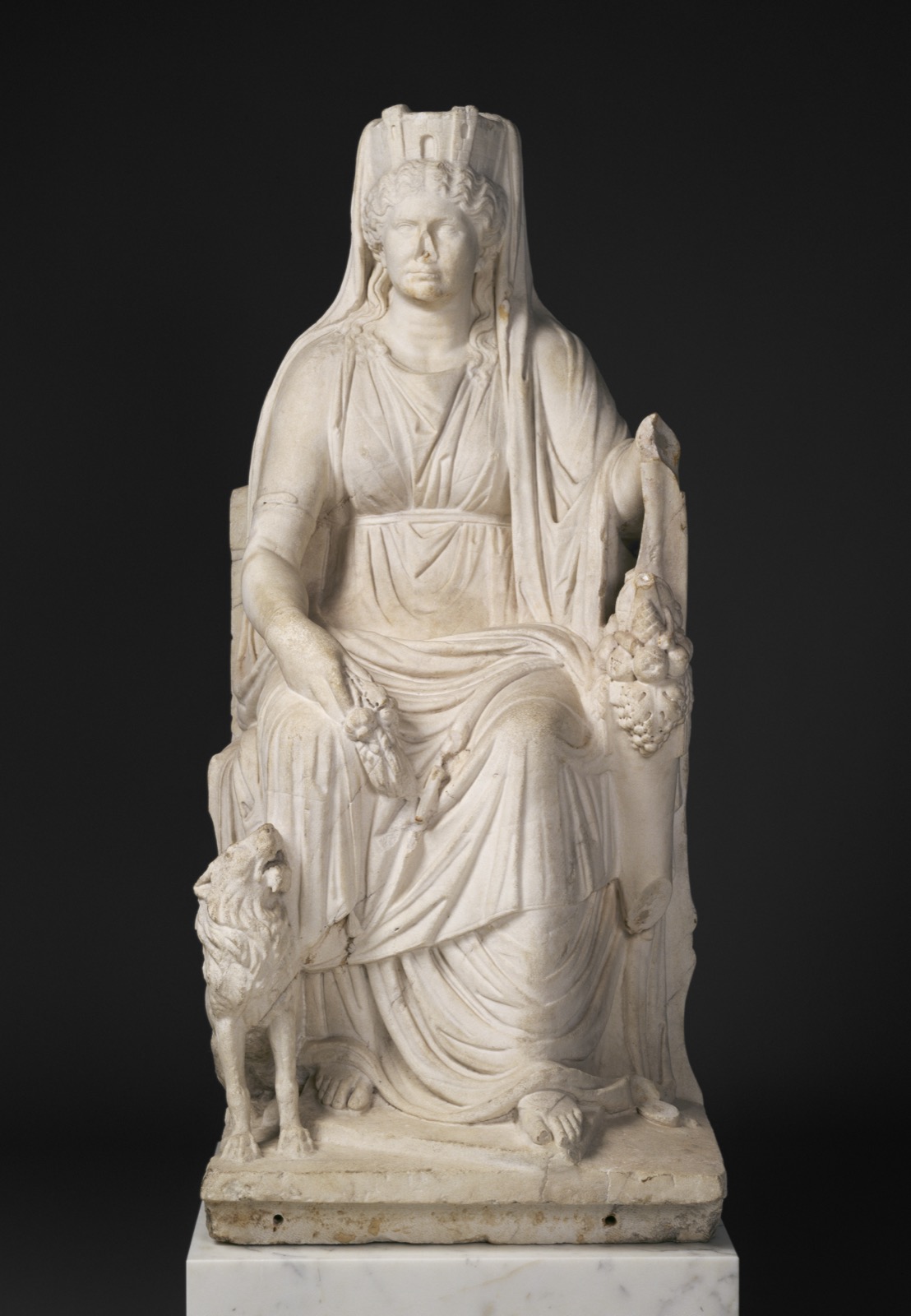
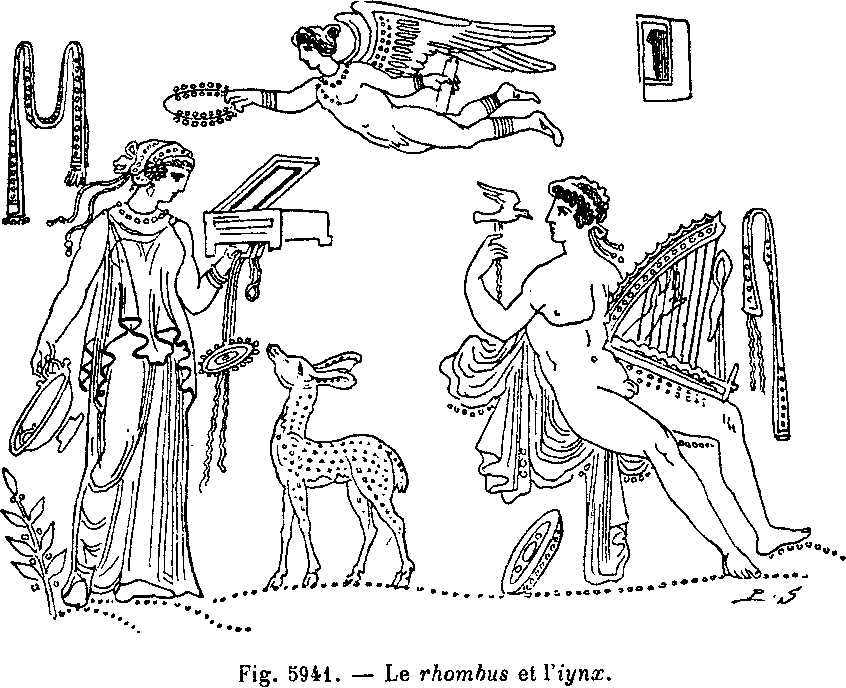
The old world remembers the female connection in a different register: not a theft, but a goddess. In the Greek sources the rhombos — the whirled bullroarer — belongs to the ecstatic rites of the great Mother. Apollonius of Rhodes, describing the cult the Argonauts founded for Rhea on Mt Dindymon, writes: “Hence from that time forward the Phrygians propitiate Rhea with the wheel and the drum” (Argonautica, Book 1) — the whirling “wheel” read, since Jane Harrison, as the rhombos. Rhea and her Anatolian double Cybele, the Mother of the Gods, are the great devouring-and-generating goddess of the ancient Mediterranean; her mysteries roared. The instrument that speaks for the Old Woman on the Fly River and for the Kunapipi Mother in Arnhem Land turns up, at the edge of written history, in the orbit of the Mother of the Gods.
The Ice Age root
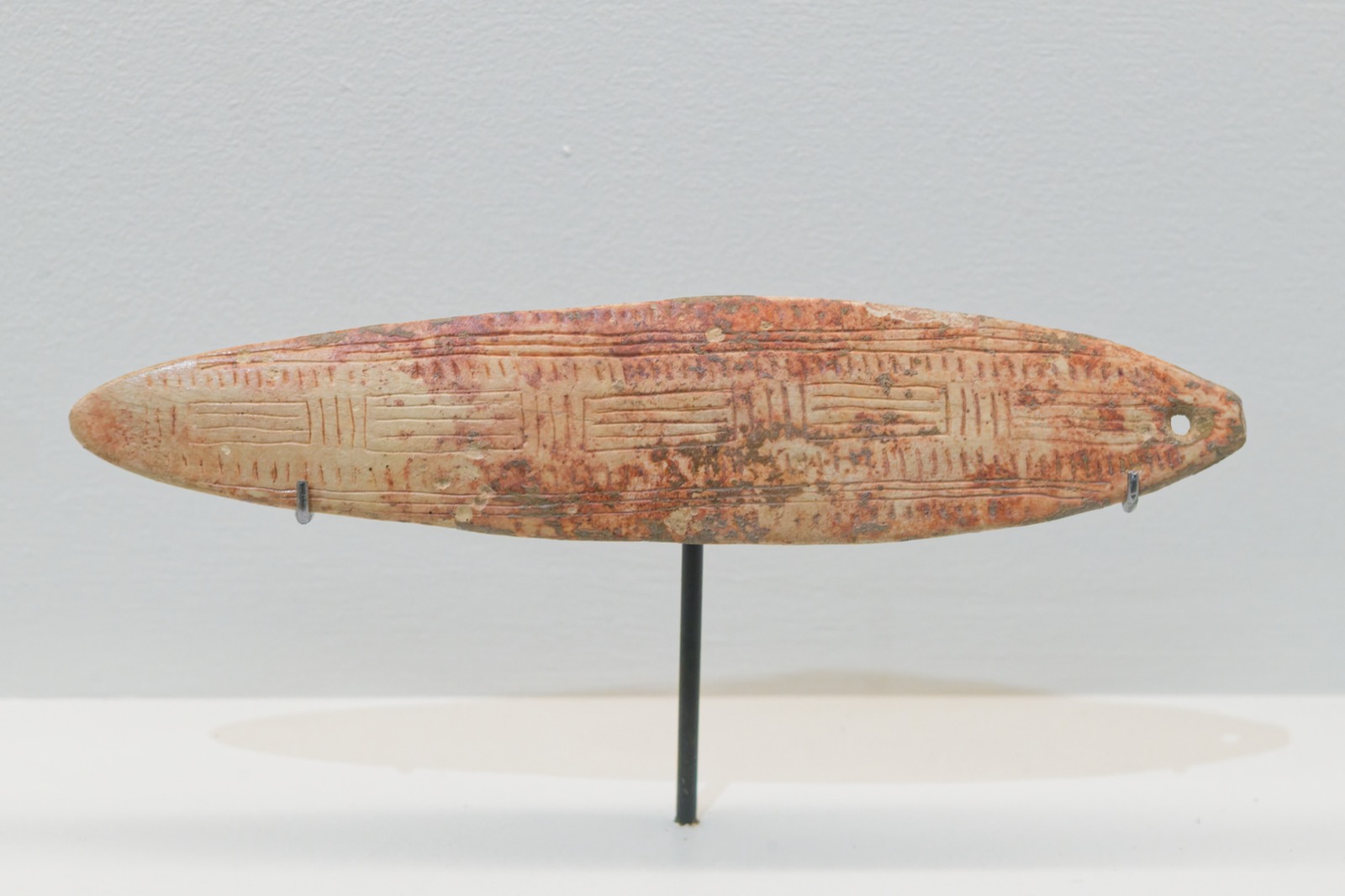
This whole complex — the roaring instrument, the initiation, the exclusion of women, the charter myth — originated once, in the Upper Paleolithic of Europe, and spread. The oldest bullroarers we have are Magdalenian and earlier: the ochred reindeer-antler rhombe from Lalinde above, the six from Lortet and the ten from Bourrouilla in the Pyrenees, and others reaching back into the Solutrean.
And they come from the same world as the bone flutes. Isturitz cave in the French Pyrenees yielded both: some twenty bone pipes, running from the Aurignacian through the Magdalenian, and two Magdalenian bone bullroarers (Saint-Périer 1936; Buisson 1990; Barandiarán 2015). At Laugerie-Basse in the Dordogne, a Magdalenian bullroarer and a Magdalenian bone whistle come from the same rock shelter. The specialists who catalogue prehistoric sound-tools — Michel Dauvois, whose acoustic experiments confirmed that the Paleolithic rhombes and pipes still sound, and Iain Morley in The Prehistory of Music (2013) — treat the whirled rhombes, the bird-bone pipes, and the phalange whistles as a single Magdalenian instrumentarium.
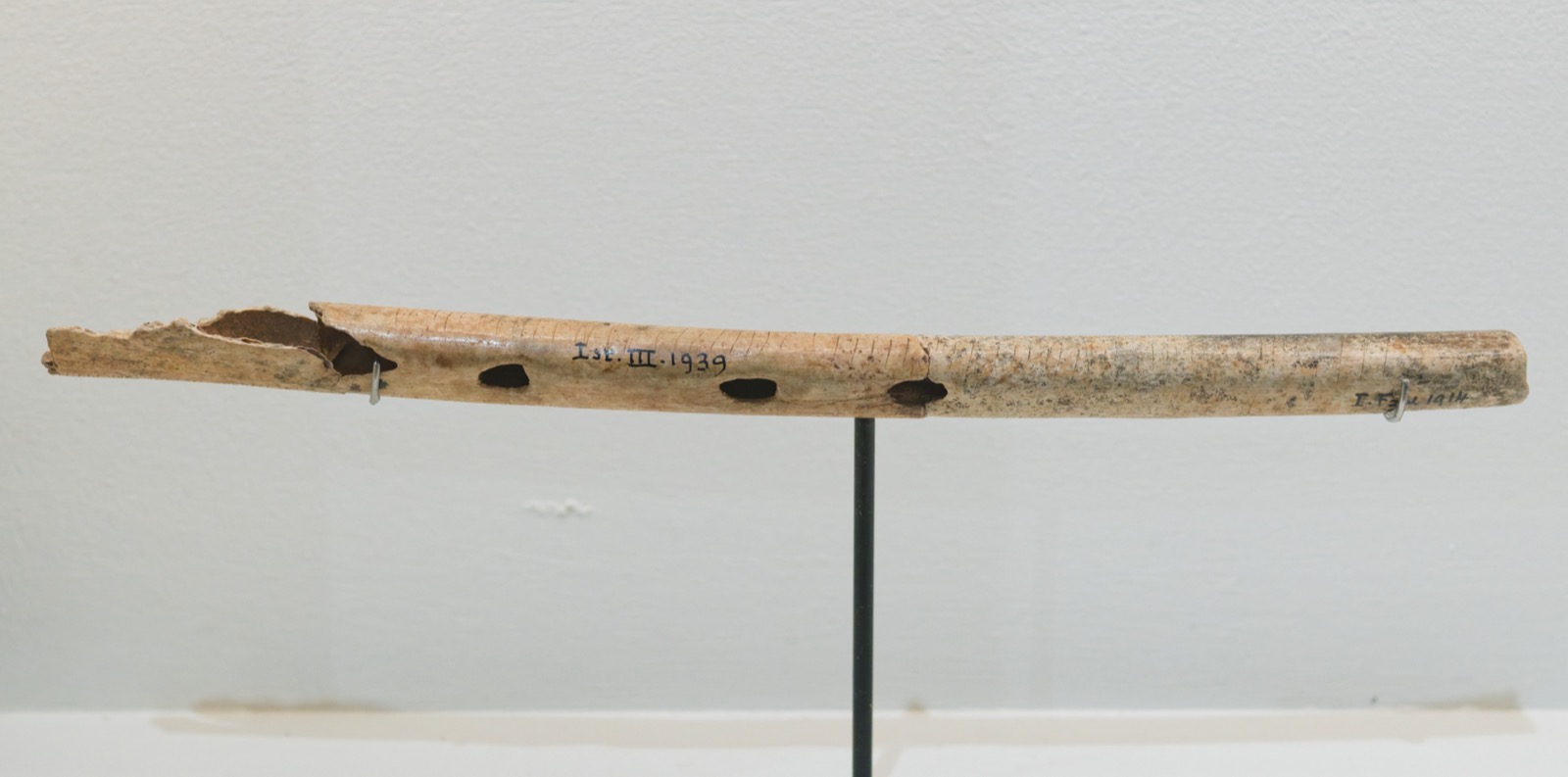
Flutes, in other words, were part of the complex from the beginning. When the Baniwa say the women held the flutes first and the Busama say a woman found the bullroarer first, they are telling the same inherited charter myth on sibling instruments of the original kit. The women-first story tracks the complex, not the particular piece of wood or bone.
What the scholars say
The recurrence was too regular to escape theory, and the theories split along a familiar line.
The sociological reading, classically Joan Bamberger’s, treats the women-first story as a charter myth in Malinowski’s sense — a story that justifies the present order by projecting it into the past. “The myth, in its reiteration that women did not know how to handle power when in possession of it, reaffirms dogmatically the inferiority of their present position” (Bamberger, “The Myth of Matriarchy,” in Woman, Culture, and Society, 1974, p. 279); it “is but the tool used to keep woman bound to her place” (p. 280).
The psychoanalytic reading takes the myth’s content seriously as male self-report. For Alan Dundes, “the bullroarer is a substitute symbolic procreative instrument, purloined from women, its original possessor, allowing the possessor to symbolically give birth” (Dundes, “A Psychoanalytic Study of the Bullroarer,” Man 11, 1976, pp. 220–38). L. R. Hiatt read the Australian rites as pseudo-procreation — men ritually appropriating female reproductive power, the bullroarer doubly coded as phallus and as the Mother’s voice (Hiatt, “Secret Pseudo-Procreation Rites,” 1971) — the same double coding that startled van Baal on the Fly. On this reading Berndt’s informant was not theorizing but confessing: we took these things from women.
The comparative fact itself was put squarely on the table by Thomas Gregor and Donald Tuzin — the ethnographers of the Mehinaku and the Ilahita respectively — whose Gender in Amazonia and Melanesia (2001) is built on the point that two regions separated by half a planet run the same men’s cults on the same women-first origin myths. They leaned toward independent invention from a shared male psychology. The atlas reads the same data the other way: the complex is too coordinated — instrument, taboo, death penalty, initiation, spirit-voice, and the women-first confession, bundled together on three continents — to be reinvented from scratch each time, and the Ice Age co-occurrence of its instruments gives the diffusionist reading a root and a date. Where the charter myth occurs, from Arnhem Land to the Sepik to the Xingu, it occurs whole — and a story that travels whole has travelled.
Hers first
Step back and the shape of the institution is unmistakable. On three continents the same bundle arrives intact: a roaring instrument, a men’s lodge, a death-penalty taboo, a spirit-voice told to the women — and, folded inside it as its innermost secret, the confession that the whole apparatus is stolen goods. The Busama spear the woman who knew; Eaglehawk cuts a slat so the murdered Mother’s scream can live on a string; the Boadzi initiates cry “we kill the old woman” while the roarer sounds in her voice; the Baniwa hero makes war on the women to take the instruments back; the Selk’nam men burn the women’s lodge and run her theater themselves. A charter this elaborate, told in the same order with the same parts from Arnhem Land to the Sepik to the Xingu to Tierra del Fuego, is not a coincidence of independent guilty consciences. It is one inherited story, carried with the instrument itself — from a kit, already assembled in the Magdalenian caves, in which the roarer and the flute travelled together.
And the men who keep the secret are the ones who keep saying so. Berndt’s informant put the whole of it in one line: “all the Dreaming business came out of women — everything.” Everywhere the bullroarer is sacred, women are barred from it on penalty of death; and everywhere, in the men’s own telling, the voice on the string is hers.
Key sources
- Gourlay, K. A. 1975. Sound-Producing Instruments in Traditional Society. New Guinea Research Bulletin 60. ANU Press.
- van Baal, J. 1963. “The Cult of the Bull-Roarer in Australia and Southern New Guinea.” BKI 119:201–14; 1966. Dema.
- Haddon, A. C. (ed.). 1935. Reports of the Cambridge Anthropological Expedition to Torres Straits, vol. I.
- Williams, F. E. 1936. Papuans of the Trans-Fly.
- Lawrence, P. 1965. “The Ngaing of the Rai Coast,” in Lawrence & Meggitt (eds.), Gods Ghosts and Men in Melanesia.
- Bodrogi, T. 1961. Art in North-East New Guinea; Hogbin, I. 1951. Transformation Scene.
- Tuzin, D. 1980. The Voice of the Tambaran.
- Berndt, R. M. 1951. Kunapipi; 1952. Djanggawul.
- Stanner, W. E. H. 1959–63/1966. On Aboriginal Religion. Oceania Monographs.
- Warner, W. L. 1937. A Black Civilization.
- Róheim, G. 1945. The Eternal Ones of the Dream; 1974. Children of the Desert.
- Wild, S. “Men as Women: Female Dance Symbolism in Walbiri Men’s Rituals.” JASHM 4(3):166–83.
- Knight, C. 1991. Blood Relations: Menstruation and the Origins of Culture.
- Wright, R. M. “The Kuwai Religions of Northern Arawak-Speaking Peoples.” Boletín de Antropología.
- Gregor, T. 1985. Anxious Pleasures; Murphy, Y. & R. Murphy. 1974. Women of the Forest.
- Gusinde, M. 1931. Die Feuerland-Indianer I; Chapman, A. 1982. Drama and Power in a Hunting Society.
- Bamberger, J. 1974. “The Myth of Matriarchy,” in Rosaldo & Lamphere (eds.), Woman, Culture, and Society.
- Dundes, A. 1976. “A Psychoanalytic Study of the Bullroarer.” Man 11(2):220–38.
- Hiatt, L. R. 1971. “Secret Pseudo-Procreation Rites Among the Australian Aborigines.”
- Gregor, T. & D. Tuzin (eds.). 2001. Gender in Amazonia and Melanesia.
- Apollonius Rhodius. Argonautica 1; Harrison, J. E. 1912. Themis.
- Barandiarán, I. 2015. Kobie BAI 6; Morley, I. 2013. The Prehistory of Music; Dauvois, M. Instruments sonores et musicaux préhistoriques.