Atlas Essay — 2026-10-06
The Little People of the Bullroarer
The Bandiagara cliffs, Mali · the MacDonnell Ranges, Central Australia · southern New Guinea · the Sepik hills · the Hopi mesas · the mountains of central Arizona
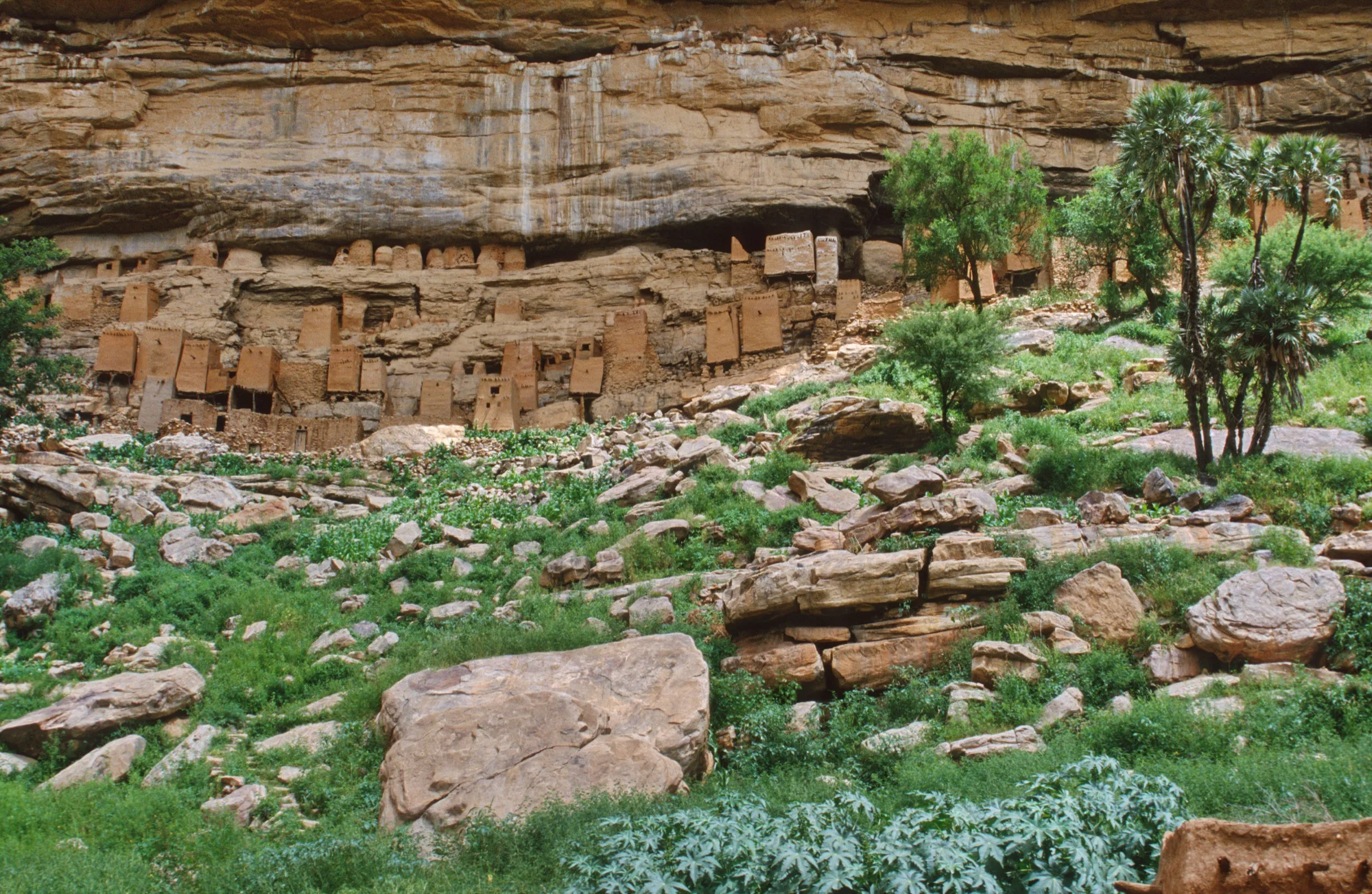
Two women were working near the village when they heard drums, dancing, and the roar of a bullroarer. Creeping closer, they found the Andoumboulou at their festival: the first people ever made, no taller than a man's forearm, long-bearded, drinking millet beer and dancing in red fibre around a great pole while an old man watched from an iron seat. One of the women told her husband. He sent her back with stones. When she threw them, the little people fled into the cliffs and left everything behind: the costumes, the mask, and an iron bullroarer. That is how the Dogon of Mali came to own the masks and the roaring voice that guards them. On the other side of the world, in the desert ranges of Central Australia, Aranda women and children were told of another crowd of little men, who wound live snakes around their bodies and walked on one leg. Their voice was the bullroarer too.
In bullroarer cults scattered across the world, with no common root, the roarer belongs to little people who were here first: they owned it before us, they are it, or they come when it calls.
In brief
- In bullroarer cults scattered across the world, with no common root, the roarer belongs to little people who were here first: they owned it before us, they are it, or they come when it calls.
- Among the Dogon of Mali, the Andoumboulou were the first humans created, and their height “does not exceed the forearm.” Driven off by a woman's stones, they abandoned an iron bullroarer, and the Dogon still forge iron roarers to remember it. In a second Dogon telling, a small, big-headed yéban is caught whirling the first roarer for fun.
- In Central Australia, the Aranda told of many little men called Tuanjiraka, and their Luritja neighbours of the Maiutu, “the short ones,” and the Apuju, “the whirring ones.” They wore live snakes, walked on one leg, killed and revived boys, and vanished underground. The novice is handed the bullroarer and told: “This tjurunga you shall call Tuanjiraka.”
- In southern New Guinea, the Bian Marind bullroarer bears the name of Ezam, a small, dwarfish being who lives under the ground and is as old as the earth. In the Sepik hills the Ilahita Arapesh roarer is the voice of Lefin, a little man with a huge red beard.
- In Arizona, the Hopi War Twins, “both being very small,” steal the thunder board and whirl up the rain, and a Yavapai healer whirls his bullroarer to call the Kakaka, tiny mountain people who were here before any humans.
- At the edges of the pattern, Seri sea animals answer the bullroarer singing “as if they were little people,” a Sámi diviner's roarer is answered from a cave where the small people below may live, and Dubois's history of Maré, describing the island's first, very small inhabitants, says the people of Maré then knew the bullroarer.
The Andoumboulou left it in the dust
The Dogon live along the Bandiagara escarpment in Mali, a sandstone cliff that runs for some two hundred kilometres above the plain south of the Niger bend. Their villages stand at its foot. Higher up, in ledges and caves that no one could climb to today, stand the small mud buildings of the people who came before. The Dogon call those builders the Tellem, and they say the Tellem learned to build in the cliff from older beings still: the Andoumboulou.
Marcel Griaule, who worked among the Dogon from 1931, set down what his informants said of them in Masques dogons (1938). The Andoumboulou were the first human beings God made. Their name, he thought, came from words meaning “short men.” They have vanished, yet they are still there, invisible, in the cliffs. “Their height does not exceed the forearm,” and they wear long beards. They taught the Tellem to raise walls on sheer rock by hauling the materials up on iron chains and making the mud bricks climb the cliff with spells. Traces of them turn up in the bush: a necklace no one owns, a coloured stone, an unexplained smell of cooking. They steal children who sleep too near their invisible villages, and leave their own in exchange, big-headed and bald, a child that never grows.
The Andoumboulou also had the first masks, and the first bullroarer. Griaule's account of how the Dogon got them begins with a family of thirty men who would later found the village of Yougo Dogorou. One man's wife was at work outside the village with a younger woman when the two of them heard drums, the sounds of a dance, and “the roar of a bullroarer.” They crept close and saw the Andoumboulou celebrating the Sigui, the great festival of the dead, in red fibre skirts and hoods, around a staff painted white, red and black that propped up a great wooden pole. An old man named Albarga sat on an iron seat beside it. A dancer wore a wooden mask of an old man, and the bullroarer sounded like that old man's groans as he struggled to get up.
The woman ran home and told her husband. He sent her back with stones. She threw them, and the Andoumboulou fled. Only old Albarga, struck by a stone, could not run, because the blow had made him unclean in the eyes of the others. Around him lay all that the dancers had dropped: skirts, hoods, bracelets, the painted staff, a crook-shaped seat, “an iron bullroarer and the wooden mask.”
The woman put on the fibres and walked into the village, and everyone fled from her, her husband with them. She hid the costume in her granary. An old man told the husband where it was, and told him to put it on and show himself to her. He did, met her on the path, and beat her with his stick until she ran into the house of the menstruating women. From then on the men kept the gear of the Andoumboulou. Until that day, Griaule's informants said, the women had ruled the men and grown more powerful every year. The men put the costumes and the bullroarer in a shelter apart and shut the captured Albarga in with them. He lived on there, and taught the men the ways of the masks. The wooden mask was named Albarga after him.
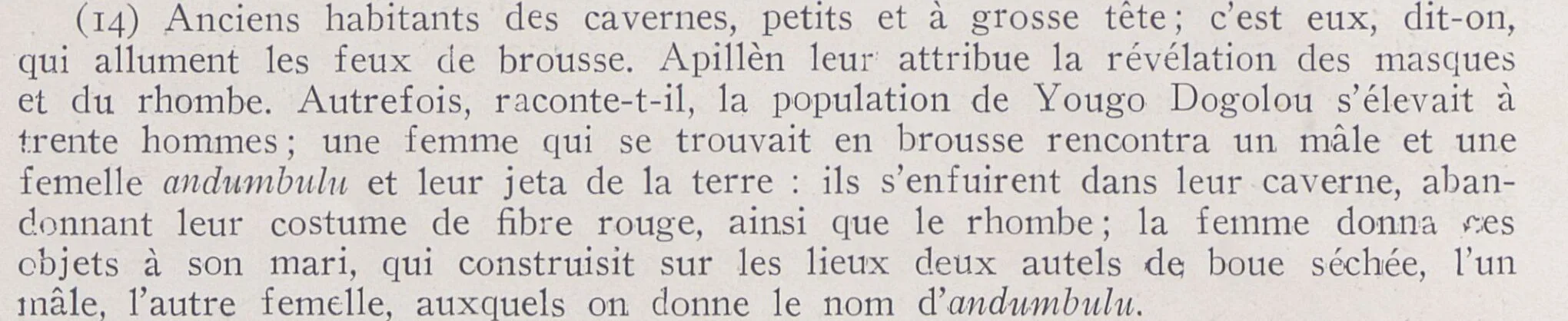
Variants of the story turn up from village to village. At Sanga three children found the masks and fibres instead, and quarrelled over the old man's staff. At Yougo Dogorou itself, a few years before Griaule's book, Michel Leiris was told a shorter version by the old head of the mask society, Apillèn. A woman in the bush met a male and a female andumbulu and threw earth at them. They fled into their cave, leaving behind their red fibre costume and the bullroarer. She gave both to her husband, who built two altars of dried mud on the spot, a male and a female, and called them andumbulu. The beings themselves, Leiris was told, were small and big-headed.
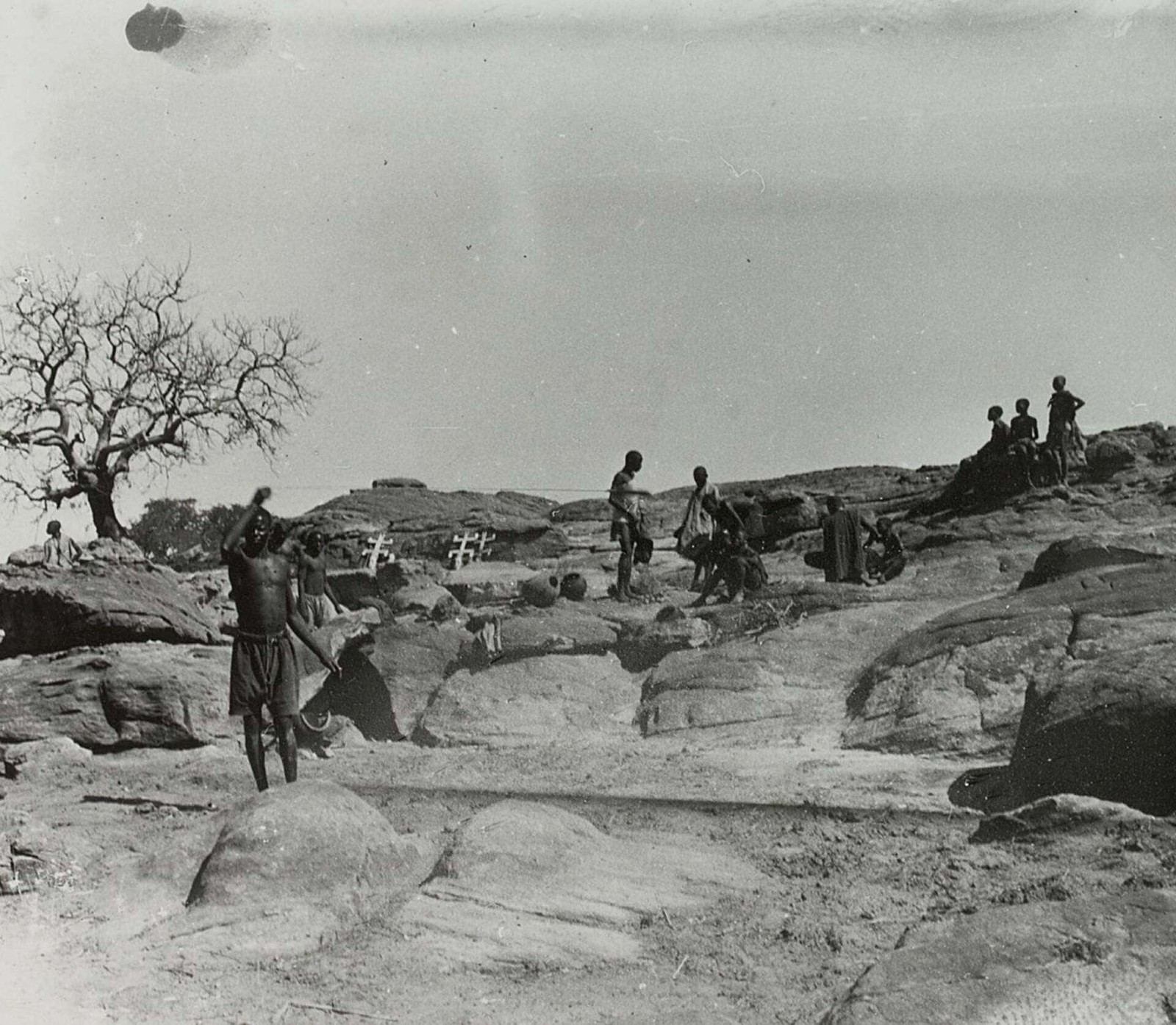
The altars are still in use. When a new class of young men enters seclusion at the Sigui, they carve a bullroarer and consecrate it by laying it on the male andumbulu while the two altars receive their sacrifice of cocks and a dog. The young men sound it during their stay in the cave. Afterwards it is kept by the head of the cave and whirled again at the death of a man old enough to have seen two Sigui, sixty years apart.
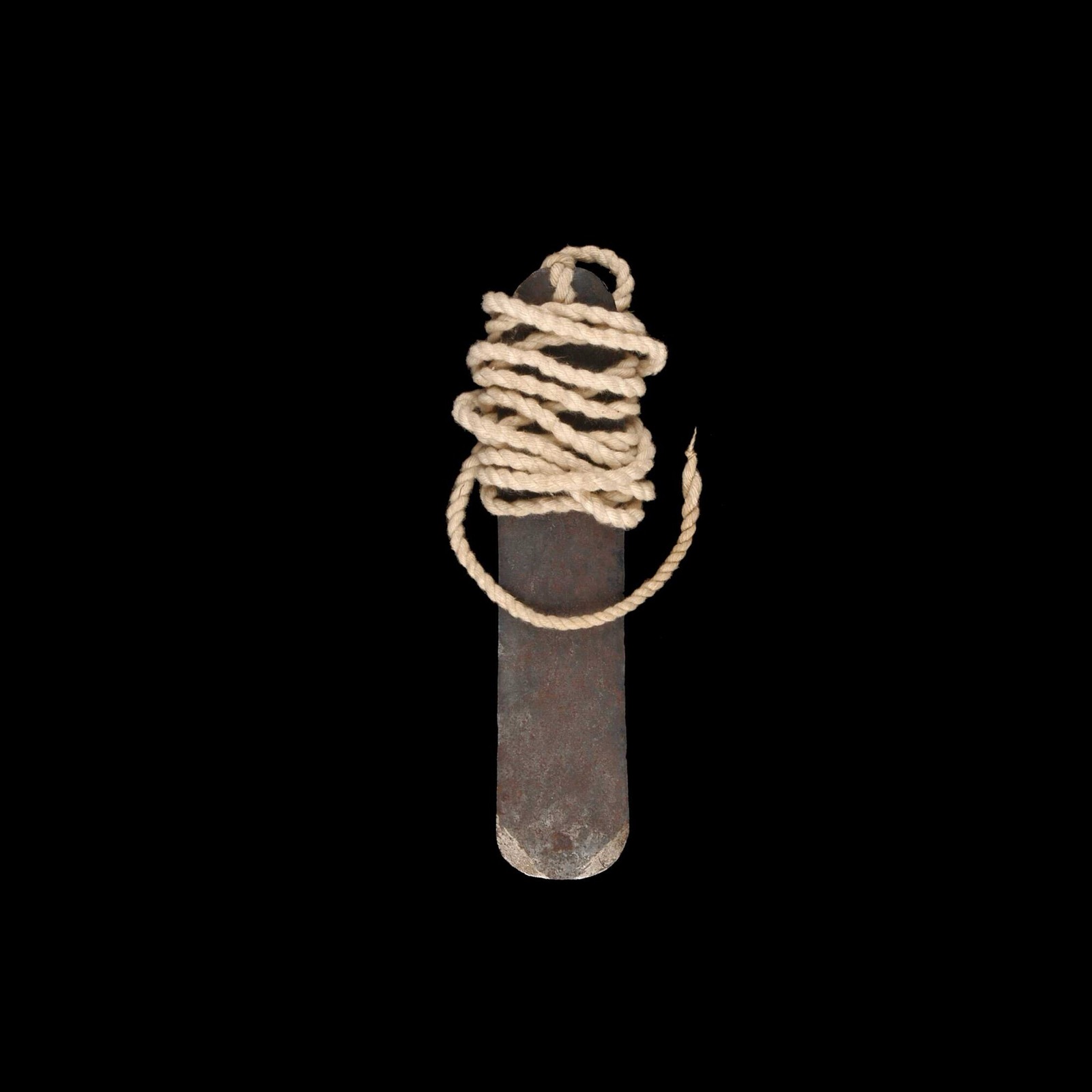
The iron bullroarer survives as well. Leiris catalogued one found in the mask cave of Tuyogu in November 1931: a flat iron blade 28.5 centimetres long with notched edges. Griaule describes the type as a long trapezoid with two rows of teeth like a saw and a ring at the broad end for the cord. It is rare, he says, because wood is the rule. But one may be forged in iron in memory of the Andoumboulou, whose roarer was iron.
A yéban was whirling it for fun
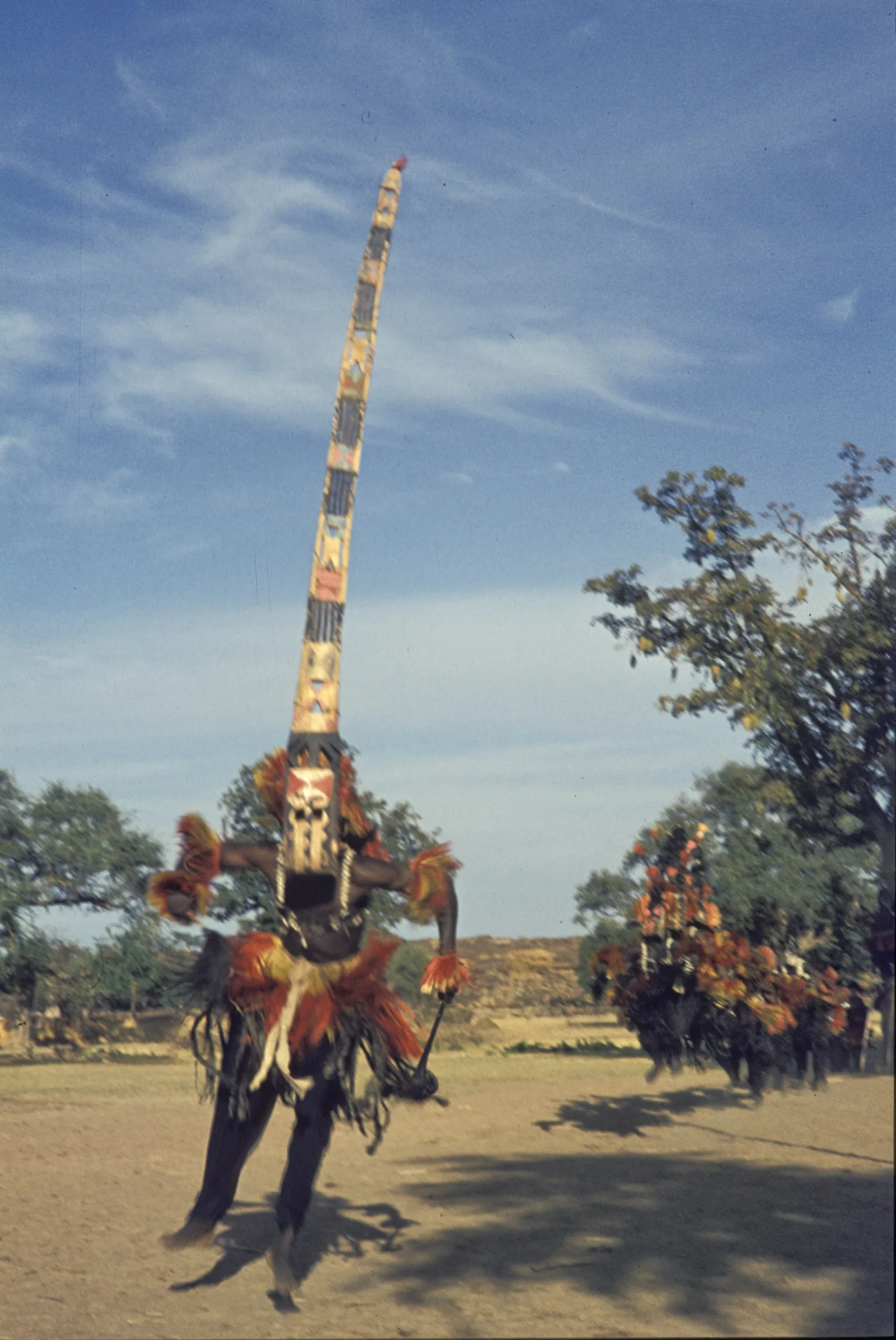
The Andoumboulou are not the Dogon's only little people. Griaule also describes the yéban, spirits created early, after the first water-beings. In the old days, when a man grew very old he turned into a snake, grew legs, and slowly became a yéban. They are “small, thin beings of human shape, with big heads,” invisible to most people. They live under spreading trees, in thick brush, and at the backs of caves, in villages with wives and children like anyone else. They hum as they move, but they never speak; if they spoke, it is said, they could live alongside men. Before the Dogon came, the yéban owned the land. Men took it from them field by field, and every farmer still pays for it with offerings. Unworked ground is left to them, and the wild animals are their herds.
At Sanga, Leiris heard that the first bullroarer was a yéban's. Ambara Sodamma, a young man of Ogoldognou, told him that a yéban left the first bullroarer in the bush together with the first fibre costume. A woman found the costume; her husband found the roarer at the foot of the same tree. He put the two together, then decided to keep the bullroarer outside the village, in the cave at its edge, because he found that it drank the blood of women and children. Ambara called the bullroarer “the mother of the mask” because it is the largest, and because it drinks the blood of women and children.
The old weaver Ambibè Badadyi, who taught Leiris the secret language of the masks, told it differently. A young goatherd heard a humming in the bush, went to look, and found “a yèmmé amusing itself by whirling the bullroarer.” The moment it saw him it vanished, leaving the instrument behind. The boy put it in his goatskin bag and took it to an old man, saying he had heard it crying in the bush. The old man took the cord and whirled it. It made a small noise. He whirled harder and it made a great one. He decided it was a good thing, and should be kept with the masks.
The yèmmé, Leiris noted, is a spirit like the yéban, or else the proper name of the particular yéban who owned the bullroarer. Ambibè gave the word other meanings too. It names the Sigui itself, the women allowed near the masks, the brotherhood of the masks as a whole, and the bullroarer. The first owner and the thing he owned share a name, as they do in Australia.
Tuanjiraka and the little men in snakes

Carl Strehlow ran the Lutheran mission at Hermannsburg, on the Finke River in the heart of Australia, from 1894 until his death in 1922. He learned to speak Aranda fluently, and spent years taking down the myths and songs of the Western Aranda and their western neighbours, the Luritja. His great work, Die Aranda- und Loritja-Stämme in Zentral-Australien, came out in parts from 1907. In the first volume, among the sacred legends, he placed a short section of tales of another kind. These, he explained, were not the secret histories told to initiated men and held by them to be true. They were told to women and children as well, “to keep them from prying into the men's secrets.” The first was the tale of Tuanjiraka.
Carl Strehlow · Hermannsburg · 1907
The Tale of Tuanjiraka
At Rubuntja, a place in the north-east, there once lived many little men called Tuanjiraka. With their stone knives they cut off their right leg, so that on their travels they went on one leg only, carrying the severed one over their shoulder; in camp they put the leg back on the body, so that they could walk on two legs again. One day, when a heavy rain had broken, one Tuanjiraka went hunting and killed many mice, which he shared out among the other Tuanjiraka who had stayed in camp. Another time he went out and found an echidna and a large lizard, which he killed and brought to camp; there he skinned the echidna and used its skin as his shield, while he used the lizard's tail as his stick; from eramata wood he made himself a spear, from pine a spear-thrower, and from fig-wood a boomerang. Then he went looking for many living snakes, and wound them around his head, his neck, his arms and his body. Opossums and wild cats went with him in place of dogs.
When a boy is to be circumcised, he is taken to Tuanjiraka. Tuanjiraka says to the boy: “Look up to the stars.” As the boy looks up, Tuanjiraka strikes his head off with the lizard's tail, so that it rolls far away over the ground. At midday the next day, when the boy's body has become full of maggots and is stinking, Tuanjiraka sets the head back on, and the boy comes alive again; then Tuanjiraka strikes him on the forehead with his shield of echidna skin, and the boy walks about again. Tuanjiraka himself circumcises the boy and travels about with him. When the women or children hear Tuanjiraka's voice [the sound made by the bullroarer], they run away in terror.
Tuanjiraka has a wife called Melbata and many children, who are called nankara [nankara is also the name of the large bullroarer]. After the circumcision such a bullroarer is shown to the newly made youth with the words: “This tjurunga you shall call Tuanjiraka.”
Carl Strehlow, Die Aranda- und Loritja-Stämme in Zentral-Australien, part I (Frankfurt, 1907), p. 102, translated from the German. The brackets are Strehlow's.
Strehlow derived the name from Aranda words for “near” and “short”: “the short-footed one, whose toes lie close together.” The story begins with a whole people of them, small, one-legged, hunting mice after the rain from a camp at Rubuntja, and closes on one Tuanjiraka who takes the boys. Each step of the closing paragraph brings him nearer to the instrument. First his voice is the roar the women hear. Then his children share their name with the great bullroarer. Then the youth, freshly cut, is handed the blade itself and told what to call it. What the women knew as a little man wrapped in snakes, the initiate holds in his hand.
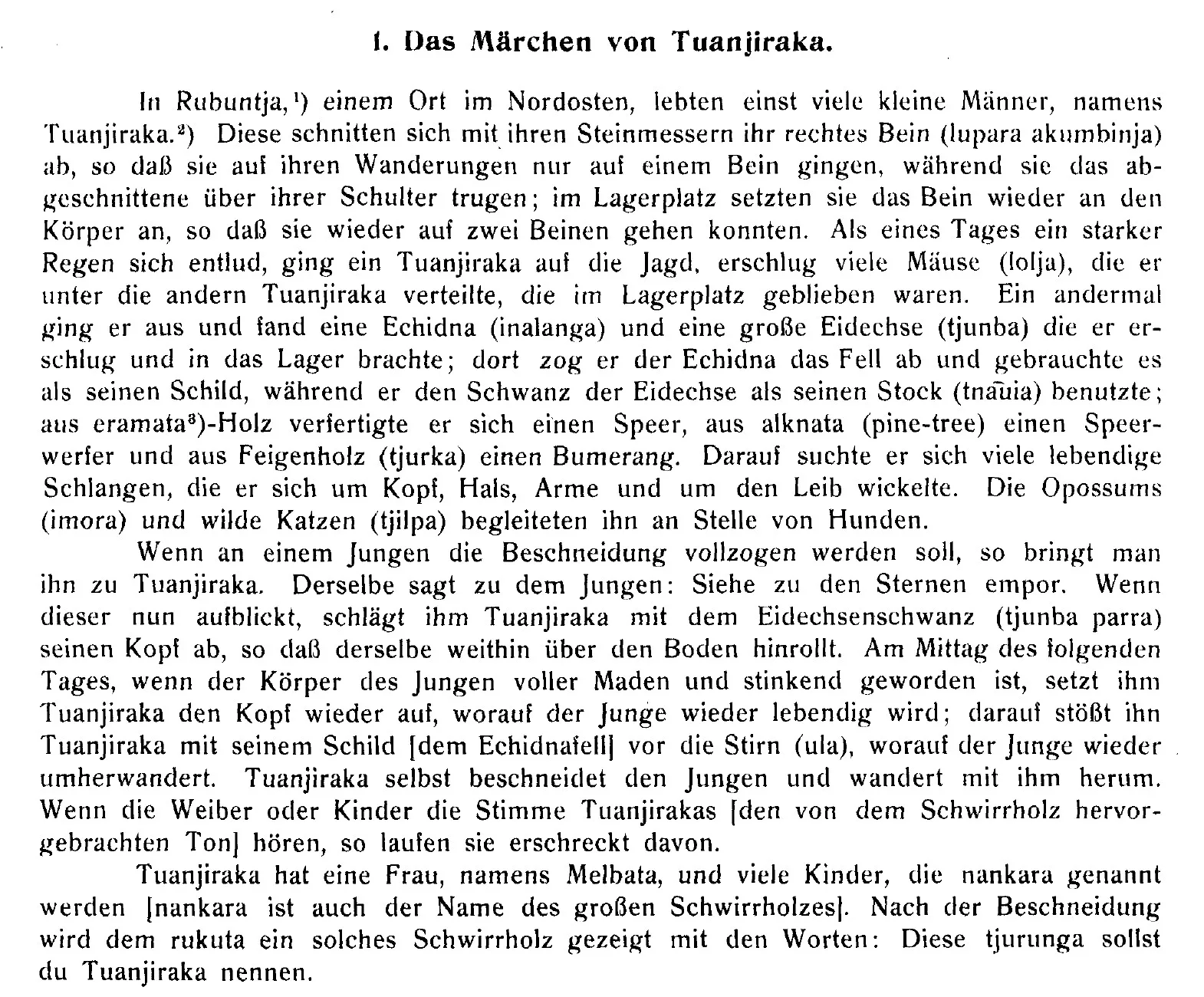
The Arunta churinga that Spencer and Gillen collected in the same years are the boards the story is about, and so is a pair of blades from the Hermannsburg country itself, one large and one small, made by the people who told Strehlow this story.
“This tjurunga you shall call Tuanjiraka.”Strehlow 1907, p. 102
The short ones and the whirring ones
The next year Strehlow published the Luritja tales, and the little men came back. The Luritja lived west of the Aranda, toward the sandhill country. Their first tale is “The Tale of the Maiutu,” and Strehlow wrote the Aranda equivalent beside the name: Maiutu (= Aranda Tuanjiraka).
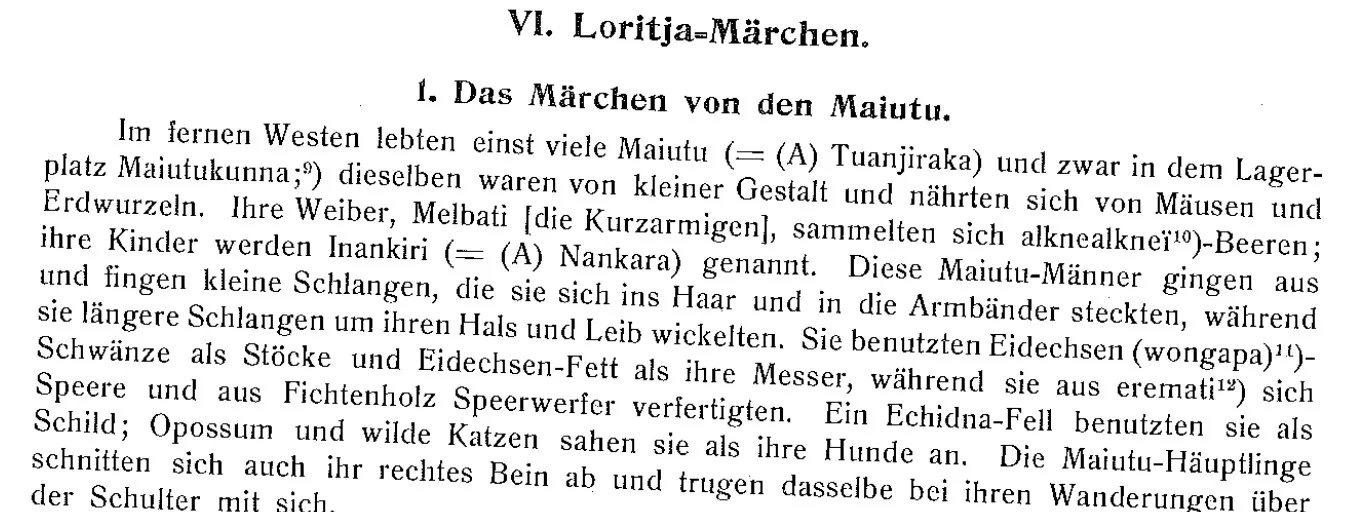
Far away in the west there once lived many Maiutu, in the camp called Maiutukunna; they were small in stature and lived on mice and roots dug from the ground. Their wives, the Melbati [the short-armed ones], gathered berries; their children are called Inankiri. These Maiutu men went out and caught little snakes, which they stuck in their hair and in their armbands, while they wound longer snakes around their necks and bodies. They used the tails of lizards as sticks and lizard fat as their knives … They used an echidna skin as a shield, and regarded opossums and wild cats as their dogs. The Maiutu chiefs also cut off their right leg and carried it over their shoulder on their travels.
Strehlow 1908, p. 48, translated from the German
The name itself means “the short one.” The children, Inankiri, are the Aranda Nankara, the name of the great bullroarer. The Luritja story of the boy goes further than the Aranda one. The women and children believed that a grown boy was taken away to a Maiutu, and had to wander with him a long time:
He says to the boy: “You, look up to the star!” While the boy is looking up, the Maiutu knocks his head off with his lizard's tail, and it rolls far away over the ground. Then the Maiutu goes after the head, takes it by the ears and sets it back on the boy's body; then he strikes him on the head with the echidna skin. Now the boy, alive again, goes off and cuts himself a reed stalk, into which he fixes a sharp spinifex stem; with this spear the boy spears the Maiutu, who, mortally wounded, cries out: “Oh woe, my young man is spearing me to death!”
When this Maiutu has died, the novice carries him into a rock cave and covers him with stones. Then the boy goes to another Maiutu, whom he finds asleep in his camp, his right leg lying beside him, stinking and full of maggots. … The Maiutu hands the boy his leg, which the boy lays in his spear-thrower; the Maiutu squats on the novice's shoulders, and the two of them leave the camp. Soon the Maiutu tells the boy to set him down in the shade of a tree and to go hunting by himself. The novice spears a grey kangaroo and carries it to the Maiutu's resting place, and the Maiutu greets him with praise: “My best friend, you have speared a great deal of meat for the two of us.” … The Maiutu now puts his right leg back on his body and travels with the novice to his camp. Later he sends the novice back to his relatives.
The Maiutu who lived at Maiutukunna with their wives and children saw one day a sea of flame coming towards them from the west; at this the Maiutu chief ran to a great slab of rock, lifted it up, and went into the cave beneath the ground.
Strehlow 1908, pp. 48–49
The words the Maiutu speak to the boy were not ordinary Luritja. Strehlow noted that they came wholly or partly from the secret language the novices had to learn for their initiation. The tale told to the women carried words from the men's secret language.
The second Luritja tale is about another crowd of little men, the Apuju, who once lived at Tunkuba, “the heap of stones.” They dug roots and baked them into dough, hunted red kangaroo and wallaby, and fed a visiting chief who announced that he had come “to the novice” staying among them. The hunters came home at the chief's call and circled the two painted chiefs, crying wá, wá, wá, and took hold of the ceremonial pole set up between them. At that moment they saw a great fire rushing toward them from the east. They lifted a great slab of rock and went down into the cave beneath the ground. Their wives, too, were the Melbati; their children, the Inankiri. And their name is the name of the instrument:
Apuju = the whirring ones; this word also denotes the large bullroarers that are put into the novices' hands after circumcision is completed.
Strehlow 1908, p. 50, n. 1
Thirty pages later, describing the Luritja initiation itself, Strehlow tells what happens to that object. As soon as the boy has been circumcised, a large bullroarer, an apuju, is put into his hand, engraved with the marks of his mother's totem, because from now on his altjiri, his mother's totem ancestor, travels with him. When his beard grows he is given a small one, the mantiki, which he swings when he wishes to marry the girl promised to him. The little men of the story and the blade in the youth's fist are called by one word.
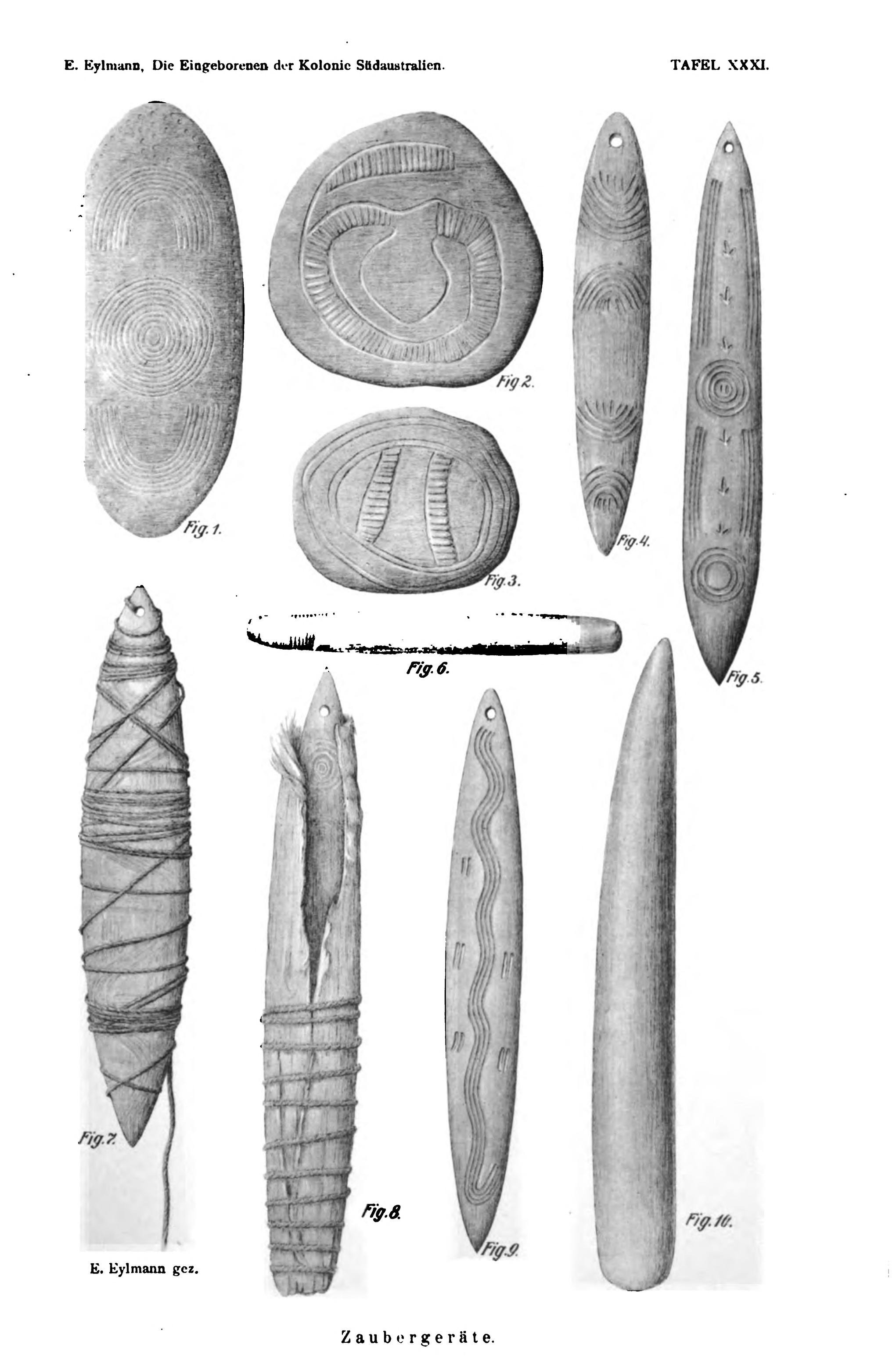
The Apuju were still at work a generation later. In a Pitjantjatjara camp southwest of the Luritja, Géza Róheim watched women mourn a youth they believed the Apuju had killed, while hidden men sounded the bullroarers. A Luritja tjurunga from Jay Creek, west of Alice Springs, kept after an initiation there in 1953, is thirty-five centimetres of wood on a cord of human hair.
A crowd of little men
In 1912 the Italian historian of religion Raffaele Pettazzoni read Strehlow's tales side by side and drew the plain conclusion. The little men are the bullroarers.
“Apuju” means “the roaring ones.” “Apuju” is, in fact, the name of the bullroarer shown to the novices after circumcision. So the Apuju are the bullroarers: in other words, the bullroarers are conceived mythically as a crowd of little Apuju men. … In short, we may say: Maiutu = Apuju = the bullroarer.
Indeed, Maiutu means “the short ones,” and likewise Melbati means “short-armed.” The chiefs of this Maiutu people cut off their right leg, loaded it on their shoulder, and carried it so on their travels. In all this there is nothing but a mythical representation, a way of conceiving mythically an object that is one-legged par excellence, as the bullroarer is.
Raffaele Pettazzoni, “Mythologie australienne du rhombe,” 1912, pp. 151–152, translated from the French
He read the rest of the tale the same way. The snakes the Maiutu wear as necklaces and belts perhaps recall the designs engraved on the faces of the blades. The dead Maiutu carried into a cave and covered with stones, and the Apuju who sink under a slab of rock, are the bullroarers laid away in the secret store where each group keeps its sacred boards. And Tuanjiraka is the many gathered into one:
So Twanjiraka really is a bullroarer — or better, he is the bullroarer personified. It is his voice that the children and women think they hear from far off, and they flee full of terror; but what they hear is only the noise of the bullroarer that the men, unseen, are whirling.
Pettazzoni 1912, p. 154
A bullroarer is a short, flat thing that hops and spins at the end of a cord. Each initiate received his own, and the sacred boards were kept in secret stores among the rocks. Seen through the women's tale, that heap becomes a camp of little people: short, short-armed, one-legged, painted with snakes, living under a rock. When the men take one out and whirl it in the dark, one of the little men has come for a boy.
Half a century later the French ethnologist Jean Servier set the Dogon and the Aranda on the same page. Among the Dogon, he wrote, the bullroarer was first used by the Andoumboulou, the little red men who peopled the country after the first creation and were stripped of their mysteries by men. He summed up the Aranda tales the same way: the bullroarer, he wrote, was given to the Arunta by a people of little men, the Twonjiraka, who had lived in the country before them. Neither people knew the other. Both had put the same small figures behind the same sound.
Ezam is as old as the earth
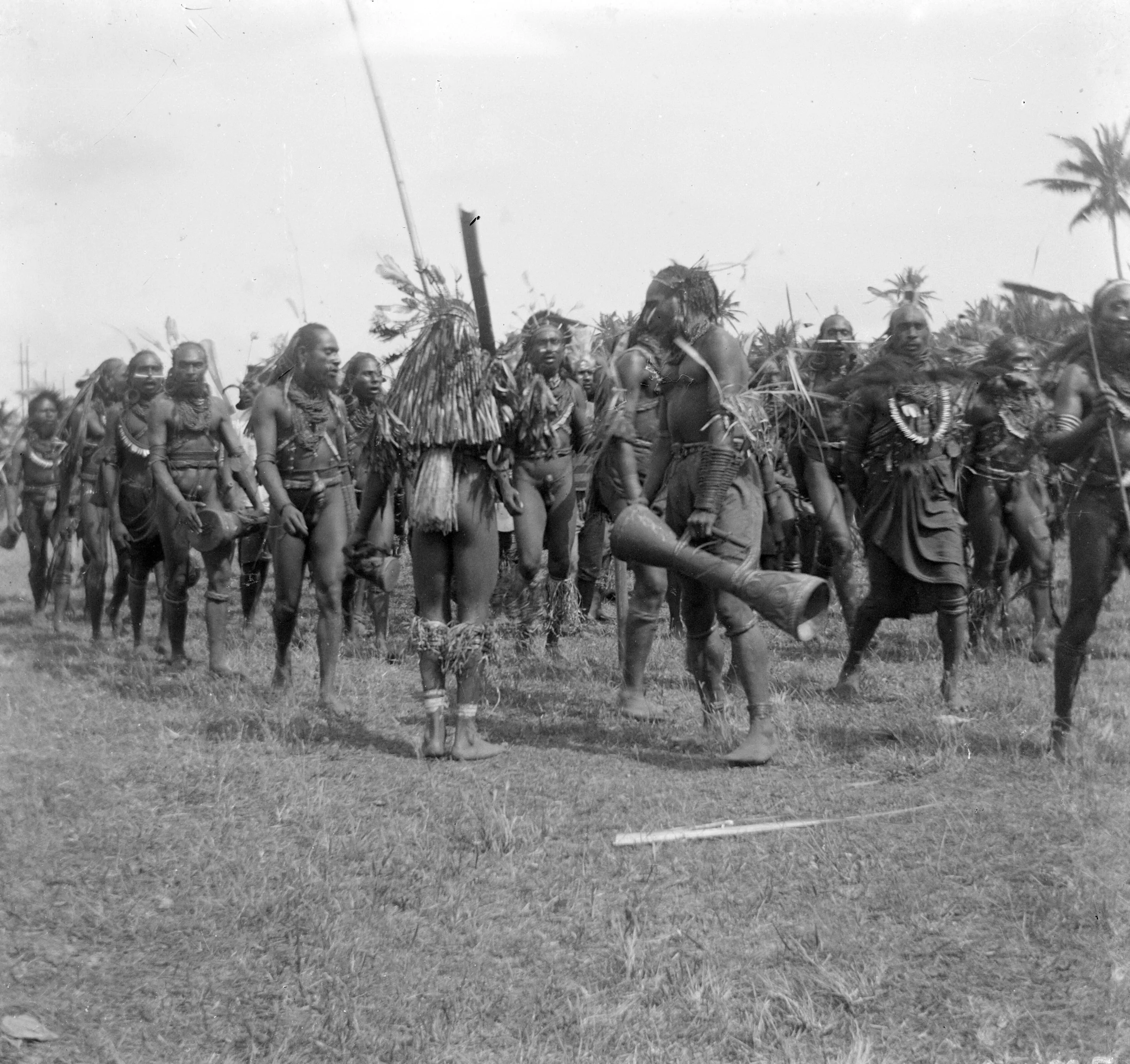
The Marind-anim live on the flat, swampy south coast of New Guinea, on the Indonesian side of the border with Papua New Guinea. Inland, along the upper Bian River, the Marind kept a cult of their own, with a bullroarer called ezam. The Swiss ethnologist Paul Wirz saw part of its rites, and the Dutch anthropologist Jan van Baal later gathered every account into his great survey of Marind religion, Dema (1966). The cult belonged to a being called Ezam, whose name means “husband,” and the bullroarer bears the same name. His wife Uzum is a pair of bamboo stamping tubes. Of Ezam himself, Wirz could learn only a little. As van Baal sums it up, Ezam is “a small, dwarfish déma, normally dwelling under the ground,” who comes up once a year at the end of the dry season. That is when the rite has to be held. Women are kept away entirely. A woman who saw the bullroarer would die on the spot.
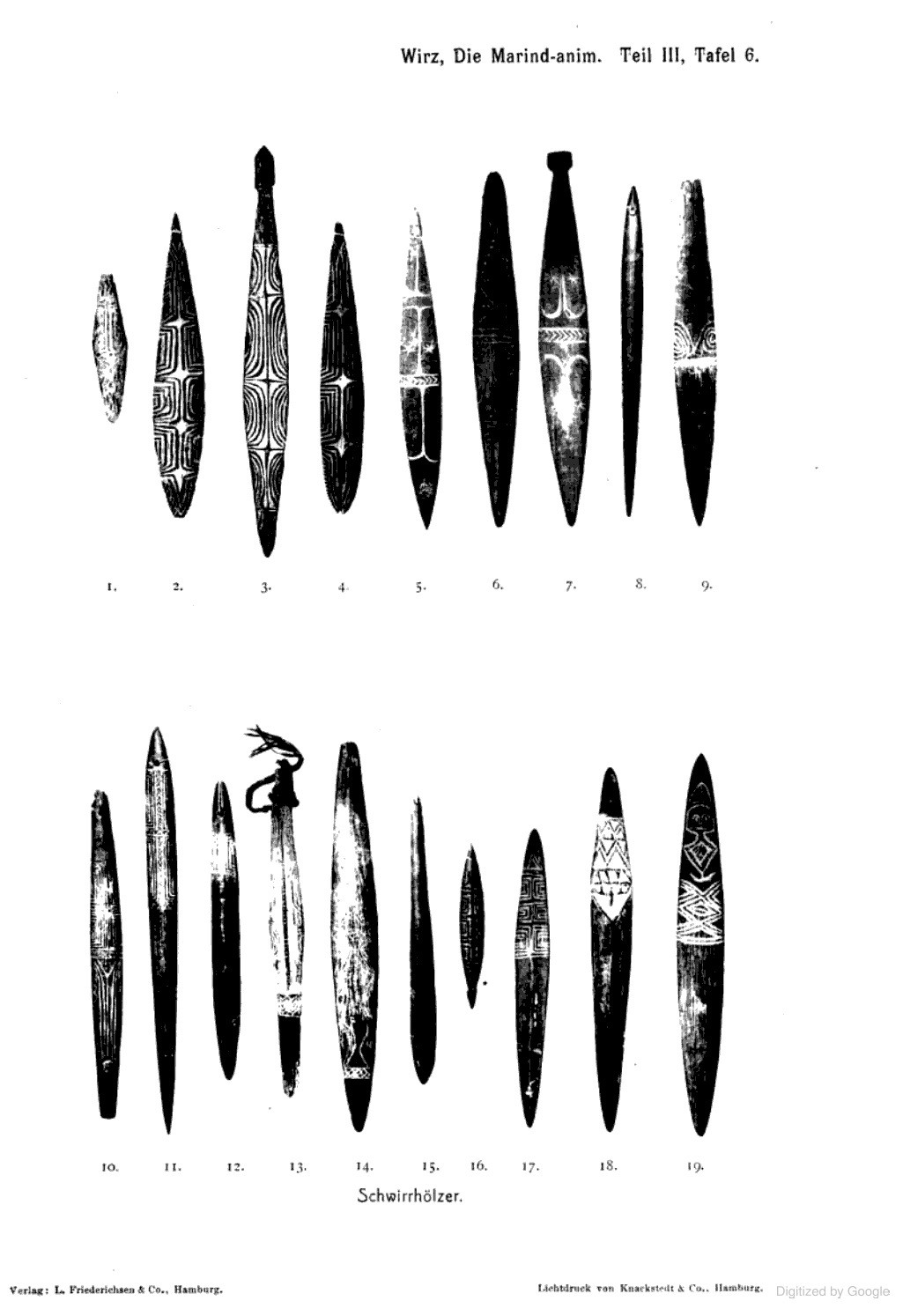
The missionary-anthropologist Jan Boelaars asked the upper Bian men who Ezam was, the being whose voice spoke in the buzzing wood. He expected to hear that Ezam had made the world. Instead they told him that “Ezam and the earth were there at the same time.” The earth itself, they said, and the sky and the first man, Geb, were the work of another being, Ndiwa. One day Ndiwa was chopping firewood and three chips flew off, buzzing. He tied a cord to one and said, “This is my Ezam.” Another man said Ndiwa tied two chips together and called them husband and wife, Ezam and Uzum.
Ezam, then, is not a little man who once lived somewhere and moved on. He is a single small being under the ground, as old as the earth, who comes up once a year to be heard. His name passed to the first buzzing chip and has stayed on every bullroarer since. In the upper Bian, van Baal concludes, the bullroarer is the voice of Ezam and Uzum together, the mysterious voice of the divine in all its aspects. Like the Dogon, one Bian telling remembers that the rites had once been the women's, until the men forced their way in one day and took them.
Lefin has a red beard and enormous teeth
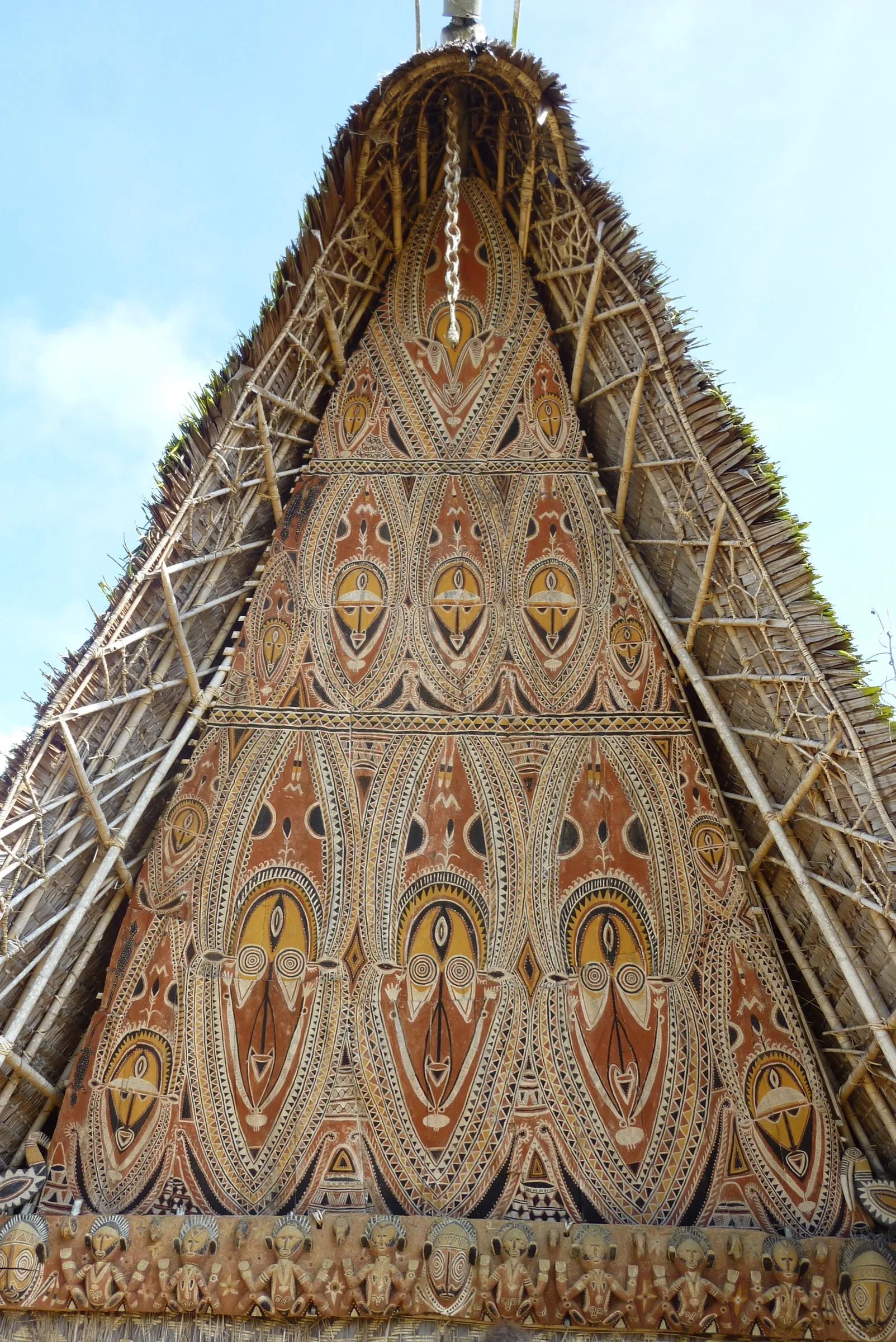
Ilahita is a large Arapesh village in the hills north of the Sepik River in Papua New Guinea. Its men's cult, the Tambaran, takes a boy through a long series of grades over many years. The American anthropologist Donald Tuzin lived there from 1969 and wrote down the grade called Lefin. Its great day is the one on which the boys are shown the bullroarers. They watch their own fathers “capture” the roarers from the initiating group, who whirl them furiously in the middle of the clearing.
The roar, the boys had always been told, was the voice of the Lefin Tambaran, “a spirit personified as a little man with a large red beard” and enormous teeth, who carves the village's drums and slit-gongs with those teeth. On the day the boys learn the true source of his voice, they are also shown a long-handled adze, the tool that really carves the drums. The little man, his voice and his teeth are given back to them as the men's own instruments.
Lefin is a single spirit, not a vanished people, and the Ilahita men did not say that he owned the first bullroarer. That honour belongs to a woman. A secret myth of the cult, which Tuzin recorded, tells that long ago a woman chopping firewood heard a chip fly off with a brrrr, tied a line to it, and frightened the whole village with its cry, until the men made her teach them, and killed her. The story of the woman is told in The Woman Who Made Mimi’unemb. The little man is the voice the women hear while the men keep her secret.
The very small gods who stole the thunder
The Hopi live on three mesas in northern Arizona. Among their gods are two brothers, the War Twins, called Pöokónghoya and his younger brother. They live with their grandmother, Spider Woman, are always playing with their buckskin ball, and get into every kind of trouble. In one of the tales the missionary H. R. Voth collected around 1900, a traveller comes upon them and sees “Pöokónghoya and his brother, both being very small, wandering and playing around there.”
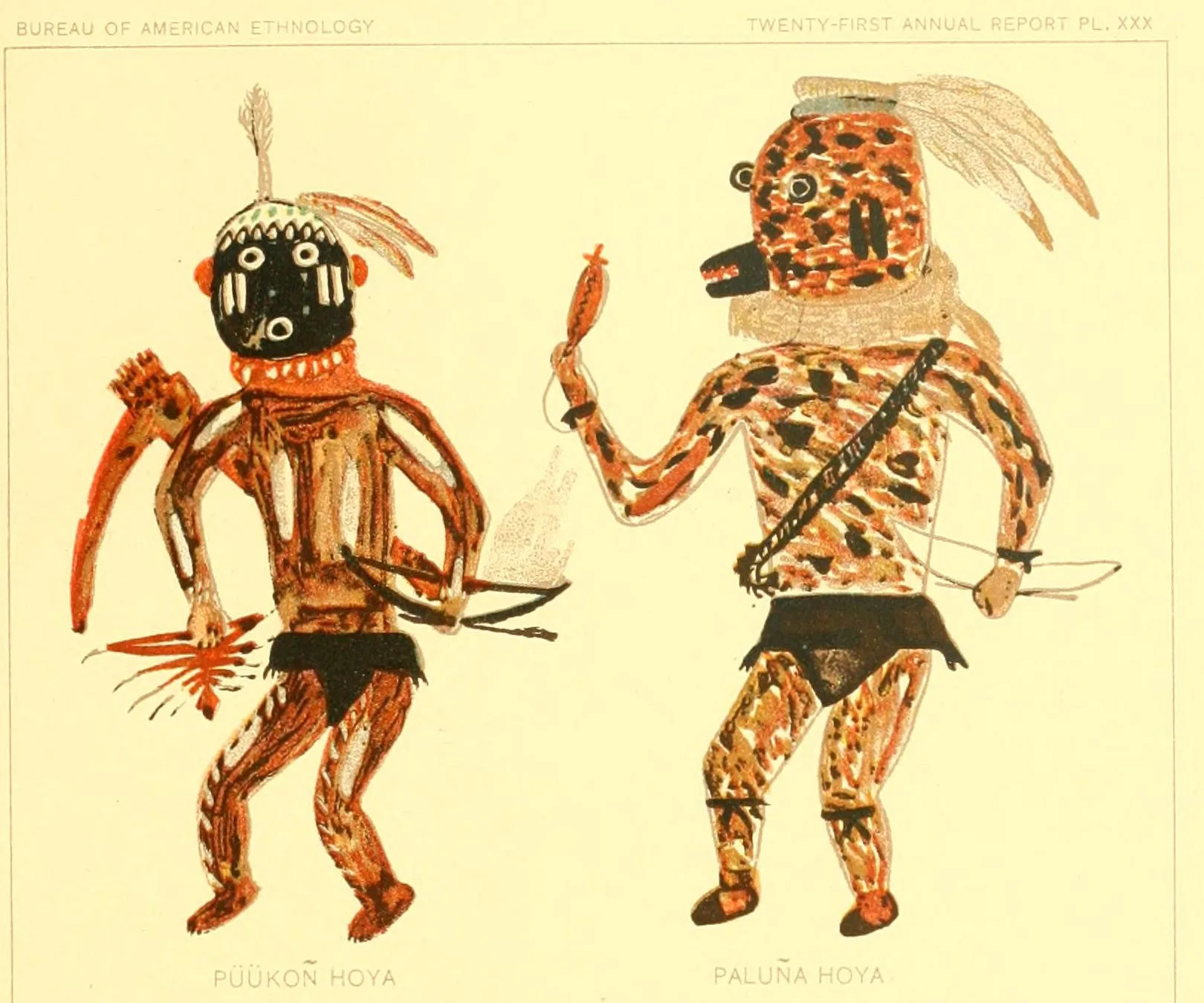
A tale told by Kúhkuima of Shupaúlavi has the little brothers set out from their grandmother's house near Shongópavi, beating their ball, until they come into Mishóngnovi during a ceremony:
All at once they entered one of the kivas and found that the Flute priests were assembled in this kiva for their ceremony. In one of the trays that were standing on the floor was lying a lightning frame, thunder board, netted water jug, etc. This tray they grabbed and went out. None of the priests said anything.
Hereupon they went into another kiva where the Snake priests were assembled for their ceremony. They were just washing the snakes in a bowl. The Pöokónghoyas grabbed a bull-snake, put it into a snake-sack and left the kiva, the younger brother holding this bag under one arm, the elder brother carrying the tray with the objects. …
They then started towards Shongópavi along the trail. After they had gone a little distance they shot the lightning frame, and twirled the bullroarer several times. By the time they had reached the canyon, or gulch, right east of Shongópavi, and as they were beginning to ascend to the village, clouds had gathered in the sky and it began to thunder and rays of lightning began shooting through the sky. Soon it began to rain.
They began to run towards their house, and just as they arrived there they once more shot the lightning frame and twirled the thunder board. By this time it thundered very hard and loud, and lightning was flashing. One of the Hopi houses in the village was struck and shattered. By this time they had arrived at their house. “Who are those little mischief makers that are coming there?” their grandmother said. “You are bad.” But the two brothers rushed into the house and put the lightning frame, thunder board, the snake, the little artificial melons, báhos and the paint, which they had brought with them, quickly but secretly into two pots which they covered up. And because the Pöokónghoyas afterwards had these things they were the cause that it always rained and the Hopi had good crops.
H. R. Voth, The Traditions of the Hopi, 1905, pp. 84–85
Here the little ones are thieves, not first owners. The priests had the thunder board, and the twins took it. But once they have it, they keep it, hidden in a covered pot in their grandmother's house, and the rain belongs to them. The Hopi thunder board was swung in just this way, to bring the clouds over the fields.
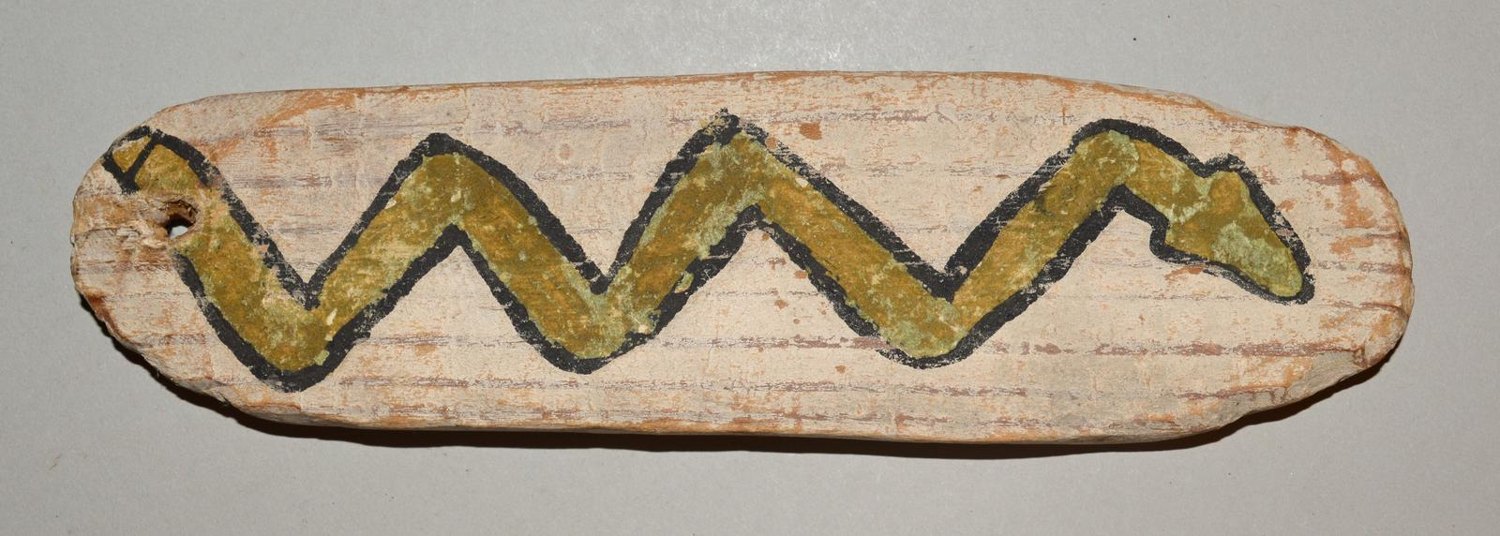
The Kakaka come out of the cliffs

The Yavapai live in central and western Arizona, around the Verde Valley and the mountains to its south and west. The Kakaka are their little people. The tribe's own culture research director describes them as the protectors of the Yavapai, “who were here before any humans,” and who taught the people the Mountain Spirit Dance. Yavapai elders at Fort McDowell, in their oral history of the tribe, describe them as just like people, only tiny, with round heads and no noses, living in rooms in the cliff ledges, speaking Yavapai but talking only to medicine men, and passing like the wind.
The ethnographer E. W. Gifford recorded how a Southeastern Yavapai healer brought them to the sick:
As an aid to curing, the shaman organized masked performances in which spirits called akaka were impersonated. These performances were held at night, usually in autumn if several people were ill. … By the uninitiated, they were believed to be spirits or deities. They had no individual names. They were believed to issue forth from cliffs and cliff dwellings where their homes were in holes and crevices. They were believed to possess more supernatural power than a shaman and to be able to control the wind and the weather. … They were believed to live on very little food, and that a sort of wild cherry, not eaten by human beings, called akakama, “akaka food.”
The shaman summoned the akaka to the ceremony by going from the camp some distance and whirling his bullroarer. The akaka approached with a peculiar quick step. They did not talk or sing, but gave an occasional shout.
E. W. Gifford, “The Southeastern Yavapai,” 1932, pp. 236–237
To the north and west, Gifford heard the same. A shaman would swing his bullroarer secretly at night to call the akaka, then go to suck out the sickness in the morning. One old healer had a bullroarer cut from a pine struck by lightning; he swung it outside a sick person's house, and when clouds and thunder came up from the east the patient would recover.
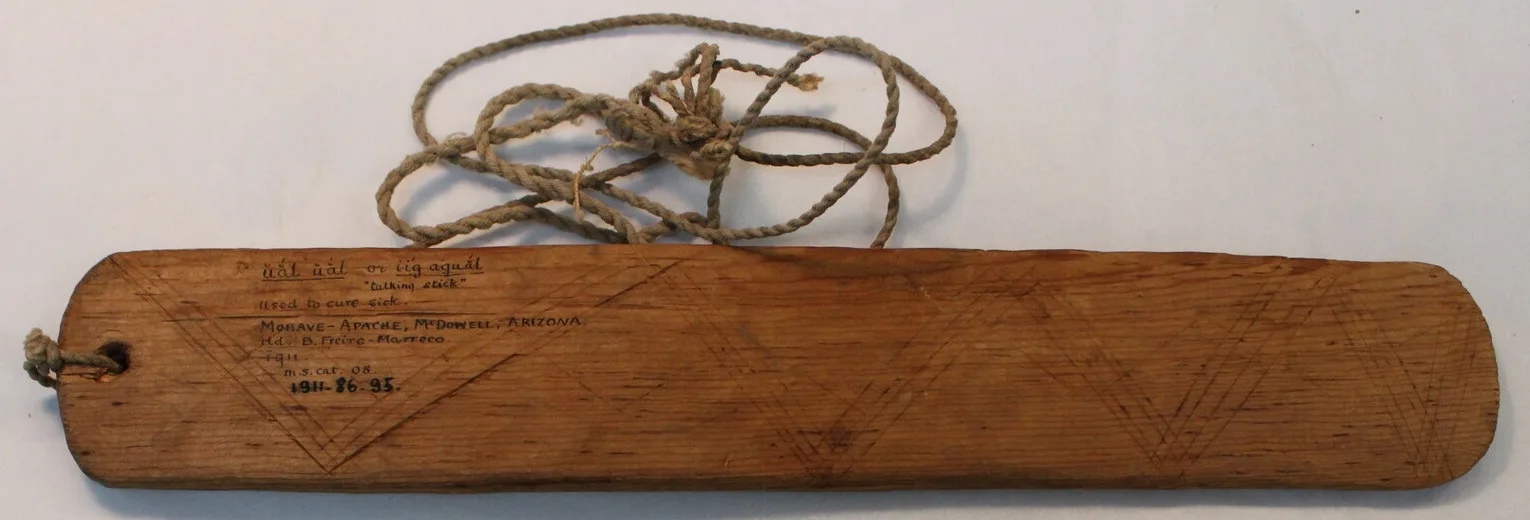
The Kakaka did not make the bullroarer and did not give it away. They gave the dance. The bullroarer is what brings them: the healer goes out from the camp alone and whirls it, and the little people who were here before anyone come down out of the rock with their quick step.
Little people at the edges
Further out, the little people thin to a glimpse.

On the desert coast of Sonora in Mexico, a Comcaac (Seri) man who wanted the “songs of the sea” built a shelter on the beach and fasted in it for four days, painting fish, sharks, whales and turtles on its walls. On the fourth night he went out onto the sand with a bullroarer and called to the sea animals. If he succeeded, William Griffen was told, they came, and would “sing and talk to him as if they were little people,” teaching him songs that told when the winds would blow and when the fish would run.
In Swedish Lapland, on the Little Lule River, a great cave mouth called the Holy Doorway was one of the most famous sacred places of the Sámi. A man called Biei've Niila, the ethnologist Bo Sommarström was told, used to stand at the left side of its opening and whirl a bullroarer round his head. The sound was like the wings of a bird, and it came back as an echo, two hours later, out of the depths of the mountain. Sommarström wondered whether the answers came from the gadnihah, “the small people below.” The instrument itself has been handed down, and in the 1980s a relative of Sommarström's informant owned it.
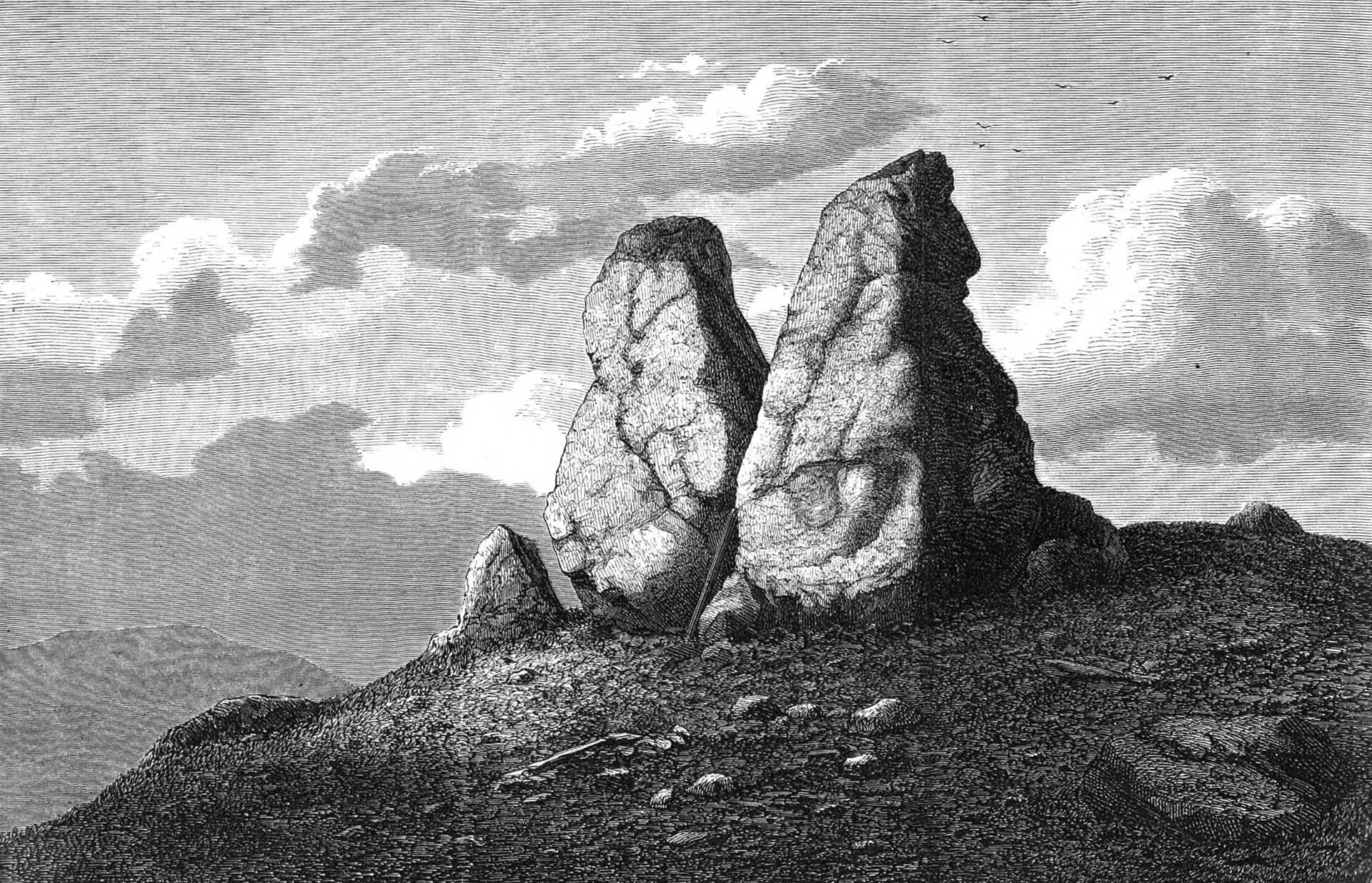
On Maré, in the Loyalty Islands east of New Caledonia in the southwest Pacific, the people remember a time when the middle of their island was a lagoon. The first people lived beside it, at Rawa. The missionary-ethnographer Marie-Joseph Dubois wrote down their traditions. “The first eletoke,” he reported in 1950, “were very small men.” In 1975, drawing on the elders Awanedr and A. Waicane, he wrote: “The people of Ta-Peorawa or of Rawa were small men.” In Dubois's history of the island they had no chiefs, no houses and no gods, until newcomers landed in the northwest with yam gardens, chiefdoms and deities. In his short history of the island, Dubois set the bullroarer among them: describing these first people, before the newcomers arrived, he wrote, “The people of Maré knew the boomerang and the bullroarer.”

By Dubois's day the bullroarer survived on Maré only as a game: whirling “a bullroarer, a board of 20 cm, at the end of a string,” not much played, whose season he never managed to note. The small first people were long gone. Their board was still turning.
Small, first, and gone below
Set the stories side by side and the same small figure keeps stepping out of them. The Andoumboulou stand no higher than a forearm. The yéban are thin and big-headed. The Tuanjiraka are “little men,” the Maiutu “the short ones,” the Apuju a crowd of them. Ezam is dwarfish, Lefin a little man, the Hopi twins “very small,” the Kakaka tiny, the first people of Maré very small men.
They are also old. The Andoumboulou were the first humans made. The yéban held the land before the Dogon came. The Tuanjiraka, the Maiutu and the Apuju “once lived” at named camps. Ezam was there when the earth was. The Kakaka were “here before any humans.” The first people of Maré lived by a lagoon that is now dry land.
And they live under the ground, or inside the rock. The Andoumboulou are in the cliffs, the yéban in the backs of caves, the Maiutu and the Apuju under a slab of stone, Ezam under the earth, the Kakaka in holes and crevices in the cliffs, the Sámi small people below the mountain. They are heard and not seen. The goatherd hears a humming before he sees the yèmmé; the Aranda women hear Tuanjiraka's voice and run. And when people come too close, they vanish and leave the bullroarer behind, or the bullroarer turns out to be them.
These peoples did not borrow the little people from one another. Each cult arrived at them on its own, and the instrument shows why. The bullroarer is a small, thin thing with an enormous voice, sounded by men who are not seen. A being made to fit it comes out small, old and just out of sight, with a voice far bigger than its body. Pettazzoni saw the fit in the one-legged men: a single blade on a cord, hopping and spinning, is a little man on one leg.
The best of these stories turn on one moment, when the little people's thing comes into human hands. The Dogon woman picks up the iron roarer the dancers dropped. The goatherd carries the yèmmé's toy home in his bag. The Aranda youth takes the blade and is told its name is Tuanjiraka. The Luritja boy is handed the apuju, the whirring one. The Arapesh initiates watch their fathers seize Lefin's voice out of the air. On the Hopi mesas the hand-over runs the other way: two very small gods take the thunder board from the priests, and the rain goes with it to their grandmother's house. Either way, the instrument lives on the border between us and them. In Mali and Central Australia, in New Guinea and Arizona, the roar that guards the mystery is the voice of something small, and older than we are.
Key sources
- Marcel Griaule, Masques dogons (Paris: Institut d'ethnologie, 1938; 2nd ed. 1963, same pagination). The women's discovery of the Andoumboulou, the iron bullroarer and Albarga, pp. 59–61; the yéban, pp. 153–155; the Andoumboulou, their stature and the Tellem, pp. 157–159; iron bullroarers in memory of the Andoumboulou, and the bullroarer bearing the Great Mask's name, pp. 253–254.
- Michel Leiris, “Rhombes dogon et dogon pignari,” Bulletin du Musée d'Ethnographie du Trocadéro 7 (1934), pp. 3–10, Gallica. Ambara Sodamma's yéban and Ambibè Badadyi's yèmmé, pp. 4–5; Apillèn and the andumbulu altars, p. 6; the iron bullroarer of Tuyogu, p. 6; the yéban, yèmmé and dyinu, p. 9 nn. 8–10; the andumbulu, p. 10 n. 14.
- Carl Strehlow, Die Aranda- und Loritja-Stämme in Zentral-Australien, ed. M. von Leonhardi, part I (Frankfurt, 1907), University of Adelaide scan: the tales told to women and children, p. 101 n.; the tale of Tuanjiraka, p. 102. Part II (1908), University of Adelaide scan: the Maiutu, pp. 48–49; the Apuju, pp. 49–50; the apuju and mantiki at initiation, p. 82. Translations from the German are ours.
- Raffaele Pettazzoni, “Mythologie australienne du rhombe,” Revue de l'histoire des religions 65 (1912), pp. 149–170, Internet Archive; the little men as bullroarers, pp. 151–154. Géza Róheim, The Riddle of the Sphinx (London, 1934), pp. 150–152, for the Apuju carried in the spear-thrower. Jean Servier, L'Homme et l'invisible (Paris, 1964); Spanish ed. El hombre y lo invisible, p. 137.
- J. van Baal, Dema: Description and Analysis of Marind-anim Culture (The Hague, 1966). Ezam as a small, dwarfish déma, p. 569; Ndiwa, the first bullroarers and the women's rites, pp. 586–587; the bullroarer as the voice of Ezam and Uzum, p. 597. J. Boelaars, Nieuw-Guinea, uw mensen zijn wonderbaar (Bussum, 1953), pp. 62–64; “Ezam en de aarde waren er tegelijk,” p. 63.
- Donald F. Tuzin, Unity in Duality: An Account of Ilahita Arapesh Social Organization (PhD thesis, Australian National University, 1973). The Lefin grade and the little red-bearded spirit, pp. 259–260; the woman who made the first bullroarer, Appendix E no. 4, p. 358.
- H. R. Voth, The Traditions of the Hopi (Chicago: Field Columbian Museum, 1905). “Pöokónghoya and His Brother as Thieves,” pp. 84–85; the brothers “both being very small,” p. 100.
- E. W. Gifford, “The Southeastern Yavapai,” University of California Publications in American Archaeology and Ethnology 29 (1932), pp. 236–237; “Northeastern and Western Yavapai,” UCPAAE 34 (1936), p. 309 (see also the Northeastern Yavapai record). Yavapai-Prescott Indian Tribe, Culture Research Director, “KaKaKa Ima — The Spirit of Yavapai Song and Dance,” Sharlot Hall Museum, Days Past, 13 September 2024. Mike Harrison, John Williams et al., Oral History of the Yavapai (2012), pp. 229–237, as quoted in “Meet the Kakaka,” #PrescottAZHistory, 2017.
- William B. Griffen, Notes on Seri Indian Culture, Sonora, Mexico (Gainesville, 1959), p. 16. Bo Sommarström, “Ethnoastronomical Perspectives on Saami Religion,” in T. Ahlbäck (ed.), Saami Religion (Åbo, 1987), p. 214, caption to fig. 2.
- Jean Poirier and M.-J. Dubois, “À propos du peuplement de Maré,” Journal de la Société des Océanistes 6 (1950), pp. 247–250, doi:10.3406/jso.1950.1680; the first eletoke, p. 248. M.-J. Dubois, Mythes et traditions de Maré (Paris, 1975), ch. IV, “Les si Rueezi”; Histoire résumée de Maré (Nouméa, 1981), p. 5; “Ethnobotanique de Maré,” JATBA 18 (1971), p. 359, doi:10.3406/jatba.1971.6867.
- Related essays: The Woman Who Made Mimi’unemb follows the women who held the bullroarer before the men; The Mother of All follows the serpent Mother whose voice the roarer carries.