Atlas Essay —
Paint Yourself Dead
A boy is taken from the camp at dusk. Out in the dark something enormous is roaring, and he has been told all his life what it is: a spirit who eats boys and gives men back. When the figures finally come for him they are not men he knows. They are white — chalked, clayed, feathered over with down until the joints and the faces are gone — and they behave as the dead behave, which is to say they take him without explaining. Years later he will stand where they stood, with a slat of wood on a cord in his hand and pipeclay drying on his chest, and the whole apparatus will be revealed to have been the work of his neighbours. The paint is the reason he never guessed.
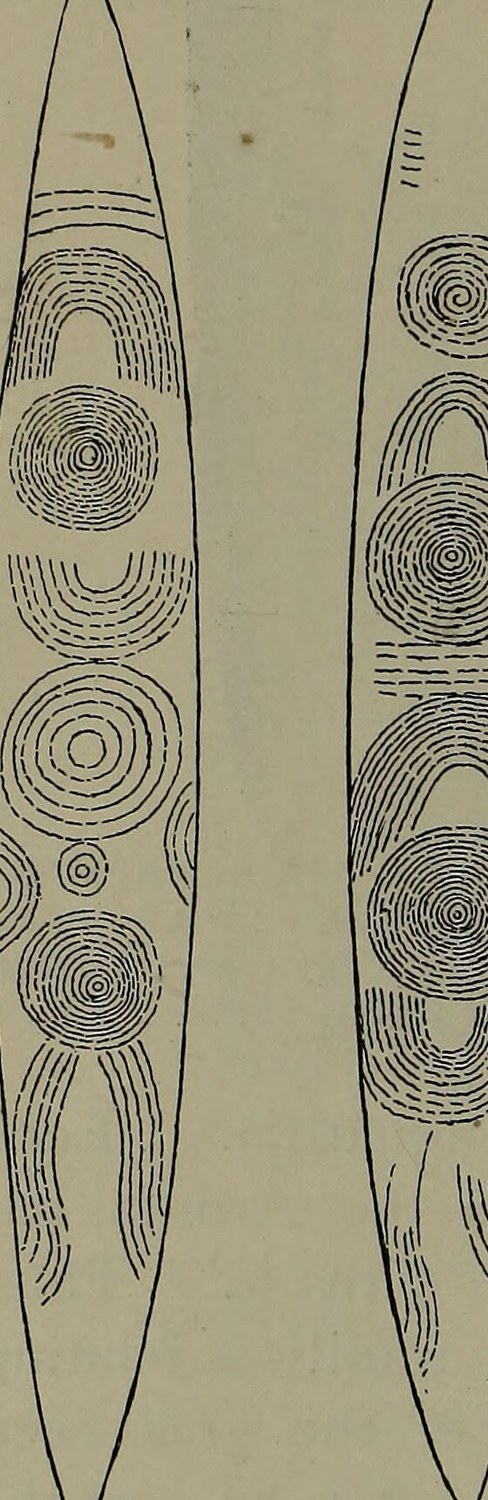
White pigment is the costume of the dead, and across the bullroarer's whole range it is worn for one stated purpose: so that the men working the mystery cannot be recognised. The roarer takes the human voice out of the performance; the whitening takes the human body out of it. They are two halves of a single machine, and where one of them is missing the other carries the entire load.
In brief
- A Greek lexicographer states the function outright: the Titans plastered themselves with gypsum before killing the child Dionysus ἐπὶ τῷ μὴ γνώριμοι γενέσθαι — "so as not to become recognisable" — and Athenian initiates were daubed with clay and bran in deliberate imitation of it.
- In the same Orphic dossier, the toys used to lure the child include the rhombos: the bullroarer.
- In Central Australia the same white pipeclay does both jobs. An Arrernte widow is smeared with it and is called Inpirta, "the whitened one"; Spencer and Gillen give the rule in six words — "white being the colour of mourning" — and say the paint is meant to be seen by the ghost. Initiates and the men performing over them are whitened with the identical clay, and with white down, while the bullroarers sound.
- In New South Wales a Gringai boy went into seclusion painted red and came out painted white: "they all wash off the red paint, and on coming out are painted white." The bullroarer of that rite has a name — Torikotti.
- In Tierra del Fuego, where there is no bullroarer at all, the paint carries everything: a six-foot recruit was refused a spirit role because his footprints would betray him, and disclosure of the secret carried death.
- In the Banks' Islands, Codrington found the bullroarer "too well known... to be used in mysteries" — the societies there ran a stone-and-palm-leaf substitute instead, for exactly this reason.

"So as not to be recognised"
Sometime in the second century, a lexicographer named Harpocration set out to gloss a difficult word in Demosthenes. The word was ἀπομάττων, "smearing," and the passage it came from was a piece of political abuse: Demosthenes taunting his rival Aeschines with the memory of Aeschines as a young man helping his mother run initiations by night. Here is what Aeschines is accused of doing, in the Loeb translation:
On arriving at manhood you assisted your mother in her initiations, reading the service-book while she performed the ritual, and helping generally with the paraphernalia. At night it was your duty to mix the libations, to clothe the catechumens in fawn-skins, to wash their bodies, to scour them with the loam and the bran, and, when their lustration was duly performed, to set them on their legs, and give out the hymn: "Here I leave my sins behind, Here the better way I find."
Demosthenes, On the Crown 259, trans. C. A. and J. H. Vince (1926)
Smearing initiates with mud and bran is the sort of detail an orator throws out to raise a laugh, and a reader five centuries later would have needed help with it. Harpocration supplies the help, and the gloss turns out to be more than lexical:
they used to anoint with clay and bran the initiates, imitating the stories told in myths according to some, that the Titans hurt Dionysus by plastering themselves with gypsum to avoid being recognized. (They say) that then this custom has ceased, but that later people smeared themselves with mud for tradition's sake.
Harpocration, Lexicon of the Ten Attic Orators, s.v. ἀπομάττων (§ a193), trans. Harpokration On Line
Every clause of that is worth having. The initiates are smeared in imitation of the Titans. The Titans are smeared with gypsum — the white of plaster and quicklime, not the brown of river mud. And the reason given for the gypsum is not purity, not sacrifice, not the sanctity of the earth. It is "to avoid being recognized." The men who fell on the child had first made themselves into things without faces.
Nonnus tells the same story with the same pigment, and adds the mirror the child was gazing into when they took him:
the Titans cunningly smeared their round faces with disguising chalk, and while he contemplated his changeling countenance reflected in a mirror they destroyed him with an infernal knife.
Nonnus, Dionysiaca 6.169–173, trans. W. H. D. Rouse (1940)
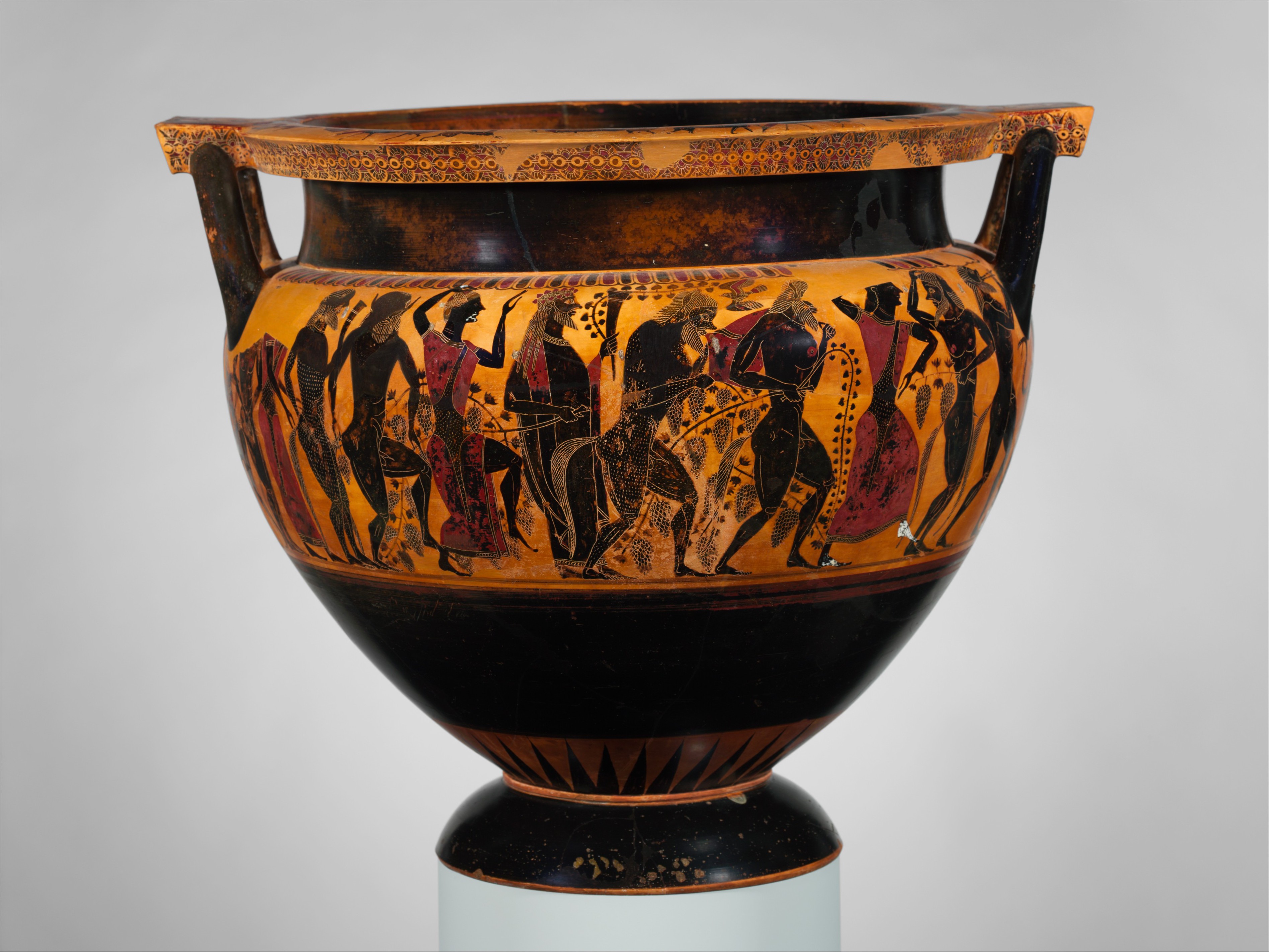
And what were the toys they used to get near him? Clement of Alexandria, hostile witness, quotes the Orphic verse and then lists the ritual objects that Dionysiac initiates handled in his own day:
First they beguiled him with childish toys, and then, — these very Titans — tore him to pieces, though he was but an infant. Orpheus of Thrace, the poet of the Initiation, speaks of
Clement of Alexandria, Protrepticus 2.17–18, trans. G. W. Butterworth (1919)
"Top, wheel and jointed dolls, with beauteous fruit
Of gold from the clear-voiced Hesperides."
And it is worth while to quote the worthless symbols of this rite of yours in order to excite condemnation: the knuckle-bone, the ball, the spinning-top, apples, wheel, mirror, fleece!
Butterworth's "wheel," in both places, is ῥόμβος in the Greek — the whirled slat on a cord, and in the second list it sits between the apples and the mirror, among the objects a living initiate handled.
Andrew Lang saw it in 1884. An ancient scholiast on this very passage of Clement had already spelled out that the κῶνος beside it roared too: "The κῶνος is a little piece of wood, to which a string is fastened, and in the mysteries it is whirled round to make a roaring noise." A piece of wood, a string, whirled, roaring. Lang read that and wrote: "Here, in short, we have a brief but complete description of the bull-roarer of the Australian turndun." Then he turned the page and joined it to Demosthenes' smeared initiates. The two halves were fitted together a hundred and forty years ago, by the man who first recognised the toy; the Dionysiac rhombos is where that door still stands.
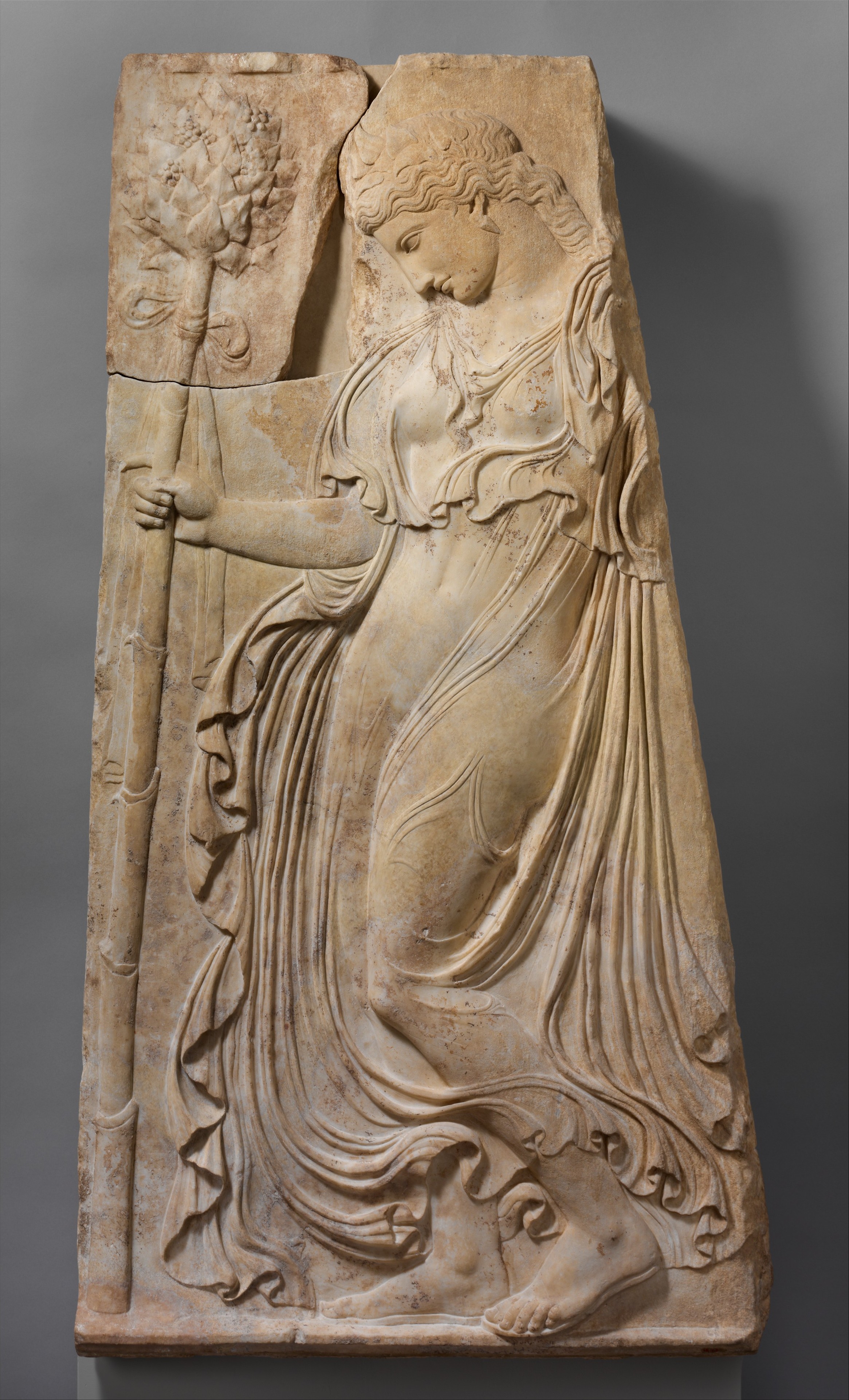
So an initiation cult smeared its candidates in imitation of the gypsum-white Titans, and when a scholar was asked why, the answer that came back was not about purity or the sanctity of the earth. It was: because that is what you do when you must not be known.
ἐπὶ τῷ μὴ γνώριμοι γενέσθαι — so as not to become recognisable.Harpocration, s.v. ἀπομάττων, on why the Titans wore gypsum
The whitened one
Now take the same pigment to the other side of the world, where nobody had read Demosthenes.
In Arrernte country a death is followed by whitening. Spencer and Gillen recorded it twice over, in the plainest language they used for anything:
When a man dies his special Unawa or Unawas smear their hair, faces and breasts with white pipeclay and remain silent for a certain time... The widow is called Inpirta, which means the whitened one in reference to the pipeclay.
Spencer & Gillen, The Native Tribes of Central Australia (1899), p. 500
A widow is not a woman wearing white; she is the whitened one, a person whose entire social position for the length of her mourning is a coat of clay. And the clay is legible — it is a message, sent to a specific reader:
the widow, standing by the grave, rubbed off the white pipeclay from her body, thus showing that her mourning was at an end... From the fact of the widow's having painted herself with white, and having made and worn the Chimurilia, he knows that he has been properly mourned for.
Spencer & Gillen (1899), p. 507
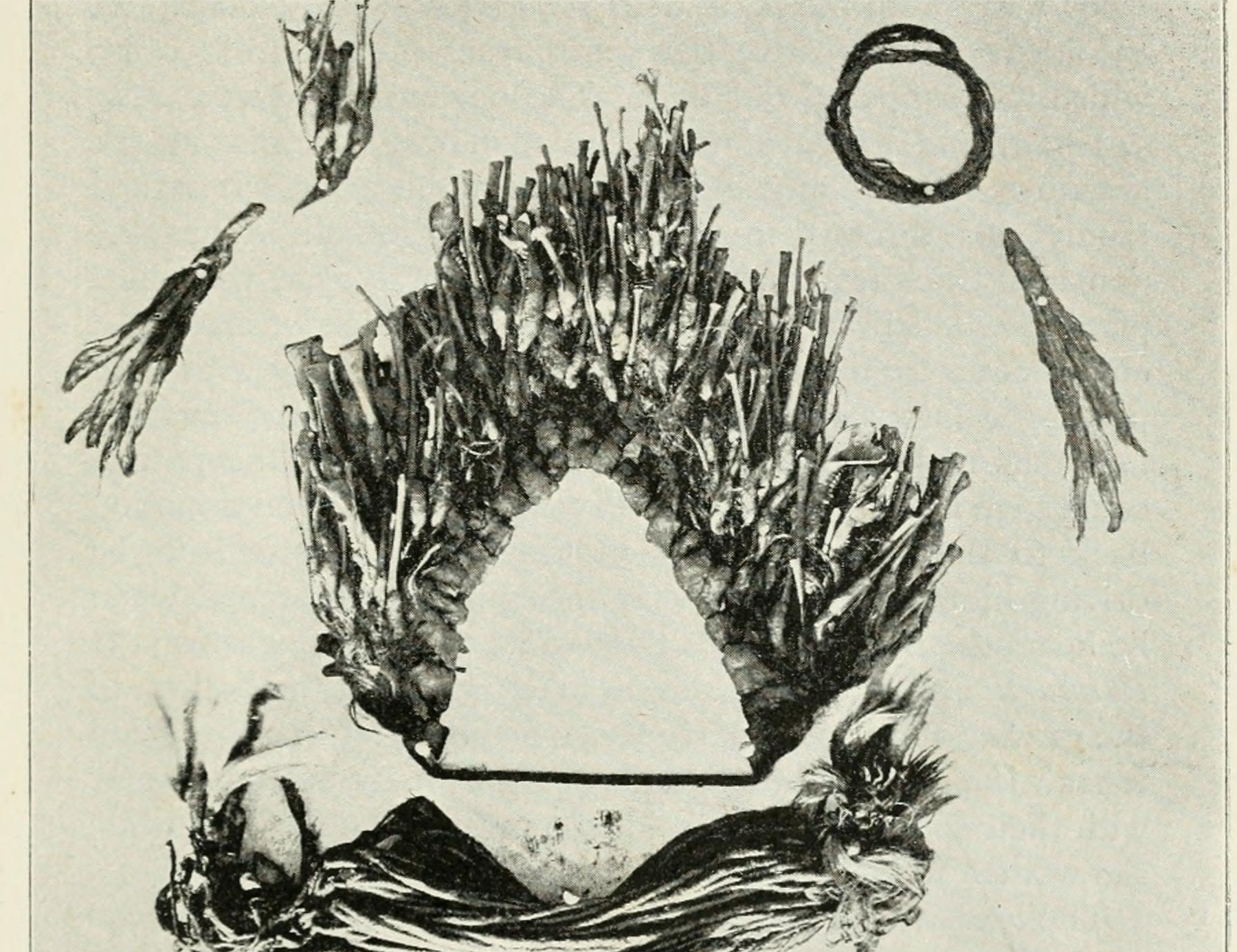
The "he" is the dead man. The pigment is addressed to the ghost, and it works because the ghost is watching. Spencer and Gillen state the rule without ornament in the same chapter — "white being the colour of mourning" — and they mean colour in the strict sense: a code, read at a distance, by the dead.
The same pigment goes onto the men's ground. In the Engwura — the long final cycle that makes a fully initiated man — two performers came out of the creek bed dressed as follows:
Each man was decorated with the usual head-dress, the front of which, as well as their face and beard, was covered with white down, while on each side of the body and extending down to the knee, was a line of circular patches of charcoal edged with white down. These patches were supposed to represent the skulls of slain and eaten men. The two performers were called ulthana, that is, the spirits of dead men, and in this instance they were supposed to have arisen from the bones of two men who had been eaten. They came up from the creek and remained at first crouching behind and hidden by a small bush from the sight of the old men who gathered by the Parra.
Spencer & Gillen (1899), p. 358
The men are covered in white down. They are wearing the skulls of the eaten. They are called the spirits of dead men. And before they are seen at all they are hidden — crouched behind a bush, managing their own disclosure, because an entrance that is not staged is only some men walking up a creek. Spencer and Gillen return to the same performance in their chapter on cannibalism and gloss it themselves: the two were "decorated with circles of white down which were supposed to represent the skulls of slain and eaten men," and "the performers themselves represented the Ulthana or spirits of the dead men wandering about in search of those who had killed and eaten them."
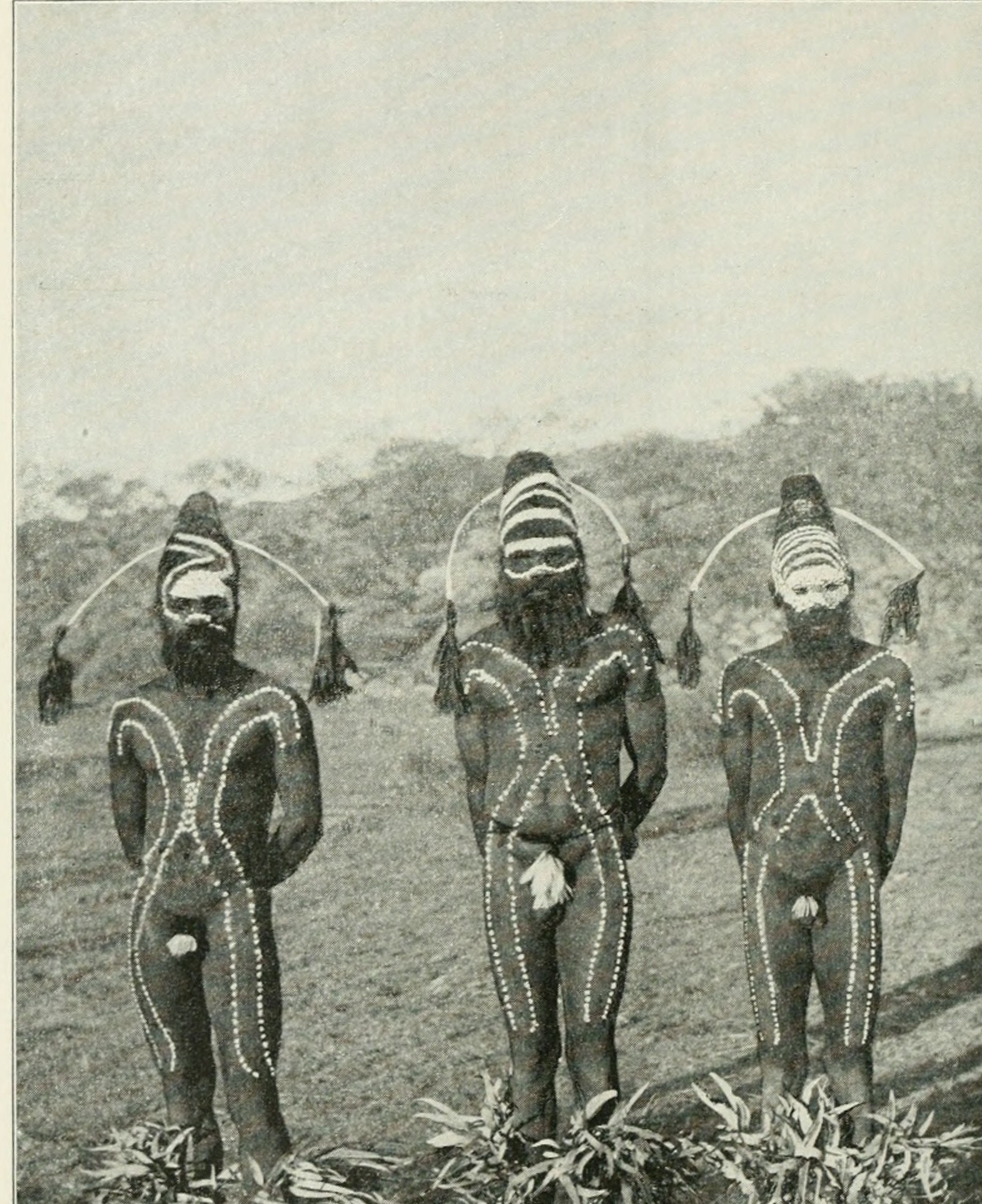
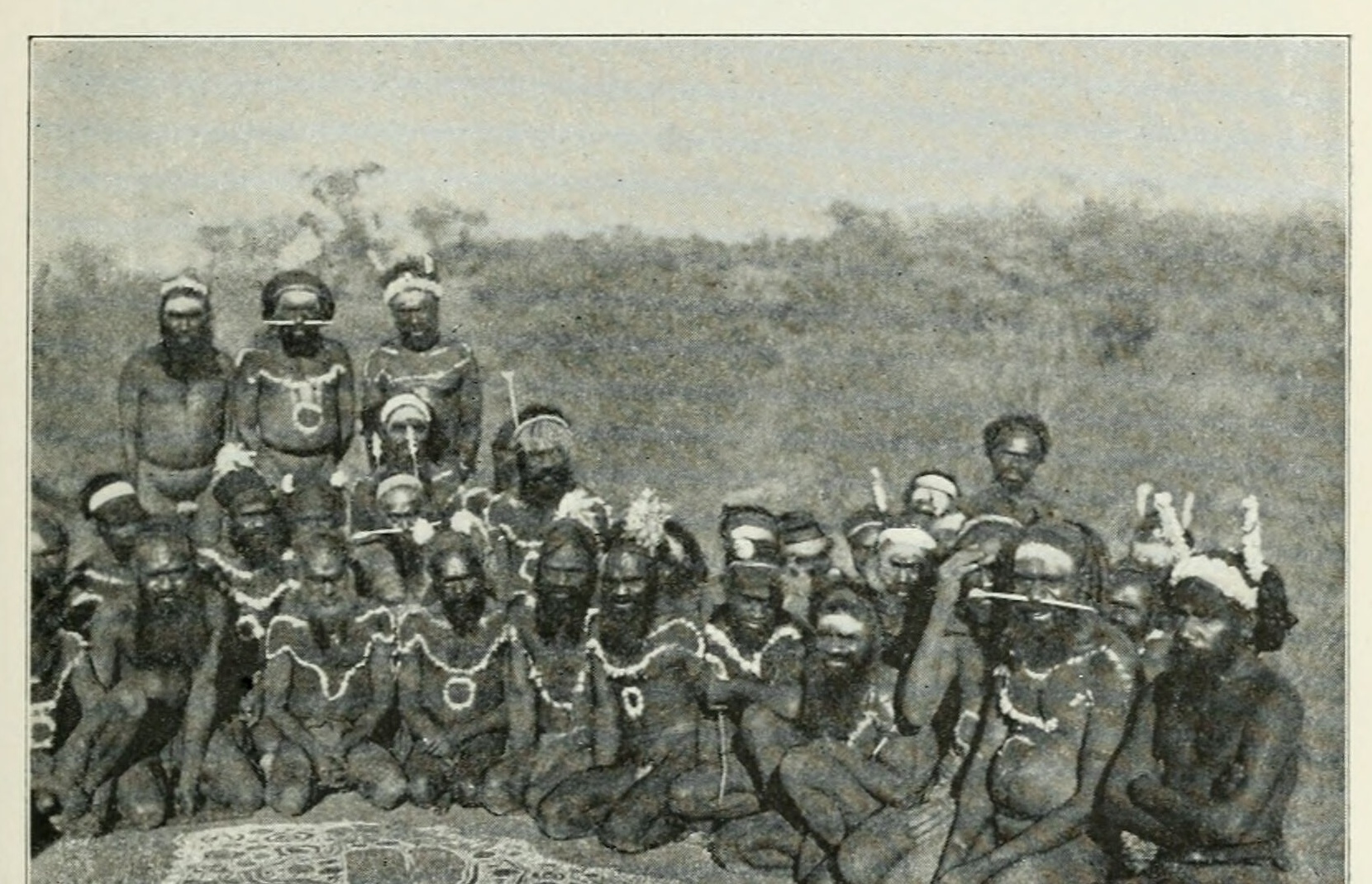
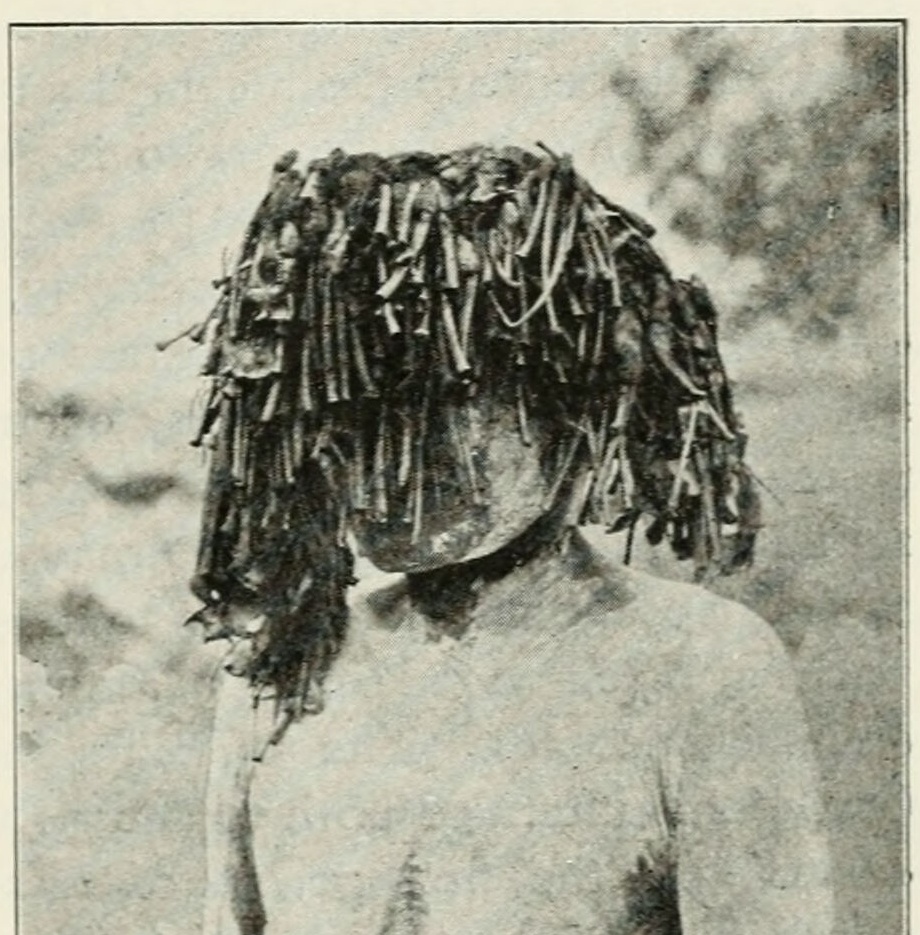
Note also what down does that paint cannot: it fills in the outline. A man banded and ringed in bird's down has no visible waist, no elbows, no jaw — the body stops being a body and becomes a shape. The boy is whitened too: on the road to his circumcision his guardians halt "for the purpose of painting his body with white pipe-clay." And while these shapes move, the sound is running:
During the whole time the bull-roarers were sounding all round so loudly that they could easily be heard by the women and children in their camp, and by them it is supposed that the roaring is the voice of the great spirit Twanyirika, who has come to take the boy away.
Spencer & Gillen (1899), p. 246
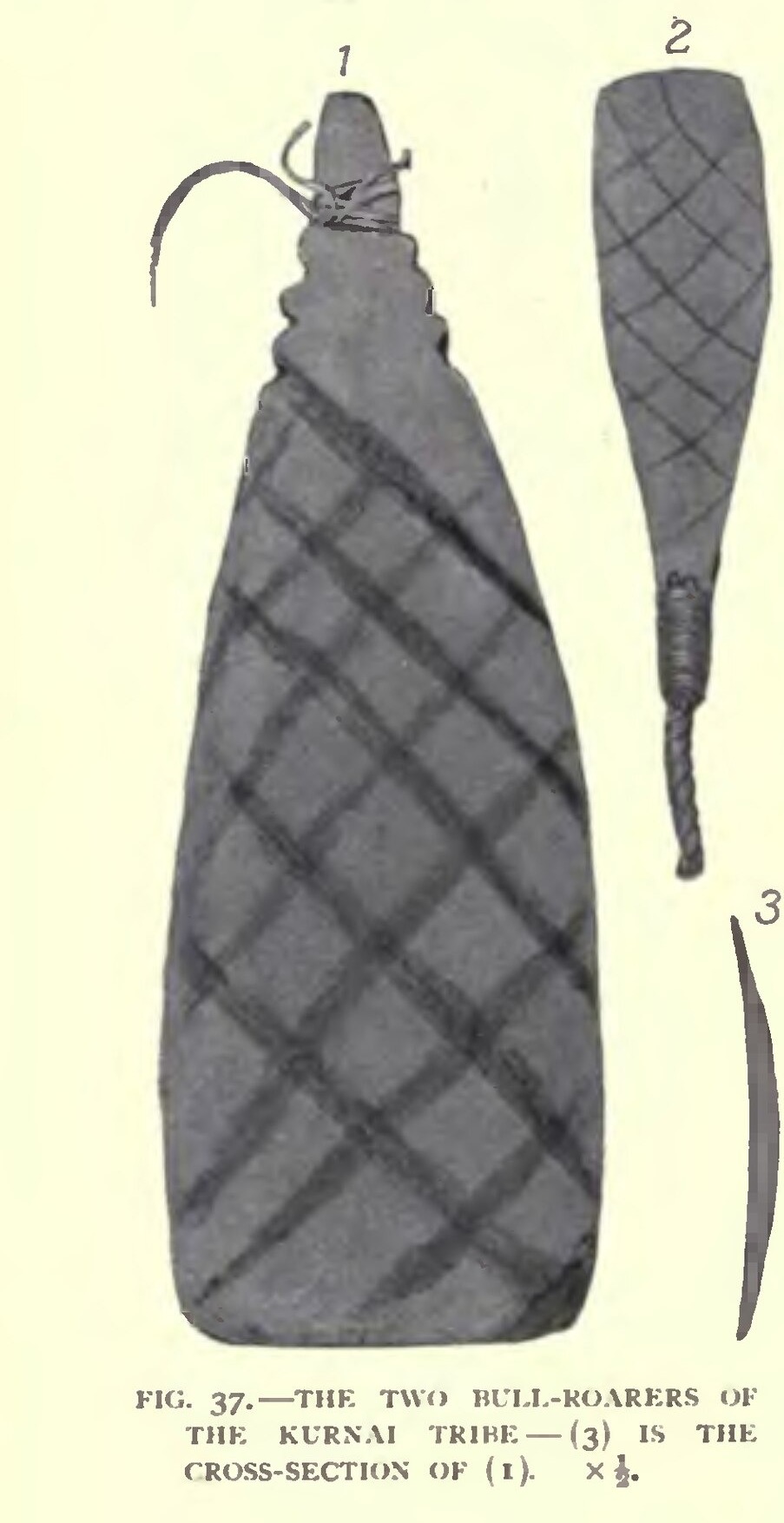
One pigment, two uses, one meaning. On the widow it says: a dead man is present and is owed something. On the initiators it says: the men you know are not here, and what is here is not alive. Twanyirika supplies the voice; the clay supplies the body.
Further north the effect was frank enough that the ethnographers reached for the obvious word. At the Warramunga fire ceremony, twelve men were to carry the burning wanmanmirri, the great torches, and this is how they were prepared:
First of all they daubed themselves all over with red mud, literally from the crown of the head to the sole of the foot. This done they smeared a thick coat of white pipe-clay all over until each of them resembled a weird, ghoul-like model of a human being, done in dripping wet clay.
Spencer & Gillen, The Northern Tribes of Central Australia (1904), p. 389
A model of a human being. Not a decorated man — a facsimile.
Washed, repainted white, returned
In the Williams River valley of New South Wales, Howitt's Gringai informants gave him a sequence that puts the whole thing in order. The boy is painted red and set in an earthen ring while the women lie around it with their faces covered. He is led, eyes down, to a second ring and shown the carved trees. He is secluded for some ten days to learn the songs and the dances. Then he is washed, painted white again, and sent back to the women's camp. Of the instrument that governs all of it, Howitt is brief: "The bull-roarer is called by the Gringai Torikotti, and is used in these ceremonies."
Read the colours as a route. Red going in, white coming out — and white is the colour a widow wears. The boy who returns to his mother's camp comes back in mourning for himself, which is the plainest possible statement of what has just happened to him: the child is dead and the men are handing back somebody else. What the men do to him out of sight is the covered half of that transaction. The paint is the half his mother is allowed to see.
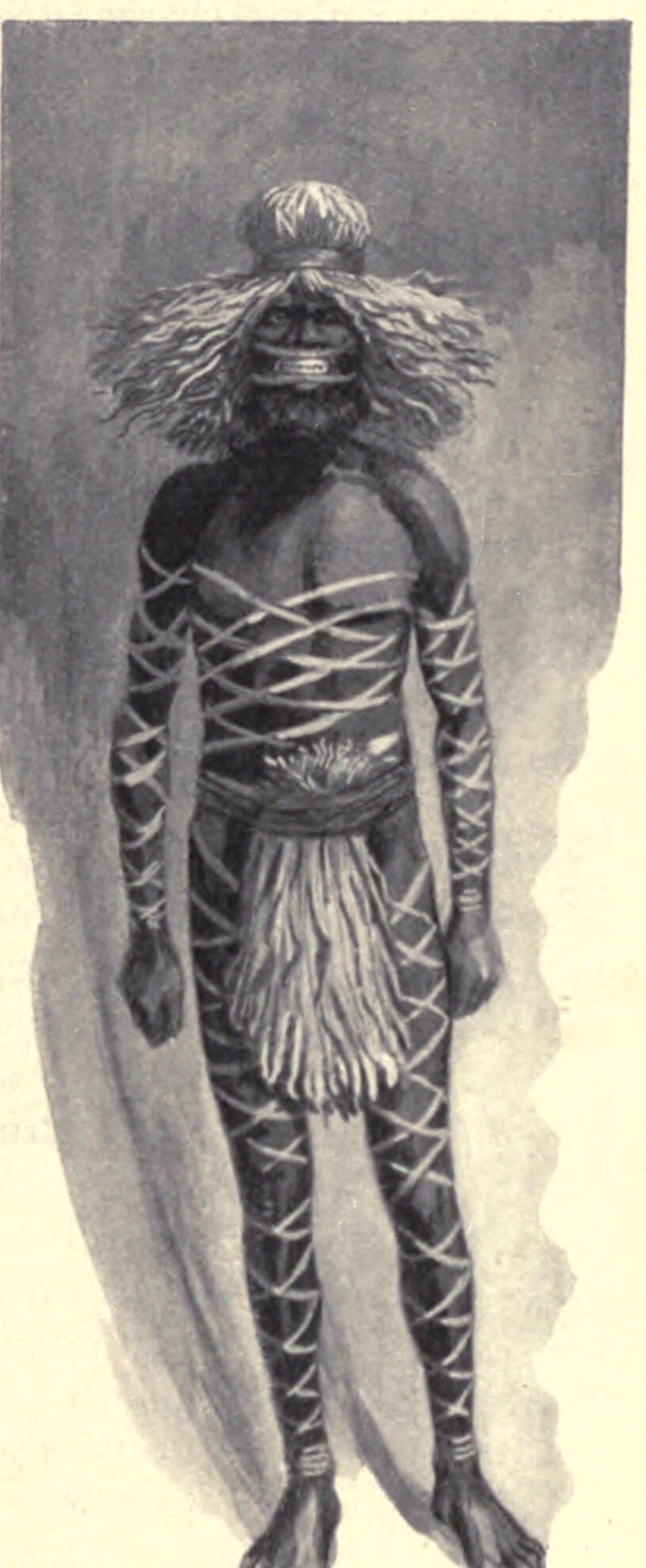
Further south, in the Yuin Kuringal, the same rite runs its sound and its pigment on separate channels. The messengers whirl the roarers hard —
Those two of the men who have the most muscular arms take the bull-roarers, which are carried with the party, and make as loud a noise with them as they are able... so that the noise made by the mudthis may be notified to the initiated at the Bunan camp, and yet may be masked from the women and children.
Howitt, The Native Tribes of South-East Australia (1904), p. 521
— while at the welcome corrobboree the women's "faces were whitened with pipe-clay, and they wore large head-dresses made of swans' feathers."
And the spirits themselves wear it. Howitt, gathering beliefs from the Lake Macquarie country, quotes the missionary Threlkeld on a being called Koin, who haunts the thick bush and takes men in the night: "He appears painted with pipe-clay, and carries a fire-stick in his hand; but generally it is the doctors (a kind of magician), who alone perceive him." When a man wants to be taken for something that is not a man, he reaches for the clay — and when the doctors of that country see the being itself, it is already wearing the clay. The costume and the thing it counterfeits have converged.
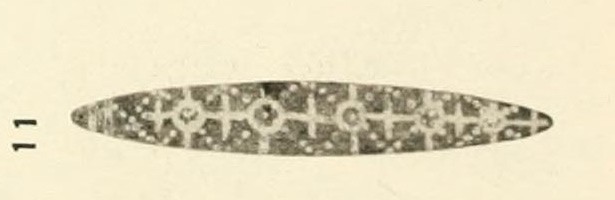
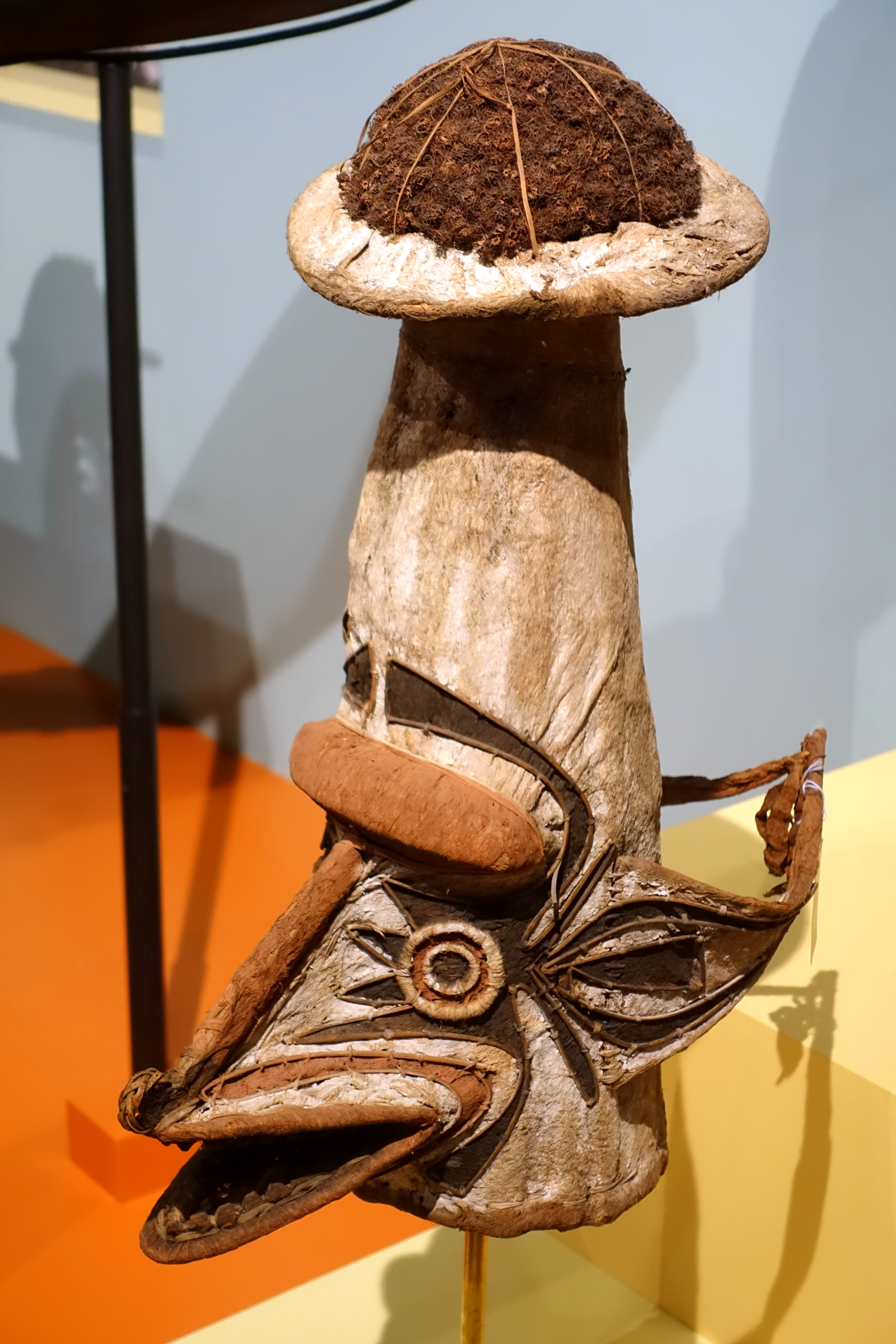
The white is on the instrument too, and in Melanesia it is on the instrument above all. A Kaimari board from the Purari delta carries a spirit face whose features are picked out in lime, raised white against dark timber. Mali Baining boards take faint touches of white lime; Tami blades are carved and limed; Marind roarers are wood and lime together. The same cosmetic that turns a man into a ghost turns a plank into a face.
The place with no bullroarer
Tierra del Fuego has no bullroarer. Loeb went looking and reported the absence in one line — "No bullroarer or substitute is reported for any of the tribes of Tierra del Fuego" — and Cooper's survey of Yahgan music agrees to the point of severity: "There were no musical instruments at all. Even the rattle, drum, and flute were absent."
What the Selk'nam had instead was paint, and they ran it harder than anyone. In the Hain the men of the lodge became a repertory company of spirits — So'orte in white dots on a dark ground, Kosmenk in white bars on red, Matan in white ovals, Ulen ringed head to foot in fine white lines — wearing bark cones and leather hoods painted to match, all of it applied inside the lodge, in secret, and hidden in the woods afterwards.
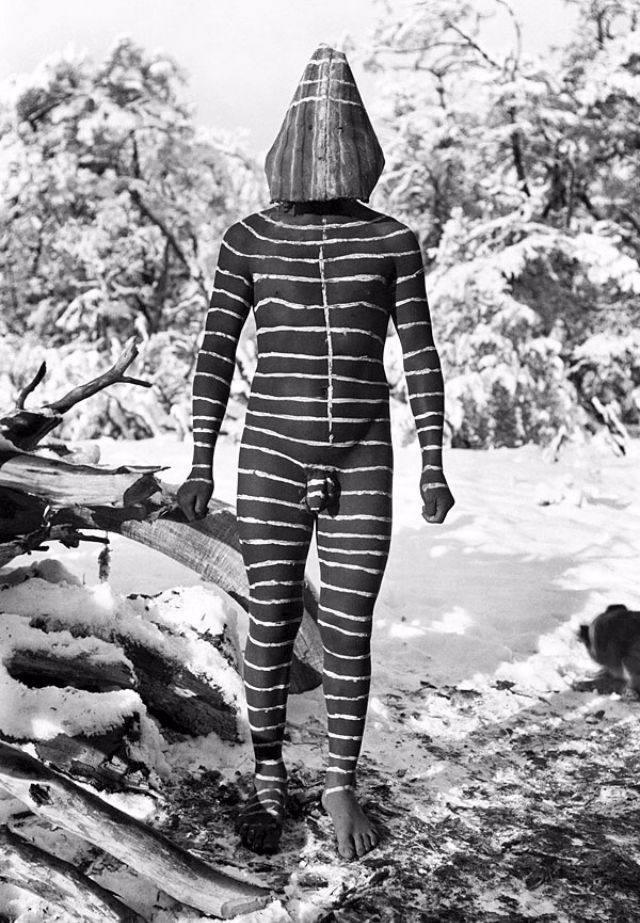
Lucas Bridges, who grew up among them and was initiated, records the design constraint with beautiful bluntness. The men were sizing him up for a role:
Standing over six feet, I qualified in height and build for a creature called Short. This, however, would be too risky; the tracks of my bare feet would give me away. Not even the women could have failed to recognize them.
Lucas Bridges, Uttermost Part of the Earth (1948), p. 411
A man is turned down for a spirit part because of his footprints. The performance is engineered around a single failure mode, and the failure mode is being known. Everything else follows from it — the padding of a small bow across a forehead "so that it could not be recognized as such," the grey down stuck over the paint to blur a man into his lichen-covered rocks, and the sanction, which Bridges was given as a warning on the day he joined:
Should any man, Halimink warned me gravely, confide to a woman or an uninitiated lad anything of what went on in the Hain, both he and the person to whom he had spoken would be killed. There would be no one to defend the guilty man, for, in the event of such an unforgivable indiscretion, brother would kill brother, father would kill son.
Bridges (1948), p. 410
And recognition, when it is finally permitted, is not a leak. It is the ceremony. The boys grow up believing in the monsters, are chased by them, are sent alone into the forest with warnings that arrows are useless against Short — and then:
it was through meeting him face to face in the Hain and wrestling with him, that the klokten learnt the great secret: that Short, Halpen, Hachai and the rest were not supernatural beings, but merely characters in a masquerade.
Bridges (1948), p. 420
Bridges watched one such match. The novice threw his opponent, as the script requires, and then the paint came off:
But when he realized the identity of his tormentor, he attacked him again with such fury that he had to be dragged off, to the accompaniment of roars of laughter, in which Short joined heartily.
Bridges (1948), p. 421
Initiation is the controlled demolition of a disguise. Which means the disguise is the thing being handed over: what a Selk'nam boy receives at the end of his ordeal is not a doctrine but a job — from now on he is one of the men who paint. The Selk'nam tell this as a theft: the women ran the lodge first, and the men killed them and took the masquerade over intact. What matters for the paint is that nothing else needed stealing. Where the roarer is absent, the pigment is the entire technology, and it is more than sufficient.
When the disguise wears out
On the Papuan coast Seligman watched the masked kaivakuku of the Roro-speaking villages, whose costume covers a man from crown to ankle, and noted what they still had to do with their feet:
The kaivakuku men would promenade the village in the afternoon, taking care to disguise their gait, and walk on the side of their feet, so that they might not be recognized. At night they would swing bull-roarers.
C. G. Seligman, The Melanesians of British New Guinea (1910), p. 299
A costume that hides the whole body is not trusted to be enough, because a walk is an identification. So the men roll onto the outer edges of their feet and go about the village moving like nothing human — and when the light goes, the roarers come out and take the voices away too. Seligman adds that the Roro had all of this from the Elema of the Papuan Gulf. The technique travelled, and it travelled complete.
A disguise maintained down to a footfall is a disguise that can fail. And when what fails is the roarer itself — when the audience learns to name the sound — the cult drops it. Codrington found the substitution already made.
In the Banks' Islands the men's societies had a noise-maker built of stone and palm-leaf, and Codrington explains why they bothered with it: "This apparatus does the work which the 'bull-roarer,' too well known in the Banks' Islands to be used in mysteries, performs elsewhere." A cult that needs a voice from nowhere cannot use an instrument the audience can name.
The societies themselves keep the point in their vocabulary: the mask worn in them and the society that wears it carry the same word, tamate — a ghost. The disguise is not like a ghost. It is the word for one.
In Cameroon the two halves are still bolted together, and there the pigment runs to a timetable. The great initiation of the Beti and Fang peoples — the Sô — drove its candidates into a forest sanctuary to be beaten, made to crawl through thorns, and ritually buried. It has a bullroarer, and the bullroarer has a name of its own: the Quai Branly holds a Mangisa Imbakiyam, sounded at the sortie de l'ésanso, the emergence from the lodge. And when Günter Tessmann described the novices' costume among the Fang — his Pangwe — he did not have to be asked what the white was doing:
The whole get-up is clear in its meaning: white is the colour of death — for the moon, whose waning is a kind of dying, is white, and white too are the bones of a dead man; hence the white coat of paint and the little white tail-cloth. […] So the "dead" may join in a festival now and then, but afterwards they must go back to their kingdom of the dead, which is to say they must sleep in the bush huts. Two rules likewise stay in force: first, the women may not see the novices eat — naturally, since the dead do not eat — and second, the novices may not go with women, the dead being sexless.
Günter Tessmann, Die Pangwe (1913), vol. II, p. 50
Which settles when the paint comes off. It is not applied at the homecoming as a badge of new life; it is worn for as long as the boy is legally a corpse, and it is withdrawn by instalments as he stops being one:
After three months in the bush hut the novices count only half among the dead, which is expressed by whitewashing the hands and feet only, and laying a piece of bark-cloth about the hips. […] This condition lasts a certain time, and after it the novices are initiates. They have put on an entirely different person, outwardly as well, in that they rub themselves with red camwood — the sign of joy, of life — and wear European cloth.
Tessmann, Die Pangwe, vol. II, p. 51
White at the death, worn through the whole of the dying, cut back to the hands and feet at the halfway mark, and finally driven out by the red of the living. It is the Arrernte widow's grammar, run in a country that never heard of her: she puts the clay on at a death and rubs it off at the grave when the mourning ends. So does a Fang boy. The whitened body is the body that is not currently a person, and the roarer speaks over it.
The dead are the only ones allowed
From Attica to the Arrernte to Tierra del Fuego the pigment is doing one job, and it is not decoration. It is a costume of the dead, worn in order not to be identified — and those two functions are the same function, because in every one of these societies the dead are precisely the class of persons who are no longer anybody in particular. A man is a neighbour, an uncle, a debtor, a rival. A ghost is none of those. Whitening a body strips it of the relationships that would make it answerable, and that is the exact condition required to take somebody's child away from them in the dark, terrify him for a fortnight, cut him, and hand him back changed. No living neighbour has that right. The dead do.
Which is why the two technologies keep turning up in each other's company, and why either can stand in for the other. The bullroarer removes the human being from the voice: it cannot be traced to a throat, it comes from all directions, and it is loud enough to be the size of whatever the listener imagines. The white clay removes the human being from the body: no face, no joints, no gait, no footprints. Each one solves half of the same problem. Where a people has both, as in Central Australia, the sound and the pigment arrive together. Where a people has only the paint, as in Tierra del Fuego, the paint is asked to do everything and does it — at the cost of a death penalty to keep it working. Where a people's roarer has become an open joke, as in the Banks' Islands, it is quietly retired and something less familiar takes its place.
Joseph Campbell saw the pattern and refused to call it chance:
It surely is no mere accident, nor consequence of parallel development, that has brought the bull-roarers on the scene for both the Greek and the Australian occasions, as well as the figures masquerading in white (the Australians wearing bird down, the Greek Titans smeared like clowns with a white clay).
Joseph Campbell, The Masks of God: Primitive Mythology (New York: Viking, 1959), p. 101
Then he turned to the genealogy of the Titans and never came back to it. He named the match and moved on, and the question of what the paint was for sits on his page unopened. It has an answer, and the people who used the technique are the ones who gave it. They plastered themselves white ἐπὶ τῷ μὴ γνώριμοι γενέσθαι — so as not to be recognised.
Key sources
- Harpocration, Lexicon of the Ten Attic Orators, s.v. ἀπομάττων (Bekker p. 28.10; = § a193 in Keaney's numbering, followed by ToposText and by Harpokration On Line). Greek text at Perseus, from Dindorf's Oxford edition of 1853; English from the Harpokration On Line project at the Duke Collaboratory for Classics Computing, CC BY 4.0. The closing clause is πηλῷ δὲ ὕστερον καταπλάττεσθαι νομίμου χάριν — clay later, by convention. Jane Harrison (Prolegomena, 1908, p. 492) renders it "plastered with gypsum out of convention," importing γύψος into a clause that has πηλός and flattening the contrast the sentence draws: gypsum in the myth, ordinary mud in the surviving custom.
- Demosthenes, On the Crown (De Corona) 259, trans. C. A. Vince and J. H. Vince, Loeb Classical Library (1926). The operative verb is ἀπομάττων, with πηλός (clay) and πίτυρα (bran); Demosthenes names no colour — the gypsum belongs to Harpocration's explanation of the custom.
- Clement of Alexandria, Protrepticus, ch. 2, trans. G. W. Butterworth, Loeb Classical Library (1919). Butterworth renders ῥόμβος as "wheel" in both the Orphic verse and the toy-list; the Greek of the verse is κῶνος καὶ ῥόμβος καὶ παίγνια καμπεσίγυια ("top, wheel and jointed dolls"), and of the list ἀστράγαλος, σφαῖρα, στρόβιλος, μῆλα, ῥόμβος, ἔσοπτρον, πόκος (knuckle-bone, ball, spinning-top, apples, wheel, mirror, fleece).
- Nonnus, Dionysiaca 6.169–173, trans. W. H. D. Rouse, Loeb Classical Library (1940). Perseus's edition numbers the same five lines 170–174.
- Andrew Lang, Custom and Myth (London: Longmans, Green, 1884), ch. "The Bull-Roarer," p. 39 for the identification of the Dionysiac κῶνος with the Australian turndun on the authority of the scholiast on Clement, and pp. 39–40 for his linking of it to Demosthenes.
- Baldwin Spencer and F. J. Gillen, The Native Tribes of Central Australia (London: Macmillan, 1899): p. 246 (the voice of Twanyirika at circumcision), 266–267 (the novice painted with white pipe-clay on the way to circumcision), 358 (the ulthana performance in the Engwura), 473 (the authors' own gloss on it, under "Cannibalism"), 500 (Inpirta, the whitened one), 503 ("white being the colour of mourning"), 507 (the widow rubs the clay off at the grave).
- Spencer and Gillen, The Northern Tribes of Central Australia (London: Macmillan, 1904): p. 389 (the Warramunga fire ceremony, the wanmanmirri torch-bearers), 521–522 (widows in pipeclay).
- A. W. Howitt, The Native Tribes of South-East Australia (London: Macmillan, 1904): p. 497 (Koin "painted with pipe-clay", Howitt quoting L. E. Threlkeld, An Australian Language, p. 47, on the Lake Macquarie country), 521 (bull-roarers on the road to the Bunan), 528 (the women's faces whitened at the welcome corrobboree), 571 (the Gringai sequence and Torikotti).
- Lucas Bridges, Uttermost Part of the Earth (London: Hodder & Stoughton, 1948), the Hain chapters: p. 410 (the death sanction, from Halimink), 411 (the footprints), 420 (what the klokten learn), 421 (the wrestling match with Short).
- Dánae Fiore, "Shelk'nam body paintings: ancient and recent uses of an ephemeral art form in Tierra del Fuego (southern end of Southamerica)," Arctic & Antarctic: International Journal of Circumpolar Socio-Cultural Issues 10 (2016), pp. 9–59, at pp. 30–32 for the spirit-by-spirit inventory of Hain designs after Gusinde 1931 and Chapman 1982.
- C. G. Seligman, The Melanesians of British New Guinea (Cambridge: Cambridge University Press, 1910), p. 299, for the kaivakuku disguising their gait and swinging bull-roarers after dark, and for Seligman's statement that the Roro had the custom from the Elema. Plate XLI, facing that page, shows three kaivakuku masks at rest in the hut built to keep them in at Hisiu (photograph by Captain F. R. Barton).
- R. H. Codrington, The Melanesians (Oxford: Clarendon, 1891), p. 80 for the stone-and-palm-leaf substitute, and pp. 79–80 n. for tamate = "a ghost".
- Günter Tessmann, Die Pangwe (Berlin: Wasmuth, 1913), vol. II, pp. 49–51, for the pigment schedule of the Sô: white clay worn through the novices' symbolic death, reduced to hands and feet on the return, and replaced by red camwood at reincorporation.
- E. M. Loeb, Tribal Initiations and Secret Societies, UCPAAE 25(3) (1929), p. 280, for the Fuegian absence; John M. Cooper in the Handbook of South American Indians 1:102 for the Yahgan instrument list, which specifies what it means: "Even the rattle, drum, and flute were absent."
- As far as we know, the reading offered here — that the whitening and the bullroarer are interchangeable solutions to a single problem of recognition — is original to this page.