The Bullroarer Atlas

PNG47 - ethnographic attestation

Siassi Islands

Papua New Guinea - Morobe - Oceania - Sahul

Restricted

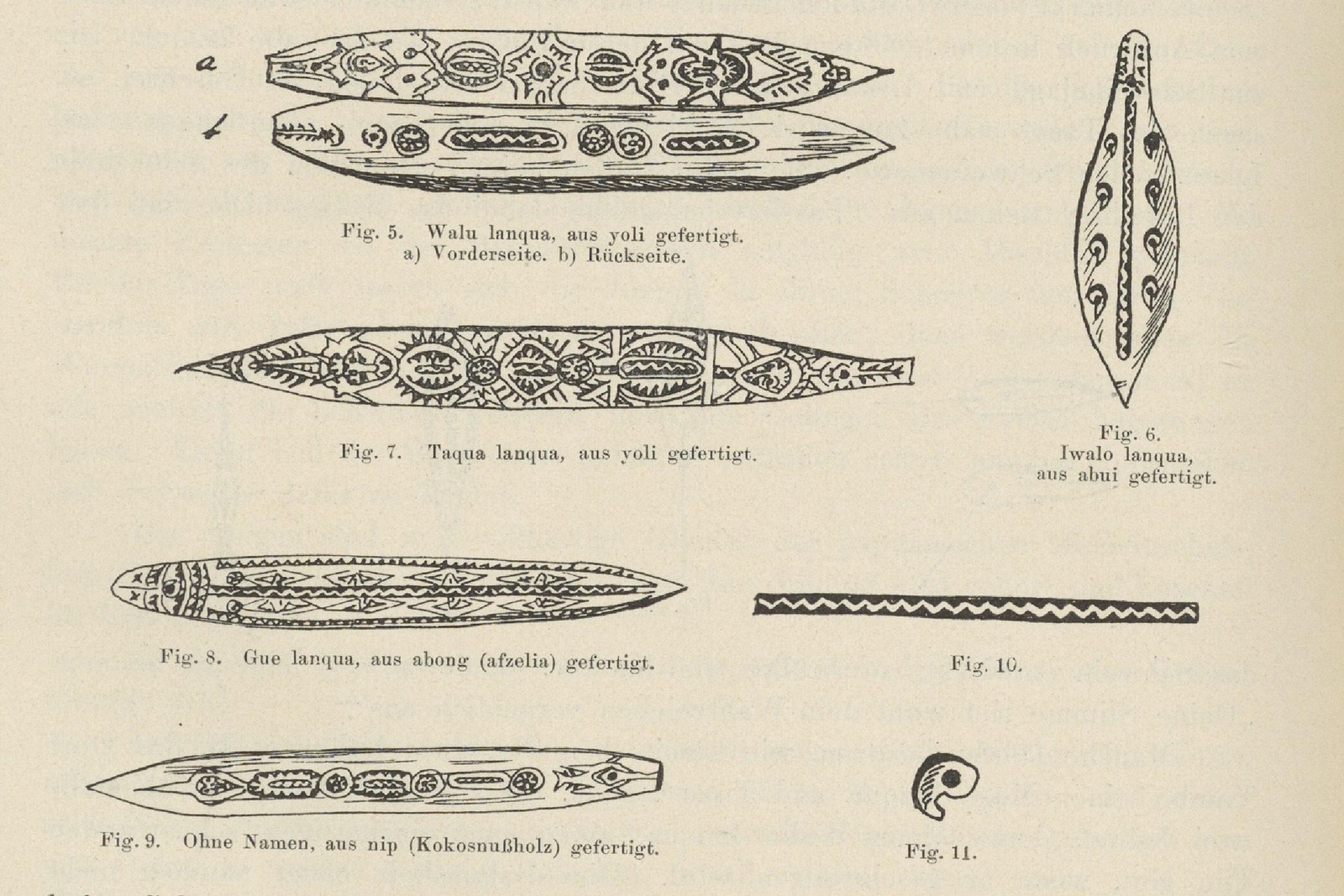
Engraved balum bullroarers of the Bukaua — lanceolate blades bearing ancestors' names (Walu, Taqua, Iwalo and Gue lanqua), figured by the...
Representative image. Engraved balum bullroarers of the Bukaua — lanceolate blades bearing ancestors' names (Walu, Taqua, Iwalo and Gue lanqua), figured by the missionary Lehner in 1911. The Bukaua were among the Huon Gulf mainlanders who, Bamler records, pressed the kani cult on the Tami; the Siassi kani itself was never photographed. R. Neuhauss, Deutsch-Neu-Guinea, Bd. III (1911), p. 412, figs. 5–11 (S. Lehner, 'Bukaua') — Universitätsbibliothek Frankfurt, DSDK Public domain Image source

kani English

Source term: bullroarer / sacred flute / slit-gong flags

kani (Tami): one word naming three things at once — the bull-roarer, the child-swallowing monster of the circumcision rite, and the souls of the dead.

Etymology. In Tami, kani is the word for the souls of the dead, applied also to the bull-roarer and to the monster who swallows the lads at circumcision; the bull-roarer's hum is that monster's voice. (high confidence)

Among the Tami people, on islands in the Vitiaz Strait off the New Guinea coast, the bullroarer was the voice of kani — a dragonlike monster said to eat children, invisible to women, who swallowed the boys at their circumcision. The same word, kani, named both the swung wooden instrument and the beast, and the hum of the bullroarer was understood as the monster's voice. The tago masquerade in which it sounded was no annual affair: the tago appeared in public only once every ten or twelve years, and then ran for about a year. The carved tago masks were kept the rest of that time in a hut in the forest; women were banned from that part of the bush, and a woman who uncovered the secret of the tago risked being put to death. Frazer, comparing the peoples of this coast, recorded the same word doing triple duty in each tongue — for the bullroarer, for the monster that swallows the novices, and for a ghost of the dead: balum among the Yabim and Bukaua, ngosa among the Kai, kani among the Tami.

The voice of the monster is heard in the hum of the bull-roarers, which are swung at the ceremony in such numbers and with such force that in still weather the booming sound may be heard across the sea for many miles.

Frazer, The Belief in Immortality and the Worship of the Dead, Vol. I (1913), p. 301 (Lecture XIII), summarizing G. Bamler, "Tami," in Neuhauss, Deutsch Neu-Guinea, III (1911), pp. 493-507
Object
bullroarer occurrence; bullroarer use; slit-gong occurrence; slit-gong use
Function
Gourlay source-catalog row with bullroarer use in PNG/Melanesia.
Map confidence
high - geocoded
Source location
Frazer 1913, I:301-302 (kani = bull-roarer / monster / the dead; circumcision rite), fnn. 475 and 481 -> Bamler 1911:493-507 (bull-roarer / circumcision) and 489-492 (kani = the dead).

View source Open this point on the interactive map