No. PNG153
Baining
Papua New Guinea · East New Britain · Oceania · Sahul
Restricted
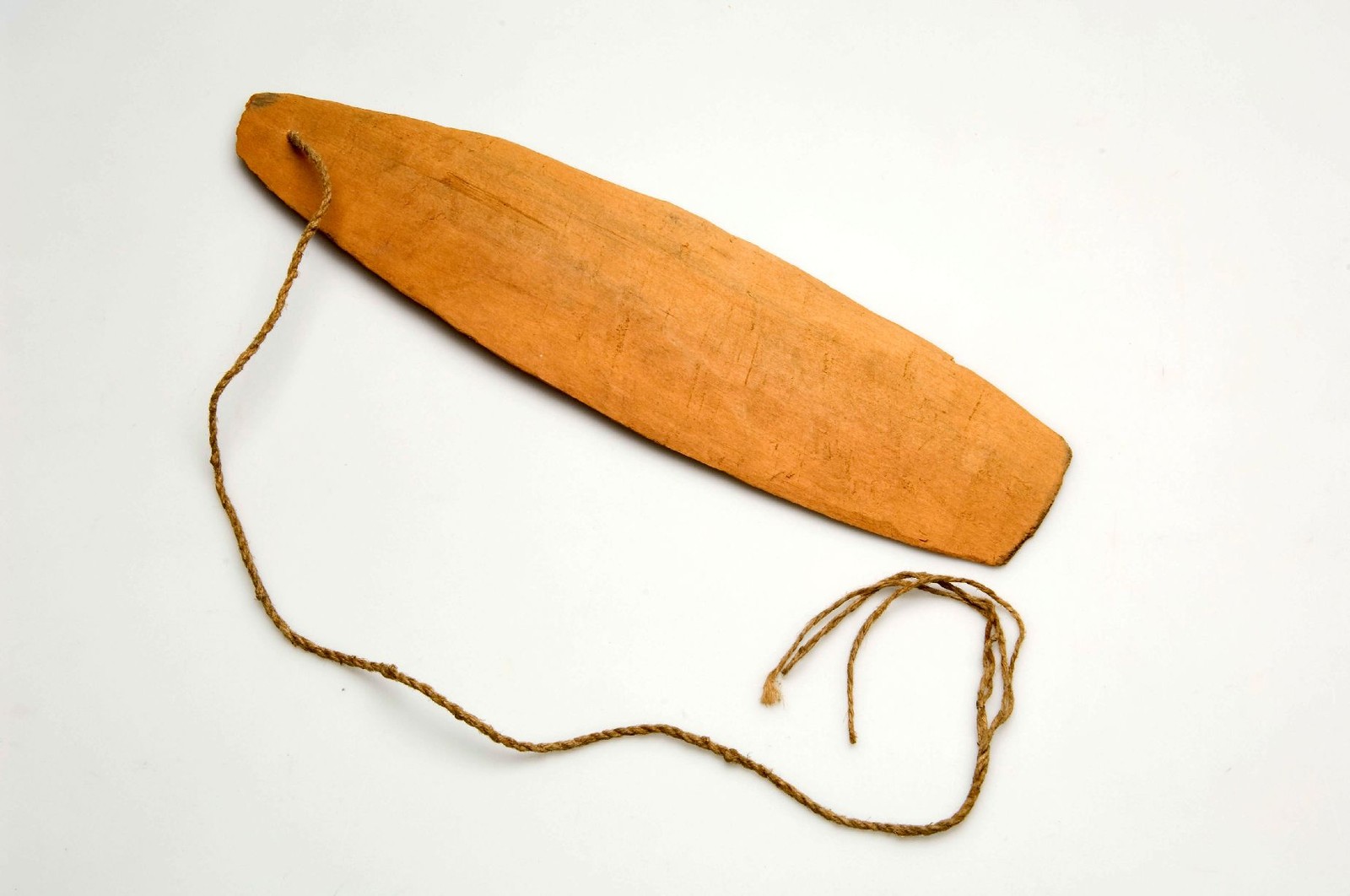
salecha
salecha: Uramot (Central Baining) name for the bullroarer.
Etymology. Among the Uramot (Central Baining) of inland New Britain the bullroarer is called salecha, and its whirring is understood as the voice of the Supreme Being Rigenmucha; the masks worn at the boys' initiation are described as the 'children of the salecha'.
Rigenmucha, ‘the one who was always there,’ made the world and the first human pair. Bodiless and sexless, he has no carved likeness: the Baining hear his warning presence in the bullroarer. The masks of the great night fire dance that closes the boys’ initiation are his children, called into existence by that voice. In Uramot initiation, fathers cover their sons’ eyes and lead them between two rows of bullroarer-men. The instruments howl; the boys learn how men make the drone. At the culminating dance, the new initiates carry snakes two to four metres long, coiled round their chests and arms, and thrust them toward the spectators. The snakes help transmit fertility, alongside the blood and sexual emblems of the rite. A Uramot origin story gives the first discovery to a woman splitting firewood: she whirls a splinter and terrifies the men, until a man learns her trick, kills her and carries the instrument to the men, who turn its terror on the women. The secret carries its own lethal warning: ‘the salecha kills.’
Seine Stimme, mahnend und warnend, wird im Surren der Schwirrhölzer (a salecha) vernommen.
His voice, admonishing and warning, is heard in the whirring of the salecha bullroarers.
Laufer, 'Rigenmucha, das höchste Wesen der Baining,' Anthropos 41-44 (1946/49), p. 510
Particulars
- Function
- Sounded in male initiation and its night fire dance; an initiate who betrayed the secret to women would be killed.
Sources
- Carl Laufer, 'Rigenmucha, das höchste Wesen der Baining (Neubritannien),' Anthropos 41-44 (1946/49): 497-560, pp. 510-511, 521-522, 531-539, 558-559
- K. A. Gourlay, Sound-Producing Instruments in Traditional Society: A Study of Esoteric Instruments and Their Role in Male-Female Relations, New Guinea Research Bulletin 60 (1975), table 1, entry 153 View