Atlas Essay —
The Serpent’s Voice
Arizona · Arnhem Land · the Kimberley · New Guinea · the Vaupés · the Bandiagara cliffs · the Upper Tigris · the hills of Liao
Swing a flat blade of wood on a cord and it howls — a low, pulsing roar that seems to come from everywhere and nowhere. Peoples on every inhabited continent have answered the same question about that sound: whose voice is it? An unusual number of them gave the same answer. It is the serpent.
On this page
Wherever the bullroarer sounds, the being it sounds for is, again and again, a serpent. The blade is painted with the snake, named for the snake, or whirled to open the snake’s own ceremony; the myth behind it is a serpent who swallows the initiate and gives him back, and the roar is the sound of the swallowing. The pairing holds on every inhabited continent and runs at least ten thousand years deep — from the Hopi Plumed Serpent and the Yolngu python to the Dogon serpent-ancestor, the yuruparí anaconda, and the snake-incised bone plaques of the Pre-Pottery Neolithic. A figure that constant, phrased in local terms each time, is not a coincidence reinvented 184 times over. It is one old idea — the serpent’s voice in the whirling wood — carried far and kept.
In brief
- 184 records tie the bullroarer to a serpent — the roaring wood is a snake, is a snake’s voice, opens a snake’s ceremony, or belongs to a cult saturated with serpent myth.
- The pairing spans the globe: the Hopi Plumed Serpent of Arizona, the watersnake of the Marind giant Sosom in New Guinea, the Yolngu python Yurlunggur, the Dogon serpent-ancestor, and the yuruparí anaconda of the Vaupés.
- It reaches deep in time: incised snake plaques from Pre-Pottery Neolithic Körtik Tepe and the jade blades of 8,000-year-old Xinglongwa stand at the far end of the trail.
- Again and again the myth is the same: the serpent swallows the initiate and gives him back — and the roar is the sound of the swallowing.
The snake-linked records reach across every inhabited continent — see them together on the Snake-linked lens.

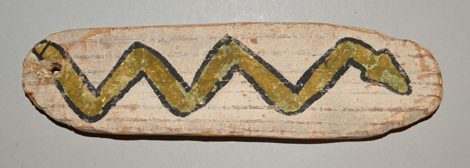
A cornfield full of snakes
In March 1900, in a kiva on the First Mesa of the Hopi, Jesse Walter Fewkes watched the Palulükoñti, the great night drama of the Plumed Serpent. In the flickering dark a little field of corn had been set up, sprouted seedlings in miniature, and out of a painted screen six effigies of the horned water-serpent Palulükoñ suddenly reared and darted, knocking the young corn flat, roaring and writhing over the field while a priest wrestled them. And off in the dark, unseen, another priest swung a bullroarer — a hollow gourd rattle and roaring wood painted, Fewkes noted, with the very masks of the Great Plumed Snake — so that the effigies moved to the sound of their own thunder. The whole scene, he wrote, was a prayer for water and for the growth of corn, staged by the serpent that owns the springs and the rain.
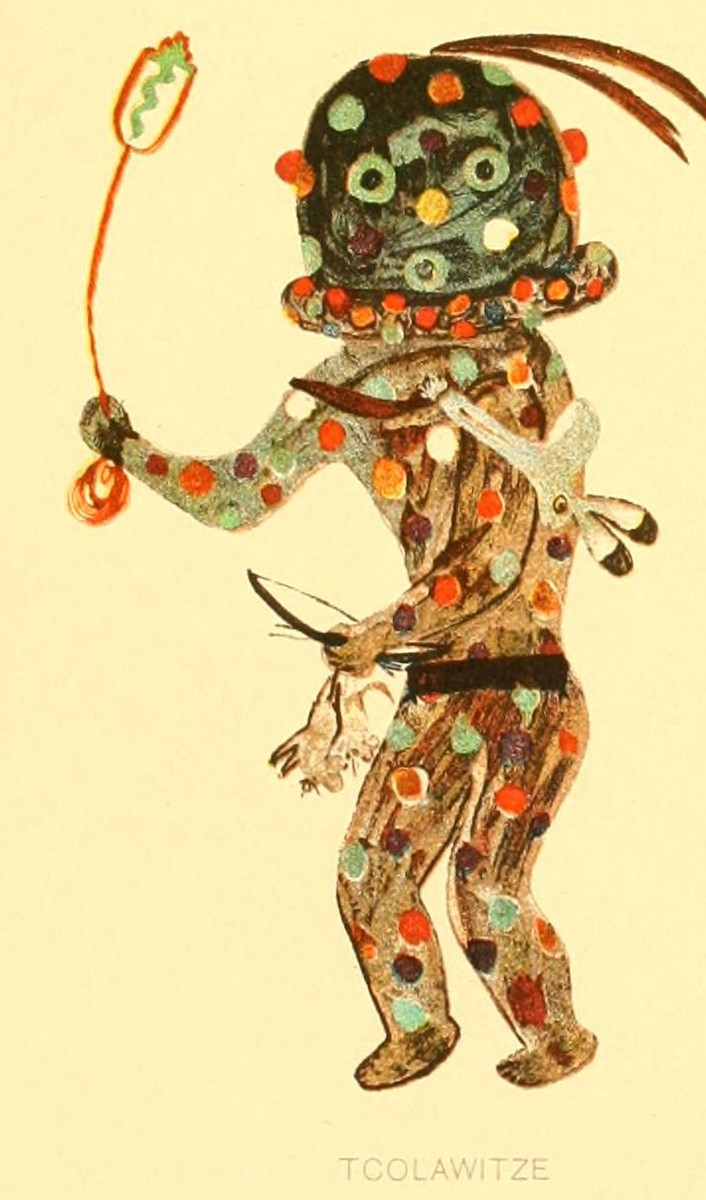
That is the Hopi answer, and it is not theirs alone across the Southwest. At the Walpi Snake Dance a Bow-priesthood warrior trails the line of Antelope priests, twirling the whizzer at the tense moments of the rite; the medicine man told John Gregory Bourke plainly why. “By making this sound they compelled the wind and rain to come to the aid of the crops.” The dance itself re-enacts Tiyo’s descent to the underworld kiva of the Snake people, from whom he learned the songs that bring corn and rain. On the neighbouring mesas the same instrument is the “thunder-stick” of Mishongnovi and the tovolpi of Shipaulovi, whirled to call the July monsoon; it passes to the Snake priesthoods of Second Mesa and, in a bone version an excavator’s Zuni workmen recognized at once, to the Ancestral Puebloans of Chaco Canyon and the deer-bone blade of Mesa Verde’s Ruin 14.
And at Zuni the serpent steps out of the corn and into the open. Frank Cushing, in the early 1880s, heard a deep whirring in the street and ran out to find Bow priests in plumed helmets carrying a war-god down the road, one man twirling a sounding slat behind them. What Cushing was not told, Matilda Coxe Stevenson set down: the whirler is sounded “to create enthusiasm among the u’wannami” — the rain-makers, whose masks are the clouds. And when Ko’loowisi, the Plumed Serpent of the western waters, is brought into the village for the initiation of the children, the rhombus is there to announce him. The Southwest gives the pairing in its purest agricultural form: a horned water-snake who owns the rain, and a roaring wood that is the sound of his coming.
… the warrior stands before the altar and whirls the rhombus, calling the clouds to gather quickly. This deafening noise continues throughout the consecrating of the water. Matilda Coxe Stevenson, on the Zuni whirler and the Plumed Serpent Ko’loowisi
The voice and the body
The tightest form of the pairing is identity: the bullroarer is not a picture of the snake and not merely a summons to it — it is the serpent, its severed body or its literal voice. The clearest case in the atlas comes from the Marind-anim of the old Dutch south coast of New Guinea, whose bullroarer, the sasam, is the male symbol above all and is in effect the dema-god Sosom himself. In the myth Sosom is a boy-giant the size of a coconut palm who swallows the boys and gives them back unharmed; the older men, weary of his endless roaring, cut off his penis; it falls into the river and becomes a watersnake — and the roaring wood the men whirl is that severed member, the serpent’s own voice rising from the ground. It is the same instrument on the same coast that the neighbouring Kiwai and the Ezam cult of the Boven-Bian Marind sound as the voice of the dead ancestors, “rising from the earth.”
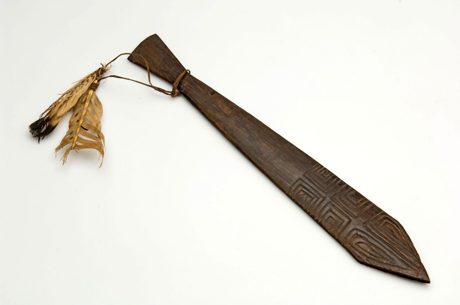
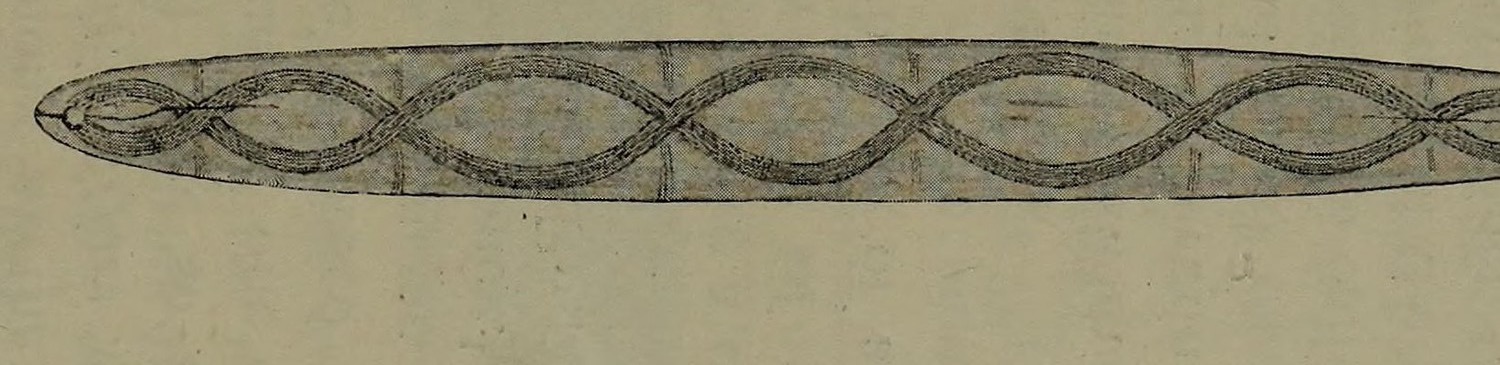
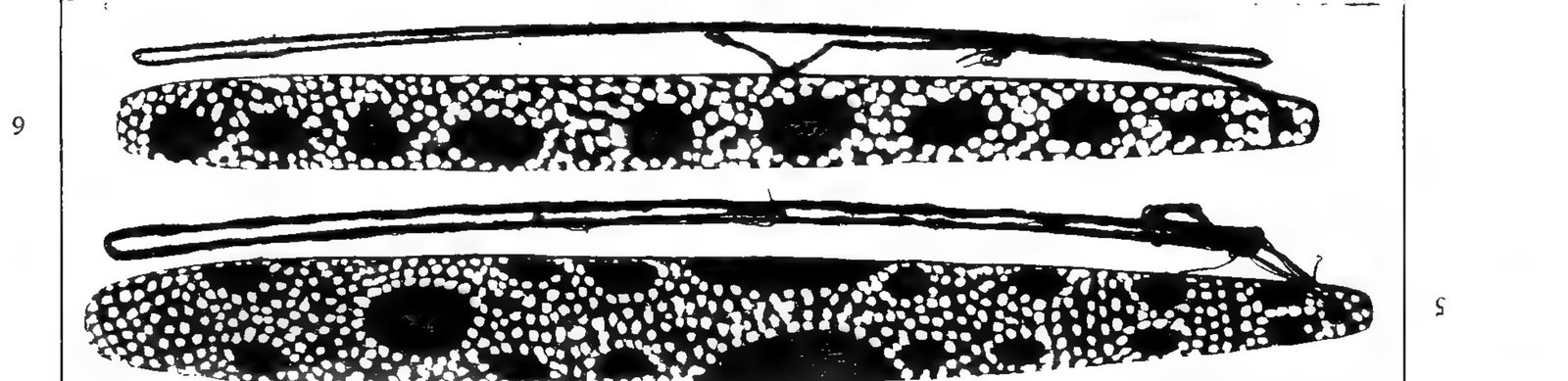
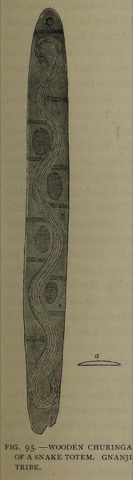
Two thousand miles south, in Arnhem Land, the identity is drawn on the wood. The python-painted paddle of the Yolngu is not a portrait of the great snake Yurlunggur; swung hard on its cord, it is his voice. The men told the women the whirring was the serpent crying out in hunger, and that any woman who came near would be swallowed whole. At initiation the men themselves become Yurlunggur: they sweep the boys up, “swallow” them into ground no woman may enter, and weeks later hand them back, regurgitated as grown men. The same logic governs the great serpent cults of the Barkly Tableland and the Gulf, where Spencer and Gillen recorded that in Warramunga myth the snake ancestors themselves owned churinga and swung them as bullroarers, and where the whole ceremonial world bent toward the Wollunqua, the giant mythic water-snake reckoned the father of all snakes. Their neighbours the Gudanji kept a churinga on which a snake winds the full length of the blade — owned by a man of the snake totem, rubbed and sung to until the wood held the snake’s Alcheringa history in it — and among the Wambaya a wooden purtuli drew its whole sacred value from Katakitji, the snake ancestor who made the Beetaloo waterhole.
Opening the serpent’s ground
A step out from identity is service: the roarer does not embody the snake but opens and guards the rite whose central being is a serpent. Northern Australia is thick with it. The Anula of the western Gulf handed each newly cut novice a sacred stick, the mura-mura, made “in the first instance by the whirlwind” and forbidden to women, who took its roaring for the voice of a spirit called Gnabaia come to swallow the boy and disgorge him a man. And Spencer and Gillen add the two details that place the Anula deep in serpent country: their own name for their whole body of sacred ceremonies was kunapipi — the Mother cult whose central being is the Rainbow Serpent — and when the ceremony of the snake totem Ulanji was to be performed, a man first went out and swung the bullroarer to warn the women away.
… its roaring is the voice of a great spirit called Gnabaia, who has come to swallow up the boy. Spencer & Gillen on the Anula mura-mura, forbidden to the women who hear it
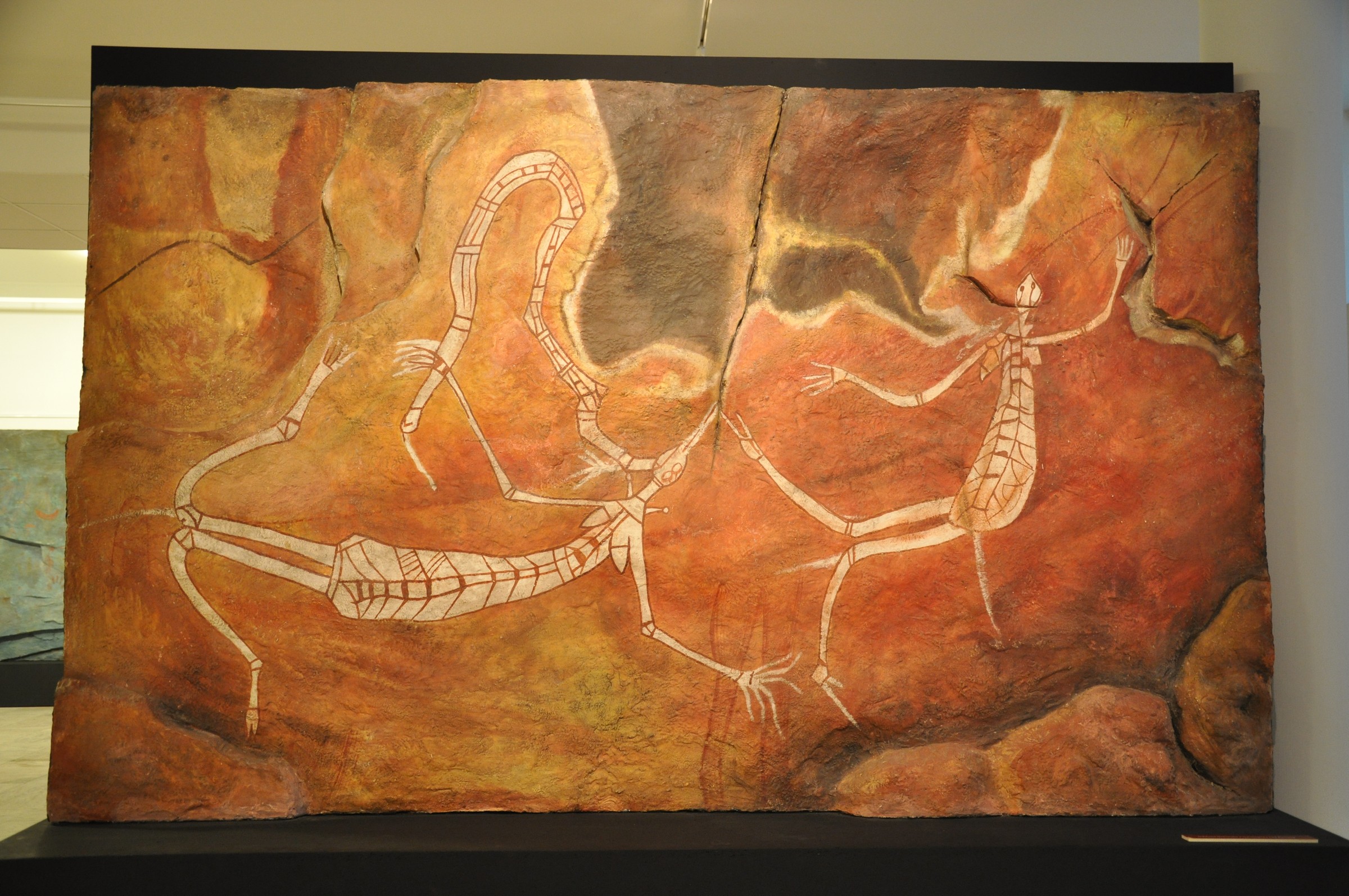
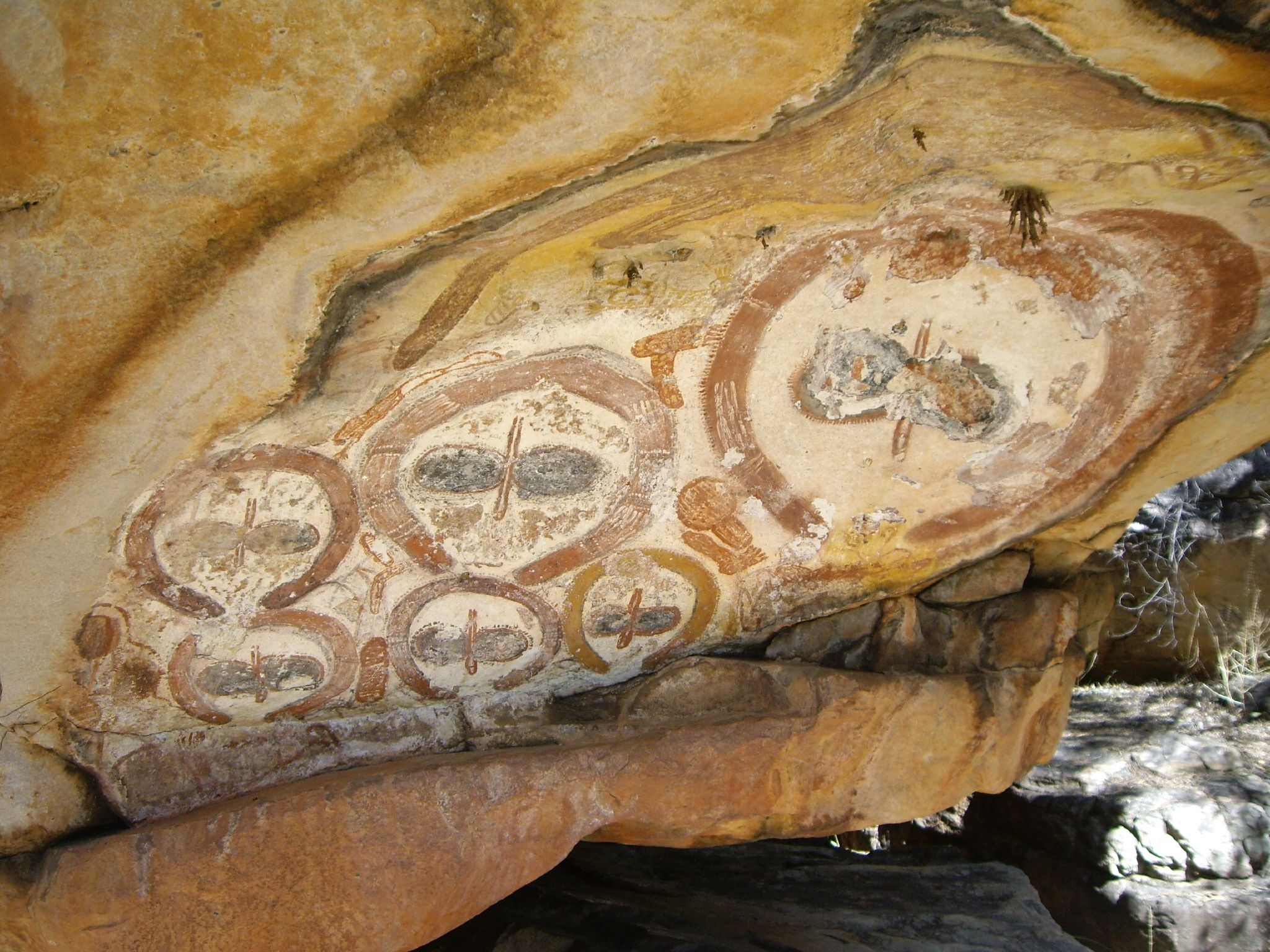
That same Kunapipi sphere runs west along the Roper. Among the Mungarai the bullroarers were themselves called Kunapipi, after the ancestral being who first owned them and after whom the Mother cult is named; among the Murinbata the roaring wood is the emblem of Karwadi, the Old Woman — and as the roar comes near, W. E. H. Stanner recorded, the older men cry with well-simulated fear, “Karwadi! Karwadi! The Old Woman is calling,” before the boys are told they will be swallowed alive and vomited up. Farther west again, the Karadjeri of the Kimberley showed the bullroarers to the novice the instant he was cut, every initiation re-enacting the deeds of the Bagadjimbiri, the twin ancestors who instituted the rite — and whose own end is serpentine, for killed and revived they turned into water-snakes. In the northern Kimberley the Ngarinyin sound the roarer inside the increase ceremonies of the Wandjina, whose dispensed life-force is Wunggurr — Ungud, the Rock Python, the Kimberley Rainbow Serpent whose coils are painted as the band around the Wandjina’s head.
Deep in serpent country
The widest circle is context: the roarer belongs to a whole cult or landscape steeped in serpent myth, even where the myth of the instrument itself is quiet. In New Guinea the Kiwai told Gunnar Landtman a founding story of exactly this shape. The yams at Budji would not grow until Maigidubu, the snake-man — who wore a snake’s skin by day — came to a woman in a dream and taught her to whirl a bullroarer to “wake up the ground” before planting. Landtman carried home the roarer, and from Baramura a companion blade whose own dream-origin tale sends its medicine flying over the yams, banana and taro to make them grow. The snake-man is the origin of agriculture; the crop bullroarer is the agriculture instrument — the connection is the tradition’s own.
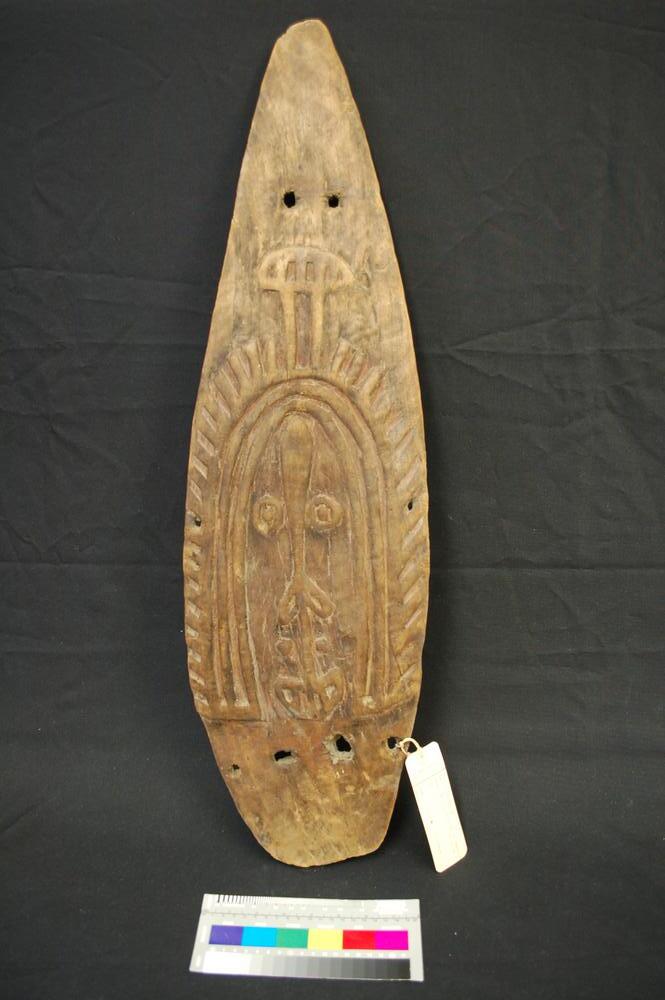
West Africa states it as theology. Among the Dogon of the Bandiagara cliffs, three bullroarers are carved before each Sigui, the great rite held once in sixty years, and they bear the very name of the carved wooden serpent that is the Great Mask of the Awa society: imina na. On the level of myth each roarer is a tongue — one of them the tongue of Dyongou Sérou, the first ancestor to die, sacrificed to make human life possible and resurrected as the serpent the Great Mask depicts. When the rhombe is spun at Yougo Dogorou it is the voice of that first ancestor, dead in serpent form; the men of the Awa raise its drone to open the masked ceremonies, and a man spins it at the approach of women, who must keep clear of anything to do with the masks. The Veni blade of Songo, one of a heap Michel Leiris found in a rock shelter in 1931, was whirled for that same serpent-ancestor’s rites.
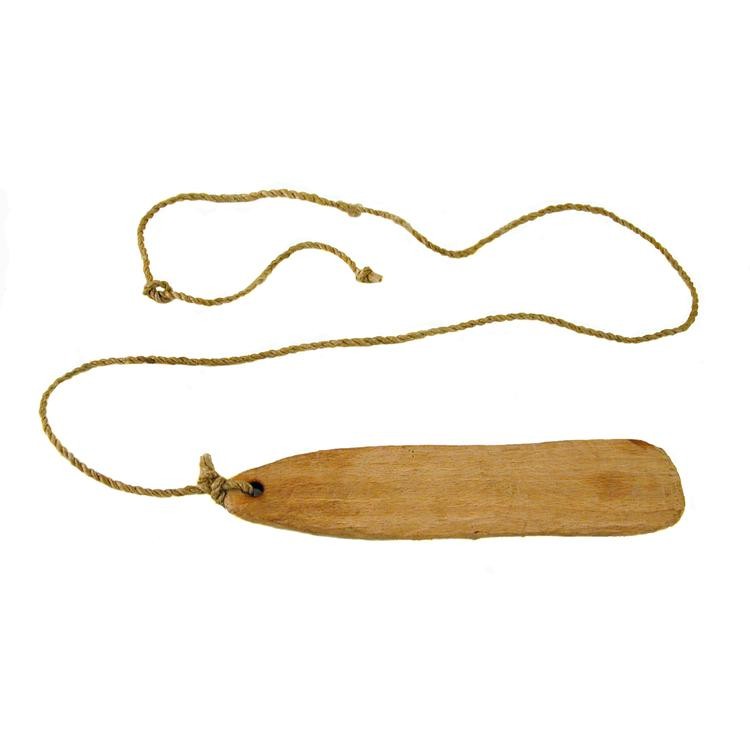
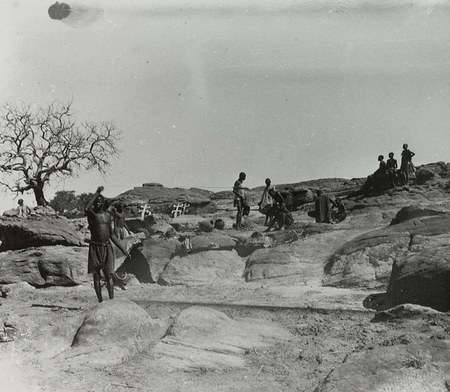
Down the Nile the theme surfaces as a lake-god. In 1913 in the Alego country of western Kenya, the Luo remembered, a man named Onyango Dunde was sitting in his hut when a gigantic snake reared out of Lake Victoria, its head in the clouds, swallowed him whole, and a moment later spat him back unharmed. “I am the God Mumbo,” it said, “whose two homes are in the Sun and in the Lake. I have chosen you to be my mouth-piece” — and among the god’s commands was that he be worshipped with dancing to the sound of drums and bullroarers, in every homestead. The swallowing serpent and the whirring voice, once more, arrive together.
The northwest Amazon carries it in a single cosmology. Across the Vaupés the sacred cult-voice barred to women belongs to the great palm flutes and trumpets of the yuruparí — and the whirled slat runs with that ensemble. The Desana swing a bullroarer they call the horsefly as one of the voices of the Sun Father, enforcing the law against incest; the Cubeo, who count themselves children of the ancestral anaconda that swam up the river with the first people inside its body, sound their whirled and blown instruments as demons women may not even know exist; the Wayãpi hero circles the village whirling a bamboo roarer until the forest spirits answer in its own growling voice. In the Tukanoan myth the sacred instruments are themselves born of a swallowing: boys devoured by the anaconda, vomited up as bones, and from the ashes of the burned serpent grows the palm from which the instruments are cut.
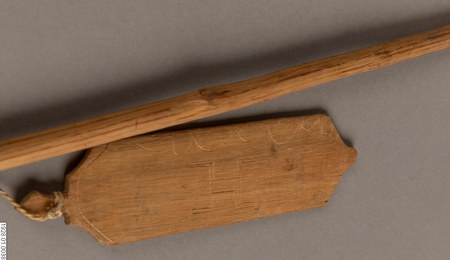
Even the classical Mediterranean keeps the bundle. In a lost Orphic poem quoted by Clement of Alexandria, the Titans lure the child Dionysus to his death with a handful of toys, and an ancient scholiast fixes one of them beyond doubt: the konos is “a little piece of wood, to which a string is fastened, and in the mysteries it is whirled round to make a roaring noise” — a bullroarer among the Dionysiac mystery toys. The god torn apart and reborn is the serpent-begotten Zagreus; the initiates of the related Sabazian mysteries, in Demosthenes’ sneer at Aeschines, marched crowned with fennel, squeezing fat-cheeked snakes above their heads. Snake and roaring wood again in one rite.
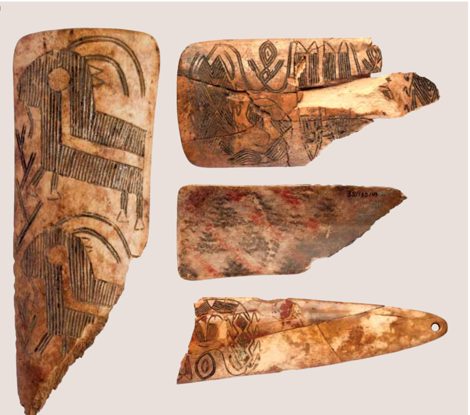
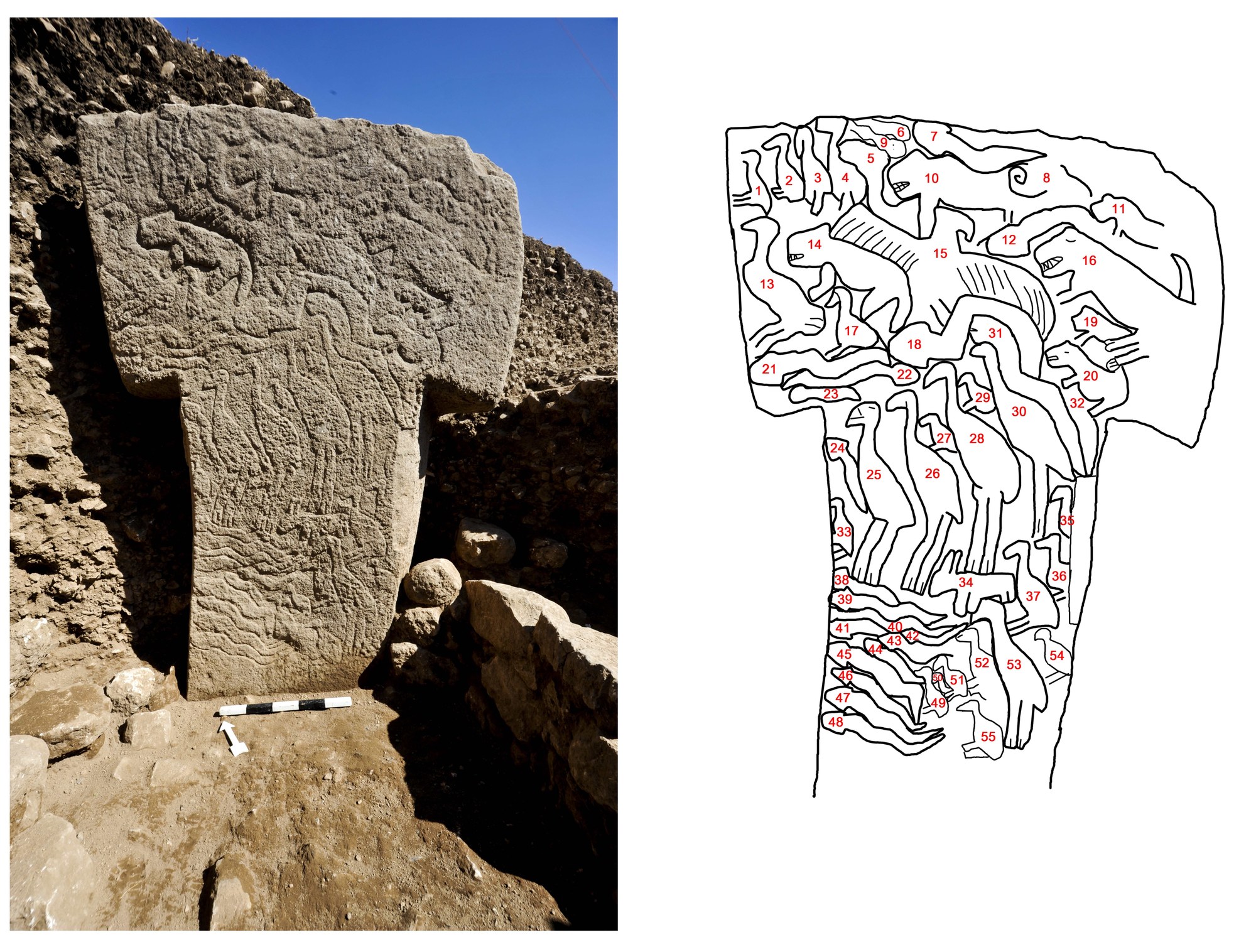
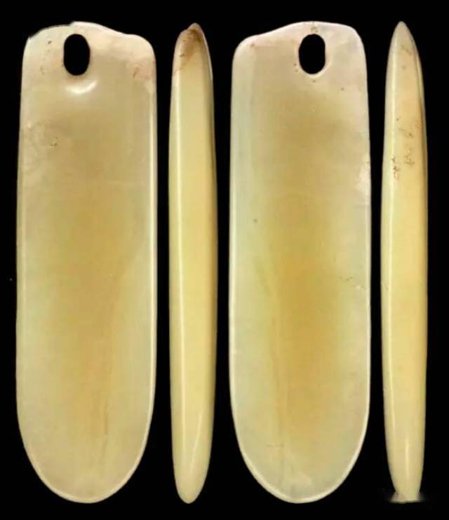
And at the far end of time the pairing is carved in bone and jade. From Körtik Tepe, a Pre-Pottery Neolithic settlement on the Upper Tigris, come perforated bone plaques — read by Göbekli Tepe’s excavators as bullroarers — incised with a snake rendered as wavy lines ending in a triangular head, and a band of three snakes worked as rows of hatched rhomboids. Comparable pieces come from Göbekli Tepe, whose monumental pillars crawl with carved serpents. And in the dry hills of Liao, the jade-working village of Xinglongwa and its neighbours — Chahai, whose famous ceremonial mound is laid out as a stone dragon, and the house-floor workshop of Xinglonggou — ground thin tongue-shaped blades, pierced at one end, whose outline is precisely that of a bullroarer, 8,000 years ago.
A serpent census
The whole set runs to 184 records; a dozen of the clearest show how consistently the two ideas arrive together, and how differently each people phrases it.
| Region | People | Serpent being | How the roarer serves it |
|---|---|---|---|
| Arizona | Hopi | Palulükoñ, horned Plumed Serpent of the springs | Whirled at the Snake Dance to voice thunder and compel the rain onto the corn |
| New Mexico | Zuni | Ko’loowisi, Plumed Serpent of the western waters | Sounded to rouse the rain-makers and announce the serpent at the children’s initiation |
| New Guinea | Marind-anim | Sosom, the boy-giant whose severed penis became a watersnake | The whirled sasam is the serpent’s own body and voice, rising from the earth |
| New Guinea | Kiwai | Maigidubu, the snake-man who taught yam magic | Swung over the gardens to “wake up the ground” before planting |
| Arnhem Land | Yolngu | Yurlunggur, the great python | The python-painted blade is his hungry voice; the men-as-serpent swallow the boys |
| Central Australia | Warramunga | Wollunqua, father of all snakes | Snake ancestors owned the churinga and swung them; the cult honours the water-snake |
| Gulf of Carpentaria | Anula | Rainbow Serpent (cult named kunapipi); snake totem Ulanji | Swung to warn women from the snake rite; its roar is the swallowing spirit’s voice |
| Kimberley | Ngarinyin | Ungud / Wunggurr, the Rock Python Rainbow Serpent | Sounded in the increase rites of the Wandjina, who dispense the python’s life-force |
| Bandiagara, Mali | Dogon | Dyongou Sérou, first ancestor reborn as the Great Mask serpent | Three roarers named imina na after the serpent; each is a tongue, spun for his rites |
| Western Kenya | Luo (Mumbo cult) | Mumbo, the lake serpent who swallowed and disgorged his prophet | The god commanded worship with dancing to drums and bullroarers in every homestead |
| Vaupés, NW Amazon | Cubeo | The ancestral anaconda who carried the first people upriver | Whirled with the yuruparí ensemble as demon-voices barred to women |
| Upper Tigris | Körtik Tepe | Snakes incised on the plaques themselves | Perforated bone bullroarer-plaques carved with serpents, ~10,000 BC |
| Northeast China | Xinglongwa | Chahai’s stone dragon mound | Bullroarer-form jade blades at Chahai, a settlement laid out around a serpent-dragon |
The shape of the trail
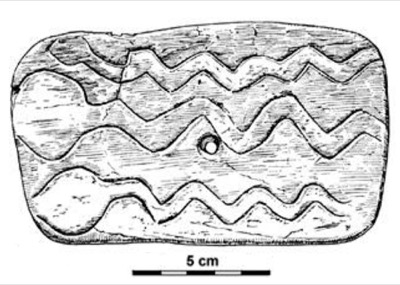
Set the records side by side and two features of the distribution stand out. The first is its antiquity. This is not a motif confined to living ethnography: the snake and the roaring blade sit together on Pre-Pottery Neolithic bone from the Upper Tigris, in the shadow of Göbekli Tepe’s serpent-carved pillars, and again in the jade of Xinglongwa and dragon-mounded Chahai — eight and twelve thousand years back. In Siberia, a related symbolic object takes the serpent imagery deeper into the Ice Age: the Mal’ta ivory plaque, engraved with three cobra-headed snakes, comes from the type-site of the Ancient North Eurasians whose descendants reach both Europe and the Americas. This churinga-like plaque is a comparative object, not a bullroarer.
The second is the recurrence itself. The same three-part figure — a serpent who swallows and gives back, an instrument that voices him, an initiation that stages the death and rebirth — turns up on every inhabited continent, phrased in local terms each time: Sosom in New Guinea, Yurlunggur in Arnhem Land, Mumbo in the lake at Alego, the anaconda of the Vaupés, Ko’loowisi at Zuni. Where the roarer’s trail and the serpent’s trail are both dense — the Australian north, the New Guinea south coast, the Puebloan Southwest, the northwest Amazon — they run together so tightly that in many cults the two cannot be pried apart at all. That is a pattern with a shape, and the shape points the way this atlas reads it: not as a coincidence independently reinvented 184 times, but as a trail — a single old idea about the voice under the earth, carried far and kept, and heard best when the blade is swinging and someone in the dark says that is the snake.
Key sources
- Fewkes, J. W. 1903. “Hopi Katcinas Drawn by Native Artists.” 21st Annual Report of the Bureau of American Ethnology, pp. 41–42 (the Palulükoñti drama) and pl. XXXV, XLVIII, LVIII.
- Bourke, J. G. 1892. The Medicine-Men of the Apache. 9th Annual Report of the BAE. On the Hopi rhombus and rain: “they compelled the wind and rain to come to the aid of the crops.”
- Stevenson, M. C. 1904. The Zuni Indians. 23rd Annual Report of the BAE. On the rhombus, the u’wannami, and Ko’loowisi.
- van Baal, J. 1966. Dema: Description and Analysis of Marind-anim Culture. The Hague: Nijhoff, pp. 271–273 (Sosom, the sasam, and the watersnake).
- Warner, W. L. 1937. A Black Civilization: A Social Study of an Australian Tribe. New York: Harper (Yurlunggur and the Yolngu rite).
- Spencer, B. & Gillen, F. J. 1904. The Northern Tribes of Central Australia. London: Macmillan, pp. 226–227, 248–249, 276–277 (Warramunga, Gudanji, and Wambaya snake churinga; figs. 94–95).
- Frazer, J. G. 1913. Balder the Beautiful, vol. II (The Golden Bough, 3rd ed.), p. 235; Spencer, B. & Gillen, F. J. 1904. The Northern Tribes of Central Australia, pp. 222–224, 372–373, 501 (the Anula mura-mura, kunapipi, and the Ulanji snake rite).
- Stanner, W. E. H. 1959–63. “On Aboriginal Religion,” Oceania (the Murinbata Punj and Karwadi).
- Piddington, R. 1932 and 1952. On Karadjeri initiation and the Bagadjimbiri water-serpents.
- Landtman, G. 1927. The Kiwai Papuans of British New Guinea, tale 261 (Maigidubu the snake-man and the garden bullroarer).
- Dieterlen, G. 1989. “Masks and Mythology among the Dogon.” African Arts 22(3): 34–43, 87 (the Sigui, the imina na, and Dyongou Sérou); Griaule, M. 1938. Masques dogons. Paris: Institut d’Ethnologie, p. 253; Leiris, M. 1934. L’Afrique fantôme (the Songo rhombes).
- Nyangweso. 1930. “The Cult of Mumbo in Central and South Kavirondo.” Journal of the East Africa & Uganda Natural History Society (the lake serpent and Onyango Dunde).
- Reichel-Dolmatoff, G. 1971. Amazonian Cosmos (the Desana nurá-mee); Koch-Grünberg, T. 1909–10. Zwei Jahre unter den Indianern (the Cubeo and the ancestral anaconda).
- Lang, A. 1884. Custom and Myth (the konos/rhombos of the Dionysiac mysteries and the scholiast on Clement).
- Dietrich, O. & Notroff, J. 2016. “A Decorated Bone ‘Spatula’ from Göbekli Tepe.” Neo-Lithics 1/16: 22–31 (the bone plaques of Göbekli Tepe and Körtik Tepe as bullroarers, with a sounding replica).
The gathering of these traditions under one lens — the snake as the being the bullroarer is unusually often sounded for — is, as far as we know, original to this atlas; each record is cited to its own source, and the mapped records are browsable on the Snake-linked map.