Atlas Essay —
The Pattern Book
Four designs recur on bullroarers from Ice Age France to Australia, New Guinea, Africa and the Americas: nested squares, rings in a row, the wave and the chevron
No ethnomusicologist, I think, would stand for plurigenesis as regards the bull-roarers, which even in decorative detail are often alike and are used for the same purpose wherever and whenever found.Jaap Kunst, “The Origin of the Kemanak,” Bijdragen tot de Taal-, Land- en Volkenkunde 116 (1960)
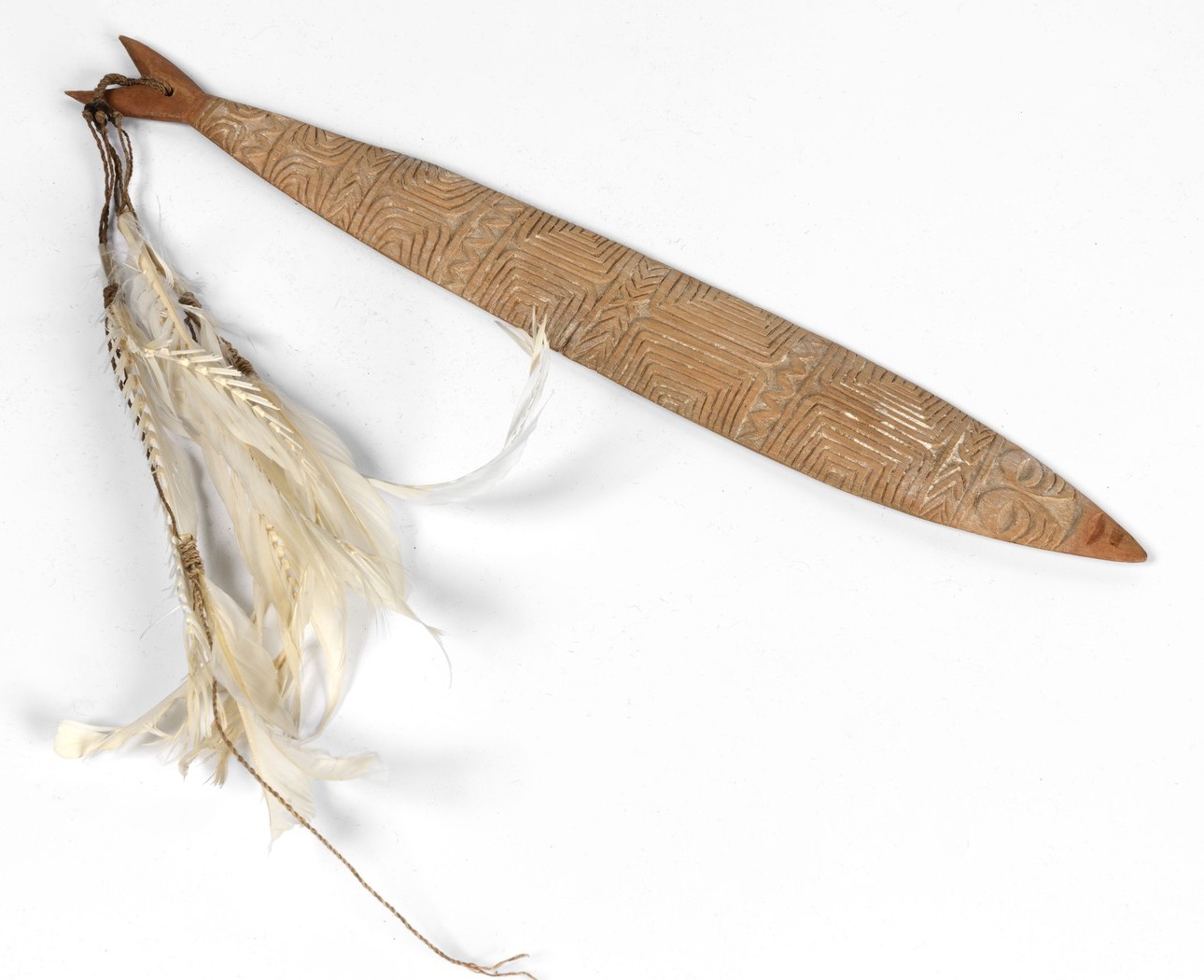
A Marind man on the south coast of New Guinea carved the blade above as a fish, with a face at its point and a row of nested squares down its body. When it was whirled at the Sosom feast, the roar was the voice of a giant. Fourteen thousand years earlier, someone in the Dordogne, in south-western France, engraved a blade of reindeer antler with a row of framed panels down its middle and coloured it with red ochre. Between them, and on every continent where the bullroarer is sounded, the same few designs come back.
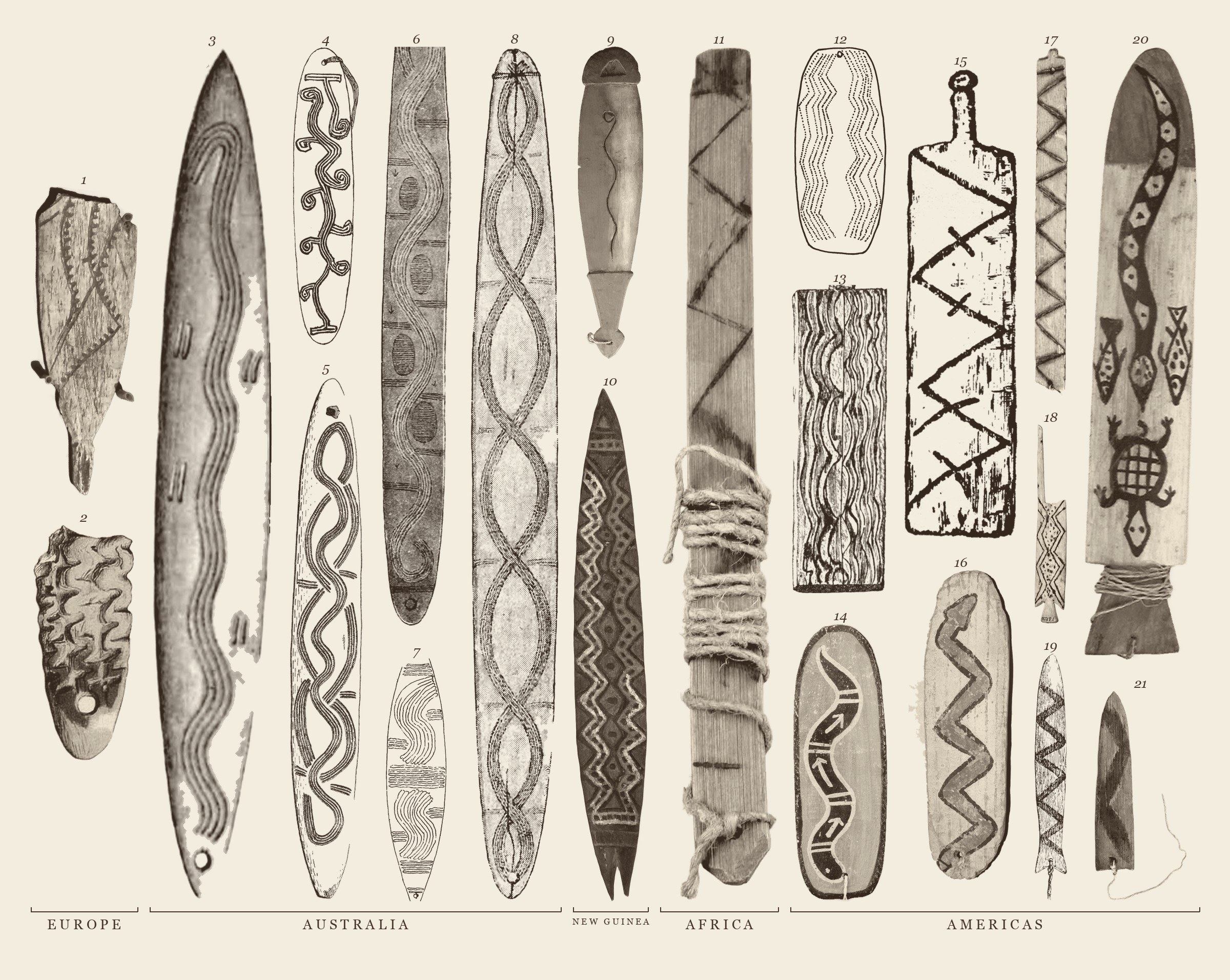
Four designs are carved and painted on bullroarers wherever they are found: squares nested in a row of panels, rings set in a row, a wave or snake running the length of the blade, and chevrons nested one inside the next.
In brief
- In 1887 the geologist Edward Hardman found on Kimberley bullroarers from Western Australia “the well-known circles, channel markings, chevrons, and squares, so familiar to all as occurring on Irish monuments.”
- Nested squares in a row of panels run down the Marind blades of southern New Guinea, boards from the Kimberley and the goldfields of Western Australia, a stone blade from Tinogasta in north-west Argentina, and, as framed panels of lines, the Magdalenian blade of La Roche de Birol in France.
- Rings in a row are engraved on the Magdalenian pendant of Saint-Marcel in central France, which Andrew Lang called “exactly akin to some Australian bullroarers”, on boards across Queensland and central Australia, on blades from the Gulf of Papua to the Sepik and the Huon Gulf in Papua New Guinea, and on a Bembe roarer from South Kivu in the eastern Congo. Among the Yaroinga of Queensland the rings were the fire-sticks swung round at the night camp-fires.
- The wave down the blade is named as a snake or as lightning by the people who carved it: the Gudanji of the Northern Territory, the Apache and Hopi of Arizona, and the Nahukwá of the Upper Xingu in Brazil, whose zigzags “count as the image of the snake.” The same line runs down blades from New Guinea, California, Nigeria and Colombia.
- Nested chevrons run end to end on grooved boards from the Pilbara and the western deserts of Australia, the Apache rhombus, carved blades from the Gulf of Papua, painted roarers from the Upper Xingu and the Fang “child-eater” of Gabon.

Circles, chevrons and squares
In 1883 and 1884 Edward Hardman, an Irish geologist, crossed the Kimberley in the far north-west of Australia for the government of Western Australia. He came home to Dublin with a collection of weapons and sacred things, and among them were two long, pointed boards, about sixteen inches each, that the men of the circumcision ground swung around their heads. He read his paper on them to the Royal Irish Academy in January 1887:
At the ceremony of circumcision, the men … swing around their heads flat sticks, such as figured in Plate II., figs. 4, 4′ and 5, 5′ … about 16 inches long … create a booming sound, supposed to be intended to drown the cries of the sufferer … no woman is supposed even to know of their existence or use, or can she look on them except on pain of death.
In this case also the markings are peculiarly suggestive of our ancient Irish markings. (Plate III., figs. 1 and 2.) Mr. W. F. Wakeman … remarked their almost exactitude. It is very remarkable, and I shall certainly not endeavour to account for it, that we should find in this collection of weapons, &c., from the Antipodes the well-known circles, channel markings, chevrons, and squares, so familiar to all as occurring on Irish monuments.E. T. Hardman, Proceedings of the Royal Irish Academy, 3rd series, vol. 1 (1888), p. 68
William Wakeman, the antiquary who drew Ireland’s carved stones, drew the two Kimberley boards for the plate. On one, a row of rings sits between pairs of short strokes. On the other, a spiral runs by a single line into a square nested six deep.
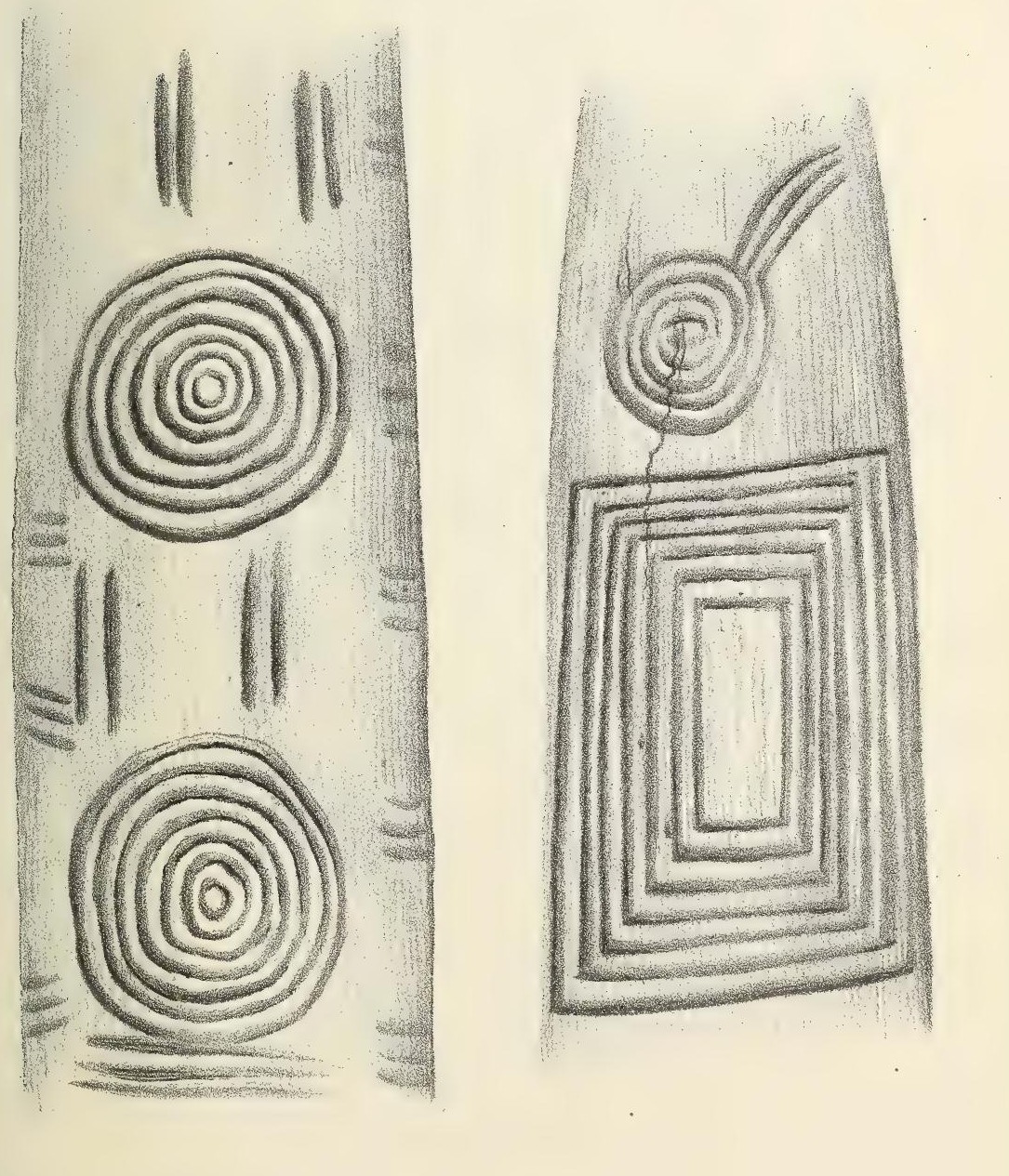
Hardman named all four designs. The circles, the squares and the chevrons are three of its four designs; his channel markings, the long grooves that run down a blade, are the fourth when they swing into a wave. Each design has its own plate below, and each plate draws on at least three continents.
The nested square
The Marind-anim live on the long, flat south coast of New Guinea around Merauke, in what is now the Indonesian province of South Papua. Their bullroarer is sosom, the voice of the giant Sosom, who came at the great feast to take the boys while the women and children fled. Jaap Kunst, the Dutch ethnomusicologist, published the blade of the hero photograph in 1950 and wrote of the feast:
The Marind-anim, for example, took over from the Kanum-anim the Sosom feast, in which the bullroarer carved in the shape of a fish plays an indispensable role as the voice of the Sosom giant.Jaap Kunst, De inheemse muziek in westelijk Nieuw-Guinea (1950), p. 76, translated from the Dutch
Up the Bian River, inland from the Marind coast, the same blade is the ezam, the voice of the cult beings Ezam and Uzum. Jan van Baal, who wrote the great book on the Marind, records that the blades were carved differently for every clan, and that when a man died his son inherited his bullroarer. The drawing in Plate IV gives the Bian blade’s whole face: a fish tail at the cord, a pair of eyes at the point, and between them nested squares in panels, divided by zigzag bands.
Across the Arafura Sea, the same face is cut into Australian wood. A board in the British Museum was given to its donor at Kalgoorlie, in the goldfields of Western Australia, in 1924. Its face carries three panels of rectangles nested five and six deep, each divided from the next by a cross of hatched triangles, the way the Marind blade divides its squares with zigzags. Hardman’s second Kimberley board carries three more, set in a row between blank wood.
The Kimberley is full of the design. R. H. Mathews, the Sydney surveyor who collected the ceremonies of half a continent, drew rows of nested squares on boards from the Oscar Ranges in 1898 and from the Nyikina of the Fitzroy River in 1907, and the Ngarinyin and Nyulnyul blades of Plate IV carry them in the same order, panel after panel down the axis. On the far side of the Pacific, in the Andean north-west of Argentina, a stone blade from Tinogasta is cut with a column of stepped frames, one set inside the next.
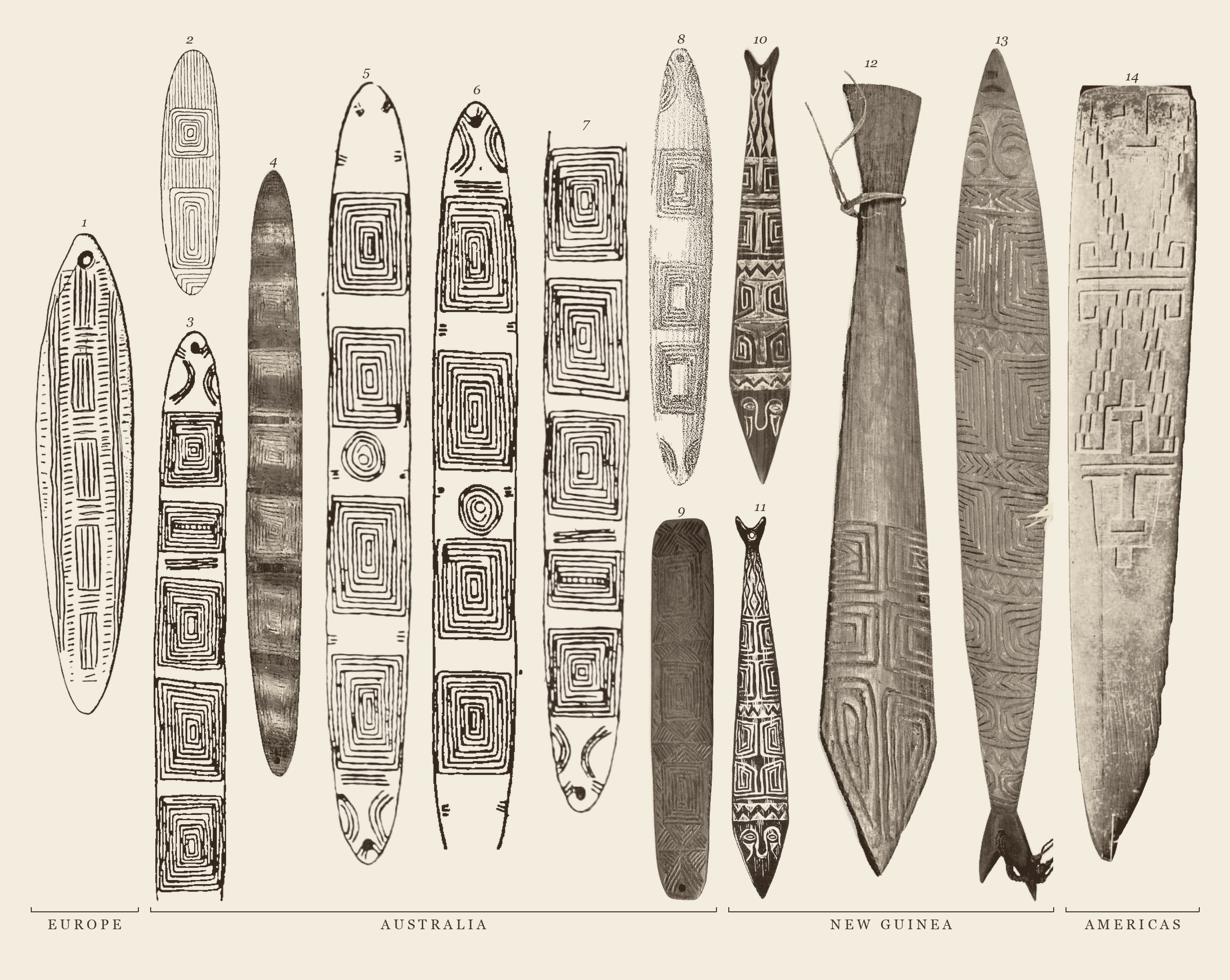
The first blade on the plate is the oldest. It was dug in 1927 from the rock shelter of La Roche de Birol near Lalinde, in the Dordogne in south-western France, from a layer of the final Magdalenian, around 13,000 to 11,000 BC. Denis Peyrony, who published it, described its face:
It is of reindeer antler and takes the shape of a fish without a tail … entirely covered with red ochre; the engraving was done afterwards. The decoration consists of four groups of five parallel lines and a fifth of only four, set at regular intervals lengthwise down the middle, separated from one another by transverse series of five strokes, likewise parallel.Denis Peyrony, L’Anthropologie 40 (1930), p. 22, translated from the French
The La Roche panels are boxes of lines rather than squares nested inside squares, but the plan of the face is the Marind plan: a single row of framed panels down the axis of a fish-shaped blade, with a band of cross-strokes between each panel and the next. Peyrony laid it beside an Australian churinga and drew the conclusion in two sentences. It was “an instrument identical to the one some Australian natives call a churinga, likewise decorated with geometric designs on one face only,” and, “showing the same characteristics as the Australian churingas, it must certainly have had the same purpose” (pp. 24–25).
Rings in a row
In 1902 the Abbé Breuil published a small engraved bone from the cave of Saint-Marcel in the Indre, in central France, a Magdalenian piece with a toothed edge, pierced at one end. Down one face run three sets of concentric circles, each round a deeply drilled point, with a small circle round the hole. Breuil thought it an amulet. Andrew Lang, the Scottish folklorist who had written the first study of the bullroarer in 1884, saw the drawing and wrote at once to the French prehistorian Harold Cook. Cook reported the letter the next year:
He remarked its toothed border, a peculiarity seen frequently on British bull-roarers … and its ornament in the form of concentric circles, which closely resembles that seen on a specimen from South Australia.Harold Cook, L’Anthropologie 14 (1903), p. 658, reporting Lang’s letter of 9 December 1902, translated from the French
Lang put it in print himself in 1904. The Saint-Marcel piece, he wrote, “in shape, serrated edges, and decoration (concentric circles) is exactly akin to some Australian bullroarers.” In the same note he set beside it an oval of mammoth ivory from Předmostí in Moravia, now the Czech Republic, Gravettian and some ten thousand years older again, with nested arcs along its edge and a knob for a thong. Its excavator took it for a pendant; Lang remarked on its “thoroughly Australian appearance.”
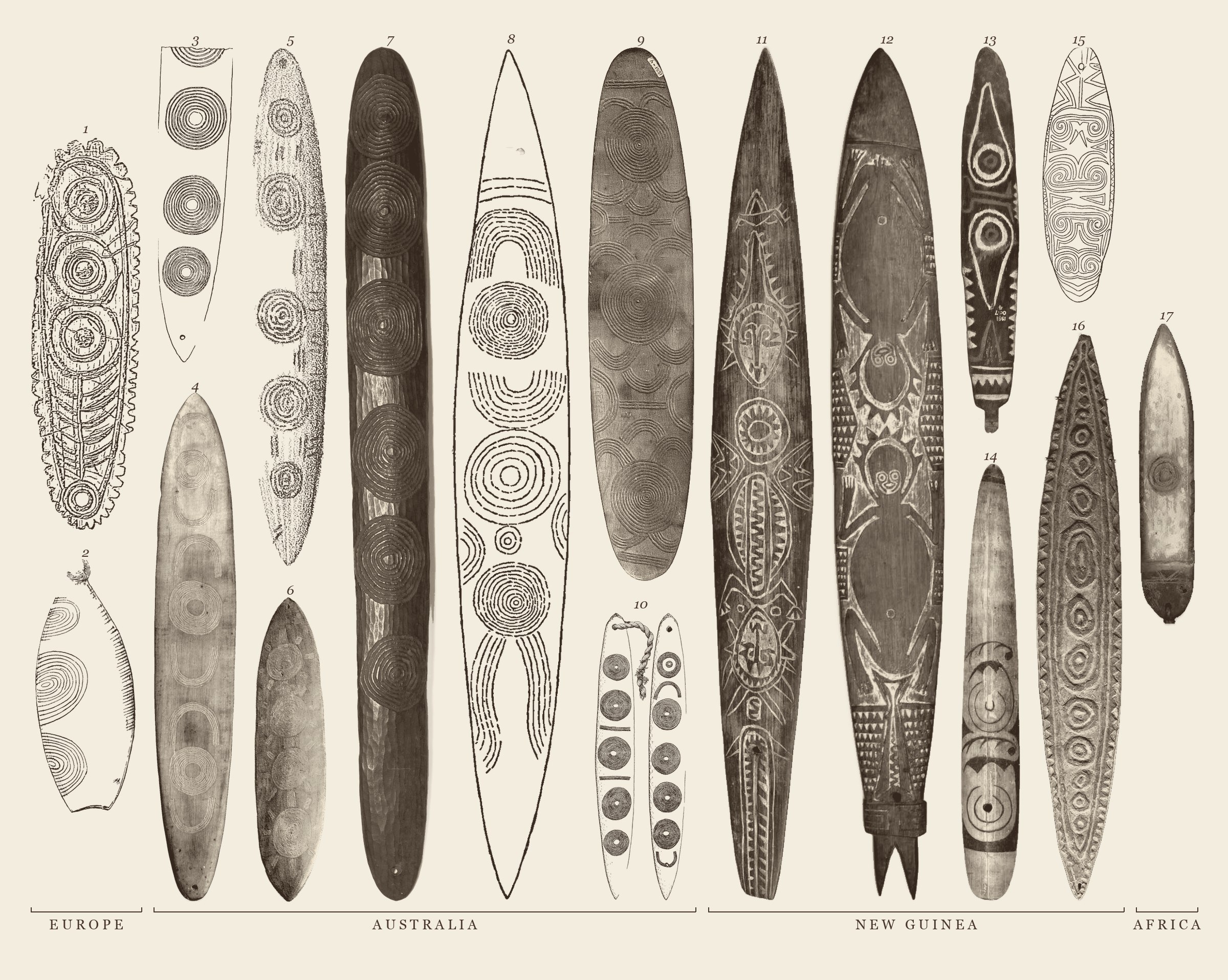
In Australia the rings say what they are. Walter Roth, the government doctor of north-west-central Queensland, wrote in 1897 of the whirlers the Yaroinga used as love charms:
Among the Yaroinga certain kinds of “whirlers” (sect. 215) are used as “love-charms.” This form of implement is obtained from the Workia (? and Undekerebina) tribe, whence its use in this connection has been learnt. It appears to have no special term applied to distinguish it from the ordinary toy-variety, than which it is larger, although it is recognisable by two types of gravings: one (Fig. 320), the ring of concentric circles, represents the smouldering fire-sticks, coolibar-roots, &c., being swung round and round at the camp fires during the “sing-songs,” &c., which often occupy the interval between sunset and sunrise.Walter E. Roth, Ethnological Studies among the North-West-Central Queensland Aborigines (1897), sect. 325, p. 182
The whirled ember draws a ring of fire in the dark, and the ring on the blade is that motion, cut into the wood that makes the same motion. Robert Etheridge of the Australian Museum, describing a board from Linda Creek in western Queensland in the same year, with five rings to each face, noticed that the ornament turned up only on bullroarers: “the only published objects bearing this circular ornamentation are ‘Bull-roarers,’ and as everyone knows these are the most precious and sacred of the Black’s possessions, and only used in the mysteries of the Bora” (pp. 4–5). In central Australia the ring is the commonest mark of all. The Warumungu, Kaytetye, Anmatyerre and Arrernte boards of Plate V carry rows of concentric circles from end to end, and the Yir-Yoront of Cape York, at the northern tip of Queensland, cut them the same way.
North across Torres Strait the rings go on. The Gogodala of the Aramia River, in Papua New Guinea, burned spirals into a bamboo blade and swung it while they planted yams, taro and bananas, to make the gardens grow; the cord hole sits at the centre of one of its spirals. On the north-east coast of the island, at the Huon Gulf, the Bukaua carved the back of their walu lanqua with rings and with zigzags in long frames, and the missionary Stephan Lehner had old carvers, former guardians of the Balum secret, read the motifs for him one by one: a little sea-snake, a scorpion that stings unseen, a spirit carrying fire, the eye of the abo fruit, which “is almost never absent from the balum wood” (Lehner 1911, pp. 412–413). Along the Gulf of Papua the Maipua and Toaripi carved rings and spirals into their blades, and inland from the Sepik, in the north of the island, the Wapei and Yangoru blades carry a column of rings in relief. Across the Indian Ocean, a Bembe roarer from South Kivu, in the east of the Democratic Republic of the Congo, carries the ring at its centre.
The wave down the blade
The third design is a line that will not stay straight. It runs the length of the blade and swings from edge to edge, and where its makers named it, they named it a snake or lightning.
In 1901 Baldwin Spencer and Frank Gillen crossed the Northern Territory and met, among the Gudanji of the McArthur River country, wooden churinga carved with a single snake. One of them winds the full length of its board between ovals and cross-bars, its head curled at the hole. “In every instance,” they wrote of these churinga, “they were regarded as of especial value because of their association with a totem” (1904, p. 276). Roth’s Queensland whirlers carry the same channelled wave in two swinging bands (1897, fig. 319).
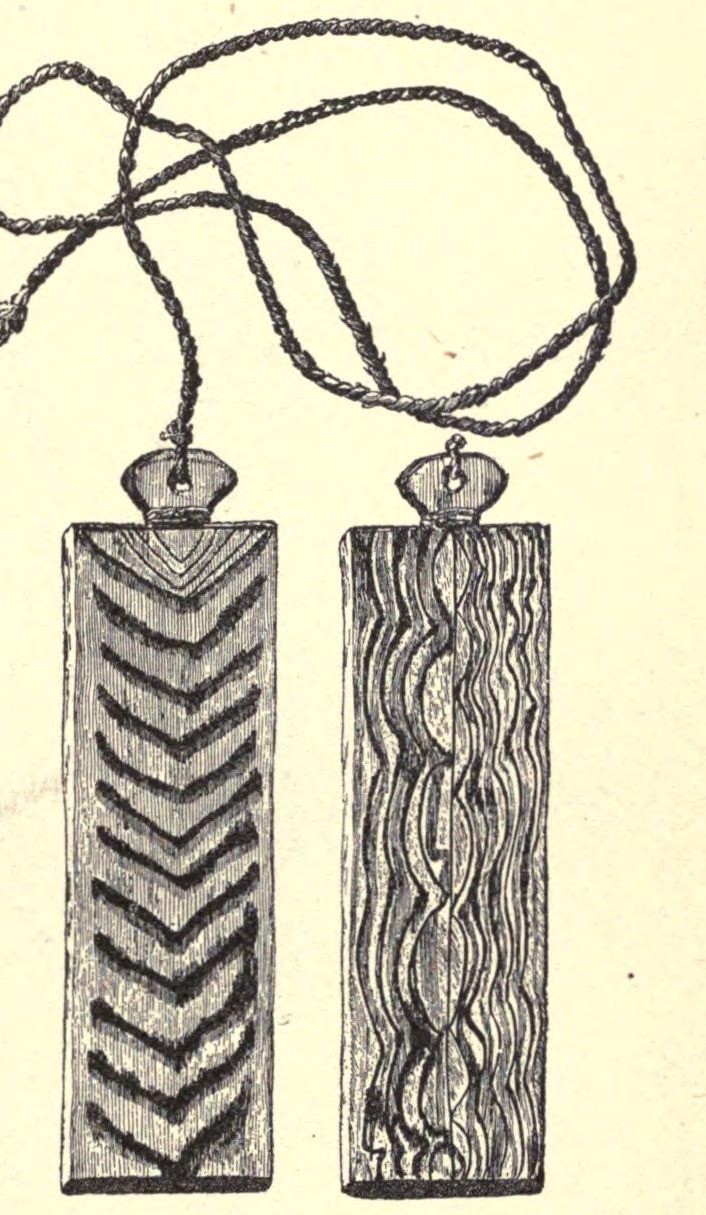
John Gregory Bourke, an American army officer who spent years among the Apache of Arizona, was shown their rhombus at San Carlos in 1884. It is a flat board with a carved head on its cord, and he was told what its two faces carried:
The Apache explained that the lines on the front side of the rhombus were the entrails and those on the rear side the hair of their wind god. The hair is of several colors, and represents the lightning.John G. Bourke, The Medicine-Men of the Apache (1892), pp. 476–477
The wood itself, Bourke was led to believe, came from a tree struck by lightning on the mountain tops. The Hopi, a few hundred kilometres to the north, painted their snake-dance roarer white with a green zigzag snake, and Bourke saw the zigzag end “in the small triangle, which did duty as the snake’s head.”
In central Brazil the German explorer Karl von den Steinen collected two fish-shaped roarers from the Nahukwá of the Upper Xingu in 1887 and 1888. One is painted from tail to point with a single broad zigzag, and he was told what it was:
On the bullroarers of the Nahuquá … zigzags of the same kind as on the back-board occur, and here too they count as the image of the snake.Karl von den Steinen, Unter den Naturvölkern Zentral-Brasiliens (1894), p. 266, translated from the German
The snake can also live in the wood without being drawn on it. Up the Bian River in New Guinea, van Baal records, an ezam blade “may … change into a snake” (1966, p. 575).
At the Grotte du Pape in Brassempouy, in the Landes of south-western France, the excavators of the 1890s found a flat oval of mammoth ivory pierced by a single large hole, from the Gravettian, around 27,000 BC. Three carved serpent-like bands fill its whole face. In the Pyrenees, at the cave of Lortet, Édouard Piette dug up Magdalenian blades of bone, and one of them carries toothed zigzag bands that swing from edge to edge.
The plate holds twenty-one of these lines. In New Guinea the Asmat of the south coast and the Kubka of the upper Sepik cut a single snaking line down the blade. On Santa Cruz Island, off the coast of southern California, a blade from an island site is drilled with a dotted zigzag. In central Nigeria the Gbagyi mark a zigzag down a bamboo roarer, and in South America the Yukpa of the Sierra de Perijá in Colombia, and the Bakairi, Trumai, Kalapalo and Apinayé of Brazil, paint it from the cord to the point.
Chevrons, nested end to end
The Apache rhombus has a second face. Turn it over from the lightning and the board is filled from the cord to the tip with chevrons, one inside the next, the wind god’s entrails. One instrument carries two of the four designs, one to each side.
The chevron fills the blade in the same way in Australia. The churinga that Peyrony set beside the La Roche blade in 1930 is cut from end to end with zigzag chevrons, one band inside the next. In the Pilbara of Western Australia, a Yindjibarndi board that reached Leiden in 1901 is cut its whole length with nested chevrons in panels; J. D. E. Schmeltz catalogued it in 1904 as carrying “an angular and an undulated figure,” and its makers swung such boards over the sick. The chevron is the commonest design of the Pilbara and the deserts beyond it: Nyamal, Ngarluma, Nyangumarta, Walmajarri, Yumu and Badimaya boards are grooved with it from end to end, and so is a board from Twilight Cove on the Great Australian Bight.
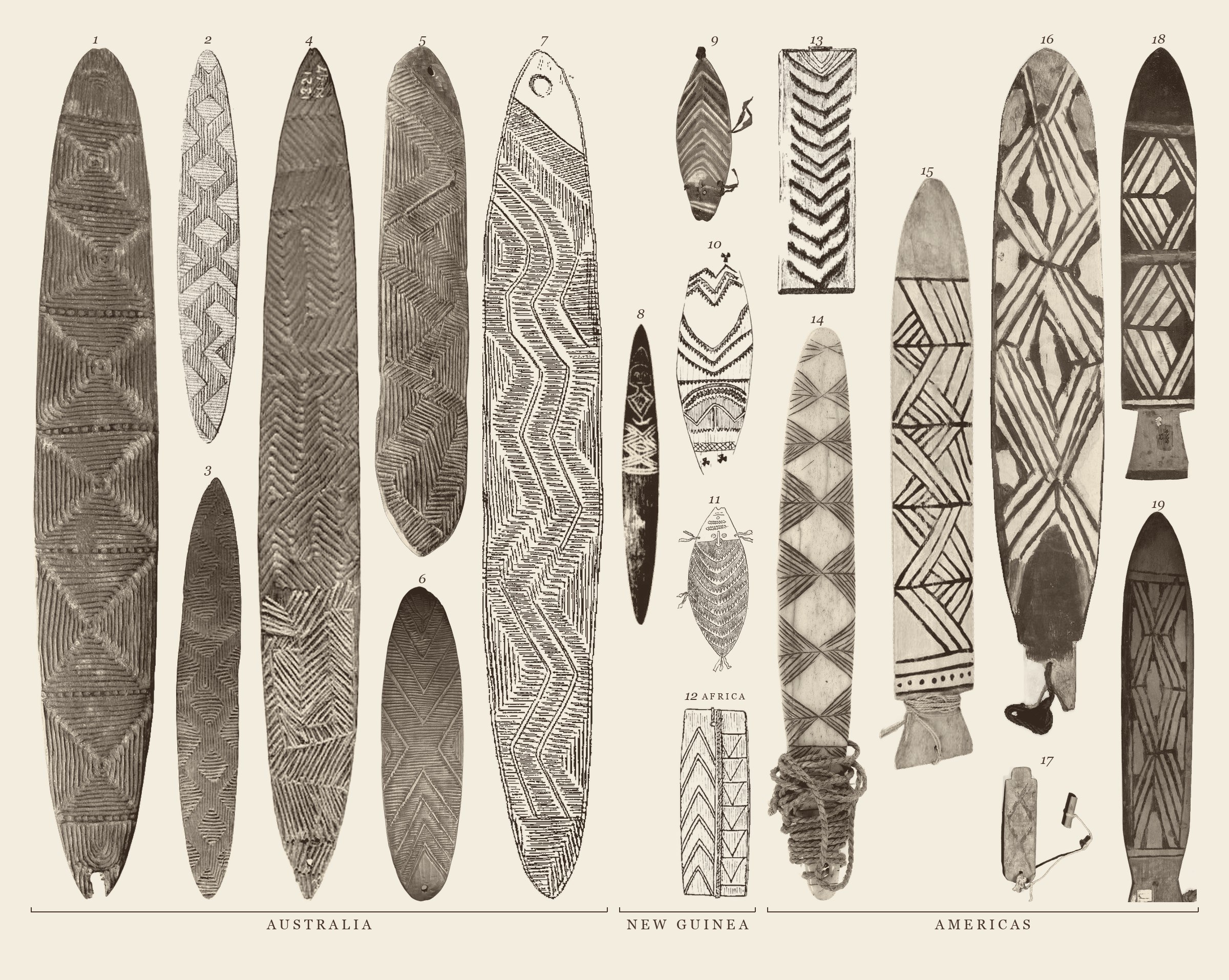
In the Upper Xingu the Kamaiurá roarer, the uriwuri, was obtained from a mythical dogfish and swung to bring rain. Kalervo Oberg, who worked among them in 1948, described it as “shaped like a fish, and covered with painted zigzag lines or diamond-shaped designs in red over a black or white surface” (1953, p. 54). The Kamaiurá blade in Oxford, collected in 1957 and 1958, has black chevrons on pale wood, bound in a frame down the blade like the Yindjibarndi panels.
Across Torres Strait the Kiwai of the Fly River estuary, in Papua New Guinea, and the Toaripi and Orokolo of the Gulf of Papua carve and paint the same nested chevrons, and the Marind of the Torassi River, on the border between South Papua and Papua New Guinea, paint them under a standing figure. In the Upper Xingu the Wauja and Kalapalo paint them black on white, as the Kamaiurá do. In North America the Karuk of the Klamath River in California cut fans of chevrons down a bone roarer, and at Shipaulovi, on the Hopi Second Mesa in Arizona, a board is painted with lozenges, one inside the next.
In equatorial Africa, the German ethnographer Günter Tessmann drew the chevron board of the Fang of Gabon and Equatorial Guinea, the edžībŏ’ngo:
An even more effective way to frighten children is the eerie sound of the bullroarer (edžībŏ’ngo = child-eater), which men and older boys often use to scare the younger ones.Günter Tessmann, Die Pangwe (1913), vol. II, p. 287, translated from the German
What the owners said
Where someone asked, the owners gave the marks names, and the names are things: a snake, a fish, a fruit, the world. On the Huon Gulf, on the north-east coast of Papua New Guinea, old Bukaua carvers who had kept the secret of the balum rite explained the roarer’s figures to the missionary Stephan Lehner. The zigzag band was the little sea-snake, and the ringed eye almost never missing from the blade was the fruit of the kabo tree:
Just as this fruit only becomes strong and resistant, and holds the seed of further growth, once it is detached from its stalk, so the boys detached from the tree, which happens at circumcision, only then become strong, resistant and able to beget a further generation.Stephan Lehner, “Bukaua,” in R. Neuhauss, Deutsch Neu-Guinea, vol. III (1911), p. 413, translated from the German
In South Kivu, in the Democratic Republic of Congo, the Bembe roarer of the god Tembwe carries a triple circle on its day face. The oldest initiates of the leopard society read it for the Belgian anthropologist Pol Pierre Gossiaux: nested circles are “the world, all created beings,” the clan, “the sun, the stars,” and the rosettes of the leopard. The lozenges on the same objects were the four cardinal points, or the thunderbolt.
On the Upper Xingu, in central Brazil, von den Steinen found that every people on the river gave the lozenge the name of one small flat lagoon fish, each in its own language, and the Nahukwá left a row of these fish lozenges in reserve on a black roarer. The Bakairi told him the rest: “Zigzags and waved lines are snakes.” In the Gulf of Papua the Elema named their mask designs too, but each clan named the same design differently, so that one spiral was a caterpillar, a butterfly’s antenna and a cane. The marks hold steady from coast to coast; the names belong to each people.
One pattern book
Laid side by side, the four plates draw the same small vocabulary from places that never met in any record: the nested square at Merauke, in the Kimberley, at Kalgoorlie, at Tinogasta and in the Dordogne; the row of rings in the Indre, Moravia, Queensland, central Australia, the Gulf of Papua, the Sepik, the Huon Gulf and South Kivu; the snake in the McArthur River country, the Sepik, Arizona, California, Nigeria, Colombia, the Upper Xingu, the Landes and the Pyrenees; the chevron in the Pilbara, the Western Desert, Arizona, California, the Gulf of Papua, the Upper Xingu and Gabon. The blade underneath is the same blade every time, long and flat and pierced for its cord, and sometimes shaped as a fish. Where its makers said what the designs were, they answered in kind: the snake, the lightning, the fire whirled in the dark, the voice of a giant or a god.
Kunst was not the first to see it. Hardman saw Irish stones in Kimberley wood; Lang saw a South Australian roarer in a Magdalenian bone; Peyrony saw a churinga in an ochred antler from the Dordogne. The English prehistorian Gertrude Levy, writing in 1948, put the whole of it in one passage: the Magdalenian roarers “are indistinguishable in general form and decoration from Australian specimens,” and the instrument “was used in the mysteries of the succeeding civilisations of Europe, sometimes retaining its Magdalenian pattern” (The Gate of Horn, p. 48).
The simplest reading of the plates follows Levy’s. The bullroarer travelled with its patterns, as it travelled with its secrecy and its voice, and the people who carried it carved the same few marks on the wood wherever they took it. A whirled blade with a row of squares on its face is the same object at Merauke and at La Roche de Birol, fourteen thousand years apart, and the plates show the same small vocabulary seventy-one times over.
Key sources
- Hardman, E. T. 1888. “Notes on a Collection of Native Weapons and Implements from Tropical Western Australia,” Proceedings of the Royal Irish Academy, 3rd series, 1: 57–69, pl. II–III — p. 68, the bullroarers of the circumcision ground and “the well-known circles, channel markings, chevrons, and squares.”
- Kunst, Jaap. 1950. De inheemse muziek in westelijk Nieuw-Guinea. Amsterdam: Indisch Instituut — p. 76, the fish-shaped sosom as the voice of the Sosom giant; ill. 32. English edition, Music in New Guinea (1967).
- Kunst, Jaap. 1960. “The Origin of the Kemanak,” Bijdragen tot de Taal-, Land- en Volkenkunde 116: 263–269 — “even in decorative detail are often alike.”
- Lehner, Stephan. 1911. “Bukaua,” in R. Neuhauss, Deutsch Neu-Guinea, vol. III. Berlin: Reimer — pp. 412–413, the carvers’ readings of the balum figures.
- Gossiaux, Pol Pierre. 2006. Le Bwamè du Léopard des Babembe (Kivu-Congo) — pp. 96–97 and ill. 46, the Tembwe roarer and its glyphs.
- Williams, F. E. 1940. Drama of Orokolo. Oxford: Clarendon — pp. 244–249, the named hevehe designs.
- Baal, J. van. 1966. Dema: Description and Analysis of Marind-anim Culture. The Hague: Nijhoff — pp. 573–575, the ezam carved for each clan and inherited, and the blade that may change into a snake.
- Boelaars, J. 1953. Nieuw-Guinea, uw mensen zijn wonderbaar — the Bian Marind ezam drawing.
- Peyrony, Denis. 1930. “Sur quelques pièces intéressantes de la grotte de La Roche, près de Lalinde (Dordogne),” L’Anthropologie 40: 19–29 — pp. 22–25 and fig. 3, the La Roche blade, its decoration, and the churinga beside it.
- Breuil, Henri. 1902. L’Anthropologie 13 — p. 152, fig. 4 and p. 154, the Saint-Marcel pendant.
- Cook, Harold. 1903. L’Anthropologie 14 — pp. 657–658, Lang’s letter on Saint-Marcel and the South Australian specimen.
- Lang, Andrew. 1904. “Bullroarers,” Man 4, no. 22, pp. 37–38 — Saint-Marcel “exactly akin to some Australian bullroarers”; the Moravian piece’s “thoroughly Australian appearance.”
- Kříž, Martin. 1896. Beiträge zur Kenntnis der Quartärzeit in Mähren — Tab. I, fig. 1, the Předmostí ivory.
- Roth, Walter E. 1897. Ethnological Studies among the North-West-Central Queensland Aborigines. Brisbane — sect. 325, p. 182, the Yaroinga love charm; figs. 318–320.
- Etheridge, Robert, Jr. 1897. Records of the Australian Museum 3(1) — pp. 4–5, the Linda Creek bullroarer and circular ornament.
- Lehner, Stephan. 1911. “Bukaua,” in R. Neuhauss, Deutsch Neu-Guinea, vol. III — fig. 5, the walu lanqua; pp. 412–413, the carvers’ readings of the balum motifs.
- Spencer, Baldwin & F. J. Gillen. 1904. The Northern Tribes of Central Australia. London: Macmillan — pp. 276–277, fig. 95, the Gnanji snake churinga.
- Bourke, John G. 1892. “The Medicine-Men of the Apache,” Ninth Annual Report of the Bureau of Ethnology — pp. 476–477, fig. 430, the Apache rhombus and the Hopi snake roarer.
- Steinen, Karl von den. 1894. Unter den Naturvölkern Zentral-Brasiliens. Berlin — p. 259, zigzags and waved lines as snakes; pp. 261–262, the lozenge as the mereschu fish; p. 266, the Nahuquá zigzag as the snake; p. 327, Abb. 122.
- Oberg, Kalervo. 1953. Indian Tribes of Northern Mato Grosso, Brazil. Smithsonian Institute of Social Anthropology 15 — pp. 53–57, the Kamaiurá uriwuri.
- Schmeltz, J. D. E. 1904. “Ethnographische Musea in Midden-Europa”/catalogue of the Clement collection, Internationales Archiv für Ethnographie 16: 26–27 — the Yindjibarndi board, pl. IV fig. 18.
- Tessmann, Günter. 1913. Die Pangwe, vol. II. Berlin: Wasmuth — p. 287 and Abb. 86, the Fang edžībŏ’ngo.
- Levy, G. Rachel. 1948. The Gate of Horn. London: Faber — p. 48, the Magdalenian roarers “indistinguishable in general form and decoration from Australian specimens.”