No. MUS2026-266
Oraibi To-Wok-Kin-Pi blade
United States · Oraibi · Third Mesa, Arizona · North America · Southwest
Weather / fertility magic
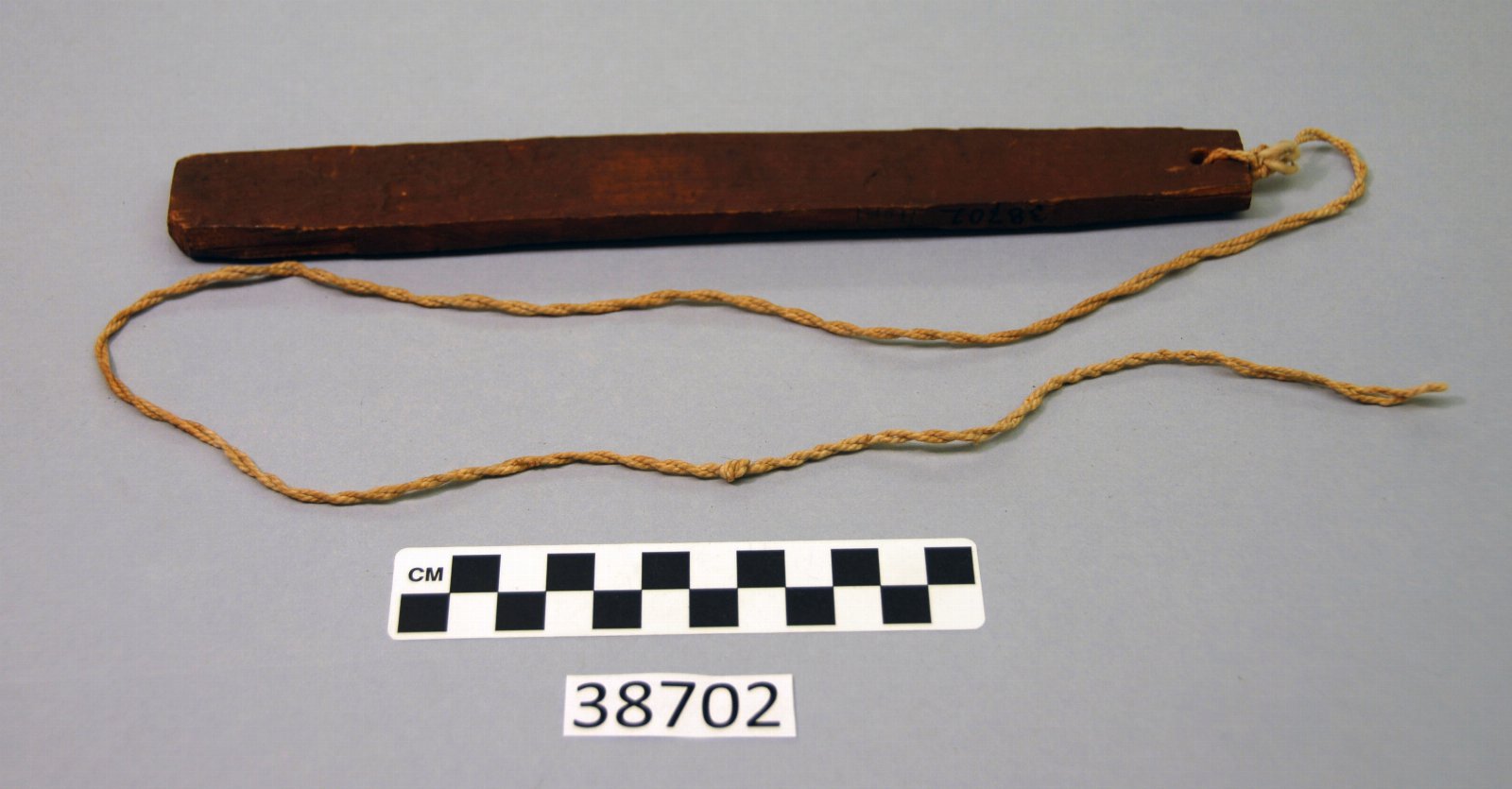
To-Wok-Kin-Pi
Source term: Bullroarer
To-Wok-Kin-Pi: the Hopi name for the bullroarer as written on this Oraibi object; it appears as tovokìnpi at Walpi and tovolpi at Shipaulovi.
Two years after this blade left Oraibi, H. R. Voth published what a thing of that name does there in August. Coming down to the spring in the Summer Snake ceremony, the priest stopped short of the water, twirled the bullroarer and blew his eagle-bone whistle — announcing himself, he said, to the water deities: Balölökongwuu, the plumed water serpent, and the Clouds. Then he prayed for rain on the corn. Stewart Culin carried this one east in 1901 with its twisted fibre cord still through the tapered end, and the Hopi word went onto the card with it.
Particulars
- Object
- Rectangular wooden blade tapering slightly to a perforated end, with a twisted fibre cord; 25.8 × 3.2 cm. A second, smaller Oraibi blade (11.7 × 2.4 × 0.8 cm), rectangular with rounded ends and one perforation, came from a ruined house, in Mischa Titiev's 1933 collection.
- Function
- Not recorded for the Penn blade; the smaller Oraibi whizzer was used in Hopi ceremonial to simulate the sound of thunder.
Sources
- Penn Museum 38702; Oraibi, Third Mesa, Arizona; Hopi; Wanamaker Southwest Expedition/R. Stewart Culin, 1901; wood and fibre; 25.8 × 3.2 cm. View · archived
- Harvard Peabody Museum 33-97-10/1791; Oraibi, Third Mesa; Mischa Titiev, 1933. View
- H. R. Voth, The Oraibi Summer Snake Ceremony, Field Columbian Museum Anthropological Series 3(4) (1903), pp. 319-320. View