No. MINE2026-087
Trumai kuth / huri huri bullroarer, Upper Xingu
Brazil · Upper Xingu, Mato Grosso · South America · Amazonia
Restricted
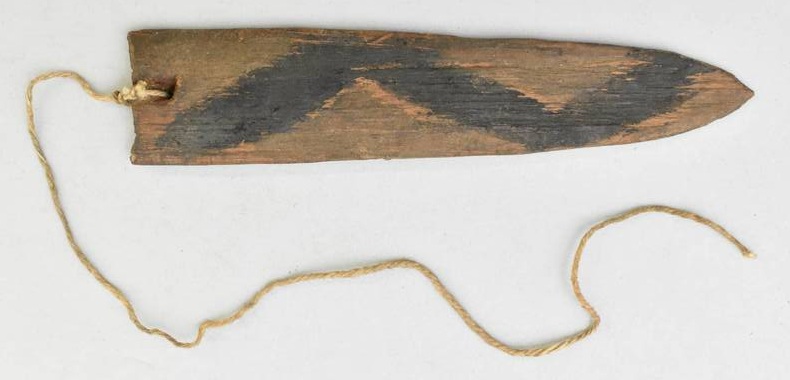
kuth; uríuri (shared with Kamayurá); huri huri
Source term: bull roarer / zunidor
kuth = the Trumai bull roarer, its rites 'buried'; uríuri = the word for bull roarer in both Kamayurá and Trumai (Murphy & Quain 1955, p. 9); huri huri = the same name as recorded in Guirardello-Damian 2011, with huri huri wal the zunidor-making ritual.
By 1938 the Trumai told Buell Quain that they had “buried the kuth”: the rite was no longer performed, but most of the men remembered travelling to the Kamayurá village for ceremonies where they “did things that the women cannot see” — and afterwards, “a great deal of wrestling and copulation.” The bullroarer’s name survives as uríuri or huri huri, along with the remembered pequi-festival rite for making it. The instruments themselves outlived the rite: three blades Herrmann Meyer collected near the Rio Culuene in the mid-1890s — one still carrying its whirling cord — sit today in Leipzig's GRASSI museum.
Yati, Maibu, and Tun played a ceremonial role known only to them, while Yati, Oirupa, and Nitvary sang certain songs at night when everyone was asleep.
Murphy & Quain, The Trumai Indians of Central Brazil (1955), p. 71.
Particulars
- Object
- Three wooden blades in Leipzig: 15 cm, painted black and still tied to its cord; 34 cm, painted black, with a twisted black cord knotted on for whirling; and 40 cm, its paint faded and its cord lost.
- Function
- Defunct by 1938. Dancing in the Trumai village came first; then everyone went on to the Kamayurá village for the rite. The roarer's making-ritual, huri huri wal, is remembered as part of the pequi festival.
Source
Robert F. Murphy and Buell Quain, The Trumai Indians of Central Brazil (1955), pp. 9 and 71; Raquel Guirardello-Damian, 'Léxico comparativo: explorando aspectos da história trumai,' in B. Franchetto (org.), Alto Xingu: uma sociedade multilíngue (2011), pp. 144-145