No. MUS2026-001
Kalapalo matapu, hidden from women
Brazil · Upper Xingu, Mato Grosso · South America
Restricted
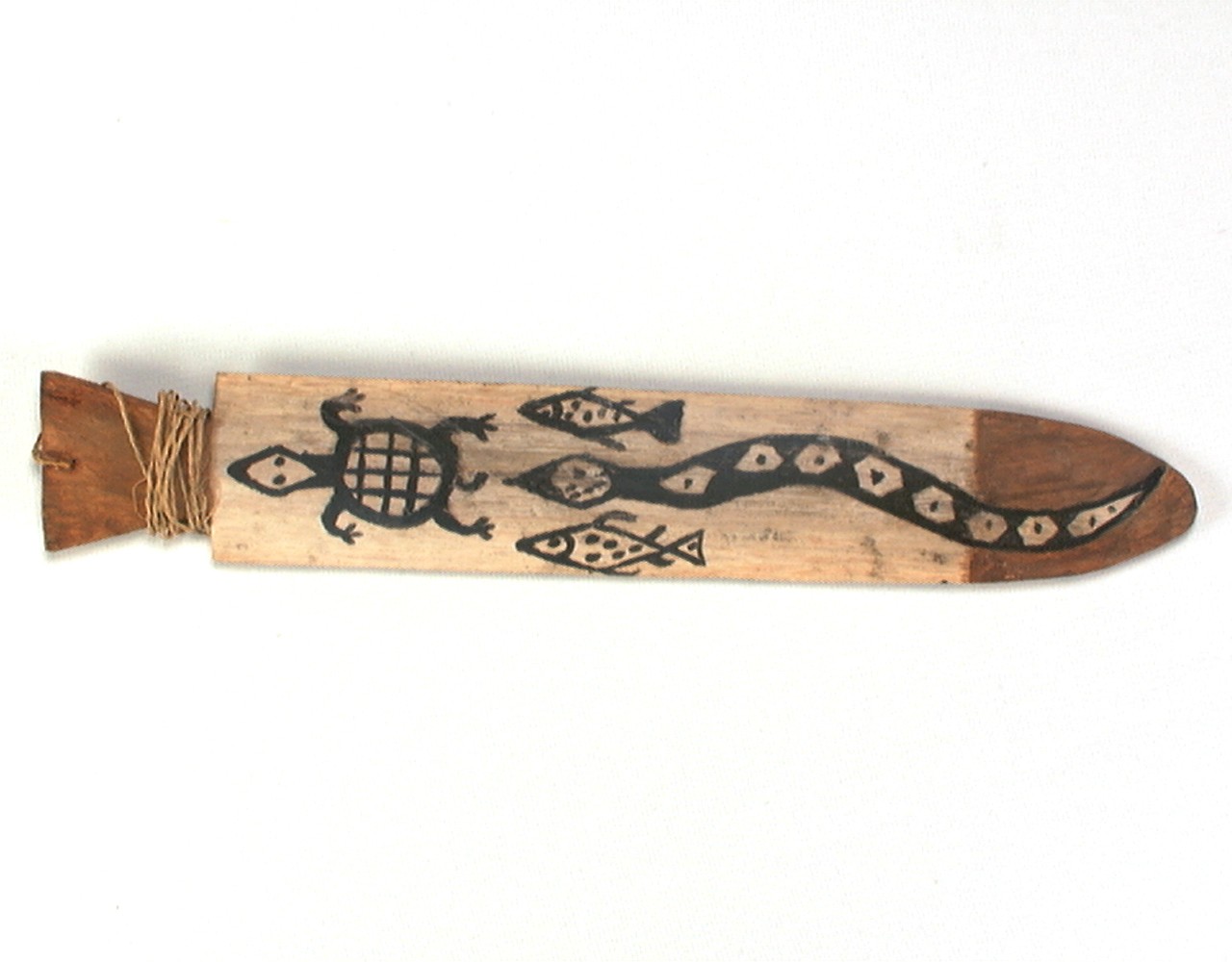
Source term: bull-roarer
A carved and painted wooden bull-roarer of the Kalapalo (Apalakiri), about 29 centimeters long, from the Upper Xingu of Mato Grosso and now in the National Museum of the American Indian, where it hangs in the Amazonia section of the "Infinity of Nations" exhibition; it was donated to the museum in 1998 by the Amanaka'a Amazon Network, a New York nonprofit that worked with Amazonian communities. In the Upper Xingu the bull-roarer belongs to the men's ritual complex centered on the small house in the middle of the village plaza, where the men keep their sacred wind instruments, which women must not see. Among the neighboring Mehinaku, Thomas Gregor found that the hummer has a spirit of its own, matapu, one of the spirits who own the pequi groves, honored with a three-day rite. In the wider region the sanction for a woman who sees the sacred flutes is rape.
Among the spirit-owners of the plantations is matapu, the spirit of the hummer, the focus of an important ritual that lasts three days. In the course of this ritual, the inhabitants of the village make hummers (an object comprised of a stick with a wooden plate at the end which, when swung around, produces a humming noise) that are hung up in the men's houses and kept at a distance from the women of the village.
Thomas Gregor, "Mehinako," Povos Indígenas no Brasil (Instituto Socioambiental)
Particulars
- Function
- A men's sacred instrument, hidden from women.
Source
Smithsonian National Museum of the American Indian, ark:/65665/ws6ca7fb332