No. BOURKE1892-002
Apache San Carlos tzi-ditindi sounding wood
United States · San Carlos Agency, Arizona · North America
Sacred / spirit
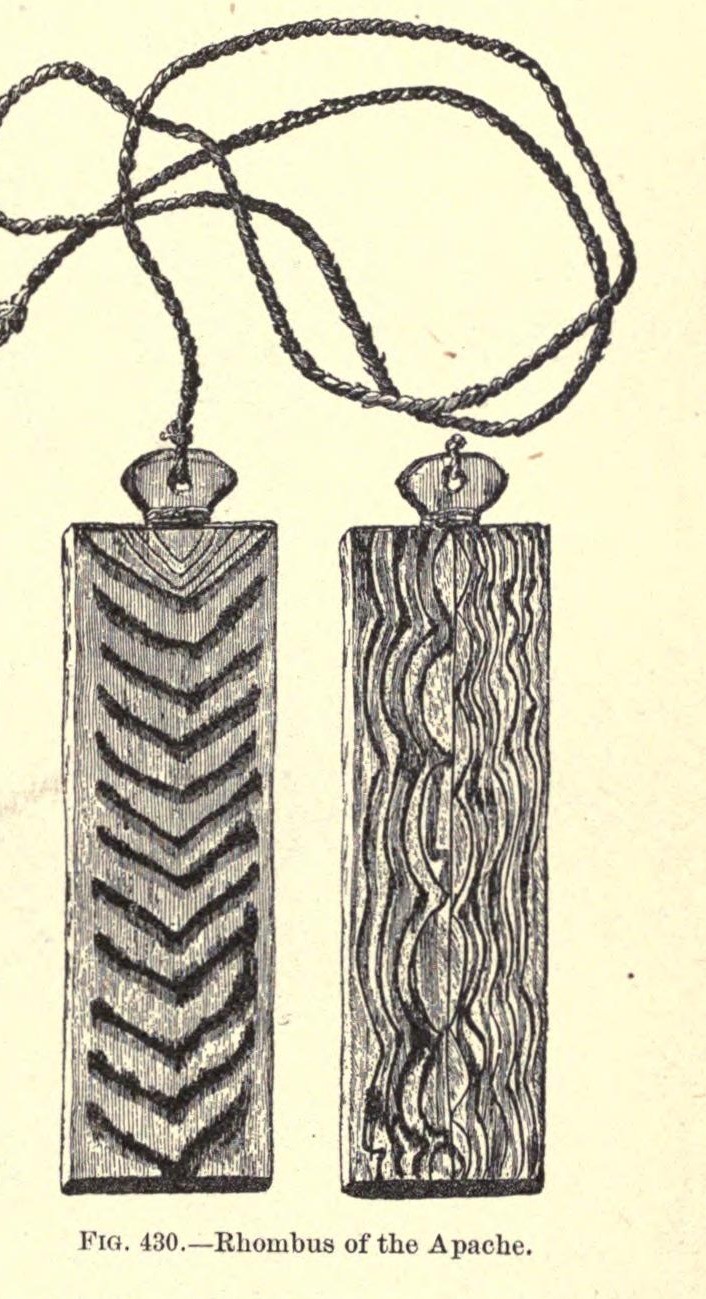
tzi-ditindi
Source term: tzi-ditindi; sounding wood; rhombus / bull roarer
tzi-ditindi: the Apache name for the bull-roarer, glossed by Bourke as "the sounding wood."
Etymology. Bourke records the Apache name for the bull-roarer as tzi-ditindi and glosses it as "the sounding wood" — the wood that produces sound when whirled.
In 1884 the season near the San Carlos Agency in Arizona had been unusually dry and the crops were parched, so the Apache medicine-men arranged a procession, two of its features being a long-handled cross and a rhombus, or bull-roarer. Captain John G. Bourke, who recorded the rite, had first seen the instrument at the snake dance of the Tusayan (Hopi) in the village of Walpi in August 1881, where the medicine-men twirled it about the head until it "faithfully imitat[ed] the sound of a gust of rain-laden wind"; by making this sound, he was told, they compelled the wind and rain to come to the aid of the crops. He found the Apache using it for the same purpose. They called it tzi-ditindi, "the sounding wood," an oblong of pine some seven or eight inches long, one end rounded to rudely represent a human head. The painted lines on its front, the Apache explained, were the entrails of their wind god, and those on the back his hair, which was of several colors and represented the lightning. Bourke was led to believe the wood itself was taken from pine or fir struck by lightning on the mountain tops, such wood being held in the highest estimation and worked into amulets of especial efficacy.
The whole bears a close resemblance to the drawings of schoolboys which are intended for the human figure.
Bourke 1892, The Medicine-Men of the Apache (Ninth Annual Report, Bureau of Ethnology):477
Particulars
- Object
- Oblong of wood, 7 or 8 inches long, 1¼ inches wide and ¼ inch thick, the cord end rounded into a rough human head; painted with lines on both faces.
- Function
- Rain magic for parched crops: whirled in the medicine-men's drought procession to compel the wind and rain to come.
Source
Bourke, The Medicine-Men of the Apache, Ninth Annual Report of the Bureau of Ethnology (1892), pp. 443-603, at pp. 476-478