PEREZDEARCE2025-001 - archaeological find
Pair of incised stone bullroarers
Catamarca - Northwest Argentina - South America
Function not recorded
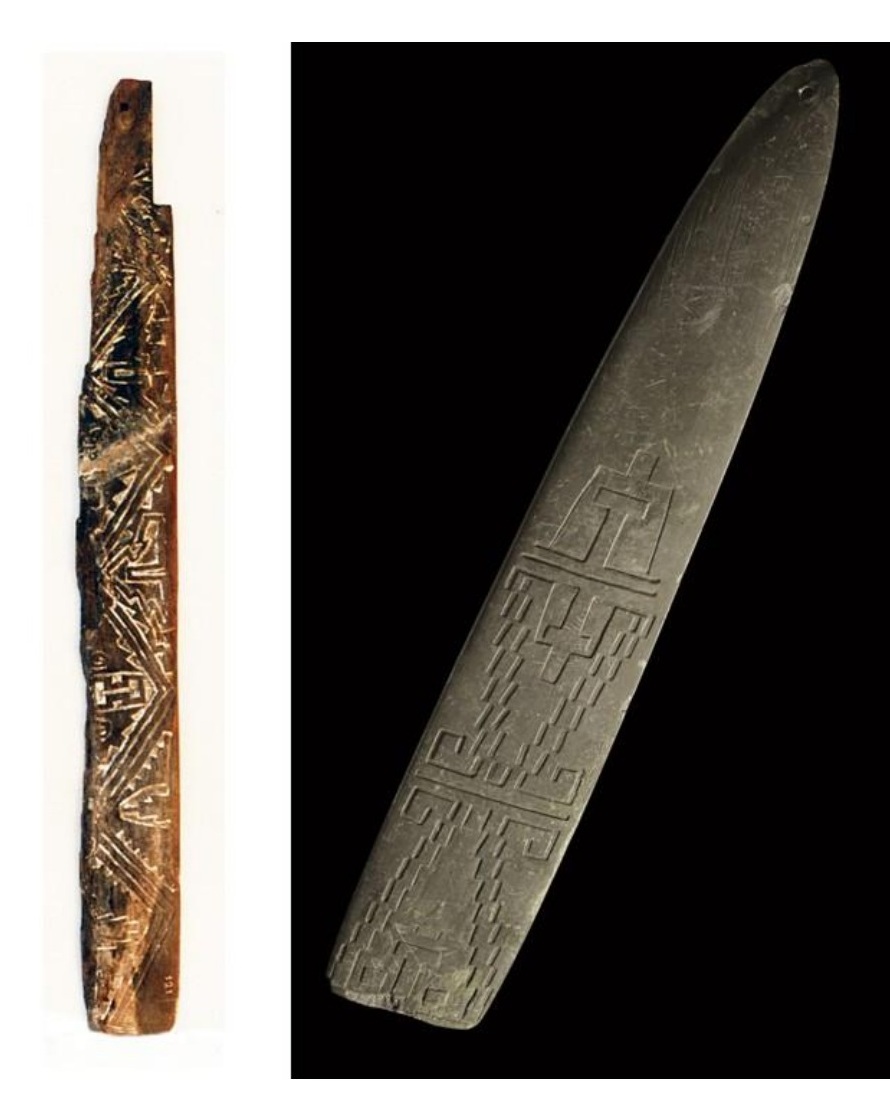
zumbador de piedra
Source term: ZUMBADOR DE PIEDRA
zumbador de piedra (Spanish): "stone bullroarer/buzzer," Pérez de Arce's own classification term for both blades.
Across both blades, human faces dissolve into stepped noses, zigzags and interlocking frets. On the slate example, a stepped H sits directly beneath the cord hole—the same geometric vocabulary that reaches monumental scale in Puma Punku’s famous H-shaped stonework. A 1999 reassessment places the blades in the Tinogasta Geométrico Temprano style, tentatively around 200 BC. In stone this large, Pérez de Arce observes, making them roar would have taken a strong cord and real force.
Dos ejemplares de piedra se han conservado en el noroeste argentino. Desgraciadamente carecen de contexto. Uno (ME 44.2472) lo pude examinar, es de piedra laja, pulida en la cara anterior, con dibujos incisos y con el reverso liso. Está parcialmente roto. El otro es de pizarra, de forma similar y también cubierto de dibujos incisos.
Two stone examples have been preserved in northwest Argentina. Unfortunately they lack context. One (ME 44.2472) I was able to examine; it is of laja stone, polished on the front face, with incised drawings and a smooth reverse. It is partially broken. The other is of slate, of similar form and also covered in incised drawings.
Pérez de Arce 2025, p. 1820
- Object
- Two large, polished stone blades, each pierced at one end and incised on one face. (1) Museo Etnográfico UBA 44-472/121, catalogued from Agua Amarilla, Catamarca: 37.9 cm long, 4.1 cm maximum width, and 0.55–0.65 cm thick; rectangular and very elongated, with a smooth reverse and a damaged pierced end that may originally have held two holes. (2) Colección Gnecco 475 (1550), later Fundación CEPPA: a carefully polished slate blade 39.9 × 6.5 cm, with no published thickness or findspot; its intact rounded tip carries one hole above registers of stepped anthropomorphic faces and key-frets.
- Function
- José Pérez de Arce classifies both as stone bullroarers. González and Baldini had interpreted the same blades as possible sceptres with wrist loops, although they noted that Piece 1 lacks a handle; no acoustic test is published.
- Source
- José Pérez de Arce, Los sonidos de América precolombina (2025), p. 1820 and fig. 1914, publishes and classifies both as ZUMBADOR DE PIEDRA. Alberto Rex González and Marta I. Baldini, 'Un nuevo estilo arqueológico del Noroeste Argentino,' Relaciones de la Sociedad Argentina de Antropología 24 (1999):29–58, identify them as Pieces 1 and 3 of the Tinogasta…
- Source location
Page references
Pérez de Arce 2025, p. 1820, fig. 1914; González and Baldini 1999, pp. 32–36, 51–52, Plate I:1 and I:3
- Source confidence
- low Agua Amarilla locality anchor in Santa María Department, Catamarca, matching the Museo Etnográfico catalogue provenance for Piece 1. Piece 3 has no known findspot; the grouped point uses the only published object locality and does not transfer it to Piece 3.