No. SA-Z1953-008
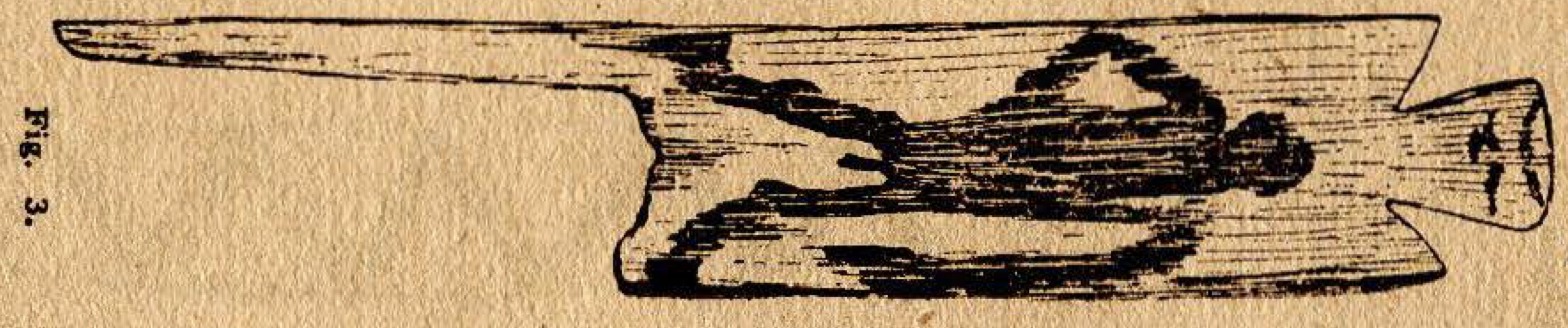
Bakairi and Nahuquá upper-Xingu bullroarers
Central Brazil · South America
Play / practical
yelo
Source term: Schwirrgerät / Schwirrholz / bullroarer
yelo / iyelo: Bakairi word for the bull-roarer, identical to their term for lightning-and-thunder ('Gewitter', thunderstorm); von den Steinen rendered it "thunder," after the instrument's hum.
Etymology. The Bakairi name yelo / iyelo is their shared word for thunder and lightning; von den Steinen rendered it "thunder," after the instrument's droning hum.
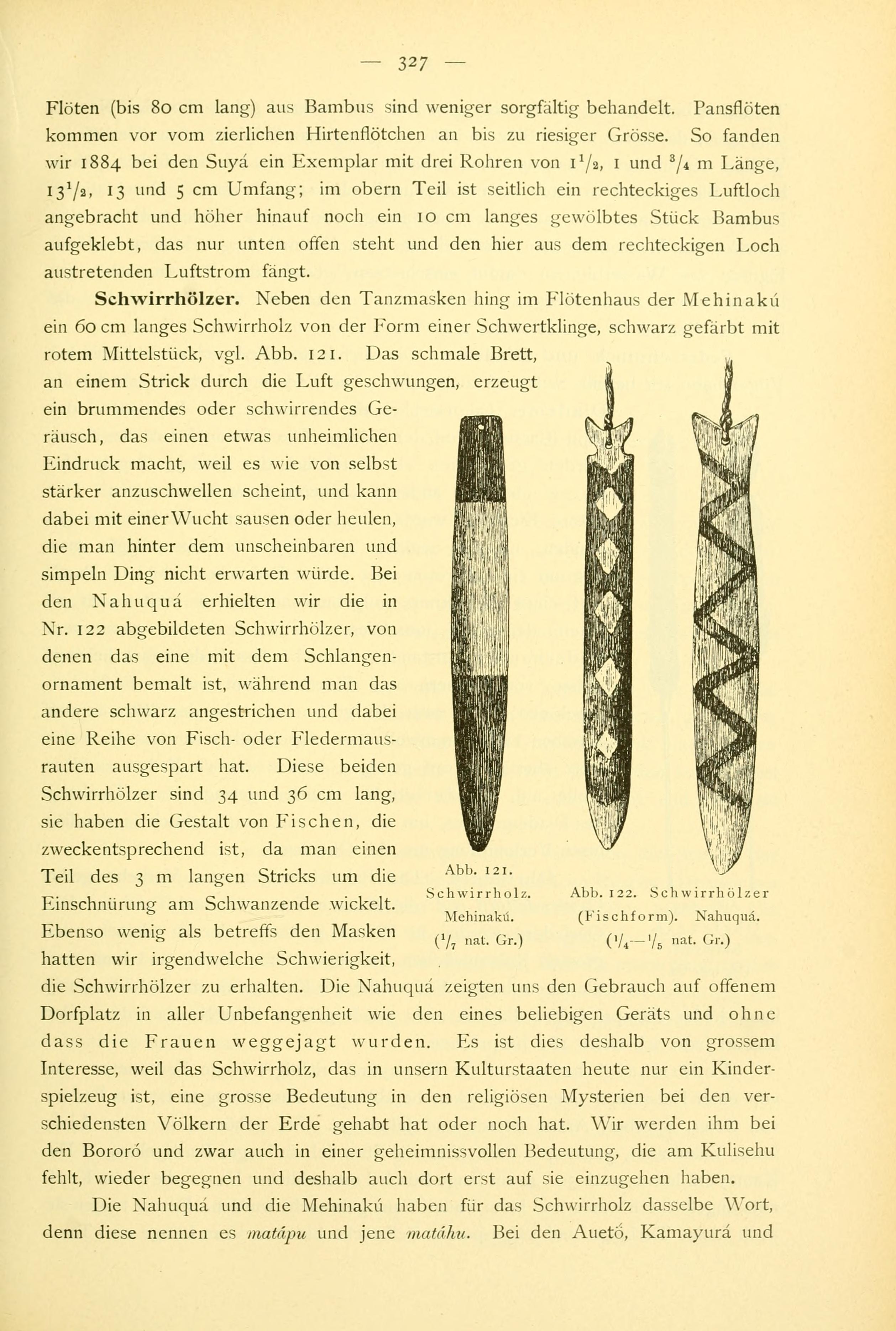
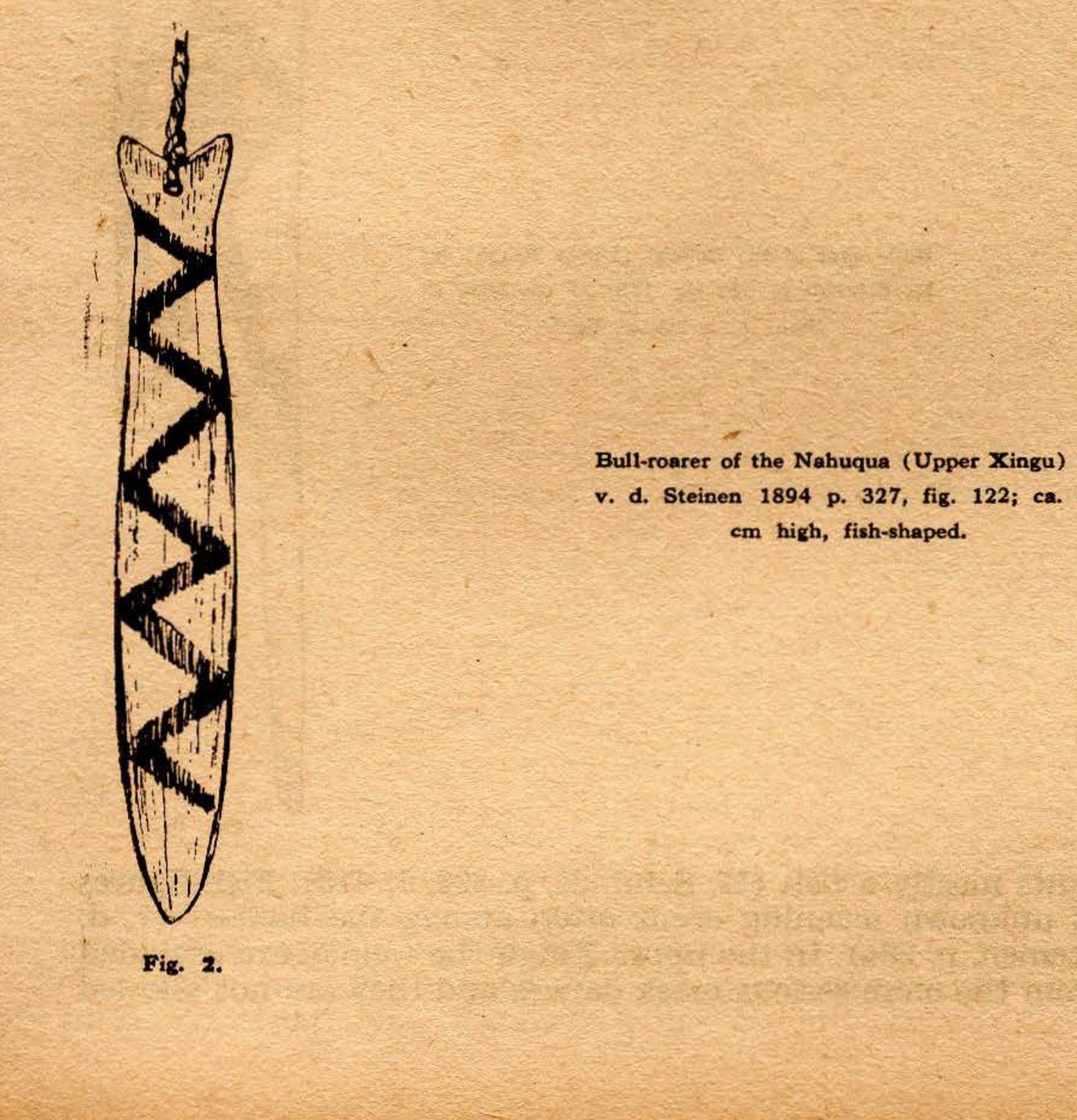
The Bakairi of the upper Xingu call the bull-roarer yelo — their one word for lightning, thunder, and storm. Karl von den Steinen came to the Kulisehu in 1887 hunting "the magic instrument" of the world's mysteries, and the word corrected him: the droning hum says thunder, not lightning. What startled him more was the openness. The Nahuquá whirled their fish-shaped roarers on the village plaza like any everyday tool, women standing by; on the Kulisehu the instrument served the merry mask dances and doubled as a toy, while the same object among the Bororó to the south was the death-feast signal a woman could be killed for merely seeing. Yet a shadow of a stricter life clung to it. In the Mehinakú flute house — the one building women entered on pain of death — a sword-shaped roarer hung among the caiman-dance masks, and Otto Zerries read its storage there as proof "it has not always been like that." Among today's Wauja the matapu is no toy at all: it is a spirit with a fish's body, the very shape the old Xingu boards already wore.
Sie erzeugten Donner und Gewitter mit dem Zauberholz; die Idee des Regens ist erst sekundär.
They produced thunder and storm with the magic wood; the idea of rain is only secondary.
Karl von den Steinen, Unter den Naturvölkern Zentral-Brasiliens (1894), p. 328
Particulars
- Function
- The Bakairi name for the bull-roarer is linked to thunder and lightning; it belongs to the men's flute/mask complex, with women's involvement varying by the seriousness of the dance (von den Steinen).
Source
Karl von den Steinen, Unter den Naturvölkern Zentral-Brasiliens (Berlin: D. Reimer, 1894), pp. 81, 296-298, 327-328, 497; Max Schmidt, Indianerstudien in Zentralbrasilien (Berlin, 1905), p. 328, fig. 158; Otto Zerries, 'The Bull-roarer among South American Indians,' Revista do Museu Paulista n.s. 7 (1953), pp. 282-283