No. MUS2026-044
Parapara and uriwuri, female and male
Brazil · Upper Xingu, Mato Grosso · South America
Restricted
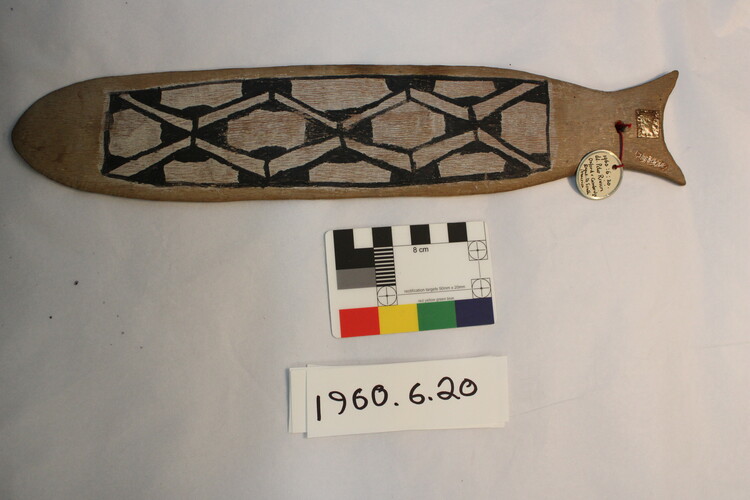
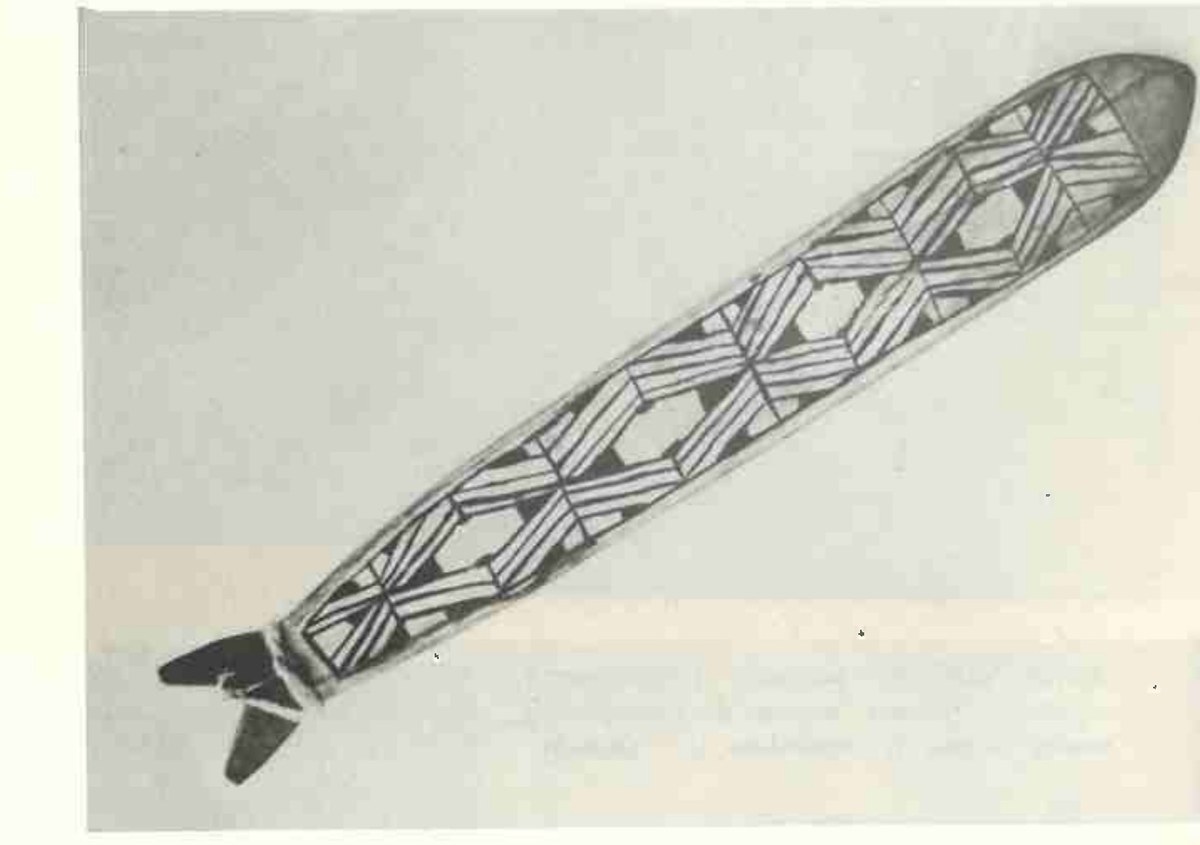
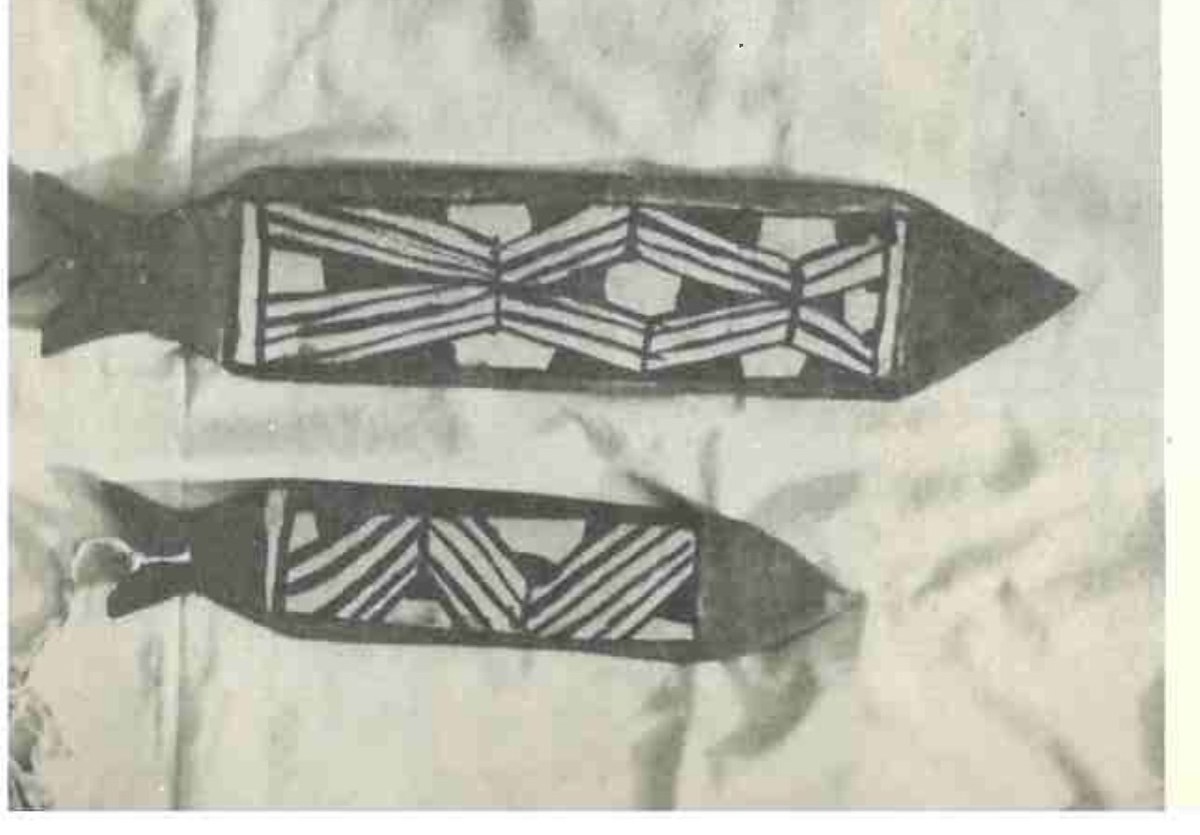
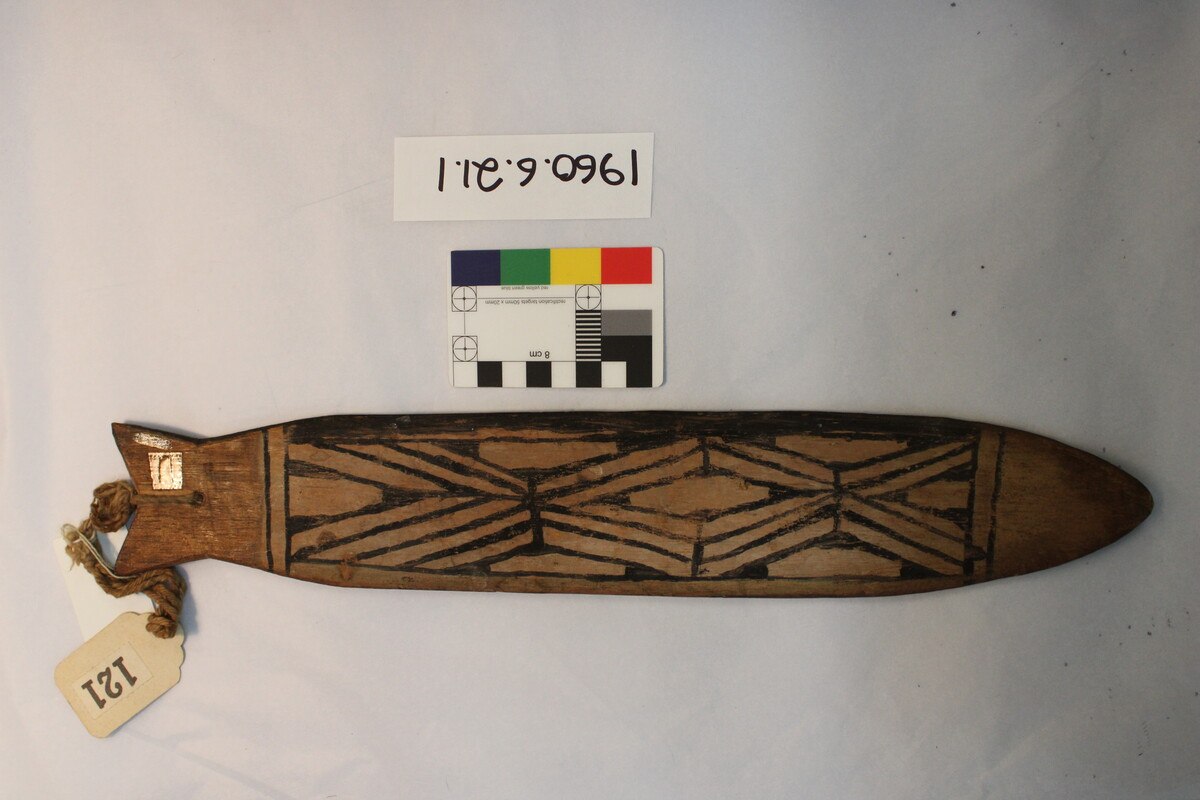
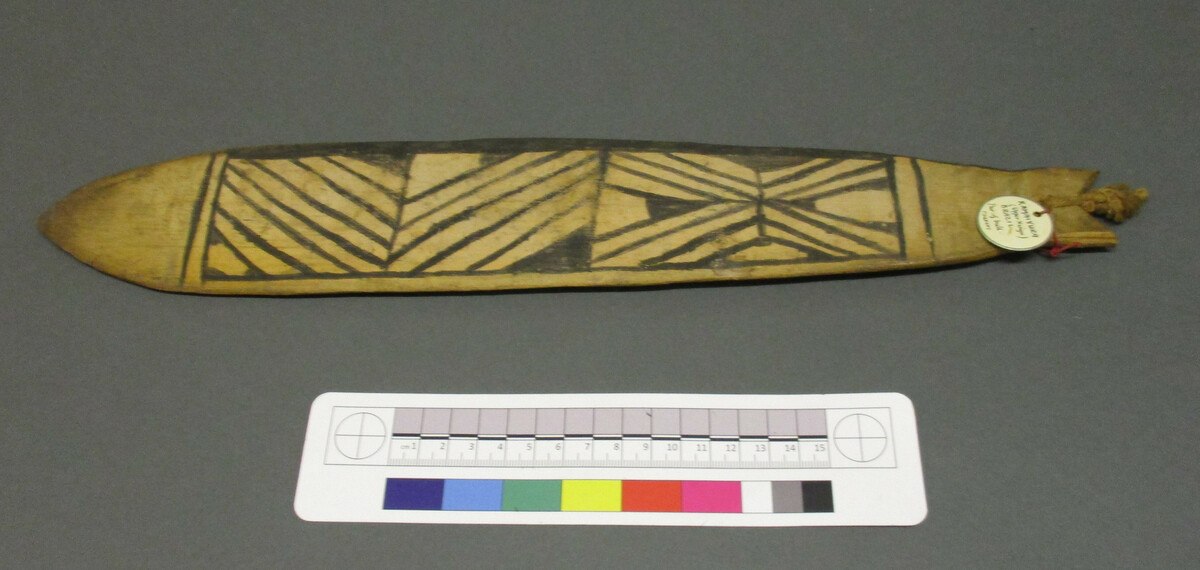
parapara / uriwuri / hori-hori (horí-horí)
Source term: hori hori (Barron); parapara, uriwuri (Bastos 1978)
parapara and uriwuri — the paired Kamaiurá bullroarers in Bastos's musicology (1978:122): both free aerophones (zunidores) of ywyra wood, cords tied to whirling rods, played in pairs; parapara 83 and 75 cm, uriwuri 43 and 35 cm. In each pair the larger blade is female, the 'conductor', the smaller male, the 'conducted' (p. 236). 'Hori hori' is Barron's earlier rendering. urivuri (Oberg's spelling, 1953:24, 54): the piqui tree's mama'é, about 18 inches long, fish-shaped, painted in red zigzags or diamonds over black or white.
In the Kamaiurá origin story, women were the first flute-players until the twins Sun and Moon drove them off with parapara and uriwuri bullroarers—fierce aquatic spirit-beings, mama'é, of fish and serpent essence. Whirled in gendered pairs, the larger blade is female and “conducting,” the smaller male and “conducted.” In the women's flight, men seized the sacred jakui flutes for themselves. The flutes are kept in the tapuwí at the village center; only men may see or touch them, and a woman who sees them faces gang rape. Elsewhere in Amazonia, Alfred Russel Wallace recorded an even harsher sacred-flute law among Uaupés River peoples: a woman merely suspected of seeing the instruments was executed, “generally by poison”; a father would sacrifice his daughter, or a husband his wife. Kalervo Oberg, working the Xingu in 1948, found the same instrument tied to a tree. The uriwuri is a guardian spirit of the piqui, and its story is a pair of trades: Yanama, the ancestor who made thunder and lightning, got the bullroarer from aika the dogfish for red toucan feathers, then handed it on to the piqui tree in exchange for the knowledge of making piqui oil. Its spirit joins the people at the piqui-harvest ceremony, and when the rains are late the bullroarer is brought out to fetch them.
The Kamayura say that two male twins, Sun and Moon, scared women flutists away by bellowing through their HORI HORI (bullroarer). As a result, the women left behind their instruments, which were then captured by the twins.
Barron, "Gender Ideology Reflected in the Flute Symbology of Various New Guinea and South American Indian Cultures"
Particulars
- Object
- Bull-roarer of the Kamaiurá, Pitt Rivers Museum, Oxford (acc. 1960.6.20). Bastos documents the type as paired lanceolate ywyra blades on whirring cords tied to whirling rods: parapara 83/75 cm, uriwuri 43/35 cm, each pair gendered female/male. Oberg 1953:54 describes the Kamaiurá uriwuri as about 18 inches long, shaped like a fish, and covered with painted zigzag lines or diamond-shaped designs in red over a black or white surface.
- Function
- A men's-restricted instrument: in the Xingu origin myth twin culture-heroes drive the women off by sounding it and then seize the women's sacred flutes, which women may no longer see.
Sources
- Pitt Rivers Museum, Oxford, 1960.6.20 View · archived
- Orlando and Cláudio Villas Bôas, Xingu: The Indians, Their Myths (1973), pp. 119–120, 158
- Alfred Russel Wallace, A Narrative of Travels on the Amazon and Rio Negro (1853), pp. 348–350, 500–502 View · archived
- Kalervo Oberg, Indian Tribes of Northern Mato Grosso, Brazil, Smithsonian Institution, Institute of Social Anthropology Publication 15 (1953), pp. 7, 24, 53–55, 57 View
- Barron, “Gender Ideology Reflected in the Flute Symbology of Various New Guinea and South American Indian Cultures”