No. MUS2026-020
Matapu, the fish spirit of the pequi festival
Brazil · Upper Xingu, Mato Grosso · South America
Restricted

matapu / aripe
Source term: bull-roarer
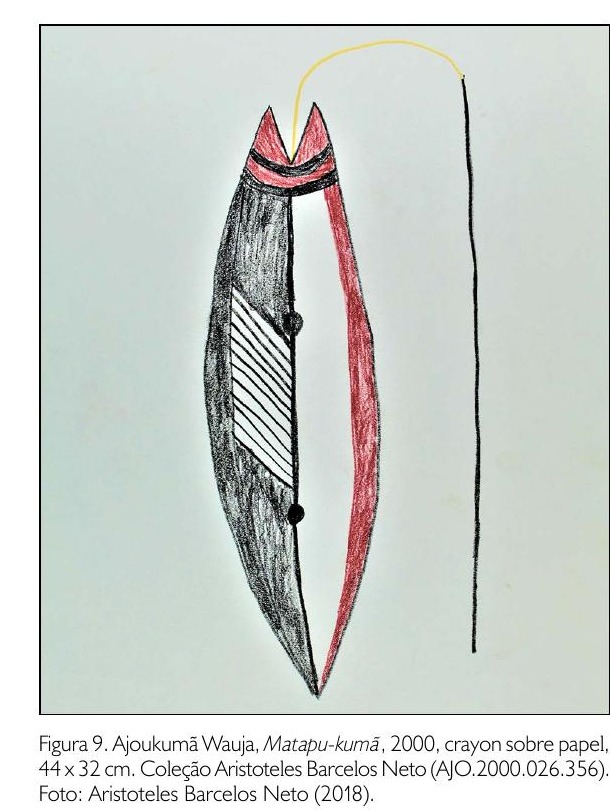
matapu: the Wauja bullroarer, itself an apapaatae (supernatural being) and not merely a spirit's instrument; sexed male or female. matapu-kumã: the supernatural or prototypical bullroarer represented as a fish spirit. aripe: 'grandfather', the smallest roarer of the set, who in his song wants only to eat pequi uncooked. mulu-mulu: boys' miniature roarers. Alapaga-kuma: chief of the roarers.
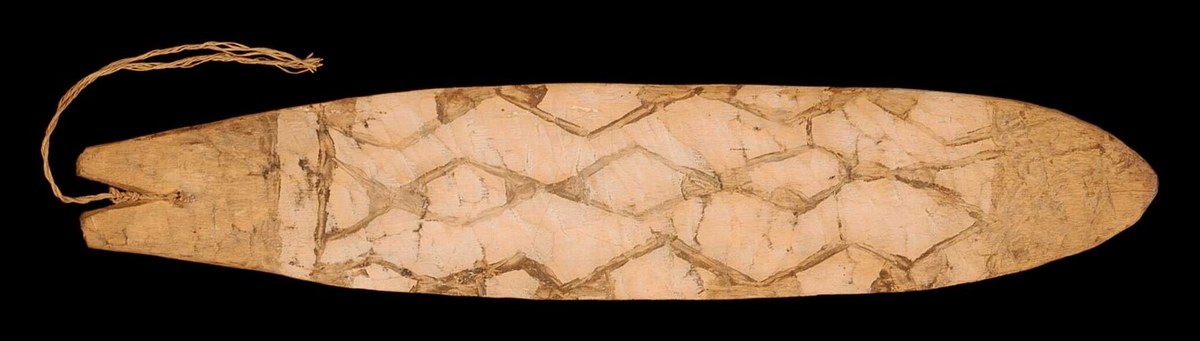
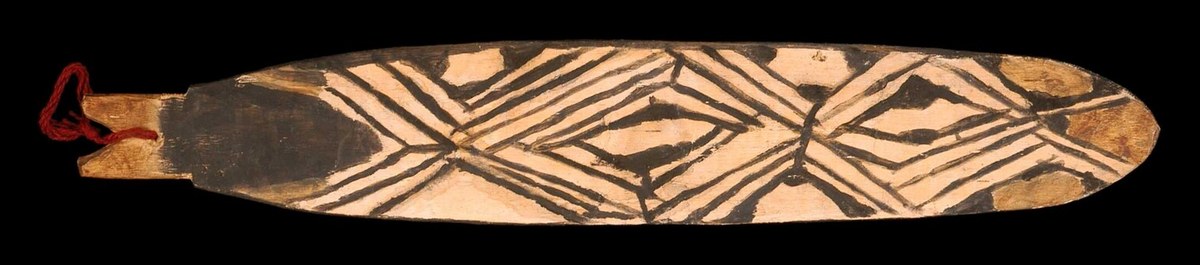
During the pequi festival, Wauja performers carry fish-shaped matapu from the village centre to the houses of the guardian-spirit masters and spin them before each house. The painted blades embody fish spirits, made in male-and-female pairs — a smaller one is aripe, 'grandfather,' and miniatures are whittled for children. Women stay indoors, forbidden to see them turning; the men who spin them are painted with temepé-aná, the anaconda motif. Wauja myth remembers an earlier age when women owned the sacred kawoka flutes, before the matapu helped drive them off and men took the instruments. The matapu's songs demand porridge and fish; the supernatural prototype, matapu-kumã, is itself a fish spirit.
As mulheres ficam presas dentro de casa, pois não lhes é permitido ver o matapu em movimento.
The women stay shut inside the house, for they are not permitted to see the matapu in movement.
Mello, Música e Mito entre os Wauja do Alto Xingu (Diss., UFSC, 1999:142)
Particulars
- Object
- Flat wooden fish-shaped bullroarers, normally made in male-female pairs, 40–70 cm long, painted for the fish represented and tied by cord to a pole about two metres long; NMAI 25/4970 is a 63.5 × 11 × 0.4 cm Wauja example with one terminal hole and surviving cord. Quai Branly 71.1971.43.104 and 71.1971.43.105 are a Wauja pair from the Upper Xingu (43.5 × 9 × 1 and 45 × 8.5 × 1 cm, wood with polychrome painting), each made for the pequi festival and representing a fish spirit; .104 keeps its twisted-fibre cord, .105 a twist of red fibre at the tail slot.
- Function
- Restricted Wauja instrument of the pequi-harvest cycle; during the celebration performers carry matapu to guardian-spirit masters' houses and spin them before each house while women remain indoors.
Sources
- Vera Penteado Coelho, 'A festa do pequi e o zunidor entre os índios Waura,' Bulletin de la Société Suisse des Américanistes 55/56 (1991/92): 37-56, pp. 39-42, 45, 52-53, 56
- Aristóteles Barcelos Neto, Apapaatai (PhD thesis, USP, 2004), p. 150
- Aristóteles Barcelos Neto, 'A flauta-jaguar e outros aerofones wauja,' Boletim do Museu Paraense Emílio Goeldi 16(3), e20200127 (2021), pp. 11-12, fig. 9 View
- Christopher Ball, 'As Spirits Speak,' Journal de la Société des américanistes 97(1) (2011): 87-117, pp. 105-106 View · archived
- Smithsonian National Museum of the American Indian, object 25/4970 View
- Musée du quai Branly – Jacques Chirac, objects 170656 and 170657
- Mello, Música e Mito entre os Wauja do Alto Xingu (dissertation, UFSC, 1999), p. 142