No. STEINEN1894-001
Nahuquä matavu fish-form bullroarer
Brazil · Kulisehu (Curisevo) river, Upper Xingu, Mato Grosso · South America
Play / practical
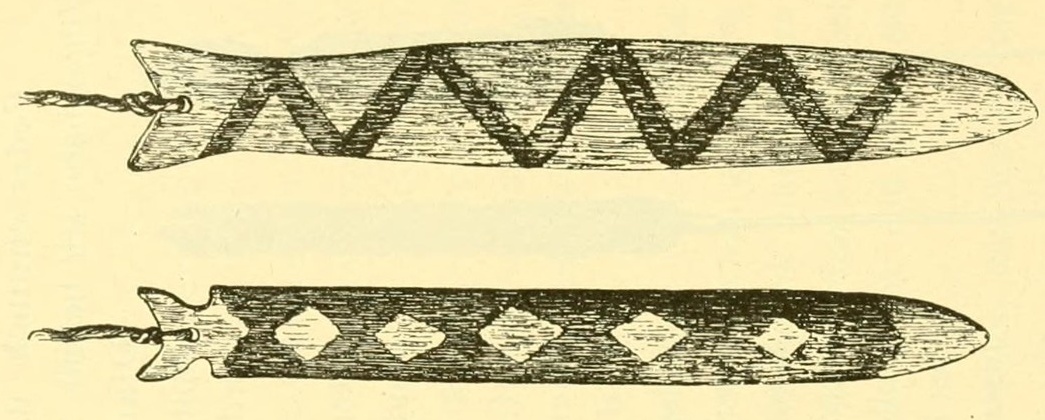
matavu
Source term: Schwirrholz — matavu
matavu = bullroarer (Upper Xingu Carib; ~ Arawak matapu)
On the Kulisehu river in 1887–88, Karl von den Steinen collected bullroarers from the Carib-speaking Nahuquä carved in the form of fish, and set their name down in his comparative word-list: matavu — printed directly opposite the Arawak Mehinaku word matapu. One word, two language families: the clearest trace of a cult term that crossed the Upper Xingu's deepest linguistic line. The zigzag running down the boards was the snake, just as it was on the back-boards the neighbouring Bakairi wore at their feasts. The Nahuquä's Carib descendants — the Kalapalo and Kuikuro of today — no longer keep the instrument; these fish-form boards are the word's only document on that side of the family line.
Auf Schwirrhölzern der Nahuquá … kommen Zickzacks derselben Art wie auf dem Rückenholz vor und gelten auch hier als Bild der Schlange.
On the bull-roarers of the Nahuquá … zigzags of the same kind as on the back-board occur, and here too they count as the image of the snake.
von den Steinen 1894, Unter den Naturvölkern Zentral-Brasiliens, p. 266 (figure p. 327, Abb. 122)
Particulars
- Object
- Two fish-shaped wooden boards, 34 and 36 cm long, the 3 m cord wound round the narrowed tail; one painted with the snake zigzag, the other black with a row of fish- or bat-lozenges left in reserve.
- Function
- Whirled for the merry mask dances, or simply as a plaything, out on the open village plaza; the women were not sent away.
Sources
- Karl von den Steinen, Unter den Naturvölkern Zentral-Brasiliens (Berlin: D. Reimer, 1894), pp. 266, 327, Abb. 122; word list from p. 525 View
- Otto Zerries, 'The Bull-roarer among South American Indians,' Revista do Museu Paulista n.s. 7 (1953), pp. 281-283
- Claude Lévi-Strauss, Handbook of South American Indians, vol. 3 (1948), p. 347; pp. 330-331, fig. 34 g-h