Atlas Essay —
The Wood That Speaks
The Copper River of Alaska · the Navajo and Apache Southwest · the Grand Canyon · the Gran Chaco
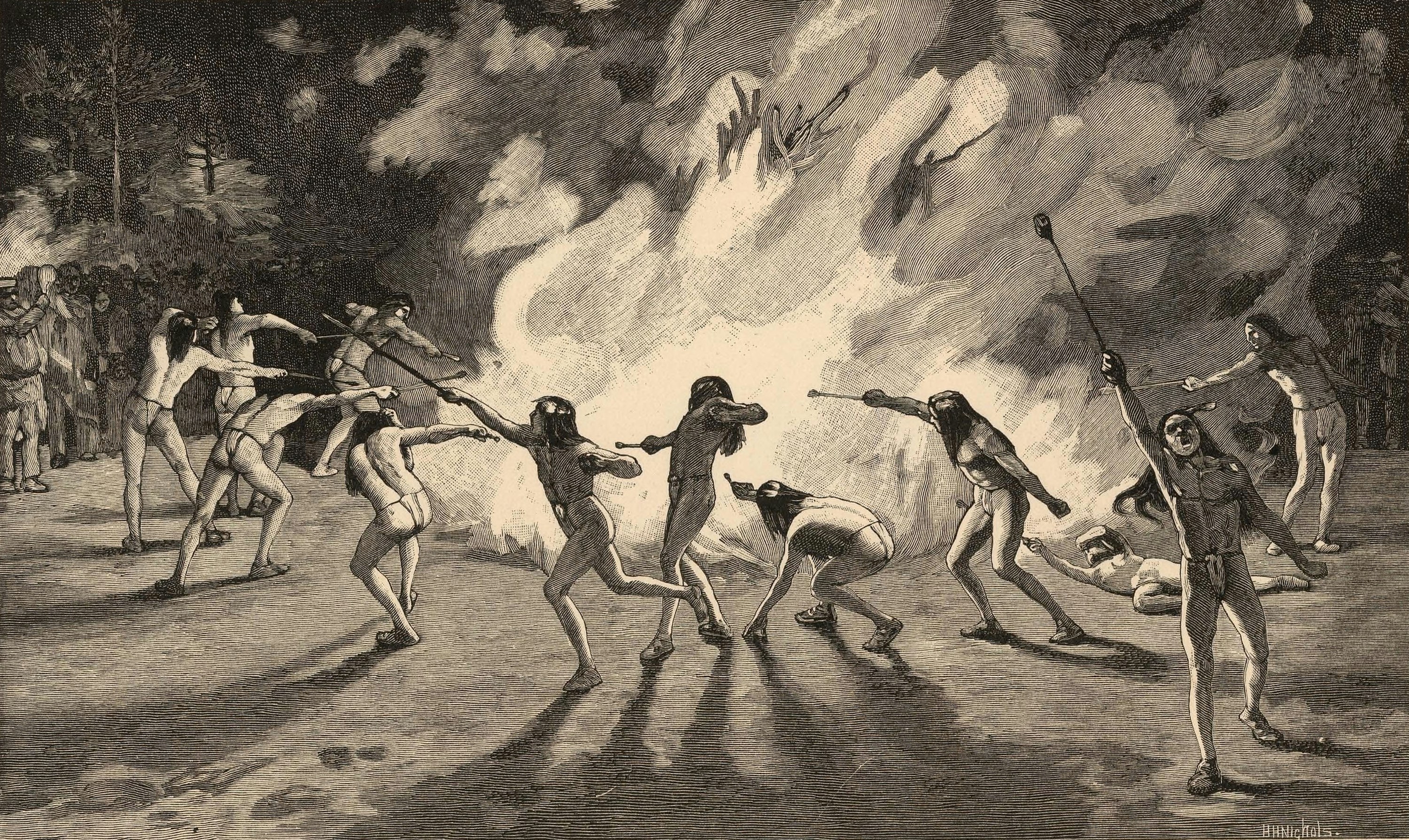
On the last night of the Navajo Mountain Chant, in a corral of piled cedar boughs lit by a great fire, a line of dancers comes in out of the dark. The man at its head whirls a thin black blade on a string, its face sparkling with ground iron ore, three chips of turquoise set in it for eyes and a mouth. Washington Matthews, who watched in the 1880s, heard “a sound like that of a rain storm.” The Navajo call the blade tsindi’ni’. Nearly four thousand kilometres to the north, on the Copper River of Alaska, the Ahtna call the same instrument deniiyi, “that which speaks.” The two peoples have not shared a homeland for well over five hundred years. They share a language family, and they share the word.
Athabaskan peoples, from Alaska to Arizona, call the bullroarer the thing that speaks: an inherited name, carried the length of the family’s migration, and echoed across the Americas wherever the roarer is named as a voice.
In brief
- The Ahtna of the Copper River, in south-central Alaska, call the bullroarer deniiyi, “that which speaks,” from nii’, the verb for saying and telling.
- The Navajo name, tsindi’ni’, is tsin “wood, stick” with a voice in it: Matthews heard it as the “groaning stick.” Cut from lightning-struck pine and whirled for rain, it speaks in Thunder’s place.
- The Apache of San Carlos in Arizona called it tzi-ditindi, “the sounding wood”: the same compound in an army captain’s spelling.
- Navajo and Apache are latecomers to the Southwest, who walked south from the Subarctic around AD 1300–1500. The word for the roarer came with them, and so did its work on the weather.
- Their Yuman neighbours, the Havasupai and Yavapai, call it “wood talking” and the “talking stick.” Further off, the Tunica of Louisiana call it the “whirling bellower,” the Wichí of the Gran Chaco the “caller of the winds,” the Mbyá of Misiones the “old snoring woman.”

That which speaks
The Athabaskan languages, which linguists group with Eyak and Tlingit as Na-Dene, are spoken across the interior of Alaska and north-western Canada, from the Yukon River to Hudson Bay. The map above shows how the family lies. Most of it is in the north. Two branches broke away: one to the coast of Oregon and northern California, where the Hupa, the Tolowa and the Kato live, and one to the Southwest, where the Navajo and the Apache live.
The Ahtna hold the Copper River basin, in the mountains east of Anchorage. When James Kari compiled their dictionary from four dialects between 1973 and 1989, the bullroarer turned up under three roots. The entry that matters most sits under nii’, “say, think,” among the everyday sentences of speech:
nts’e nii? what is he saying?; nts’e dinii? how do you say that? … ne’ukats’ezeli k’etkonii it sounds like someone is hollering for us; dadzineh you (sg) be quiet, don’t talk! …
deniiyi (n;n/laa) bull-roarer, lit. ‘that which speaks’
James Kari, Ahtna Athabaskan Dictionary (1990), p. 304
The second name sits under yotl’, the root for blowing and breathing, the one Ahtna uses when it says a gentle breeze is blowing: hwdelyoli, “that which blows” (p. 441). Up the river at Mentasta the roarer had a third name, ladinen’, which also means “hemp rope”: a Russian word for rope that came up from the Dena’ina of Cook Inlet and named the instrument for its cord (p. 272). So the Ahtna roarer has a voice, a breath and a string. The voice comes first. A thing that speaks is somebody.
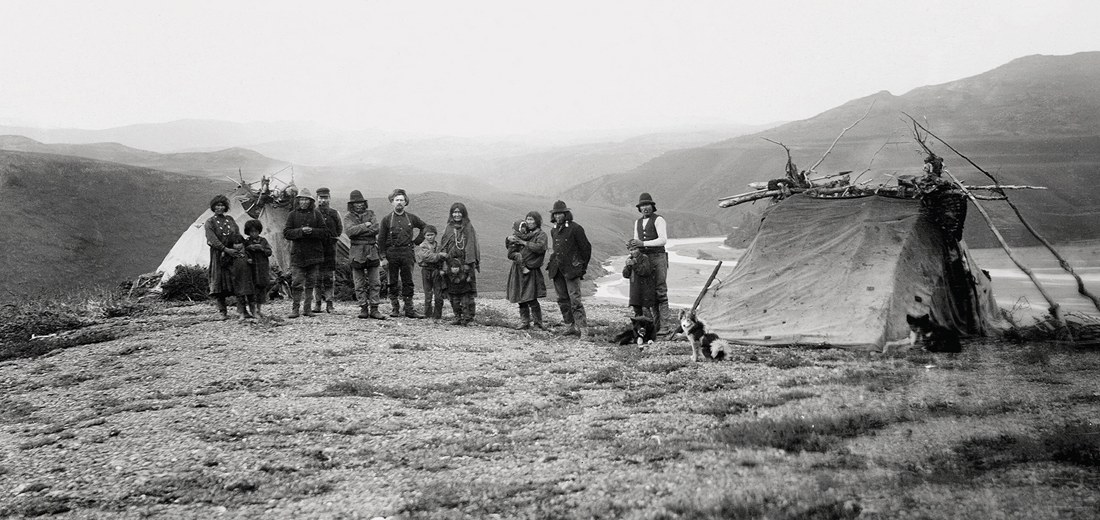
Their neighbours swung it for the same reasons people across the north did. On the beaches of Cook Inlet the Dena’ina whirled it when the waves came rolling in, to make fine weather. Among the Dakelh of British Columbia it moved the weather and sometimes brought rain; among the Chandalar Gwich’in it could turn back an approaching storm; a Kaska man swung it for milder weather and before he chipped a stone blade. In Dunne-za story the Giant Spider whirled one on a mountaintop to lure people to their death. The Dene north did not treat the roarer as a mere noise. They treated it as a power that answers the wind.
The stick that thunders
At the other end of the family, the Navajo word for the bullroarer is tsindi’ni’. Leon Wall and William Morgan printed it in their Navajo-English Dictionary of 1958: “tsindi’ni’, bull-roarer.” The first half is tsin, wood or stick, the word in tsin ’ii’áí, “a tree,” on the same page. The second half is the voice in the wood. Matthews, who had the word from the chanters themselves, put it into English as the “groaning stick”: a stick that utters. The Navajo hear the loudest voice of all in their sky, and the same dictionary sets it down:
’adi’ni, it thunders.
ii’ni’, thunder; lightning.
Leon Wall and William Morgan, Navajo-English Dictionary (1958)
The Navajo bullroarer answers that voice. It is a stick that groans and speaks, and the chanters made it out of the sky’s own handiwork, so that it could speak with Thunder’s authority:
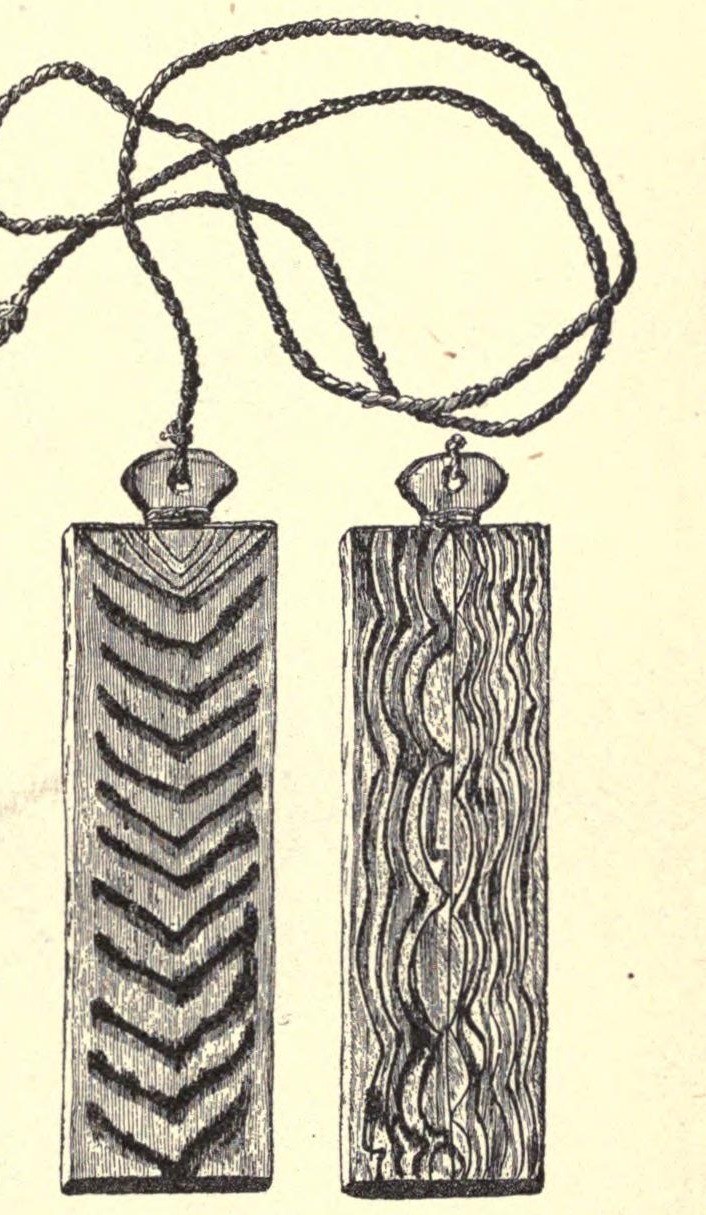
The instrument designated above as the whizzer is a thin, flat, pointed piece of wood, painted black and sparkling with the specular iron ore which is sprinkled on the surface; three small pieces of turquoise are inlaid in the wood to represent eyes and mouth. … It is called by the Navajo tsin-¢e‘ni‘, or groaning stick. It is used among many tribes of the southwest in their ceremonies. The Navajo chanters say that the sacred groaning stick may only be made of the wood of a pine tree which has been struck by lightning.
Washington Matthews, “The Mountain Chant: A Navajo Ceremony” (1887), para. 135, p. 436

The Mountain Chant, Matthews adds, may be held only “in the season when the thunder is silent and the rattlesnakes are hibernating” (para. 5). In the dead of winter, with the real Thunder asleep, the chanters cut his voice from a tree he had struck and whirled it at the head of the procession, filling the corral with the sound of rain. The Mountain Chant is a curing rite, and in the curing chants the bullroarer goes to work on the patient. An assistant soaks its thong in the medicine, circles the hogan whirling it while everyone inside keeps silent, then presses it to the sick person’s limbs. Among the Eastern Navajo, if the blade flew off its cord or turned in the air without a sound, the patient would die. Among the Western Navajo it would refuse to sound at all if anyone used it in public. A thing that can fall silent is a thing that speaks.
The sounding wood of the Apache
Captain John Bourke, who spent the 1880s on the Apache campaigns in Arizona, saw the roarer in an Apache rain procession at San Carlos in the dry October of 1884 and wrote down its name:
The Apache explained that the lines on the front side of the rhombus were the entrails and those on the rear side the hair of their wind god. The hair is of several colors, and represents the lightning. I did not ascertain positively that such was the case, but was led to believe that the rhombus of the Apache was made by the medicine-men from wood, generally pine or fir, which had been struck by lightning on the mountain tops. … The Apache name for the rhombus is tzi-ditindi, the “sounding wood.”
John G. Bourke, “The Medicine-Men of the Apache” (1892), p. 477
Tzi-ditindi is tsindi’ni’ heard by an English ear: the wood, and the verb that sounds. A blade in the Museum of Fine Arts in Boston, thought to be Apache, carries the name as tsinidi’ni’, closer still to the Navajo. The material is the same lightning-struck pine. The thing it makes is the same rain-laden wind.
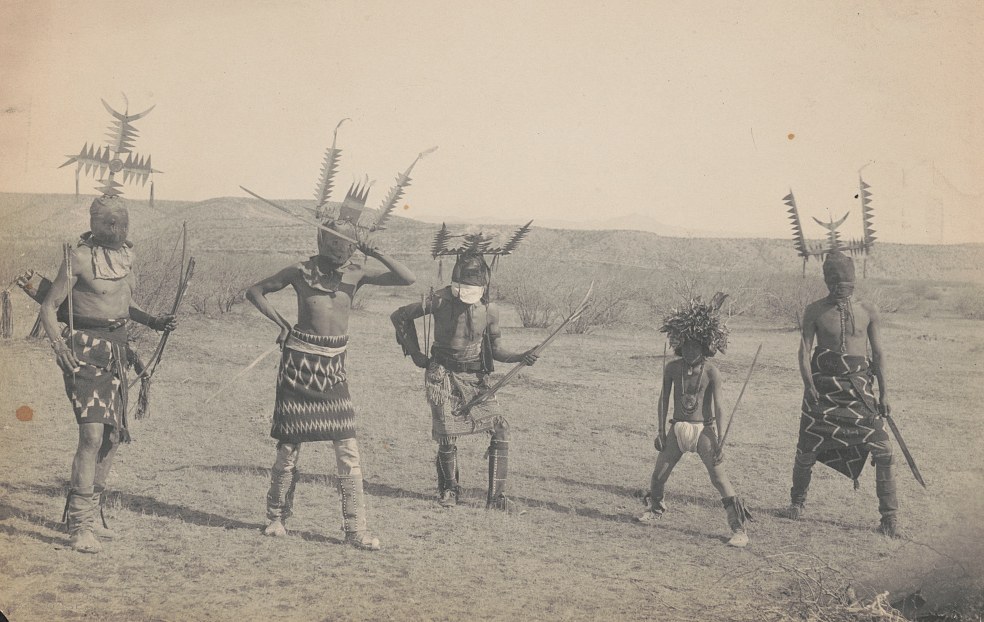
In the Apache dances the roarer announced the spirits. Among the White Mountain Apache the clown whirled it to tell the people the masked Gaan were coming, then kept it sounding through the dance. At Eastern White Mountain and Cibecue it was swung in the open, before everyone. In the curing work of the Northern Tonto a shaman whirled it toward each of the four directions before he entered a sick person’s house. In each case the roarer goes ahead of something holy and speaks for it before it arrives.
Latecomers to the Southwest
The Navajo and the Apache did not grow up in the desert. Their languages are close kin to those of the Canadian Subarctic, and their ancestors walked south from there, down the high plains and the mountain front, reaching the Southwest around AD 1300 to 1500. By then the Pueblos had farmed the mesas for two thousand years. The migration line on the map is drawn dashed because its exact road is reconstructed. The two ends of it are not.
The newcomers carried their old words with them and set them to work on a new world. Edward Sapir showed this in 1936 from inside the Navajo language. Navajo had to name crops it met for the first time, and its word for corn, naadą́ą́’, is built from the old roots for “enemy” and “food”: the food of the enemy, the people already farming when the Navajo arrived. A word for a horn dipper became the word for a gourd dipper. The language kept a record of the journey.
“deniiyi … bull-roarer, lit. ‘that which speaks’”
James Kari, Ahtna Athabaskan Dictionary, 1990The bullroarer’s name is part of that record. Corn was new, so it got a new name from old parts. The roarer was not new. It arrived already called a speaker, and the Navajo and Apache kept the name. What they met in the Southwest was a country where the roarer already belonged to the Pueblos’ rain rites. Bourke first saw it at the Hopi Snake Dance at Walpi in 1881, where it imitated “the sound of a gust of rain-laden wind,” and then found the Apache using it for the same purpose. The Hopi call theirs tovokìnpi, and the Zuni towokpi: a different word, shared between the two Pueblos, with no trace of the Athabaskan speaker in it.
The weather work did not have to be learned from the Pueblos either. The north already had it: the Dena’ina calming the surf, the Dakelh calling rain, the Gwich’in turning a storm. The Southwest gave the old voice a new and grander script. Thunder, in a land where rain is life; lightning-struck pine, which Navajo, Northern Tonto and Hopi roarer-makers all prized; masked spirits, crops and the summer storms. The name stayed what it had been on the Copper River. The wood still speaks.
Wood talking
West of the Navajo, on the Colorado Plateau and down into central Arizona, live peoples of another family altogether. The Havasupai of the Grand Canyon and the Yavapai speak Upland Yuman languages, unrelated to Navajo or Apache. Leslie Spier, who lived among the Havasupai in the 1920s, recorded their name for the bullroarer as ĭ’igȯgwaúwȯ, “wood talking” (Spier 1928, p. 288). They swung it for rain. In 1911 Barbara Freire-Marreco bought a Yavapai medicine roarer at Fort McDowell, east of Phoenix, and wrote on the blade itself what its owners called it.
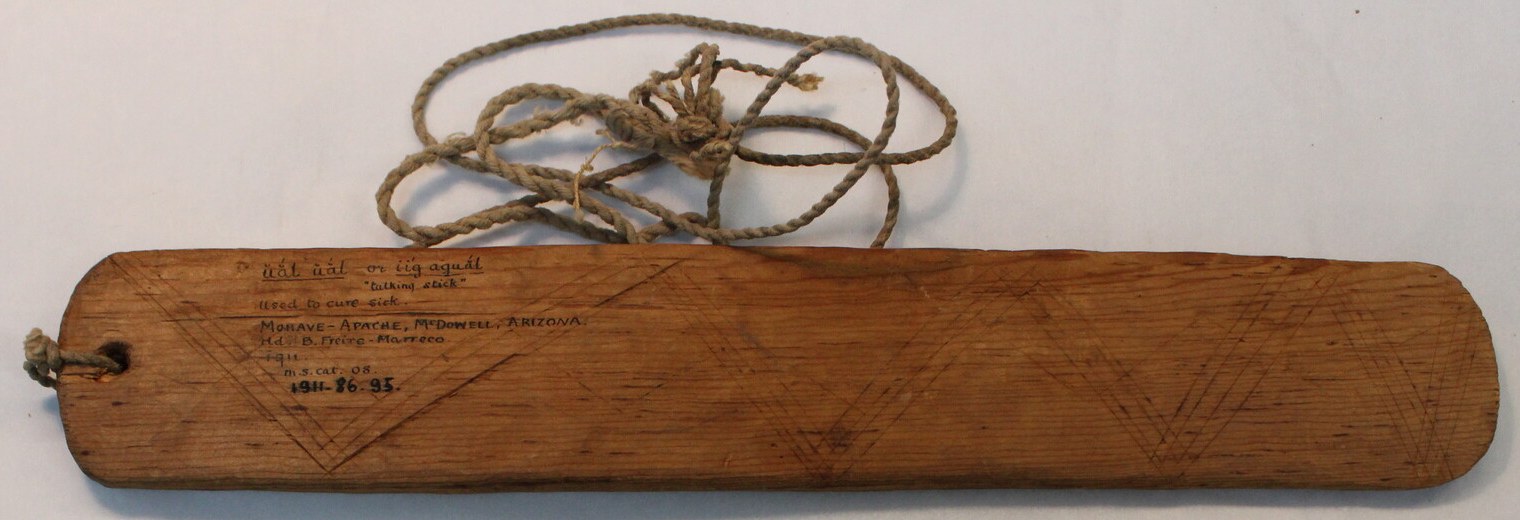
The Yavapai ii’g agual and the Havasupai “wood talking” are one Yuman compound, and it says in Yuman exactly what tsindi’ni’ says in Navajo: wood that speaks. These peoples are neighbours. A Yavapai shaman whirled his roarer outside the sick person’s house, and if cloud, lightning and thunder rose in the east the patient would live (Gifford 1936, p. 309). The army even lumped the Fort McDowell Yavapai in with the Apache, as “Mohave-Apache,” the label on the blade.
Which way did the phrase travel? Ahtna settles it. “That which speaks” was already the roarer’s name on the Copper River, more than three thousand kilometres north of any Yuman speaker, in a branch of the family that never went south. The speaking wood is old Athabaskan. When the Apacheans came down into Arizona, their Yuman neighbours took the name into their own words, and the Havasupai and Yavapai roarer still talks in the Apachean way.
A voice, again and again
Beyond the Southwest the instrument keeps getting named as a voice, not as a sound. In Louisiana the Tunica call it taheriyowini, the “whirling bellower”: ta-, the one who does it; heri, to bellow, growl or howl; yowini, whirling, the same element that names the tornado as the “whirling wind” and the waterspout as the “whirling water.” The roarer is the bellower in the storm.
In the Gran Chaco of northern Argentina, the Wichí name it Lhayialh, the caller of the winds. In drought a Wichí shaman whirled it to “call the four winds into conference” (Whitley 2022). A caller calls, and the winds answer.
East of the Chaco, in the forests of Misiones, the Mbyá-Guaraní cut theirs from bamboo and named it after a person:
“Waimí kerambú” means “old snoring woman,” and the two objects described under this name are used as toys, not as musical instruments.
Raúl Martínez-Crovetto, “Juegos y deportes de los indios guaraníes de Misiones” (1968), p. 18, translated
Even as a child’s plaything, the Mbyá roarer is an old woman snoring. A toy can lose its rite and keep its voice. These names come from Tunica, a language with no known relatives, from the Mataguayo family and from Tupí-Guaraní, none of them tied to Athabaskan. They do not share a word. They share the hearing: whoever whirls the board is making someone speak.
That hearing runs deeper than any one family. The Paleolithic word for voice, prayer and oath names the roarer from Eurasia to the Djanggawul and Nggwal of Australia and New Guinea (see In the Beginning Was the Word). The Athabaskan name is the American chapter of the same story. A people who carried the roarer from Alaska to Arizona called it, at both ends of the road, the thing that speaks.
A speaker, not a noise
Most peoples who swing a board on a string could have named it for its sound. Many did: the Germans’ whirring wood, the Dutch whirr-bone, the Spanish zumbador, the buzzer. The Athabaskans did not. From the Copper River to the San Carlos agency, across four thousand kilometres and the whole span of their migration, they named it for what it does: it speaks. In Navajo it is wood struck by Thunder, and it speaks with his voice. In Apache it speaks for the wind god whose hair is the lightning. In Ahtna it simply speaks, and the dictionary sets it beside “what is he saying?” and “it sounds like someone is hollering for us.”
A name that holds across a family’s whole range, through a migration of centuries, is no accident of description. It is inherited. The Apacheans came late to the Southwest and found new corn, new neighbours and a new sky, and they named the corn for their enemies. The roarer they named the way their ancestors had in the north, and their neighbours learned to say it after them: wood talking. The bullroarer is not an imitation of the storm. It is the one who speaks in it.
Key sources
- Kari, James (comp. and ed.). 1990. Ahtna Athabaskan Dictionary. Fairbanks: Alaska Native Language Center — deniiyi under nii’ “say,” p. 304; hwdelyoli under yotl’ “blow,” p. 441; ladinen’, p. 272.
- Wall, Leon, and William Morgan. 1958. Navajo-English Dictionary. Washington: Bureau of Indian Affairs — tsindi’ni’, ’adi’ni, ii’ni’, s.vv.
- Matthews, Washington. 1887. “The Mountain Chant: A Navajo Ceremony.” Fifth Annual Report of the Bureau of Ethnology, pp. 379–467 — the winter season, para. 5; the whizzer leading the dance, para. 133, p. 435; the groaning stick and its lightning-struck pine, para. 135, p. 436.
- Franciscan Fathers. 1910. An Ethnologic Dictionary of the Navaho Language. Saint Michaels, Arizona — the bullroarer in the curing chants, pp. 414–415.
- Bourke, John G. 1892. “The Medicine-Men of the Apache.” Ninth Annual Report of the Bureau of Ethnology, pp. 443–603 — Walpi and San Carlos, p. 476; tzi-ditindi, figs. 430–431, p. 477.
- Gifford, E. W. 1936. “Northeastern and Western Yavapai.” University of California Publications in American Archaeology and Ethnology 34(4), pp. 289, 309.
- Gifford, E. W. 1940. “Culture Element Distributions: XII, Apache-Pueblo.” Anthropological Records 4(1), pp. 58–59, 151–152, 182.
- Spier, Leslie. 1928. Havasupai Ethnography. Anthropological Papers of the American Museum of Natural History 29 — “wood talking,” p. 288; the rain use, p. 290.
- Pitt Rivers Museum, Oxford, 1911.86.95: Yavapai bullroarer, Fort McDowell, collected by Barbara Freire-Marreco, 1911.
- Sapir, Edward. 1936. “Internal Linguistic Evidence Suggestive of the Northern Origin of the Navaho.” American Anthropologist 38: 224–235.
- Seymour, Deni J. (ed.). 2012. From the Land of Ever Winter to the American Southwest: Athapaskan Migrations, Mobility, and Ethnogenesis. Salt Lake City: University of Utah Press.
- Osgood, Cornelius. 1937. The Ethnography of the Tanaina. Yale University Publications in Anthropology 16, p. 175.
- Tunica-Biloxi Tribe of Louisiana. 2018. Yanatame Nisa Luhchi Yoroni (draft Tunica dictionary), p. 64.
- Whitley, Duncan. 2022. “The caller of the winds.” Words from the Birds, 27 June 2022.
- Martínez-Crovetto, Raúl. 1968. “Juegos y deportes de los indios guaraníes de Misiones (República Argentina).” Etnobiológica 6, p. 18 and fig. 3A.
- Glottolog 5 (Max Planck Institute for Evolutionary Anthropology): coordinates of the Athabaskan-Eyak-Tlingit languages, used to draw the approximate ranges on the map.