No. OSGOOD1936-001
Crow River toothed rain-scarer
Canada · Old Crow River · middle and lower Porcupine River, Yukon · North America · Subarctic
Play / practical
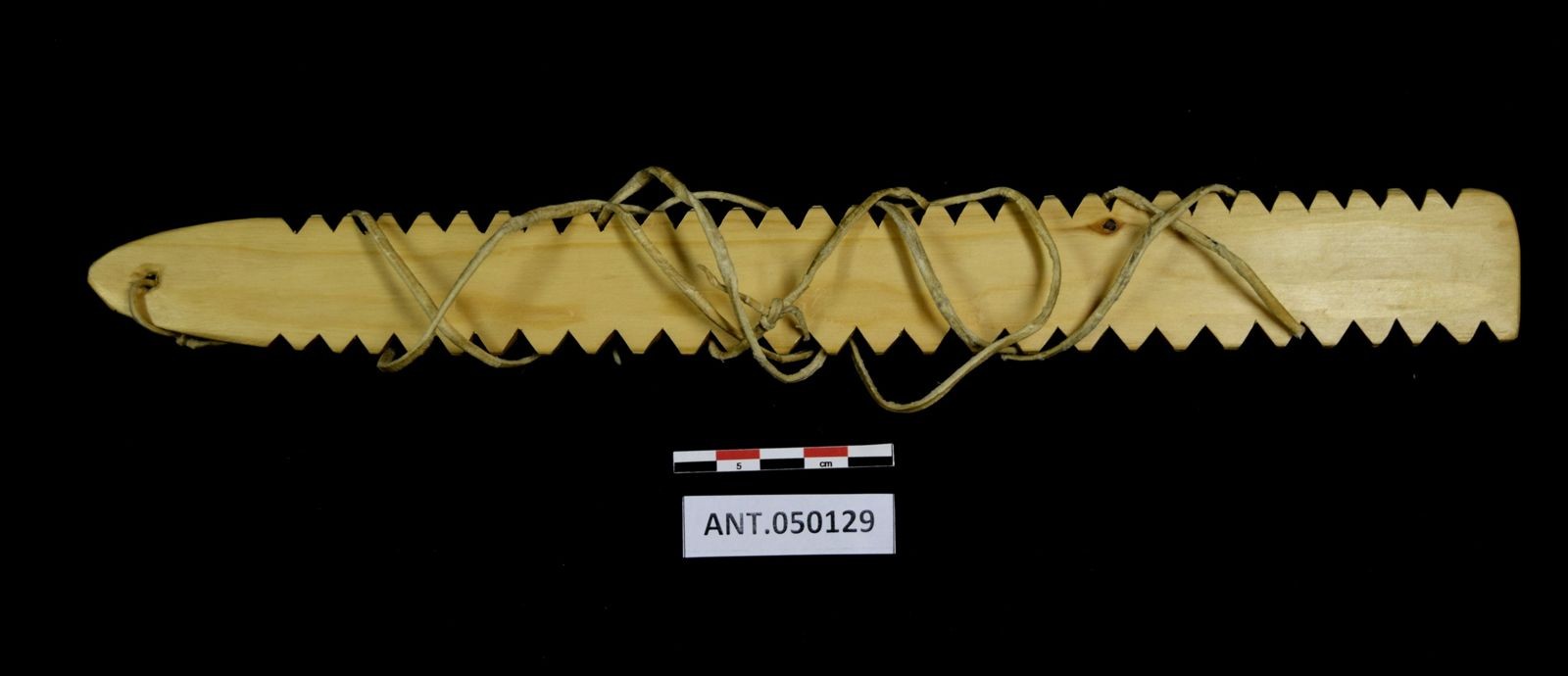
Source term: buzz-toy / bull-roarer
buzz-toy: Osgood's English label for the Crow River bullroarer.
The Vunta Kutchin — today's Vuntut Gwich'in — lived by the caribou herds along the Old Crow and the middle and lower Porcupine in the northern Yukon, and Osgood took much of his Crow River account from Charlie Crow, born at the mouth of the Old Crow River. Their buzz-toy was built for noise: a wooden blade six to eight inches long, tapered at both ends, both edges cut like rip-saw teeth, notched at one end and strung there. It commonly served as a toy, whirled for the buzz. But Osgood was told the thing had begun with a larger job — scaring the rain away.
Although this buzz commonly serves as a toy, it is said to have its origin as an instrument to scare away the rain.
Osgood 1936:100.
Particulars
- Object
- Wooden blade about 6-8 inches long and 1.5 inches at its widest, tapered at both ends, serrated like rip-saw teeth on both edges, notched at one end and fitted there with a string.
- Function
- Commonly used as a toy; said to have originated as an instrument for scaring away rain.
Source
Cornelius Osgood, Contributions to the Ethnography of the Kutchin, Yale University Publications in Anthropology 14 (1936), Crow River Kutchin, Arts and Amusements / Toys and Dolls